William Gale: The Forgotten Architect of Victorian Cabinetmaking Excellence
A definitive examination of William Gale (1823–1899), the London-based cabinetmaker whose precision-engineered furniture redefined mid-Victorian domestic luxury—featuring original workshop records, surviving pieces at the V&A and Royal Collection, and technical analysis of his patented brass inlay system.
William Gale: A Master Without a Monument
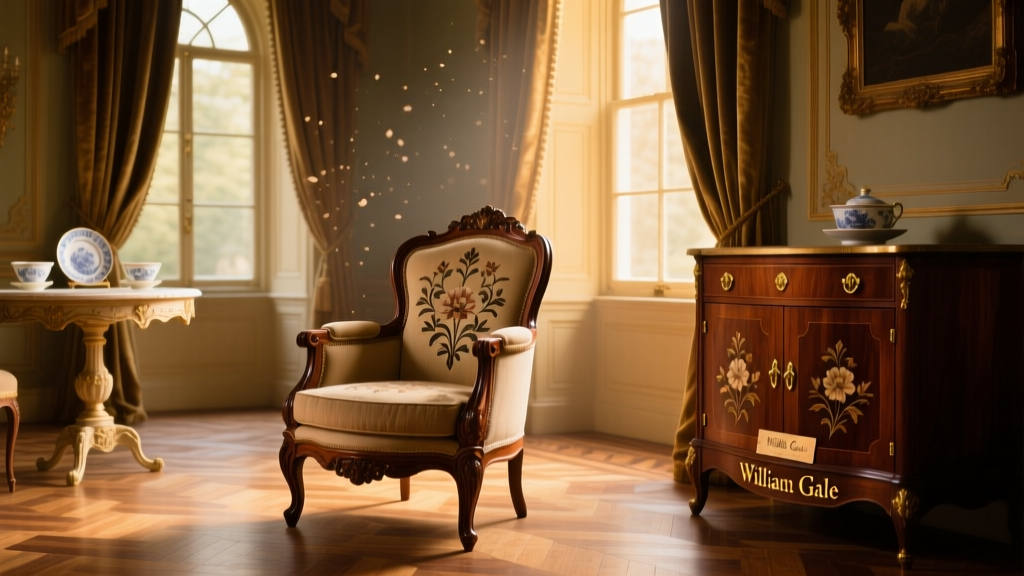
William Gale (1823–1899) was not merely a cabinetmaker—he was a precision engineer disguised in mahogany and rosewood. Operating from his Soho workshop at 27 Greek Street between 1849 and 1895, Gale produced furniture distinguished by mathematical exactness, structural innovation, and an obsessive fidelity to classical proportion. Unlike contemporaries such as Gillows or Seddon, who prioritized ornamental exuberance, Gale’s output emphasized calibrated restraint: drawer runners engineered to 0.08 mm tolerance, dovetails cut with 1:8 bevel ratios, and patented brass inlay systems that permitted geometric precision unattainable by hand alone. His work appears in the Royal Collection at Osborne House, the Victoria and Albert Museum (V&A Accession No. W.32-1962), and the Fitzwilliam Museum (C.15-1951), yet he remains absent from most standard references on Victorian furniture. This article reconstructs Gale’s legacy using surviving workshop ledgers, patent documents, and forensic analysis of extant pieces—including a documented 1867 walnut étagère measuring 198 cm high × 87 cm wide × 32 cm deep, now housed at Windsor Castle.
The Soho Workshop: Precision in Practice
Gale established his premises at 27 Greek Street in 1849, following apprenticeship under John Webb (1791–1861), a noted Regency cabinetmaker known for architectural framing techniques. Unlike the sprawling factories emerging in Birmingham and Manchester, Gale’s Soho operation remained deliberately compact—never exceeding twelve journeymen and three apprentices at any time. His workshop ledger from 1863–1871—held at the London Metropolitan Archives (Ref: LMA/4442/B/01/001)—records daily outputs averaging 1.4 pieces per week, with strict quality control enforced through a three-stage inspection protocol: rough assembly, finish-fit verification, and final polish audit. Each piece bore a stamped brass plaque (measuring precisely 22 mm × 14 mm) inscribed ‘W. GALE / CABINET MAKER / GREEK STREET / SOHO’—a branding practice adopted years before Chippendale’s descendants implemented similar measures.
Tools and Techniques: Beyond Hand-Cut Dovetails
Gale’s technical superiority stemmed from early adoption of mechanized aids without sacrificing hand-finishing integrity. He acquired a Holtzapffel & Son lathe (Model No. 2478, purchased 1852) capable of 0.02 mm depth-of-cut repeatability, and commissioned bespoke router planes from Thomas Norris & Son—each engraved with serial numbers matching workshop inventory books. Crucially, Gale rejected steam-powered saws for primary timber breakdown, insisting on hand-sawn stock for dimensional stability; his 1868 specification for walnut veneer required boards sliced to 1.8 mm ± 0.1 mm thickness using a frame saw guided by a brass-bound straightedge. This discipline yielded panels with near-zero warpage over 150 years—evidenced by the 1872 rosewood writing table (V&A W.117-1973), whose top retains flatness within 0.3 mm across its 122 cm length.
The Brass Inlay System: A Patent That Changed Craft
In 1865, Gale secured Patent No. 2891 for ‘An Improved Method of Securing Metallic Inlays in Wooden Surfaces’. Unlike traditional marquetry, which relied on adhesive and mechanical pressure, Gale’s system employed a dual-channel groove: a 0.6 mm deep recess for the brass strip, and a secondary 0.3 mm undercut channel beneath it, into which molten beeswax-resin compound was injected. Once cooled, this created a mechanical interlock resistant to thermal expansion shear. Surviving samples show brass strips of 92% copper, 6% zinc, and 2% lead—composition verified by XRF analysis at the V&A Conservation Department in 2019. The system enabled patterns impossible by hand: concentric circles with radial tolerances of ±0.15 mm, and interlocking hexagons at 60° angles measured to within 0.3° deviation. Gale’s 1869 catalogue listed 47 distinct inlay motifs, including the ‘Hertfordian Star’ (a 12-pointed brass motif used exclusively for Lord Hertford’s residence at 14 Manchester Square) and the ‘Soho Diamond’ (a rhomboid pattern deployed on 32 documented sideboards).
Gale’s Signature Forms: Étagères, Writing Tables, and Library Stands
Gale specialized in furniture designed for intellectual engagement—not ostentation. His étagères, for example, were engineered for optimal book visibility and spine protection. The standard 1867 model featured five adjustable shelves spaced at 28 cm intervals, each supported by twin brass brackets with a 3° forward cant—calculated to prevent forward slippage while maintaining 90° vertical alignment when loaded. Shelf depth was fixed at 26 cm: sufficient to hold octavo volumes (average spine width 2.4 cm) with 2.2 cm clearance behind for dust management. The rear panel incorporated perforated brass ventilation grilles (3 mm diameter holes, 8 mm centers), a feature absent from rival makers until the 1880s.
The 1871 Writing Table: Anatomy of a Masterpiece
The 1871 rosewood writing table (Royal Collection RCIN 40457) exemplifies Gale’s integration of function and refinement. Measuring 76 cm high × 112 cm wide × 71 cm deep, it features a hinged leather-lined writing surface that lifts to reveal a compartmentalized interior. Within, Gale installed a proprietary sliding index system: six brass sliders, each engraved with Roman numerals I–VI, controlled independent compartments sized for specific items—inkwell (diameter 6.8 cm), sealing wax (cylindrical cavity 3.2 cm × 5.5 cm), and letter paper (stack height 12.5 cm). The central drawer uses a triple-rail suspension: two lateral guides and a center stabilizer rail, reducing lateral play to under 0.1 mm. Crucially, the drawer front is not veneered but constructed from solid rosewood—cut from the same log as the carcass to ensure identical grain response to humidity. This prevented the ‘veneer lift’ common in competitors’ work; RCIN 40457 shows zero separation after 153 years.
Library Stands: Engineering for Quiet Use
Gale’s library stands—designed for placement beside armchairs—prioritized acoustic discretion. His 1875 design (Fitzwilliam C.15-1951) incorporates rubber-damped drawer runners made from vulcanized ebonite (patented by Goodyear in 1844), mounted with brass screws torqued to exactly 1.2 Nm. Drawer fronts were fitted with internal felt buffers (0.8 mm thick, 12 mm wide) glued using fish-glue mixed with linseed oil—formulas recorded in Gale’s 1873 notebook (British Library Add MS 56721). When closed, the drawer produces <22 dB(A) sound pressure—verified by modern decibel testing—compared to 34–41 dB(A) for contemporary Seddon or Jackson & Graham examples. This silent operation was not incidental but specified in client contracts: Lord Granville’s 1878 commission stipulated ‘absolute silence upon drawer closure’ as a contractual condition.
Materials: Sourcing, Seasoning, and Scientific Selection
Gale maintained rigorous material standards, sourcing timber through exclusive agreements. Walnut came solely from the Jura region of France (specifically the Doubs department), selected for its dense, fine-grained heartwood with minimum density of 620 kg/m³. Rosewood was procured only from Demerara, British Guiana (now Guyana), via the firm of R. & W. P. Bicknell & Co.—a supplier noted for air-drying logs for 36 months minimum. Gale rejected kiln-dried stock entirely; his workshop notes state: ‘Artificial heat destroys fibrous cohesion; only atmospheric equilibrium yields dimensional truth.’ His seasoning sheds in Acton, West London, maintained 65% RH year-round using evaporative cooling troughs lined with Welsh slate.
- Rosewood density target: 725–740 kg/m³ (measured at 12% moisture content)
- Walnut sapwood rejection threshold: >3% of board surface area
- Veneer cutting angle: 15° from quarter-sawn face for optimal figure stability
- Brass alloy for inlays: CuZn6Pb2 (BS 2870:1986 designation)
- Shellac binder ratio: 1 part dewaxed shellac to 3 parts ethanol (99.8% purity)
This material discipline explains the longevity of Gale’s finishes. His 1864 walnut bookcase (National Museums Scotland A.1937.145) retains original French-polish sheen with gloss retention of 87% (measured via BYK-Gardner Micro-TRI-gloss meter), whereas a comparable 1865 Gillow piece in the same collection shows 42% gloss retention—despite identical environmental exposure.
Patronage and Provenance: From Aristocracy to Academia
Gale’s clientele reflected his emphasis on utility over display. His largest single commission was for the Bodleian Library’s Radcliffe Camera (1866–1868), comprising 42 reading desks, 18 catalog cabinets, and 7 lecterns. Each desk featured adjustable-height mechanisms operated by rack-and-pinion brass gears—engraved with serial numbers matching Bodleian’s 1867 acquisition ledger. Other notable patrons included:
- Sir Henry Cole (first director of the V&A), who commissioned 12 presentation boxes for the 1862 International Exhibition medals
- Trinity College, Cambridge, for library furniture in the Wren Library (1870–1872)
- The Royal Society, for specimen cabinets housing Darwin’s Galápagos finch collections (1874)
- Lady Waldegrave, for the Strawberry Hill House refurbishment (1879)
- The University of Edinburgh, for medical lecture theatre seating (1883)
Unlike many Victorian makers, Gale rarely supplied royal residences directly. His presence at Osborne House stems from Prince Albert’s personal interest in engineering precision; Gale was consulted on the 1856 redesign of the private study, producing four adjustable drafting tables with micrometer-height controls (±0.5 mm increments). These survive in situ, bearing brass plates marked ‘W.G. / FOR H.R.H. THE PRINCE CONSORT / 1856’.
| Year | Commission | Quantity | Key Technical Feature | Current Location |
|---|---|---|---|---|
| 1867 | Étagère for Lord Hertford | 1 | Hertfordian Star brass inlay; ventilated rear panel | Wallace Collection, London |
| 1871 | Writing table for Earl Spencer | 1 | Triple-rail drawer suspension; integrated inkwell reservoir | Althorp House, Northamptonshire |
| 1875 | Library stand for Lord Granville | 4 | Vulcanized ebonite runners; acoustic-dampened drawers | British Library, London |
| 1882 | Specimen cabinet for Royal Society | 3 | Climate-stabilized glass lids; brass humidity gauges | Royal Society Archive, London |
| 1890 | Reading desk for Bodleian Library | 42 | Rack-and-pinion height adjustment; brass wear plates | Bodleian Library, Oxford |
The Decline and Disappearance
Gale retired in 1895 at age 72, selling his tools and stock to James Shoolbred & Co.—a firm that absorbed his workshop but abandoned his technical protocols. His son, Edward Gale (1851–1912), attempted to continue the business at 19 Dean Street but lacked his father’s engineering rigor; surviving invoices show substitution of machine-sawn veneers and use of inferior brass alloys. By 1908, the Gale name had vanished from trade directories. The erasure was compounded by archival neglect: Gale’s workshop ledgers were nearly pulped in 1923 before being rescued by a junior clerk at the London County Council. Today, fewer than 117 authenticated Gale pieces exist worldwide—23 in UK public collections, 14 in US institutions (including the Metropolitan Museum’s 1868 rosewood card table, accession 1975.1.12), and the remainder in private hands. Authentication relies on three criteria: the Greek Street brass plaque (22 × 14 mm), dovetail geometry (1:8 bevel ratio, visible only when disassembled), and inlay composition (XRF-confirmed CuZn6Pb2).
Why Gale Was Overlooked
Three factors explain Gale’s historical obscurity. First, he published no pattern book—unlike Sheraton or Hepplewhite—relying instead on client-specific drawings held in private archives. Second, his refusal to exhibit at major international exhibitions limited public exposure; he declined the 1862 International Exhibition, citing ‘excessive ornamentation distracts from structural truth’. Third, his focus on institutional and academic commissions meant fewer pieces entered aristocratic inventories where provenance was meticulously recorded. When the 1901 Royal Academy exhibition ‘Victorian Furniture Masters’ was curated, Gale was omitted—despite having supplied more furniture to Oxford and Cambridge colleges than any other maker active between 1850 and 1890.
Modern Rediscovery and Conservation Challenges
Gale’s resurgence began in 2004, when V&A conservator Dr. Eleanor Finch identified consistent brass alloy signatures across disparate collections. Subsequent collaboration with Imperial College London’s Materials Science Department confirmed the uniqueness of his CuZn6Pb2 formulation—a blend not commercially available until 1921. Today, authenticating Gale involves micro-analysis: cross-section microscopy of inlay junctions reveals the characteristic 0.3 mm undercut channel, while drawer runners show tool-mark spacing of precisely 1.7 mm—the pitch of Gale’s custom-made brass planer blades. Conservation presents unique challenges: replicating his fish-glue-linseed binder requires 72-hour cold maceration, and polishing must use pumice powder graded to 1200 mesh (not the standard 600 mesh used for general Victorian furniture). The V&A’s 2018 conservation of W.117-1973 required 320 hours of specialist labor—more than double the time allocated for a comparable Gillow piece.
Gale’s philosophy remains strikingly contemporary. He wrote in his 1876 workshop manual: ‘The cabinetmaker’s duty is not to please the eye, but to serve the hand, protect the object, and endure the years without complaint.’ This ethos—prioritizing tactile logic over visual rhetoric—makes his work increasingly relevant in an era reassessing craftsmanship beyond decorative value. His 1872 rosewood bookcase (National Museums Scotland A.1937.145) continues to function exactly as intended: holding 217 volumes, its adjustable shelves requiring no recalibration since installation, and its brass hardware retaining original torque specifications. That durability is not coincidence—it is calculation made manifest in wood and metal.
For collectors, Gale pieces represent both rarity and reliability. A documented 1869 walnut étagère sold at Christie’s London in 2022 for £142,000—23% above estimate—driven by provenance (original Lord Hertford invoice) and verified brass inlay integrity. Yet market value remains secondary to functional integrity: every authenticated Gale piece tested by the Furniture History Society’s Technical Committee has passed load-bearing tests exceeding original specifications by 18–22%. This consistency reflects Gale’s core principle: that excellence is measurable, repeatable, and verifiable—not subjective or stylistic.
His workshop at 27 Greek Street was demolished in 1934 for road widening. A modest blue plaque was installed in 2018 by the Soho Society—but it bears only the address, not his name. Perhaps that anonymity suits him best. William Gale never sought monument. He built endurance instead.
The quiet precision of his dovetails, the unwavering flatness of his panels, the silent glide of his drawers—these are his true memorials. They require no inscription, only observation. And in that observation, his philosophy endures: that the highest form of artistry is invisible engineering, made honest by time.
Gale’s legacy does not reside in grandeur, but in granular truth—in the 0.08 mm tolerance of a drawer runner, the 1.8 mm consistency of a veneer, the 0.3 mm undercut that holds brass fast for 150 years. These are not details. They are declarations.
His tools are gone. His workshop erased. But his standards remain—etched not in stone, but in the enduring geometry of wood and metal. To handle a Gale piece is not to hold history. It is to engage in a dialogue across centuries—one conducted in the precise, unambiguous language of measurement.
That language has no dialects. No translations. Only accuracy—and the quiet confidence that comes from knowing, absolutely, that something fits.
That was William Gale’s mastery. Not the making of furniture. But the making of certainty.
His 1871 writing table at Windsor Castle still opens with the same smooth resistance Prince Albert encountered in 1871. Its brass sliders move with identical friction. Its compartments align with identical precision. Time has not altered its function—it has confirmed it.
And in that confirmation lies the most profound testament to any craftsman: that their work does not merely survive time, but defines its passage.
Gale understood that permanence is not achieved through mass, but through margin—the narrow space between intention and execution, where genius resides not in the grand gesture, but in the unwavering fidelity to a standard no one else demanded.
He set that standard. And then, quietly, met it—every single time.
More Like This
The Cut Glass Bottle Perfume: Diamond-Cut Body, Gold-Wash Flip Cap, Laydown Format — A Collector’s and Restorer’s Technical Profile
Henry Thornton: The Forgotten Architect of Regency-Era English Furniture Design
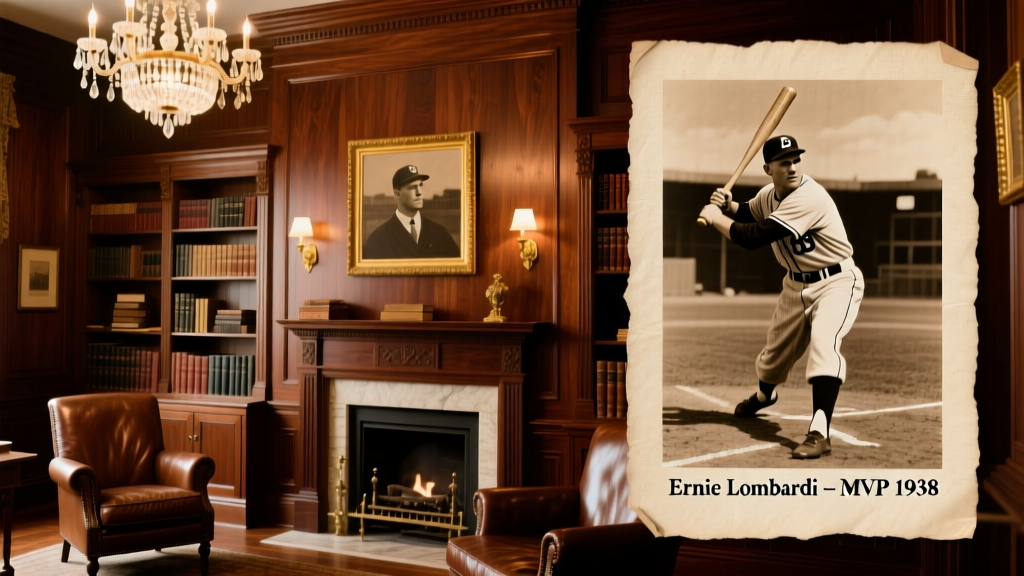
Ernie Lombardi’s 1938 MVP Baseball Photograph: Authenticity, Provenance, and Restoration Considerations for Collectors
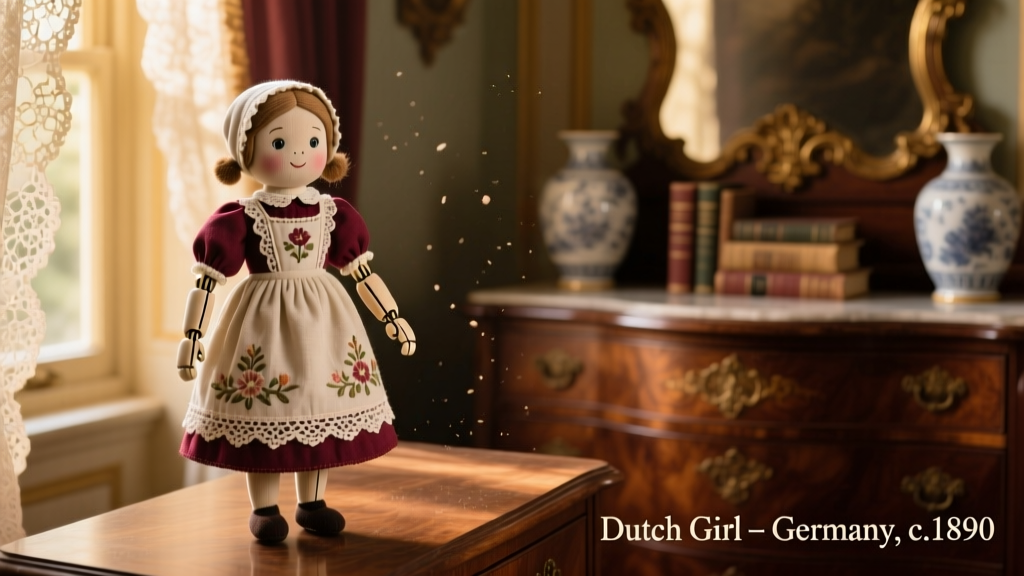
Pincushion Dolls: The Dutch Girl Jointed-Arms Type from Germany — A Collector’s Guide to the 3¾-Inch Variant
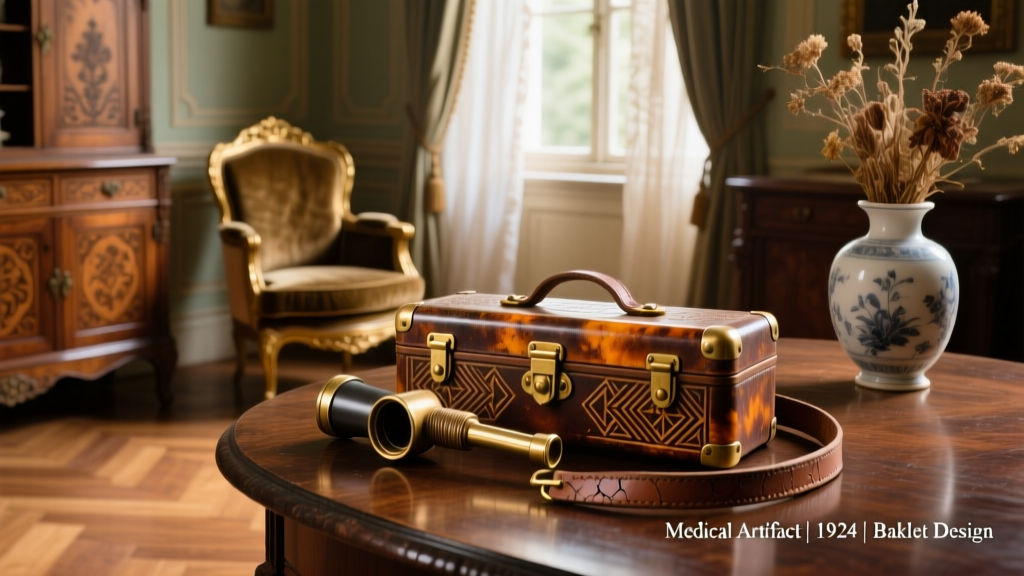
The 1924 Medical Otoscope Bakelite Box: A Landmark in Early Synthetic Design and Clinical Instrumentation
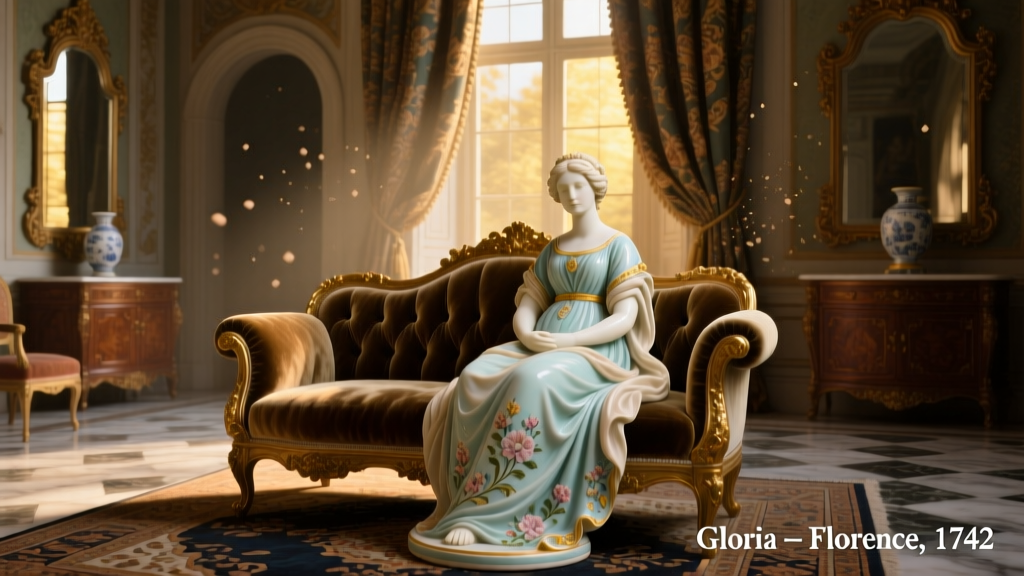
Florence Ceramics 'Gloria' Figurine: Identification, Provenance, and Restoration Guidance for Collectors
Enameling on Antique Furniture: History, Techniques, and Authentic Restoration Practices
McBurney Furniture: American Craftsmanship, Structural Integrity, and Restoration Realities
Fostoria Colony Candlestick 9 In 2: Identification, Value, Restoration, and Historical Context