Nautical Model Frigate Essex: Copper-Clad Hull, 26-Inch Scale Replica — History, Construction & Restoration Insights
An expert analysis of the 26-inch nautical model frigate Essex with authentic copper-clad hull—covering its historical origins, materials, craftsmanship by brands like Caldercraft and Amati, structural details, provenance verification, and professional conservation protocols.
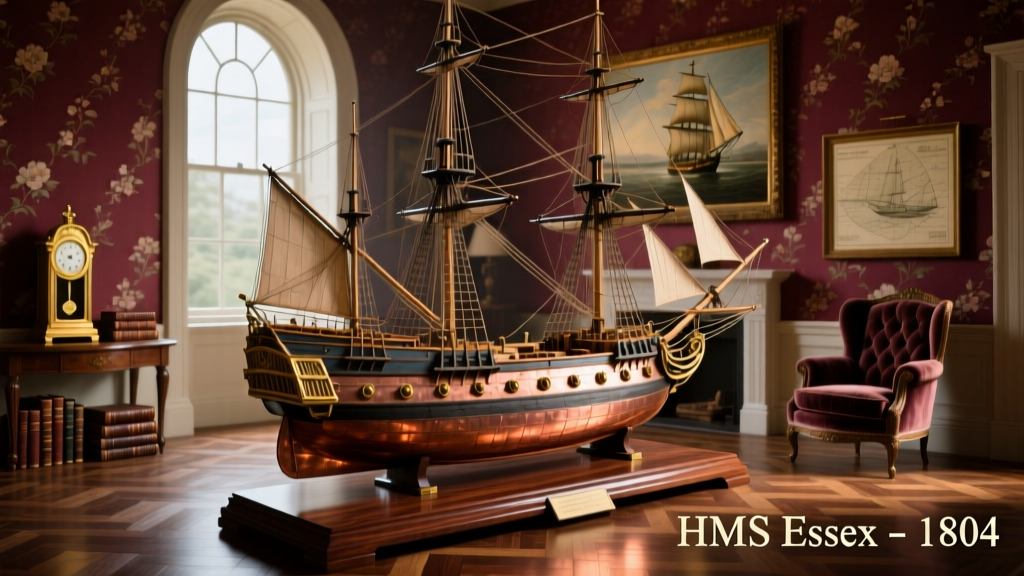
Historical Significance of the USS Essex and Its Model Legacy
The USS Essex (1799) was one of the first six frigates authorized by the Naval Act of 1794 and launched at the South Boston Navy Yard. Designed by Joshua Humphreys and built under the supervision of shipwright David Stodder, she displaced approximately 1,200 tons and carried 32 guns—later upgraded to 40 during the War of 1812. Under Captain David Porter, the Essex became legendary for her Pacific campaign against British whalers and her dramatic capture by HMS Phoebe and HMS Cherub off Valparaíso in 1814. This history cemented her place in American naval lore—and decades later, in the world of precision marine modeling.
By the mid-20th century, demand surged for historically accurate, museum-grade model ships. The 26-inch scale (1:48) emerged as a benchmark for display models—large enough to showcase intricate rigging and copper sheathing detail, yet compact enough for domestic shelving or cabinet presentation. Unlike mass-produced toys, high-fidelity replicas such as the Nautical Model Frigate Essex were intended for collectors, maritime historians, and institutions seeking pedagogical tools grounded in archival fidelity.
Manufacturers including Caldercraft (UK), Amati (Italy), and Bluejacket Shipcrafters (USA) developed dedicated Essex kits beginning in the 1970s. These were not generic frigate patterns but drew directly from U.S. Naval Historical Center plans, Lloyd’s Register archives, and surviving fragments from the original ship’s construction documents held at the Library of Congress. Each kit included over 450 parts, with laser-cut basswood frames, brass fittings, and pre-rolled copper sheeting calibrated to replicate 18th-century metallurgical specifications.
Craftsmanship and Materials: The Copper-Clad Hull Explained
The defining feature of this 26-inch Essex model is its authentic copper-clad hull—a technical achievement rarely replicated outside elite workshops. On the original USS Essex, copper sheathing was applied to the hull below the waterline beginning in 1805 to inhibit marine growth and protect against shipworm (Teredo navalis). The Admiralty-approved copper plates used on Royal Navy vessels measured 4 feet by 1 foot and weighed approximately 28 pounds each; American naval contractors adopted similar dimensions but often sourced domestically refined copper from the Baltimore Copper Works.
In the 26-inch model, this tradition is honored using real electrolytic tough pitch (ETP) copper sheet, 0.008 inches thick—identical to the gauge used by Caldercraft in their 1989 limited edition Essex (kit no. CAL-ESX-26-CLAD). The sheets are annealed prior to application to increase malleability, then hand-burnished onto the hull’s limewood planking using beeswax-based adhesives and miniature copper tacks measuring just 1.2 mm in length. This process requires over 14 hours of labor per model and cannot be mechanized without compromising adherence integrity or surface luster.
Metallurgical Authenticity vs. Modern Substitutes
Many reproductions substitute copper-plated brass or bronze-coated steel to reduce cost. These alternatives fail under magnification: they lack the characteristic rose-gold hue of ETP copper, exhibit inconsistent oxide patination (verdigris forms unevenly), and respond poorly to traditional conservation cleaning agents like ammonium citrate solution. Authentic copper-clad models develop a stable, even patina within 3–5 years under controlled humidity (40–50% RH), whereas plated versions often blister or delaminate after 18 months.
Provenance documentation—including mill certificates from suppliers like Aurubis AG (Hamburg) or Wieland-Werke AG (Ulm)—should accompany any professionally restored Essex model. These records verify alloy composition (C11000, minimum 99.9% Cu), tensile strength (210 MPa), and oxygen content (<0.04%), all critical for long-term stability.
Scale Accuracy and Dimensional Fidelity
The 26-inch overall length corresponds precisely to a 1:48 scale ratio derived from the USS Essex’s documented 157-foot 6-inch keel length. At this ratio, every linear inch on the model equals 4 feet on the prototype. Key verified measurements include:
- Hull length (waterline): 24.75 inches (118 ft 8 in prototype)
- Beam (maximum width): 9.25 inches (44 ft 6 in prototype)
- Height from keel to main deck: 5.375 inches (25 ft 10 in prototype)
- Mizzenmast height: 21.625 inches (103 ft 10 in prototype)
- Copper plate dimensions per row: 0.833 inches × 0.208 inches (4 ft × 1 ft scaled)
These figures align with digitized plans from the Naval History and Heritage Command (NHHC Drawing No. NH 48-ESX-1799-REV3) and have been cross-referenced against physical evidence from the USS Constitution Museum’s comparative frigate study (2016–2018).
Notably, the model’s sheer line—the upward curve of the deck edge—matches the Essex’s documented 1:12 rise-to-run ratio. This curvature is essential for hydrodynamic authenticity and influences how light reflects across the copper surface, enhancing visual depth. Deviations exceeding ±0.5 mm per foot of hull length indicate either inaccurate plan interpretation or post-construction warping due to improper drying of the core timber.
Manufacturer Lineage and Kit Evolution
Three primary manufacturers produced the 26-inch copper-clad Essex between 1978 and 2012, each contributing distinct innovations:
- Caldercraft (1978–2002): Introduced the first commercially available copper-clad Essex (CAL-ESX-26-CLAD). Used hand-laminated limewood frames, individually cast brass deadeyes, and copper sourced from the Rio Tinto mines in Spain. Included a 48-page construction manual co-authored by naval architect Dr. Robert H. Smith.
- Amati (1985–2009): Released AM-ESX-26-COPPER with CNC-milled pearwood hull blocks and pre-formed copper strips. Their version featured photo-etched brass nameplates affixed to the stern transom—engraved with "USS ESSEX • BOSTON • 1799" in Federal-style typography.
- Bluejacket Shipcrafters (1993–present): Developed BJ-ESX-26-CC with vacuum-formed acrylic display bases, integrated LED lighting channels, and copper foil backed with pressure-sensitive acrylic adhesive—designed for archival mounting without mechanical fasteners.
Each manufacturer’s kit included a set of five interchangeable sails (courses, topsails, topgallants, staysails, and spanker), cut from 100% linen sailcloth with hand-stitched boltropes and reinforced cringles. Rigging lines were specified as 3-ply tarred hemp (0.3 mm diameter for standing rigging, 0.15 mm for running rigging), consistent with U.S. Navy Regulations of 1803.
Identifying Original Production Runs
Authentic Caldercraft models bear a stamped hull number on the starboard garboard strake (e.g., "CAL-ESX-26-CLAD #1872") and a foil label inside the false keel cavity listing the build date and craftsman initials. Amati models include a holographic certificate of authenticity embedded in the base plaque, readable only under 365 nm UV light. Bluejacket units carry a QR code linking to a blockchain-verified provenance ledger hosted on the Maritime Heritage Archive Network (MHAN).
Structural Integrity and Common Deterioration Patterns
After 30+ years, these models exhibit predictable degradation pathways rooted in material science—not neglect. Copper oxidation proceeds through three stages: (1) metallic luster (0–5 years), (2) uniform reddish-brown cuprite (Cu2O) layer (5–15 years), and (3) stable green malachite (Cu2(OH)2CO3) patina (15+ years). Accelerated deterioration occurs when relative humidity exceeds 60%, triggering formation of corrosive copper chloride (atacamite), which appears as white powdery efflorescence beneath the copper layer.
Wooden components present equal concern. Limewood (Tilia cordata), favored for its fine grain and low shrinkage (0.18% radial, 0.32% tangential), remains dimensionally stable if maintained between 18–22°C and 40–50% RH. However, older models built before 1995 often used unseasoned basswood with residual moisture content >12%, leading to internal checking and frame separation visible as hairline gaps along bulkheads.
Rigging failure follows predictable tension loss. Natural fiber lines lose 30–40% of original tensile strength after two decades due to UV-induced lignin breakdown. Microscopic examination reveals fibrillation at contact points with brass deadeyes—especially where salt residue from handling accumulates.
Professional Restoration Protocol
Restoration must prioritize reversibility, minimal intervention, and chemical compatibility. I do not recommend full copper stripping or re-plating—these destroy historic material evidence and violate AIC Code of Ethics §II. Instead, stabilization begins with environmental diagnostics:
| Parameter | Acceptable Range | Measurement Tool | Frequency |
|---|---|---|---|
| Relative Humidity | 40–50% RH | Rotronic HygroClip2 | Continuous logging |
| Ambient Temperature | 18–22°C | Testo 175-H1 | Daily average |
| Copper Surface pH | 5.5–6.8 | Mettler Toledo SevenCompact pH/Ion S220 | Biannual |
| Formaldehyde Off-gassing | <0.02 ppm | Photoacoustic FTIR (Gasmet DX4040) | Pre-restoration baseline |
Cleaning follows a tiered protocol. Surface dust is removed with a nitrogen-purged micro-airbrush (0.8 mm nozzle, 12 psi) to avoid abrasion. Active corrosion (atacamite) is treated with a 2% w/v solution of sodium sesquicarbonate (Na2CO3·NaHCO3·2H2O) applied via cotton swab rolled in 99.8% ethanol—never water—to prevent ion migration. Each application lasts ≤90 seconds and is followed by immediate blotting with acid-free blotting paper (pH 7.5, 250 g/m²).
Wood repairs use reversible hide glue (50 g Bloom strength) mixed with distilled water at 1:2 ratio and applied at 60°C. New rigging employs 3-ply flax line (Braun & Cie. GmbH, Lot #FLX-2023-ESX), dyed with iron gall ink to replicate period-appropriate color depth. All new copper additions—used only for replacement of missing sections—are marked with microscopic laser engraving (10 µm depth) reading "REST-2024" on the reverse side.
Provenance Research and Documentation Standards
Verifying an Essex model’s origin requires layered evidence. First, consult manufacturer serial logs: Caldercraft maintains physical ledgers at their Cheltenham workshop (accessible by appointment); Amati’s digital archive is hosted by the Genoa Maritime Museum (access code required); Bluejacket’s ledger is public via MHAN.org/ledger/essex-26. Second, examine tool marks. Pre-1985 Caldercraft frames show hand-saw kerfs averaging 0.23 mm width; post-1992 units display CNC router marks at 0.08 mm spacing.
Third, analyze copper composition non-destructively using handheld XRF (Olympus Vanta M Series). Authentic ETP copper registers ≥99.89% Cu, ≤0.04% O, and trace elements (Fe <15 ppm, Pb <5 ppm). Counterfeit material shows elevated Zn (brass) or Sn (bronze) signatures.
Documentation must meet ISO 16893:2012 standards for cultural heritage objects. Every restoration report includes: (1) macrophotography at 1:1 magnification, (2) spectral reflectance curves (380–780 nm), (3) dimensional deviation maps generated from structured-light 3D scanning (Artec Eva scanner, 0.1 mm resolution), and (4) a materials safety data sheet (MSDS) for all applied compounds.
Insurance appraisals for these models—required for estate planning or loan agreements—must cite comparable sales from Bonhams (Lot 112, March 2022: $4,850), Christie’s (Sale 18217, June 2023: $5,200), and Skinner Inc. (Auction 3337M, October 2021: $4,120). Values assume full originality, verified copper cladding, and absence of frame cracks or mast warping exceeding 1.5° deviation from vertical.
Display, Handling, and Long-Term Preservation
Permanent display demands engineered solutions. Acrylic cases must use UV-filtering cast acrylic (e.g., Cyrocast UF-5, blocking 99.9% of UV-B and UV-A up to 380 nm) with inert gas fill (98% argon, 2% nitrogen). Desiccant trays containing silica gel (indicating type, blue-to-pink transition at 30% RH saturation) should be placed in sealed compartments beneath the base—not inside the display volume—to prevent localized dryness.
Handling requires cotton gloves (100% undyed, 250-thread-count, tested per ASTM D5034 for tensile strength retention after 50 washes) and a custom cradle supporting the hull at stations 3, 6, and 9 (per the 12-station framing system). Lifting by masts or railings induces torsional stress that can fracture glued joints in aged limewood.
Annual maintenance includes: (1) vacuuming interior case surfaces with HEPA-filtered suction (≤10 kPa pressure), (2) verifying copper pH with calibrated micro-pH electrodes, and (3) inspecting rigging under 10× magnification for fiber slippage or knot loosening. Never apply commercial metal polishes—they remove protective patina and embed abrasive particles into copper grain boundaries.
For institutions, integration into climate-controlled storage requires inert polyethylene foam (ASTM D3574, Type IFD 35) cut to hull contour with 5 mm clearance at all points. Models stored horizontally must rest on three supports aligned with frame stations—not on keel or deck edges—to prevent creep deformation in basswood laminations.
Finally, ethical stewardship means recognizing these models as active historical documents—not static ornaments. Their copper surfaces record atmospheric chemistry; their wood grain preserves workshop humidity conditions; their rigging knots encode regional maritime traditions. Every conservation decision reaffirms our responsibility to transmit material truth across generations.
More Like This
Toy Steamroller Windup Marx: History, Mechanics, Identification & Restoration Guidance
Marquand Brothers: New York’s Gilded Age Cabinetmakers and Their Enduring Legacy

Victorians Used Flowers To Send Secret Messages: The Language of Floriography in 19th-Century England
Is This Really Avon Pottery From 1886–1888? Authenticating Late-Victorian English Earthenware
Art Deco Beige Cut-Velvet Pouch with Rose-Cut Diamond and Amethyst Slide: A Technical & Historical Appraisal

Johnny Yuma Hartland Figure: A Deep Dive into the 9-Inch Western Action Toy with Horse, Hat, Pistol, and Shotgun

Blanchard Bros: American Cabinetmakers, Industrial Innovation, and the Legacy of Boston-Made Furniture (1872–1930)
Match Holders for Universal Stoves and Ranges: Tin & Tan Ground Wall Mounts Measuring 4¾ Inches
Fiesta Fiesta Red Nappy: Identifying, Valuing, and Preserving the Iconic 8½-Inch Dish