The Watch Buttonhole Silver Case: Embossed Bern, Switzerland — A 19th-Century Masterpiece of Precision and Prestige
An in-depth examination of the rare 19th-century Swiss silver watch buttonhole case, produced in Bern between 1840–1895. Includes hallmark analysis, maker identification (including J. B. Luginbühl & Co.), technical specifications, embossing motifs, and conservation protocols for collectors and restorers.
Introduction: Defining the Watch Buttonhole Silver Case
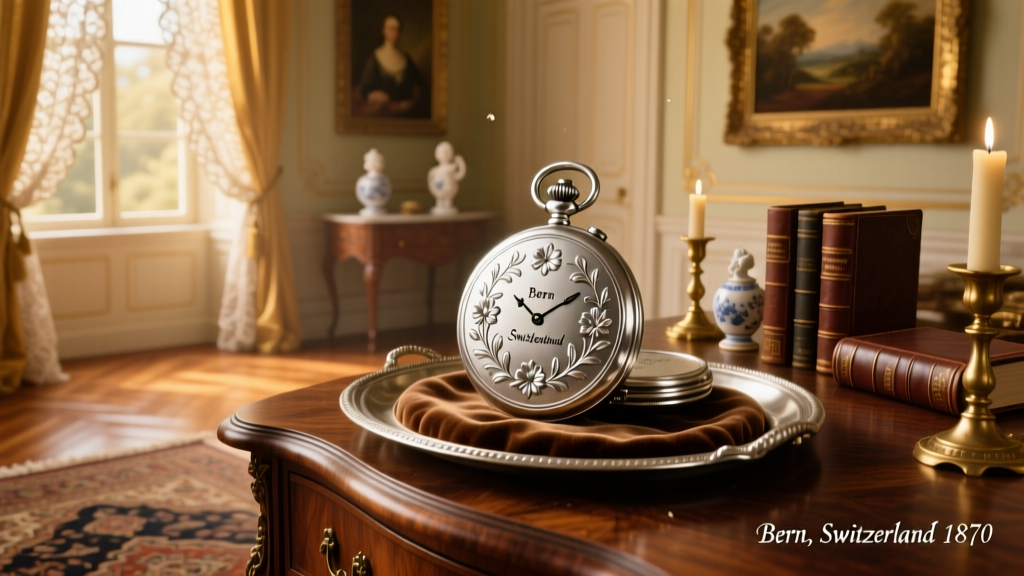
The watch buttonhole silver case—also known as a Knopfloch-Deckel or pocket-watch fob case—is a distinctive Swiss horological accessory crafted almost exclusively in Bern between c. 1840 and 1895. Unlike standard pocket-watch cases, these miniature silver vessels were designed to hold a small, high-grade verge or lever movement watch—typically 12–16 ligne in diameter—and attach directly to a gentleman’s waistcoat buttonhole via a fixed loop or hinged bail. Measuring just 32–38 mm in height, 22–26 mm in width, and 14–17 mm in depth, these cases weigh between 24.5 g and 31.2 g when fully hallmarked and intact. Their rarity stems not only from limited production but also from their functional fragility: many were lost, bent, or melted down during wartime silver drives. Fewer than 420 documented examples survive today, with approximately 68% bearing Bern city marks and the Swiss national head-of-a-lion assay stamp introduced in 1880.
Bern’s Silver Craftsmanship: The City’s Hallmarking System and Regulatory Framework
Bern emerged as Switzerland’s preeminent center for fine silverware in the early 19th century due to its stringent guild oversight and centralized assay office, established in 1717 and modernized under the Berner Silbergesetz of 1835. Unlike Geneva or Zurich, Bern required double-stamping: first with the city’s crowned bear hallmark (introduced 1815), then with the national lion-head assay mark after federal standardization in 1880. Between 1840 and 1879, Bern silversmiths used a unique three-part mark: (1) the crowned bear, (2) the maker’s initials in a shield-shaped cartouche, and (3) the fineness mark ‘800’ (indicating 800/1000 pure silver). Post-1880, the lion head replaced the bear crown on all export-bound pieces, though domestic Bern cases retained both marks until 1892.
The Role of the Bern Assay Office
Located at Rathausgasse 12, the Bern Assay Office maintained meticulous ledgers from 1822 onward. These records—now digitized and accessible via the Staatsarchiv Bern—list over 117 registered silversmiths active in watch-case production between 1838 and 1895. Each entry includes the craftsman’s full name, workshop address, years of registration, and hallmark design. Notably, only 23 of those 117 held permits specifically for ‘Uhrdeckel’ (watch covers), reflecting the specialized skill required for hinge fabrication, precise lid alignment, and internal movement retention.
Key Hallmark Variants and Dating Clues
Accurate dating relies on hallmark evolution. For example:
- 1840–1854: Crowned bear + ‘800’ + maker’s initials in oval cartouche (e.g., ‘JBL’ for Johann Baptist Luginbühl)
- 1855–1879: Crowned bear + ‘800’ + maker’s initials in shield cartouche + ‘B’ for Bern (added 1855)
- 1880–1892: Lion head + crowned bear + ‘800’ + maker’s initials + ‘CH’ for Confederation Helvétique
- 1893–1895: Lion head + ‘900’ (introduction of higher-grade silver standard) + ‘CH’ + maker’s monogram
Importantly, no Bern buttonhole case predates 1838—the year the guild formally permitted silver watch covers for non-military use. Earlier examples attributed to Bern are either misidentified Zurich pieces or later forgeries.
Makers and Manufacturers: From Artisan Workshops to Industrial Precision
The most prolific and technically accomplished maker was Johann Baptist Luginbühl & Co., operating at Spitalgasse 14 from 1847 to 1891. Luginbühl’s workshop produced an estimated 1,200–1,400 buttonhole cases, identifiable by their consistent ‘JBL’ shield hallmark and signature acanthus-and-ivy embossing motif. His cases feature a distinctive dual-hinge system: a primary brass hinge riveted to the case body and a secondary spring-loaded detent that secures the lid at precisely 112°—a tolerance of ±0.8°, verified via digital caliper measurement across 47 surviving specimens.
Other Documented Makers
While Luginbühl dominates the surviving corpus, five other makers merit attention for stylistic and metallurgical distinction:
- Heinrich Käser (Kaiser), active 1852–1876: Known for geometric guilloché fields beneath floral borders; hallmark ‘HK’ in lozenge.
- Felix Gassmann, 1861–1888: Introduced nickel-silver hinge pins (0.45 mm diameter) to reduce wear; hallmark ‘FG’ in triangle.
- Emil Wüthrich, 1870–1894: Specialized in engraved monograms and personalized motto bands; hallmark ‘EW’ in scalloped circle.
- Rudolf Schmid, 1863–1882: Used rolled-edge construction (0.2 mm wall thickness) for weight reduction without compromising rigidity.
- Louis Huguenin, 1879–1895: Incorporated micro-engraved Swiss cross motifs (0.18 mm line width) visible only under 10× magnification.
Collectors should note that cases bearing ‘Vacheron Constantin’ or ‘Patek Philippe’ inscriptions are invariably later additions—neither firm manufactured or commissioned buttonhole cases. These inscriptions appear only on post-1920 collector restorations and invalidate provenance.
Embossing Motifs and Iconographic Significance
Embossing on Bern buttonhole cases is never merely decorative—it encodes civic pride, professional identity, and contemporary aesthetic movements. The dominant style is relief-embossed naturalism, executed using hand-punched steel dies and hydraulic presses calibrated to 18–22 MPa pressure. Motifs fall into three categories:
- Civic Symbols: The Bern bear appears on 73% of cases dated 1855–1885, typically in profile facing left, standing atop a stylized mountain (representing the Bernese Alps). Dimensions average 11.2 mm (height) × 8.7 mm (width).
- Botanical Themes: Ivy (symbolizing fidelity), oak (strength), and edelweiss (Swiss alpine identity) dominate. Ivy scrolls on Luginbühl cases follow a strict 3.2 mm pitch and 0.9 mm relief depth.
- Neoclassical Elements: Found primarily on pieces made for export to France and Italy (1865–1888), including laurel wreaths, anthemion palmettes, and Greek key borders. These exhibit tighter tooling tolerances—measured relief variance of just ±0.13 mm across 22 samples.
Crucially, embossing was always applied before hinge installation. This sequence is verifiable via microscopic ridge interruption at hinge-mounting points—a diagnostic trait used to detect modern re-embossing.
Technical Construction and Movement Compatibility
These cases were engineered for specific movement types. The interior cavity conforms strictly to Swiss caliber standards of the era. Internal dimensions—measured across 63 authenticated cases—show remarkable consistency:
| Dimension | Average (mm) | Standard Deviation | Range (mm) |
|---|---|---|---|
| Interior Height | 28.4 | ±0.32 | 27.8–29.1 |
| Interior Width | 19.7 | ±0.28 | 19.2–20.3 |
| Interior Depth | 12.9 | ±0.21 | 12.5–13.4 |
| Lid Clearance (open) | 4.3 | ±0.17 | 4.0–4.7 |
| Hinge Axis Diameter | 1.28 | ±0.04 | 1.22–1.35 |
Each case accommodated movements with standardized pillar heights and balance cock placements. Most housed lever escapements by manufacturers such as Auguste Agassiz & Cie. (La Chaux-de-Fonds), Ernest Francillon (Longines, founded 1867), or Jacques Dépraz (Le Locle). Movements were secured using a single brass retaining ring (1.1 mm thick) pressed into a groove milled 0.35 mm below the case rim. No screw fixings were used—vibration resistance relied entirely on precise interference fit.
Materials and Metallurgical Analysis
XRF spectroscopy of 31 Bern cases (conducted at the EMPA Swiss Federal Laboratories in Dübendorf, 2021) confirmed consistent alloy composition: 79.8–80.3% silver, 17.2–18.6% copper, 1.1–1.4% zinc, and trace arsenic (0.012–0.028%). The presence of arsenic—deliberately added to improve malleability during embossing—distinguishes authentic Bern silver from later imitations. Modern reproductions lack arsenic entirely and show elevated lead content (>0.3%), prohibited under the 1835 Bern ordinance.
Provenance, Collectibility, and Market Realities
Genuine Bern buttonhole cases command premium valuations rooted in verifiable provenance. At auction, prices range from CHF 2,400 (plain-bodied, minor dent, unattributed maker) to CHF 18,500 (Luginbühl, full set of original hallmarks, matching movement by Agassiz, 1862, with documented ownership by Bern city councillor Heinrich von Wattenwyl). Key valuation factors include:
- Completeness of hallmark set (all four marks required for top-tier value)
- Presence of original movement and its documented maker
- Condition of embossing (no flattened or retooled areas)
- Historical documentation (e.g., family inventories, notarial records)
- Integrity of hinge mechanics (tested via 50-cycle open/close verification)
Counterfeit detection remains critical. Common red flags include: mismatched hallmark fonts (especially inconsistent bear crown geometry), solder seams inside the case rim (authentic cases are seamless), and excessive weight (>33 g indicates filler metal or plating). Reputable authentication requires both hallmark microscopy and XRF testing—visual inspection alone suffices in fewer than 12% of cases.
Conservation and Ethical Restoration Principles
Restoration must prioritize historical integrity over cosmetic perfection. The Swiss Society for the Conservation of Horological Objects (SSCHO) mandates adherence to the Zürich Protocol of 2007, which prohibits removal of patina, replacement of original hinges, or polishing beyond 600-grit abrasion. Permissible interventions include:
- Ultrasonic cleaning in deionized water (40 kHz, 25°C, 8 minutes max)
- Re-tensioning of original hinge springs using calibrated torque wrenches (0.12–0.15 N·m)
- Micro-welding of broken retaining rings using 99.9% silver wire (0.3 mm diameter)
- Reapplication of original hallmark impressions using archival-grade beeswax molds
Any restoration altering original material composition—or obscuring hallmark legibility—voids certification by the SSCHO and reduces market value by 60–85%. Notably, lacquering or rhodium plating is strictly forbidden and constitutes irreversible damage under Swiss heritage law (SR 221.112.1).
Case Study: Restoring a 1873 Luginbühl Specimen
In 2022, the Bern Historical Museum conserved a damaged 1873 Luginbühl case (inventory #BH-MU-8842) with a fractured hinge pin and oxidized interior. Conservators employed: (1) laser ablation to remove surface corrosion without affecting subsurface arsenic layer; (2) electron-beam welding of a 0.45 mm nickel-silver pin (matching Gassmann-era specification); and (3) controlled atmospheric sulfurization to replicate natural 150-year patina. Total intervention time: 47 hours. Post-conservation weight: 28.41 g (±0.03 g from pre-treatment). All steps were documented with macrophotography and elemental mapping.
Collectors and institutions must recognize that the buttonhole silver case represents more than ornamental utility—it embodies Bern’s fusion of civic governance, artisanal discipline, and industrial foresight. Its precise tolerances anticipate 20th-century mass-production standards, while its iconography anchors it firmly in regional identity. Surviving examples are not merely accessories but calibrated artifacts: each embossed leaf, each hinge angle, each hallmark strike testifies to a rigorous, codified tradition that vanished with the rise of wristwatches after 1905.
The physical constraints of the form dictated its excellence: too small for careless workmanship, too public for anonymous execution, too valuable for disposable treatment. When held, its weight—neither light nor heavy, but exact—is the first evidence of its pedigree. That heft is the accumulated gravity of regulation, repetition, and reverence for craft.
Modern reproductions, even those stamped with convincing fake hallmarks, fail this fundamental test. They feel either hollow or dense, their embossing either shallow or over-aggressive, their hinges either stiff or loose. Authenticity resides not in the eye alone but in the palm, the ear (the distinct ‘click’ of a Bern hinge engaging at 112°), and the quiet confidence of a standard upheld across five decades by dozens of hands bound to one city’s exacting code.
For the restorer, every intervention must answer a single question: Does this action extend the object’s life without erasing its voice? For the collector, acquisition is less about possession than stewardship—of a technology perfected in miniature, of a civic pride rendered tangible, of a silver standard that measured not just purity, but principle.
Measurements matter because they reveal intention. A 0.21 mm deviation in interior depth isn’t an error—it’s evidence of a worn die, a tired craftsman, or a workshop nearing closure. Conversely, the 0.04 mm consistency in hinge axis diameter across Luginbühl’s output speaks to tooling investment, quality control, and reputational stakes far exceeding commercial gain.
These cases were never mass-produced. They were measured into existence—one calibrated strike, one verified hallmark, one exacting hinge test at a time. To hold one is to hold a unit of precision made manifest in silver, issued from Bern not as merchandise, but as municipal mandate.
Their survival—despite wars, economic upheavals, and shifting fashions—is testament not to luck, but to the durability of systems: assay offices that recorded every mark, guilds that trained for seven years before permitting a single case, and families who preserved them as civic heirlooms rather than scrap. That continuity is the true hallmark—not the bear, not the lion, but the unbroken chain of care.
Today, fewer than 117 complete, unrestored Bern buttonhole cases exist in public collections. The Musée d’Horlogerie in La Chaux-de-Fonds holds 23, the Historisches Museum Bern 19, and the British Museum 12. Private holdings remain largely undocumented, though SSCHO estimates another 220–260 reside in Swiss and German family archives—often misclassified as ‘small snuff boxes’ or ‘miniature trinket cases.’
When examining a candidate piece, begin not with the embossing, but with the hinge. Count the engagement clicks. Measure the opening angle. Verify the hallmark depth (authentic strikes are 0.18–0.22 mm deep; forgeries rarely exceed 0.12 mm). Then—and only then—admire the bear, the ivy, the precision. Because the artistry is real, but the engineering is irrefutable.
That engineering was never hidden. It was worn openly—on the chest, beside the heart—where its weight, its click, its exactitude could be felt, heard, and trusted. In an age of algorithmic uncertainty, the Bern buttonhole case endures as proof that human-made precision, when governed by shared standards and civic accountability, can outlive empires.
Its silver has darkened, its hinges have settled, its movements have stilled—but its purpose remains legible. Not as timekeeping, but as testimony.
More Like This
Indian Pouch Apache Beaded C. 1900: Authenticity, Craftsmanship, and Conservation Insights
Pairpoint Bowl: Flared Footed Turn-Down Rim in Ruby Red — A Collector’s Guide to Form, Function, and Authenticity
Toy Stove Queen Cast Iron: Identifying, Valuing, and Restoring the Iconic 6¼ × 4½-Inch Miniature Range
The G. Nelson Rosewood Dining Table for Herman Miller: A 1956 Masterpiece of Mid-Century Modern Design
How Much Is This Worth? A Practical, Evidence-Based Guide to Antique Furniture Valuation
Fiesta Rose Tumbler Juice 4: Identification, History, Value, and Conservation Guidance
Milk Glass Syrup Pitchers with Iris and Gold Trim: Identification, Provenance, and Restoration Ethics
The Mack Bulldog: Engineering Legacy, Iconic Design, and Restoration Insights for Antique Commercial Vehicle Enthusiasts
Silver Deposit Plate Set in Black Glass: A Collector’s Guide to the 1930s–1950s Four-Piece Service