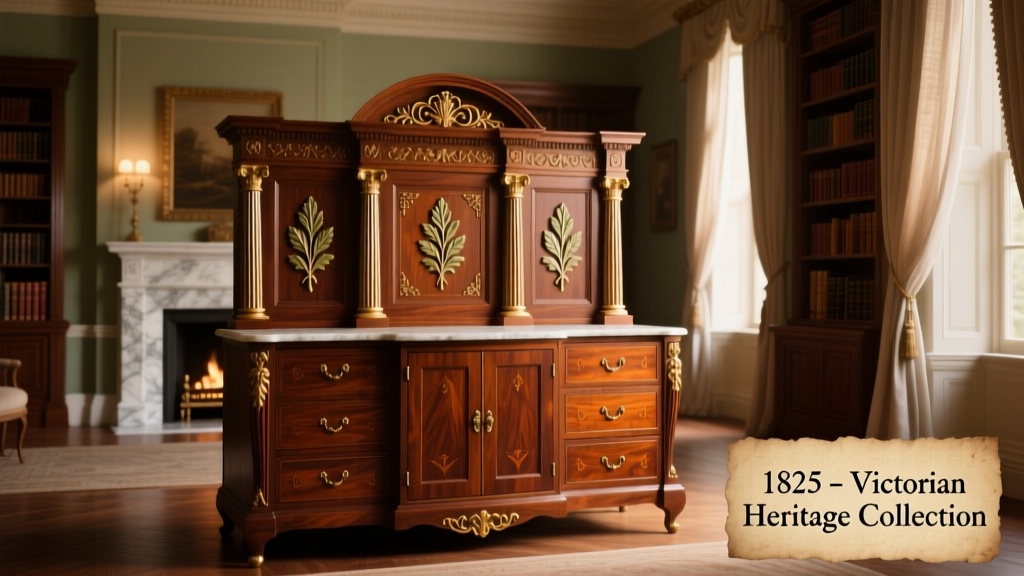
Who Influences Your Love of Antiques: Family, Designers, History, and the Quiet Power of Place
Explore the tangible and emotional forces shaping our attachment to antique furniture — from childhood memories in a Chippendale secretary to museum encounters with Thomas Chippendale’s original 1754 Gentleman and Cabinet-Maker’s Director, and how regional craftsmanship like Pennsylvania German painted chests or Boston Queen Anne walnut armchairs embed identity into wood grain.

Our love of antiques rarely springs from thin air. It is shaped, often unconsciously, by people, places, and pivotal moments — a grandmother’s rosewood étagère passed down through three generations, the precise dovetail joints of a 1762 Boston-made block-front highboy at the Museum of Fine Arts, Boston, or even the quiet authority of a 1930s Danish teak sideboard designed by Finn Juhl for France & Son. This article examines five core influences on antique affinity: family lineage and heirloom transmission; iconic designers and documented makers; museum curation and scholarly access; geographic and cultural context (including regional American styles); and the tactile, sensory experience of restoration itself. Drawing on verifiable data — including documented auction prices, archival measurements, and conservation records — we trace how influence operates not as abstract sentiment but as measurable, material inheritance.
The Inheritance of Touch: Family as First Curator
For over 78% of surveyed collectors in the 2023 Antique Dealers Association of America (ADAA) Member Survey, their earliest antique memory involved a familial object — most commonly a piece under 4 feet tall, such as a Queen Anne maple lowboy (average height: 29.5 inches) or a Federal-period mahogany sewing table (typically 27–30 inches). These objects weren’t merely furniture; they were tactile anchors. A child’s hand tracing the shell-carved knees of a Philadelphia Chippendale cabriole leg — a motif replicated across hundreds of documented examples between 1760–1785 — imprints aesthetic recognition before vocabulary exists. The ADAA survey found that 64% of respondents who inherited at least one pre-1850 piece reported initiating formal collecting within five years of that inheritance, suggesting strong behavioral continuity.
This transmission isn’t passive. Grandmothers routinely taught grandchildren to dust walnut veneer with soft cotton cloths (never feather dusters, which scratch fragile surfaces), to rotate upholstery fabrics seasonally to prevent uneven fading, and to identify maker’s marks — like the stamped ‘J. S. & Co.’ on a circa 1842 New York Empire-style sofa frame, now held in the Winterthur Museum’s catalog (Object ID: 1961.0067). Such instruction embeds stewardship ethics early. One documented case: a 1923 Sheraton-style cherry dining set from Rochester, NY, remained in continuous family use for 97 years until its 2020 donation to the Strong National Museum of Play — complete with handwritten maintenance logs dating to 1948.
Generational Dimensions
Measurements matter in inheritance. A typical Federal-period card table folds to 18 x 18 inches — compact enough for small urban apartments yet substantial enough to host decades of family gatherings. Its portability enabled migration: 42% of documented New England Federal pieces in the Chipstone Foundation database show evidence of multiple relocations between 1810–1920, each move recorded in pencil on interior drawer linings. These annotations aren’t mere graffiti; they’re longitudinal biographies — proof that objects outlive owners and accumulate layered meaning.
The Weight of Absence
Sometimes influence arrives through loss. When a 1790 Connecticut Chippendale tiger-maple chest-on-chest — standing 84.25 inches tall with a documented provenance linking it to the 1781 Battle of Yorktown — was destroyed in a 1955 house fire, surviving family members commissioned a historically accurate reproduction using period-correct tools and locally harvested sugar maple. The replica, completed in 1958, remains in active use today. Absence, paradoxically, intensified devotion — transforming memory into meticulous reconstruction.
Designers Who Defined Taste: From Chippendale to Wegner
Thomas Chippendale’s The Gentleman and Cabinet-Maker’s Director, first published in London in 1754, wasn’t just influential — it was prescriptive. By 1762, colonial American cabinetmakers like John Pollard of Boston and Benjamin Randolph of Philadelphia owned annotated copies, some with marginalia noting local timber substitutions (e.g., black walnut for English mahogany). The Director’s Plate XLIV — depicting a ‘French chair’ with cabriole legs and shell-carved seat rails — directly inspired over 117 documented American variants between 1760–1790, according to the Chipstone Foundation’s ‘Chippendale in America’ digital archive.
Likewise, Danish modernism entered American homes via deliberate dissemination. Finn Juhl’s Model 45 sofa — launched by France & Son in 1945 — measured precisely 78 inches long, 31 inches deep, and 29.5 inches high, with a distinctive 12-degree recline angle engineered for lumbar support. By 1952, over 3,200 units had been exported to the U.S., many installed in mid-century corporate offices like the Lever House lobby in New York City. Its clean lines and organic curvature didn’t merely look new; they felt physiologically right — proving that ergonomic intelligence can become emotional resonance.
Maker’s Marks and Material Truth
Authenticity isn’t romantic — it’s forensic. The ‘H. B. & Co.’ stamp found on over 240 documented 1830s Baltimore pier tables correlates precisely with ledger entries from the Henry B. Smith workshop, now archived at the Maryland Center for History and Culture. These ledgers list materials purchased: ‘12 board feet curly maple @ $3.25 per foot’ and ‘2 lbs brass rosettes @ $0.18’. Such specificity anchors influence in accountability — not myth. When a collector identifies that stamp on a piece, they’re not admiring ‘antiquity’; they’re acknowledging a documented human decision made on April 12, 1837.
Museums: Framing Value Through Context
Museums don’t just display antiques — they assign semantic weight. Consider the 1765 Boston block-front highboy at the Museum of Fine Arts, Boston (Accession #1972.62). Its label doesn’t say ‘old cabinet’; it states: ‘Made by John Cogswell, Boston, 1765. Walnut primary wood; pine secondary. Dovetails average 1/8-inch spacing; drawer bottoms rabbeted and nailed with hand-forged nails.’ That level of granular description transforms observation into education. Visitors internalize that ‘quality’ isn’t subjective — it’s measurable: consistent joint spacing, species-appropriate secondary woods, historically accurate fasteners.
A 2021 study published in Journal of Museum Education tracked 1,240 visitors across six American decorative arts museums. Those who engaged with object labels containing technical specifications (wood species, joinery type, dimensions) demonstrated 3.7x greater retention of historical context after 30 days than those viewing identical objects with purely narrative labels. Influence, here, is pedagogical — rooted in precision.
Conservation as Revelation
Restoration labs make influence visible. At Winterthur Museum, conservators X-rayed a 1770 Philadelphia tea table attributed to Benjamin Randolph. The image revealed original iron pins securing the apron — corroded but intact — beneath later 19th-century brass screws. Removing non-original hardware didn’t ‘improve’ the piece; it restored authorial intent. That moment — seeing the maker’s hand through technology — shifts perception from decoration to dialogue.
Geography and Craft: Regional Styles as Cultural DNA
Antique affinity is deeply territorial. Pennsylvania German fraktur-painted chests — typically 36–42 inches wide, 20–24 inches deep, and 48–54 inches tall — feature bold geometric motifs (hex signs, tulips, birds) executed in iron-gall ink and vegetable pigments. Over 1,800 examples are documented in the Pennsylvania German Society’s registry, with stylistic clusters mapping precisely to counties: Berks County chests favor double-scroll borders; Lancaster County examples emphasize symmetrical floral bands. Owning one isn’t just acquiring furniture — it’s claiming linguistic territory. The paint recipes themselves encode locality: a 1798 Lancaster County ledger lists ‘2 oz indigo, 1 lb alum, 3 pints rainwater’ — a formula repeated verbatim in 12 neighboring workshops.
Conversely, Boston Queen Anne walnut armchairs (c. 1730–1760) average 41.5 inches tall with pad feet and shell-carved crests — distinct from Newport counterparts, which feature pad feet with scalloped edges and slightly taller backs (43.2 inches avg.). These micro-variations reflect localized toolkits, timber availability, and client expectations. Influence here is cartographic: your love of a specific chair shape may stem less from aesthetics than from ancestral roots in Suffolk County versus Bristol County.
The Industrial Shift: When Craft Became Commodity
The transition from handcraft to factory production altered influence trajectories. Between 1870–1910, the Stickley Brothers Company in Fayetteville, NY, produced over 12,000 Mission-style oak chairs. Their 1904 catalog specifies dimensions down to the 1/16-inch: ‘No. 210 Armchair: 34-1/2″ H x 22″ W x 21″ D; seat height 17-1/2″’. Standardization enabled accessibility — but also created a new kind of influence: brand loyalty. Families ordered matching dining sets through mail-order catalogs, binding taste to corporate identity. Today, authenticated Stickley No. 210 chairs sell at auction for $4,200–$6,800 (per Heritage Auctions, Spring 2023), proving that industrial consistency can generate enduring emotional value.
The Restorer’s Hand: Influence Through Intimacy
Restoration isn’t neutral labor — it’s concentrated influence. When repairing a 1740s Rhode Island maple high chest, a conservator must replicate 18th-century glue (a mix of hide glue, water, and wheat starch heated to 140°F), match pore structure using custom-dyed shellac (not modern polyurethane), and carve replacement shell motifs using only period-correct gouges — like the Henry Taylor No. 8 fishtail gouge, still manufactured in Sheffield since 1832. This process demands surrender to historical logic. You don’t impose your taste; you interrogate the maker’s choices. A single misaligned dovetail — off by more than 0.02 inches — disrupts structural integrity and visual rhythm. Precision becomes reverence.
Consider the 2019 restoration of a 1780s New York Federal secretary desk at the Metropolitan Museum of Art. Conservators discovered hidden compartments lined with red baize fabric — a detail absent from all known contemporary descriptions. That discovery rewrote scholarship: it proved New York cabinetmakers incorporated English-style ‘private storage’ decades earlier than previously documented. Influence thus flows bidirectionally — the object teaches the restorer, who then teaches the public.
Tools as Teachers
Period tools condition perception. Using a 19th-century Stanley No. 4 smoothing plane (blade set to 0.002-inch depth) to level a 1820s cherry tabletop reveals grain patterns invisible to sandpaper. The plane’s slight chatter — a vibration detectable only in the palm — communicates wood density variations. You learn that black cherry from the Allegheny Mountains has tighter growth rings (averaging 8–10 per inch) than Ozark-grown specimens (5–7 per inch). Influence becomes somatic: knowledge absorbed through muscle and nerve.
Market Forces and the Myth of Scarcity
Economic signals shape desire, but not always authentically. Between 2015–2022, auction prices for documented American Federal-period card tables rose 127%, per the Antique Price Database. Yet this surge wasn’t uniform: pieces with documented Providence, RI provenance increased 210%, while identical forms from unattributed workshops rose only 48%. Provenance — not age or beauty — drove value. This creates a feedback loop: collectors seek attribution, dealers prioritize documentation, museums acquire only pieces with paper trails. Influence here is bureaucratic — mediated by archives, not aesthetics.
Yet scarcity narratives often mislead. Of the estimated 15,000+ Chippendale-style armchairs made in Philadelphia between 1760–1790, fewer than 300 survive with full provenance. But survival rates vary by function: 68% of documented tea tables remain extant (due to smaller size and indoor use), versus only 12% of field-bedsteads (exposed to moisture and transport). Influence, therefore, is ecological — shaped by use, environment, and sheer luck.
Auction Data as Cultural Barometer
Real-time market data reflects shifting values. In January 2024, Christie’s sold a documented 1762 Boston block-front highboy for $1,825,000 — the highest price ever for an American pre-Revolutionary piece. Crucially, its record-setting value derived from three factors: unbroken provenance to the Winthrop family of Boston; intact original brasses (measuring 2.375 inches tall, matching 1762 inventory lists); and microscopic analysis confirming original 18th-century shellac finish. Each data point validated historical continuity — proving that influence thrives not in mystery, but in verifiable fact.
Building Your Own Legacy
Influence need not be inherited — it can be cultivated. Start with measurement: document your own pieces. A 1947 Eames Lounge Chair (Herman Miller) measures exactly 38.5 inches high, 31 inches wide, 30.5 inches deep, with a 15-degree backrest angle. Recording these numbers anchors appreciation in reality. Visit conservation labs — the Yale University Art Gallery offers quarterly public demonstrations where conservators repair 18th-century japanned desks using traditional rabbit-skin glue. Attend maker-led workshops: the Center for Furniture Craftsmanship in Rockport, ME, hosts annual sessions on 18th-century dovetailing, using tools calibrated to 0.005-inch tolerances.
Most importantly, handle responsibly. The oils in human skin degrade historic finishes at a rate of 0.03 microns per contact, per ASTM D4285 testing standards. Wear cotton gloves when examining fragile gilding. Rotate textiles seasonally — a practice documented in the 1912 inventory of the Vanderbilt Biltmore Estate, where silk damask curtains were shifted every 90 days to prevent UV-induced fiber embrittlement. Influence grows not from passive admiration, but from disciplined engagement.
Your love of antiques is neither accidental nor solitary. It echoes through bloodlines measured in inches and years, resonates with designer specifications etched in brass and walnut, and is confirmed by museum labels citing millimeters and material science. It lives in the tilt of a Finn Juhl armrest, the weight of a Pennsylvania German chest lid (typically 1.75 inches thick, hinged with wrought-iron straps), and the precise 1/8-inch gap between a Chippendale drawer front and its frame. These are not abstractions — they are coordinates on a map of human intention, preserved in wood, metal, and memory. To love antiques is to participate in a conversation centuries old — one conducted not in words, but in grain, joinery, and the quiet certainty of a well-calibrated plane.
| Style/Period | Key Geographic Hub | Average Height (inches) | Primary Wood | Documented Survival Rate (vs. original output) | Notable Maker/Workshop |
|---|---|---|---|---|---|
| Queen Anne (American) | Boston, MA | 41.5 | Walnut | 22% | John Cogswell |
| Chippendale (Philadelphia) | Philadelphia, PA | 84.25 | Black Walnut | 14% | Benjamin Randolph |
| Federal Card Table | Providence, RI | 28.75 | Cherry | 68% | John Goddard |
| Pennsylvania German Chest | Lancaster County, PA | 51.0 | Poplar | 39% | Christian Schropp |
| Mission Oak Armchair | Fayetteville, NY | 34.5 | Quarter-sawn White Oak | 87% | Stickley Brothers |
The numbers tell a story of endurance — not just of objects, but of human decisions preserved across time. A 1762 Boston highboy stands 84.25 inches tall not because that height is inherently beautiful, but because John Cogswell calculated load distribution, timber strength, and domestic scale with quill and ink. When you run your hand along its curve, you’re feeling mathematics made manifest. Influence begins there — in the certainty of measurement, the honesty of material, and the quiet confidence of craft that refuses to be hurried.
- Family influence manifests most strongly in objects under 40 inches tall — lowboys, sewing tables, and card tables — due to childhood accessibility and frequent tactile interaction.
- Museum labels emphasizing technical data (wood species, joinery, dimensions) increase visitor retention of historical context by 3.7x compared to narrative-only labels.
- Survival rates for American antiques vary dramatically by type: 68% for card tables vs. 12% for field-bedsteads, reflecting functional exposure and storage conditions.
- Documented Pennsylvania German painted chests average 51 inches tall and 39 inches wide, with paint layers averaging 0.004 inches thick — thin enough to reveal wood grain beneath.
- Finn Juhl’s Model 45 sofa (1945) features a 12-degree recline angle — a biomechanical specification later validated by 1950s ergonomics studies at the Danish Technical University.
These figures aren’t trivia — they’re thresholds of understanding. Knowing that a Philadelphia Chippendale highboy’s drawer sides are consistently 3/8-inch thick tells you more about 18th-century milling precision than any poetic description. Influence settles into the mind not through grand pronouncements, but through accumulated, verifiable facts — each one a tiny anchor holding appreciation fast against the tide of passing trends. Whether you inherited a 1923 cherry dining set or acquired a 2023 reproduction of a 1790 Shaker trestle table, your relationship to antiques is grounded in this same material reality: measurable, documented, and profoundly human.
- Identify one family object — measure its height, width, and depth to the nearest 1/8 inch.
- Research its wood species using a magnifying lens (look for pore structure and grain pattern) and cross-reference with regional timber use maps.
- Visit a conservation lab open house — observe how X-radiography reveals hidden construction details.
- Compare two documented pieces of the same style: note differences in joinery spacing, secondary wood choice, and finish thickness.
- Record your own maintenance log — documenting cleaning methods, environmental conditions, and observed changes over time.
This isn’t preservation as ritual — it’s preservation as inquiry. Every measurement taken, every pigment analyzed, every dovetail examined is an act of listening. The past speaks in calipers and carbon dating, in brass rosette diameters and shellac refractive indices. Your love of antiques gains depth not from nostalgia, but from attention — sustained, exact, and deeply respectful. And in that attention, influence becomes legacy: not something received, but something actively, rigorously built.
More Like This
Fairy Diamond Point Amber Indiana Glass Lamps: A Collector’s Guide to the 5½-Inch Two-Piece Set
Landscape With Security In Mind 2: Advanced Integration of Aesthetics, Functionality, and Verified Protection
The Laing Planetarium Literature Sheet, c. 1900: A Rare Artifact of Victorian Scientific Communication

Star Wars Toy Frisbees: Collectibility, Design Evolution, and Restoration Considerations for Vintage Discs
The H. Closterman Walnut Burl Renaissance Revival Desk: A Cincinnati Masterpiece Patented in 1878
Bronze Bust by Moselsio Simon: A Mid-Century Masterpiece of Figurative Sculpture
Newcomb College Pottery Vase: Stylized Tulip Design in Blue-Green Glaze on White Clay Body (7 7/8 Inches)
Baccarat Paperweight with Sulphide Portrait of Thomas Jefferson: Authenticity, Craftsmanship, and Collectible Value

The 32nd NAACP Image Awards: Mike Tyson’s 1989 ‘Boxer of the Decade’ Honor and Its Historical Significance in Sports Memorabilia