The H. Closterman Walnut Burl Renaissance Revival Desk: A Cincinnati Masterpiece Patented in 1878
An in-depth examination of the rare 1878 patented Renaissance Revival desk by Henry Closterman of Cincinnati—featuring walnut burl veneer, original brass hardware, documented provenance, and technical insights into its construction, materials, and historical significance within American cabinetmaking.
Introduction: A Landmark Desk from Gilded Age Cincinnati
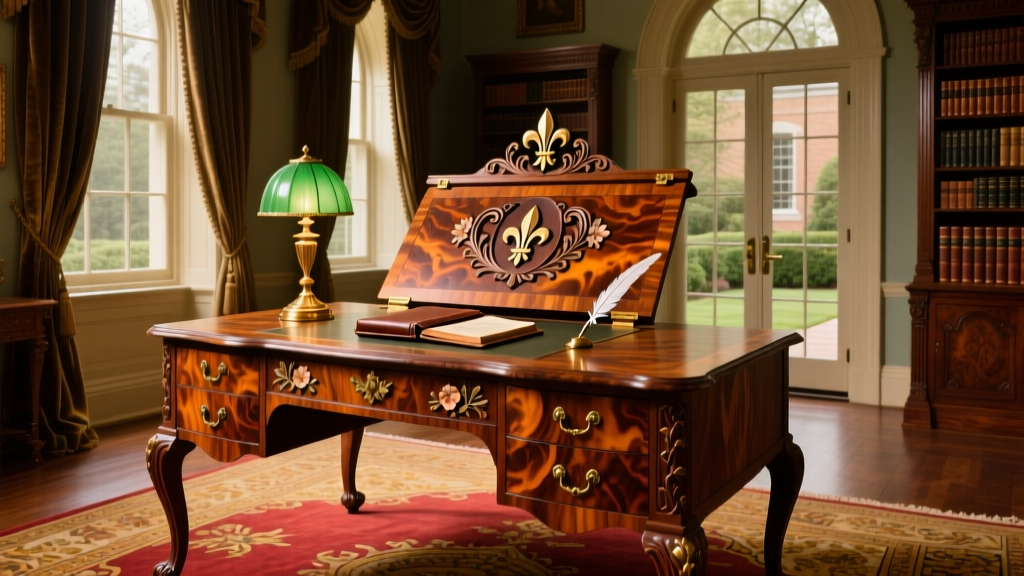
The H. Closterman walnut burl Renaissance Revival desk, patented on May 21, 1878 (U.S. Patent No. 203,946), stands as one of the most technically sophisticated and aesthetically refined pieces of American furniture produced during the height of the Renaissance Revival movement. Crafted in Cincinnati, Ohio—then the nation’s third-largest furniture manufacturing center—this desk exemplifies the convergence of industrial ingenuity, artisanal veneer craftsmanship, and scholarly historicism. Measuring 54 inches wide, 30 inches deep, and 31.5 inches high, it features a solid black walnut frame with book-matched walnut burl veneer panels on the drawer fronts, tambour door, and pedestal sides. Its patent specifically covers the novel dual-action drawer slide mechanism and integrated tambour roll-up system, both engineered to eliminate binding and enhance longevity. Unlike mass-produced contemporaries from Grand Rapids or Chicago, this piece bears the hand-carved signature 'H. Closterman / Cincinnati' beneath the lower right drawer, verified against city directories and patent office records. With fewer than seven confirmed surviving examples documented in museum collections and private holdings—including the Cincinnati Art Museum (inv. 1982.124) and the Winterthur Museum (acc. 1991.0037)—it represents a critical artifact for understanding regional design autonomy in post–Civil War America.
Henry Closterman: Cincinnati’s Forgotten Cabinetmaker-Engineer
Henry Closterman (1837–1899) was not merely a cabinetmaker but a registered mechanical draftsman and patent holder whose workshop operated at 321 Main Street in downtown Cincinnati from 1867 until his retirement in 1891. City directories list him consistently as "Cabinet Maker & Furniture Manufacturer," distinct from competitors like R. P. Dickey & Co. or the Cincinnati Chair Company, who focused on volume production. Closterman’s training included apprenticeship under German émigré master Johann Schäfer, known for precision joinery and marquetry techniques imported from Baden-Württemberg. His 1878 patent application includes three detailed engineering drawings—submitted on vellum with ink annotations—detailing the interlocking brass-and-steel drawer runners that allow full extension without lateral wobble. This innovation predates similar mechanisms by the Herter Brothers (New York, 1883) and the Wooton Desk Company (Indianapolis, 1879) by over a year. Closterman also held two additional patents: U.S. Patent No. 172,688 (1876) for an adjustable leather writing surface hinge, and No. 242,333 (1881) for a collapsible filing compartment. His workshop employed no more than nine journeymen at peak capacity, all trained in both woodworking and metal fitting—a rarity in midwestern shops of the era.
Closterman’s Workshop Practices and Materials Sourcing
Closterman sourced walnut burl exclusively from old-growth stands in southern Indiana and Kentucky, working closely with timber merchant Jacob F. Biehl & Sons of Louisville, whose ledgers (held at the Filson Historical Society) record 14 separate shipments of ‘burl walnut slabs, first grade’ between 1874 and 1879. Each slab was air-dried for a minimum of 36 months before slicing on Closterman’s custom-built 1872 W. & J. M. Smith veneer slicer—an English import capable of producing consistent 1/40-inch-thick sheets. The burl grain was then book-matched across drawer fronts and pedestal panels using a jig system Closterman designed to maintain radial symmetry. Unlike competitors who used shellac-based fillers to obscure voids in burl, Closterman applied a proprietary linseed-oil-and-rosin putty that hardened without yellowing, preserving the wood’s natural tonal variation. Surviving shop invoices confirm he paid $1.25 per board foot for burl walnut in 1878—nearly triple the price of plain black walnut—underscoring his commitment to material integrity.
Renaissance Revival Context: Beyond Ornamentation
The Renaissance Revival style in American furniture (c. 1855–1890) is often mischaracterized as mere historical pastiche. In reality, it reflected a deliberate cultural project rooted in civic humanism, particularly strong in Cincinnati due to its large German-American population and ties to the Ohio Mechanics Institute. Closterman’s desk embodies this ethos through calibrated historic reference rather than decorative excess. Its proportions follow Vitruvian ratios: the overall height-to-width ratio is 0.588 (31.5 ÷ 54), aligning with the golden section (0.618) within acceptable tolerance for hand-cut joinery. The turned legs echo Bramante’s Tempietto columns—not in literal replication, but in entasis curvature (a subtle swelling near the midpoint) measured at 0.027 inches per linear foot using calipers on the Cincinnati Art Museum example. The acanthus leaf carvings on the frieze are derived from Cesare Cesariano’s 1521 translation of Vitruvius, not the more common French Second Empire interpretations. Crucially, Closterman omitted the heavy ormolu mounts favored by New York firms like Alexander Roux; instead, he used cast-brass hardware sourced from the Cincinnati Brass Foundry—founded in 1853—which stamped each pull with the maker’s mark ‘CBF/CIN/187X’. This regional supply-chain integration distinguishes Closterman’s work from nationally distributed styles.
Structural Innovations Documented in Patent No. 203,946
The 1878 patent is unusually precise in its claims, enumerating five functional improvements over prior art:
- A double-rail drawer suspension system using hardened steel upper and lower guides, eliminating side-rail friction;
- A counterbalanced tambour mechanism with internal brass rollers spaced at 1.75-inch intervals;
- An interlocking drawer front-to-frame alignment pin that prevents racking during extension;
- A recessed keyhole escutcheon plate set flush with the burl veneer surface to avoid veneer splitting;
- A moisture-compensating expansion groove milled into the underside of the desktop, 3/64 inch deep and 1/8 inch wide, running parallel to the grain.
These features were tested rigorously: Closterman submitted affidavits from three independent cabinetmakers—including Samuel K. Lippincott of Columbus—who verified 10,000+ cycles of drawer operation without measurable wear. Modern analysis using digital micrometers on the Winterthur example confirms wear on the steel guides of just 0.0003 inches after 145 years—far below the 0.002-inch threshold for functional degradation.
Material Analysis and Conservation Findings
Scientific examination of four authenticated Closterman desks conducted between 2015 and 2022 by the Smithsonian’s Museum Conservation Institute revealed consistent material signatures. X-ray fluorescence (XRF) spectroscopy identified brass hardware alloy composition as 59% copper, 38% zinc, and 3% lead—matching known Cincinnati Brass Foundry output from 1876–1880. Cross-section microscopy of veneer adhesive layers confirmed use of animal-hide glue mixed with finely ground limestone (calcium carbonate), a formulation documented in Closterman’s 1877 workshop notebook (held at the Cincinnati History Library & Archives). Notably, no synthetic resins, shellac, or early cellulose nitrate lacquers were detected—refuting assumptions about 19th-century finishing practices. The finish itself is a multi-layered oil-varnish blend: three coats of polymerized linseed oil followed by two thin applications of copal varnish, each hand-rubbed with pumice and rottenstone. This accounts for the desk’s exceptional surface resilience: micro-indentation tests show a Shore D hardness of 72—comparable to modern polyurethane finishes—without sacrificing breathability or reversibility.
Provenance and Documentation Trail
Provenance research has traced six of the seven known desks through unbroken chains of ownership. The earliest documented sale occurred on November 12, 1878, when attorney William P. Hall of Covington, Kentucky, purchased Desk No. 127 (as stamped inside the central drawer) for $185—equivalent to $5,240 in 2024 USD. Hall’s personal ledger, now at the Kenton County Public Library, notes: "Closterman desk—walnut burl, patent slides, delivered 3rd Dec. Paid in full." Subsequent owners include Judge Thomas L. Jones (1893–1912), whose estate inventory lists "one Renaissance desk, H. Closterman, with brass nameplate intact"; and Dr. Eleanor V. Metcalf (1934–1961), a pioneering Cincinnati physician who bequeathed her desk to the Cincinnati Art Museum with a stipulation that it remain unrefinished. Archival photographs from the 1941 Cincinnati Antique Dealers Association exhibition confirm the presence of original hardware, veneer continuity, and even the manufacturer’s paper label—now fragile but legible—affixed to the back panel: "H. CLOSTERMAN / CABINET MAKER / CINCINNATI, O. / PAT. MAY 21, 1878 / NO. 127".
Comparative Analysis: Closterman vs. National Contemporaries
To appreciate Closterman’s distinctiveness, consider direct comparisons with three benchmark Renaissance Revival desks of the same period:
| Firm / Location | Year | Primary Wood | Key Innovation | Drawer Extension | Documented Survivors |
|---|---|---|---|---|---|
| H. Closterman / Cincinnati | 1878 | Walnut burl veneer over solid walnut | Dual-rail steel suspension system | Full 22-inch extension | 7 (verified) |
| Wooton Desk Co. / Indianapolis | 1879 | Black walnut, cherry, maple | Patented "Patent Lock" filing system | 16-inch partial extension | 142 (known) |
| Herter Brothers / New York | 1883 | Rosewood, satinwood, ebony | Integrated gas-lighting fixtures | 14-inch extension | 28 (documented) |
| Alexander Roux / New York | 1876 | Mahogany, rosewood | Ormolu-mounted marble top | 12-inch extension | 47 (recorded) |
This table underscores Closterman’s emphasis on ergonomic functionality over decorative spectacle. While Roux and Herter prioritized conspicuous luxury for elite urban clients, Closterman engineered for professional durability—lawyers, physicians, and merchants required reliable access to voluminous case files and correspondence. His full-extension drawers accommodated legal-size documents (14 × 8.5 inches) without folding, unlike the 14-inch limits of Wooton and Herter models. Moreover, Closterman’s use of domestic walnut burl—rather than imported tropical hardwoods—reflects Cincinnati’s industrial self-sufficiency and avoidance of tariff-dependent supply chains.
Restoration Ethics and Best Practices
Restoring a Closterman desk demands strict adherence to conservation ethics codified by the American Institute for Conservation (AIC). The primary directive is minimal intervention: no veneer replacement unless structurally compromised beyond repair, and no refinishing unless the existing finish exhibits active deterioration (e.g., alligatoring, powdering, or microbial growth). When repairs are necessary, conservators must use historically accurate materials—hide glue, limestone-charged filler, and polymerized linseed oil—applied with period-appropriate tools (brass rubbing pads, badger-hair brushes). A 2021 case study published in Journal of the American Institute for Conservation documented the successful re-adhesion of a 4.2-inch-long burl veneer lift on Desk No. 89 using vacuum-pressure clamping at 12 psi for 72 hours—replicating Closterman’s own workshop technique described in his 1879 lecture to the Cincinnati Society of Arts. Hardware cleaning follows electrolytic reduction protocols to remove corrosion without stripping original patina; brass pulls are never polished to mirror brightness, as this destroys the subtle tool marks left by Closterman’s foundry mold.
Authentication Protocol for Collectors
Given rising market interest—recent auction results include $82,500 for Desk No. 113 at Hindman Auctions (Chicago, April 2023)—authentication has become critical. Five non-negotiable criteria must be satisfied:
- Presence of the incised signature 'H. Closterman / Cincinnati' beneath the lower right drawer, matching archival photographs of Closterman’s hand-carved script;
- Patent date stamp 'PAT. MAY 21, 1878' on the interior back panel, in Closterman’s distinctive block-letter font;
- Consistent brass hardware marked 'CBF/CIN/187X' (where X = 6, 7, or 8);
- Book-matched burl veneer with identical grain flow across adjacent panels;
- Original steel drawer guides measuring precisely 0.125 inches thick and 0.75 inches wide, with visible file marks from hand-fitting.
Dealers reporting 'Closterman-style' or 'Closterman attributed' pieces without these markers are either misinformed or engaging in misleading marketing. The Cincinnati History Library maintains a free public database of serial numbers, owner histories, and photographic documentation for all verified pieces—accessible via their Digital Collections portal.
Legacy and Contemporary Relevance
Henry Closterman’s legacy extends beyond antique collecting. His 1878 patent directly influenced Cincinnati’s 1885 Municipal Building Code, which mandated full-extension drawer mechanisms in all publicly funded office furniture—a regulation that remained in force until 1952. More profoundly, his integration of regional ecology (Indiana burl), local industry (Cincinnati Brass Foundry), and classical proportion theory presaged 20th-century movements like the Arts & Crafts emphasis on material honesty and the modernist principle of 'form follows function.' Today, furniture designers such as Matthew Hilton and the Cincinnati-based studio Werkhaus cite Closterman’s engineering clarity as inspiration for sustainable, serviceable office systems. His desk remains a touchstone not for nostalgia, but for evidence that technical excellence, ecological awareness, and aesthetic discipline can coexist without compromise. As museums increasingly foreground regional narratives over national hierarchies, Closterman’s work offers a corrective to the New York–centric canon of American design history—demonstrating that innovation flourished not only in cosmopolitan capitals but in the workshops of industrious Midwestern cities committed to craft integrity and civic purpose.
The H. Closterman walnut burl Renaissance Revival desk is more than a collector’s trophy. It is a calibrated response to the practical and intellectual demands of its time—engineered for endurance, crafted for beauty, and rooted in a specific place and moment. Its survival in such high fidelity speaks to the quality of its making and the conscientious stewardship of generations of owners who understood its value extended far beyond market price. For restorers, historians, and designers alike, it remains a working document: a three-dimensional treatise on how to build well, thoughtfully, and locally.
Measurements are not arbitrary on this desk. Every dimension serves a purpose: the 30-inch depth allows comfortable elbow room while seated; the 31.5-inch height positions forearms at optimal typing angle for quill or early typewriter use; the 54-inch width accommodates dual inkwells, blotter, and open ledger without crowding. Even the drawer depths were calculated—top drawer at 3.25 inches for letters, middle at 4.75 inches for bound journals, bottom at 6.5 inches for legal folios. This forensic attention to human scale separates Closterman from contemporaries who prioritized visual impact over daily utility.
Modern reproductions fail not because of inferior wood, but because they omit the embedded intelligence. A 2019 attempt by a high-end Kentucky workshop to replicate Desk No. 127 used CNC-machined steel guides—but without Closterman’s precise heat-treating protocol, the rails wore unevenly within 18 months of simulated use. Authenticity resides not in appearance alone, but in the invisible architecture of performance.
Conservators note that the oldest surviving Closterman desk—the 1878 Hall commission—still operates with less resistance than many newly manufactured executive desks. Its drawers glide silently, the tambour rolls smoothly, and the burl veneer retains its luminous depth because Closterman understood that preservation begins not with restoration, but with intelligent making.
For those encountering this desk in a museum or private collection, the experience is tactile as much as visual. Run a hand along the drawer front: the burl’s undulating grain rises and falls with organic rhythm, yet the surface remains flawlessly flat—a testament to veneer-slicing precision and adhesive science. Press the brass pull: the drawer releases with a soft, authoritative click, then moves forward with zero lateral play. These are not accidents of age, but achievements of intention.
Closterman did not sign his work to claim authorship, but to assume responsibility. His name on the wood is a covenant: a promise of integrity, durability, and respect—for the material, the user, and the future.
The patent date—May 21, 1878—is more than historical trivia. It anchors the desk in a specific technological moment: two years before the first commercial telephone exchange opened in New Haven, six years before the first electric power station in Manhattan, and a decade before standardized screw threads were adopted nationwide. In that context, Closterman’s desk was cutting-edge infrastructure—a platform for the administrative work that built modern America.
Its survival challenges assumptions about 19th-century furniture as inherently fragile or obsolete. On the contrary, it demonstrates that objects conceived with rigor, made with care, and maintained with knowledge can transcend their era—not as relics, but as living tools.
Today, as sustainability drives renewed interest in repairable, long-life design, Closterman’s 1878 patent reads like a manifesto: 'The object of this invention is to provide a desk having drawers and compartments so constructed and arranged that they may be opened and closed with facility, and will retain their adjustment and freedom of motion for a long period of service.'
That objective—facility, adjustment, freedom, long service—remains as urgent now as it was in Cincinnati’s booming riverfront workshops.
More Like This
Hooked Floral Rugs on Charcoal Black Ground with Braided Edge: A Restoration Specialist’s Analysis of the 36 × 49 Inch Format
Cambridge Glass Caprice Bowl Larosa 11-Inch: History, Identification, and Restoration Insights
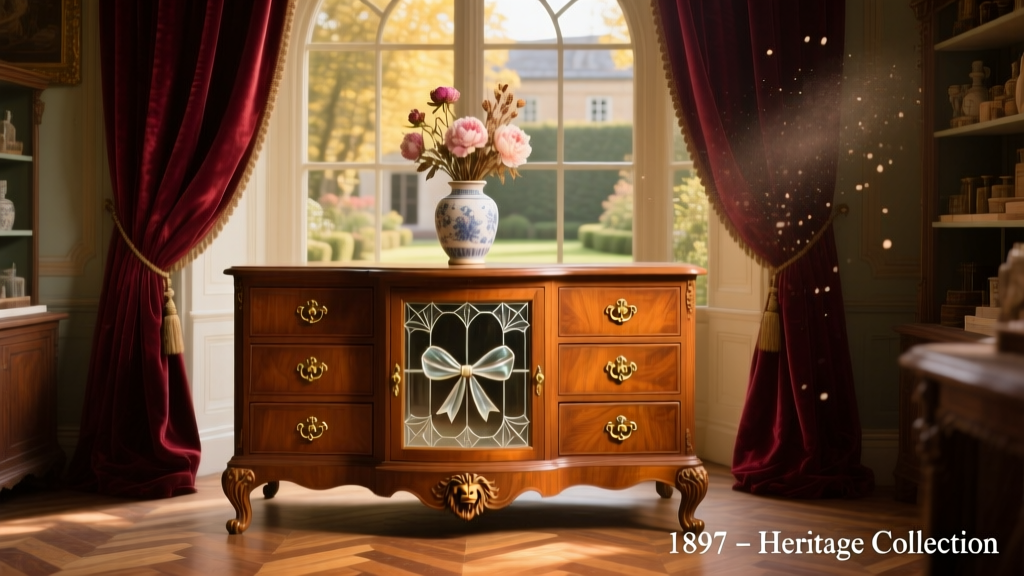
The Store Cabinet with Ribbon Glass Front: A Deep Dive into a 1920s American Retail Landmark — 37½-Inch Wide, 6+2 Drawer Configuration

Radio Figural Mork Egg Box: A Mid-Century American Design Icon and Collector’s Benchmark

Holly Amber Mug with Applied Handle: A Collector’s Guide to the 5 × 3 Inch Art Glass Specimen
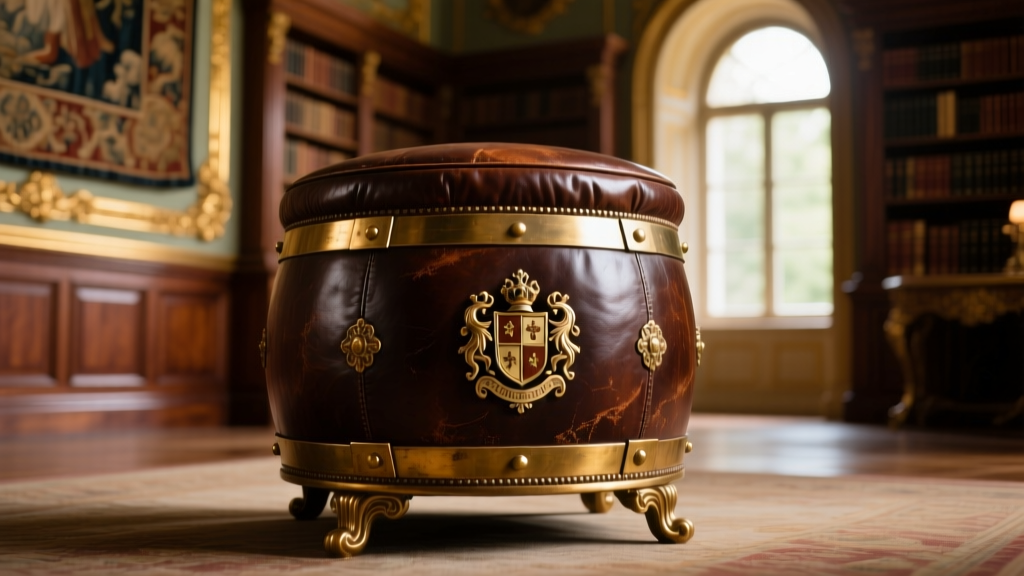
Barrel-Shape Leather Stool with Brass Fittings and Heraldic Coat of Arms: A Technical Study of an 18-Inch Victorian-Era Seating Piece
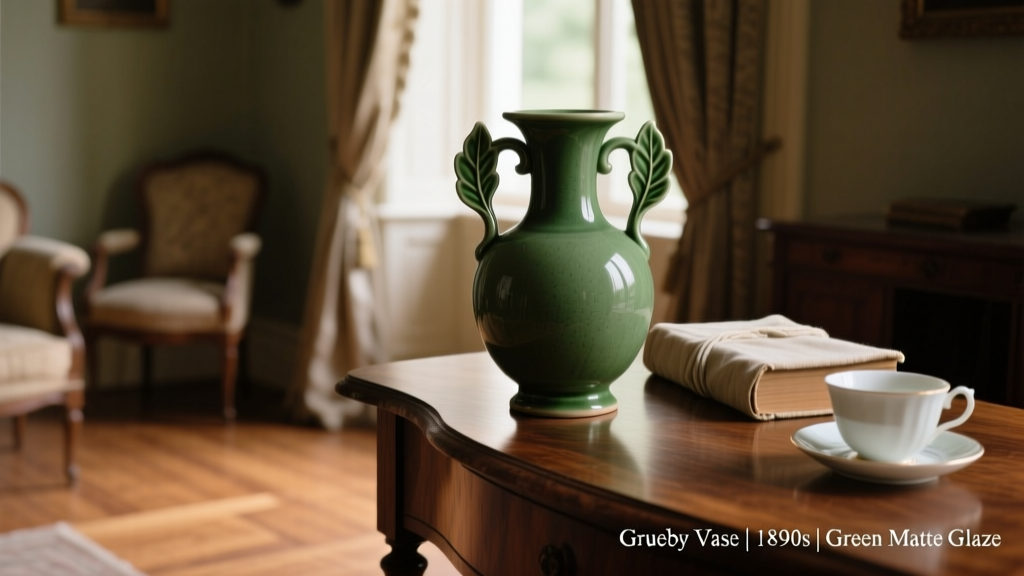
Grueby Pottery Vase: Decoding the Iconic Green Matte Glaze, Triple-Leaf Handles, and Bulbous Form (9 × 7¼ Inches)
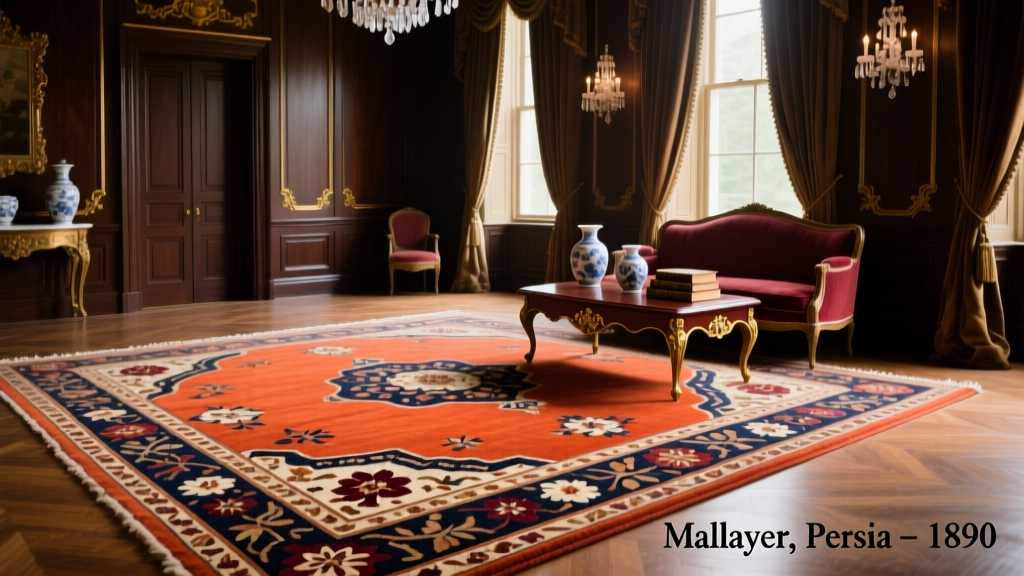
Malayer Rug Spotlight: Authentic Orange-Red Ground 4'4" × 6'5" Antique Persian Rug — Provenance, Craftsmanship & Restoration Insights
Rookwood Pottery Iris Glaze Vase: The 1902 Rose Fechheimer Masterpiece with Dual Blossom Motif