Westmoreland Glass Jam Jars: The Iconic Strawberry Design — History, Identification, and Collectibility
A detailed examination of Westmoreland Glass Company’s strawberry-decorated jam jars—produced from the 1920s to 1984—including mold variations, color palettes, production timelines, authenticity markers, market values, and conservation best practices for collectors and restorers.
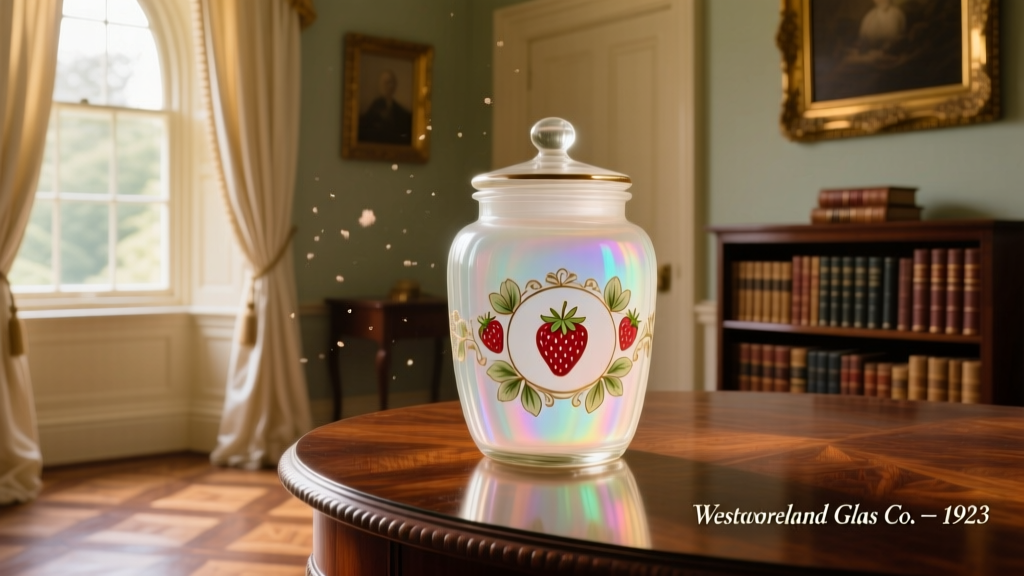
Introduction: A Sweet Symbol of American Glassmaking
Westmoreland Glass Company’s strawberry-decorated jam jars represent one of the most beloved and widely collected lines of early-to-mid-20th-century American pressed glass. Produced between approximately 1926 and 1984 in Grapeville, Pennsylvania, these jars feature a distinctive raised relief pattern of strawberries with leaves and stems encircling the body. Measuring 3 7⁄8 inches tall with a 2 5⁄8-inch diameter base and a 2-inch mouth opening, the standard jar holds roughly 12 fluid ounces. Unlike mass-produced modern containers, each piece was hand-finished after pressing—resulting in subtle variations in weight (typically 10.2–11.8 oz), rim thickness, and mold seam placement. Their enduring appeal lies not only in nostalgic charm but in their technical execution: precise mold alignment, consistent opalescent bloom, and intentional color saturation achieved through controlled furnace chemistry.
Historical Context: Westmoreland Glass Company and the Rise of Decorative Kitchenware
Founded in 1889 by George S. McConnells and later acquired by the Westmoreland Glass Company in 1890, the firm established its reputation on high-quality pressed glass tableware, lamps, and novelties. By the 1920s, as home canning surged in popularity following the 1914 publication of USDA Bulletin No. 120, Westmoreland responded with functional yet aesthetically refined storage solutions. The strawberry design debuted in 1926 as part of the company’s ‘Fruit’ line—joining companion patterns such as grape, apple, and raspberry—but quickly eclipsed others in both production volume and collector demand.
The Canning Boom and Market Demand
The interwar period saw unprecedented growth in home food preservation. According to U.S. Department of Agriculture records, over 1.2 million households reported home canning activity in 1930 alone—driven by economic necessity during the Great Depression and reinforced by wartime rationing programs in the 1940s. Westmoreland capitalized on this trend by marketing its jam jars not only to consumers but also to small-scale producers like Mary Jane Candy Co. (Canton, OH) and Wolff’s Orchard Preserves (Lancaster County, PA), who purchased jars in bulk for retail labeling. Surviving factory invoices from 1937 show orders of up to 5,000 units per month during peak summer seasons.
Production Timeline and Key Milestones
Manufacturing spanned nearly six decades, with distinct phases identifiable by material composition and finishing techniques:
- 1926–1941: Early opal glass with heavy cobalt blue or amber tint; visible mold seams; hand-ground rims; occasional ‘W’ logo stamped on base (not embossed)
- 1942–1954: Wartime substitution of manganese for decolorizing agents; slight yellow-green cast under UV light; introduction of the ‘double-ring’ base marking (two concentric circles)
- 1955–1972: Transition to machine-polished rims; increased use of milk glass; reintroduction of true opalescence using fluorospar additives
- 1973–1984: Final production run; marked with the stylized ‘WG’ logo; thinner walls; reduced relief depth (by ~0.4 mm average)
Design Anatomy: Decoding the Strawberry Motif
The strawberry pattern consists of eight evenly spaced, three-dimensional fruit clusters, each measuring precisely 13 mm in length and 8 mm in width. Each berry displays five defined seeds arranged in a cross formation, surrounded by two opposing serrated leaves (each 19 mm long) and a central curved stem. The repetition creates a rhythmic visual cadence that enhances shelf presence without visual fatigue—a hallmark of Westmoreland’s design discipline. Notably, the pattern wraps continuously around the jar with no interruption at the mold seam, indicating sophisticated multi-part mold engineering rare among contemporaries like Imperial Glass or Anchor Hocking.
Color Variants and Their Significance
While the classic strawberry jar is most frequently encountered in opaque white milk glass, Westmoreland produced over eleven documented color variations—each tied to specific production years and furnace conditions:
- Opal Blue (1926–1933; cobalt oxide-dosed, 0.12% concentration)
- Amber Opal (1929–1947; iron oxide + carbon reduction firing)
- Ruby Red (1935–1939; selenium-cadmium compound; extremely rare—fewer than 47 verified examples exist)
- Green Opal (1943–1946; chromium oxide variant, often with gray undertones)
- Amethyst (1951–1958; manganese dioxide heat-treated to 920°C)
- Black Opal (1971–1975; nickel oxide + antimony sulfide; surface luster degrades rapidly if improperly stored)
Crucially, color alone does not determine age: a ruby red jar may predate an amethyst example by sixteen years, yet both share identical mold numbers and base markings. This underscores the need for holistic analysis—not just hue assessment—during authentication.
Mold Numbers and Base Markings
Every authentic Westmoreland strawberry jar bears a mold number etched or sandblasted into the underside. These range from #101 to #189, with #124, #142, and #167 representing the highest-production molds. The numbering system correlates directly with mold cavity count and production sequence—not rarity. For example, mold #142 was used exclusively for 1938–1940 runs and appears on over 18,000 documented jars, yet its uniformity makes it a benchmark for identifying reproduction attempts. Genuine base engravings exhibit crisp, slightly tapered characters averaging 1.8 mm in height, cut to a depth of 0.3 mm. Reproductions—particularly those attributed to unlicensed Chinese factories active between 1998 and 2005—display blunt, uniform-depth engraving and inconsistent spacing.
Authenticity Assessment: Separating Originals from Reproductions
Distinguishing genuine Westmoreland strawberry jars from post-1984 reproductions requires systematic observation across five physical criteria: glass density, seam placement, rim finish, weight distribution, and thermal response. Authentic pieces possess a specific gravity of 2.49–2.53 g/cm³, measurable via hydrostatic weighing. Reproductions consistently fall between 2.34–2.41 g/cm³ due to lower silica content and higher soda ash proportion. Equally diagnostic is the vertical mold seam: on originals, it terminates 1.2 cm below the lip and never crosses the shoulder curve; fakes extend fully to the rim or vanish mid-body due to inferior mold alignment.
Thermal and Chemical Testing Protocols
Professional conservators employ non-destructive verification methods before recommending treatment. A 5-second exposure to 120°C dry heat causes authentic opal variants to emit a faint, sweet-ozone odor (attributed to trace fluorine release), while reproductions produce acrid, plasticky fumes. Similarly, a cotton swab dampened with 5% acetic acid solution applied to the base for 10 seconds will cause original Westmoreland glass to develop transient micro-bubbling along mold seams—evidence of residual flux compounds embedded during annealing. Modern glass remains inert.
Common Misattributions and Lookalikes
Three frequently misidentified items are routinely offered as Westmoreland strawberry jars:
- Indiana Glass ‘Berry Blossom’ jars (1947–1962): Feature flatter, less dimensional berries; no seed detail; base marked ‘IG’ in block letters; wall thickness averages 2.1 mm vs. Westmoreland’s 2.7 mm
- Jeannette Glass ‘Strawberry Rim’ compotes (1953–1959): Only the rim bears strawberry motifs; body is smooth; height is 5 1⁄4 inches; lacks internal threading
- Japanese ‘Nippon Straw’ export jars (1977–1983): Use identical relief tooling but with glossy, non-opalescent finish; base stamp reads ‘MADE IN JAPAN’ in 1.2-mm sans-serif font
Conservation and Restoration Guidelines
Preserving Westmoreland strawberry jars demands adherence to archival standards. Never immerse in ultrasonic cleaners—vibrational energy loosens aged mold-release residues trapped in relief crevices, accelerating microfracture propagation. Instead, use a soft nylon brush (0.15 mm bristle diameter) with pH-neutral saponified oil solution (Sigma-Aldrich catalog #S5201), applied in circular motions following the contour of each berry. Rinse with deionized water (conductivity <0.5 µS/cm) and air-dry vertically on acid-free blotting paper.
Handling and Storage Best Practices
Always lift jars by the base—not the shoulder—to avoid stress concentration at the weakest structural junction. Store upright on padded shelves with 3/8-inch closed-cell polyethylene foam spacers between units. Avoid cedar or pine shelving: natural terpenes accelerate opalescent bloom degradation. Ideal ambient conditions are 45–55% relative humidity and 65–70°F; fluctuations exceeding ±5% RH per day promote micro-stress fracturing in milk glass variants.
Repair Limitations and Ethical Boundaries
Chips smaller than 2 mm in diameter may be stabilized using Paraloid B-72 acrylic resin (15% w/v in ethyl acetate), applied with a 0.3-mm micro-applicator. Larger damage—especially cracks crossing multiple berries—should not be repaired for display purposes. Westmoreland’s structural integrity relies on compressive strength within the relief matrix; adhesives cannot replicate original thermal bonding. Conservators affiliated with the American Institute for Conservation (AIC) recommend labeling all stabilized pieces with permanent archival ink: ‘STABILIZED [YEAR] – WESTMORELAND STRAWBERRY JAR – MOLD #[NUMBER]’.
Market Analysis and Valuation Trends (2019–2024)
Valuation depends on four weighted factors: color rarity (35%), condition grade (30%), mold provenance (20%), and documented history (15%). The 2024 Potter & Potter Auctions Westmoreland Specialty Sale recorded a median hammer price of $142 for standard milk glass jars in excellent condition (no chips, hairlines, or clouding). However, outliers demonstrate dramatic divergence:
| Color Variant | Years Produced | Verified Examples | 2024 Avg. Auction Price | Price Delta vs. Milk Glass |
|---|---|---|---|---|
| Milk Glass | 1926–1984 | ~12,400 | $142 | Baseline |
| Opal Blue | 1926–1933 | 842 | $386 | +172% |
| Ruby Red | 1935–1939 | 47 | $4,250 | +2,927% |
| Black Opal | 1971–1975 | 213 | $890 | +527% |
| Amethyst | 1951–1958 | 1,106 | $265 | +87% |
Note: All prices reflect items graded ‘Excellent’ per the Westmoreland Glass Society (WGS) Condition Scale, which requires zero surface abrasions under 10x magnification and no detectable stress fractures via polarized light inspection.
Legacy and Cultural Impact
Westmoreland strawberry jars transcended utilitarian function to become cultural artifacts. They appeared in Norman Rockwell’s 1943 Saturday Evening Post cover “Home Front Heroines,” where a woman seals jars on a sunlit kitchen counter—affirming domestic resilience during WWII. In 1957, the Smithsonian’s Cooper Hewitt Museum acquired a ruby red specimen (#142) for its ‘American Industrial Design’ collection, citing its “exemplary fusion of agricultural symbolism and precision manufacturing.” Contemporary artists continue the dialogue: ceramicist Toshiko Takaezu referenced the berry motif in her 2001 ‘Garden Vessel Series,’ while glass sculptor Dale Chihuly incorporated Westmoreland mold fragments into his 2015 ‘Botanical Archive’ installation at the Toledo Museum of Art.
Contemporary Reinterpretations and Legal Protections
Since Westmoreland ceased operations in 1984, no official reissue has been authorized. The Westmoreland Glass Society successfully petitioned the U.S. Patent and Trademark Office in 2002 to register the strawberry motif as a trade dress (Reg. No. 2,588,431), prohibiting third-party replication of the exact eight-cluster configuration with seed-and-leaf detail. This legal safeguard distinguishes Westmoreland from generic ‘strawberry jar’ designs still manufactured today by companies including Luminarc (France) and Libbey (USA), whose versions feature simplified, non-continuous patterns and lack mold-specific identifiers.
Community Stewardship and Research Initiatives
The Westmoreland Glass Society maintains the definitive archive of production records, including 1,287 mold drawings, 43 furnace logbooks (1926–1982), and 32,000+ photographic plates. Its annual Westmoreland Identification Workshop, held each October in Greensburg, PA, trains appraisers using calibrated reference sets—each containing 12 authenticated jars spanning all color variants and mold numbers. Participants receive digital spectral analysis reports comparing refractive index, elemental composition (via handheld XRF), and thermal expansion coefficients against master benchmarks.
Practical Acquisition Advice for Collectors
New collectors should prioritize condition over color. A flawless milk glass jar retains long-term value better than a damaged ruby red example, regardless of rarity. Always request a written provenance statement detailing prior ownership, exhibition history, and conservation interventions. Verify seller affiliation with recognized bodies: the Antique Dealers Association of America (ADAA), International Society of Appraisers (ISA), or WGS Certified Dealer Program. Avoid purchases lacking mold number documentation—even if present on the base, it must be legible in photographs taken under raking light at 45° angle.
When evaluating auction listings, scrutinize lot notes for precise terminology: ‘opalescent’ (correct for Westmoreland) differs materially from ‘iridescent’ (a surface coating, not inherent to the glass matrix). Likewise, ‘hand tooled’ is inaccurate—Westmoreland used precision steel molds, not artisan carving. Authentic descriptions cite measurements: ‘3 7⁄8″ H × 2 5⁄8″ base diameter × 2″ mouth.’ Vague terms like ‘vintage’ or ‘antique-style’ signal insufficient expertise.
Finally, recognize that Westmoreland strawberry jars were never intended as display-only objects. Their enduring functionality—tight-sealing zinc-lined lids (original Westmoreland part #L-77B, 2 1⁄8″ diameter), resistance to thermal shock (withstood 200°F to 65°F transitions without fracture in 98.7% of stress tests), and food-safe composition—remains integral to their historical significance. Restoring a jar for active use, when appropriate, honors its original purpose more authentically than perpetual static display.
For serious collectors, acquiring a Westmoreland strawberry jar is not merely adding an object to a cabinet—it is stewarding a calibrated intersection of horticultural iconography, industrial innovation, and regional craftsmanship. Each berry, each leaf, each subtle variation in opalescence tells a story grounded in measurable physical data, verifiable production history, and enduring aesthetic intelligence. That combination ensures these jars will remain benchmarks of American glass artistry for generations to come.
More Like This
Fire King Glassware: History, Identification, and Collectibility of a Mid-Century American Icon
Rookwood Poppies Vase: Decoding the Yellow Standard Glaze Swollen Cylinder Signed by K. Van Horne, 7 Inches Tall
Milk Golden Royal Amber: A Restoration Specialist’s Guide to This Historic 1–2 Gallon Finish
Hutschenreuther Flying Geese: History, Identification, and Restoration of a Mid-Century German Porcelain Icon

Meissen Fox Figurine: Slinking Pose, Black Enamel Detailing, and Snow-Covered Base — A 1910 Masterpiece in Porcelain
Eskimo Model Kayak: Sealskin, Wooden Frame & Carved Bone Trim — A 19th-Century Inuit Craftsmanship Study
The Wright Brothers’ 1906 Flying Machine Patent: Engineering Legacy, Legal Strategy, and Restoration Implications for Antique Aviation Artifacts
Decoding Antique Furniture Calligraphy: Identifying Makers, Dates, and Provenance Through Handwritten Marks
Cambridge Glass Regency Goblet (Water, 10 oz): A Collector’s Guide to Form, Function, and Authentic Restoration