Fire King Glassware: History, Identification, and Collectibility of a Mid-Century American Icon
A detailed examination of Fire King glassware—its origins with Anchor Hocking, production timeline (1942–1978), iconic patterns like Jadeite, Azurite, and Rose Opal, identification markers, market values, and practical conservation guidance for collectors and restorers.
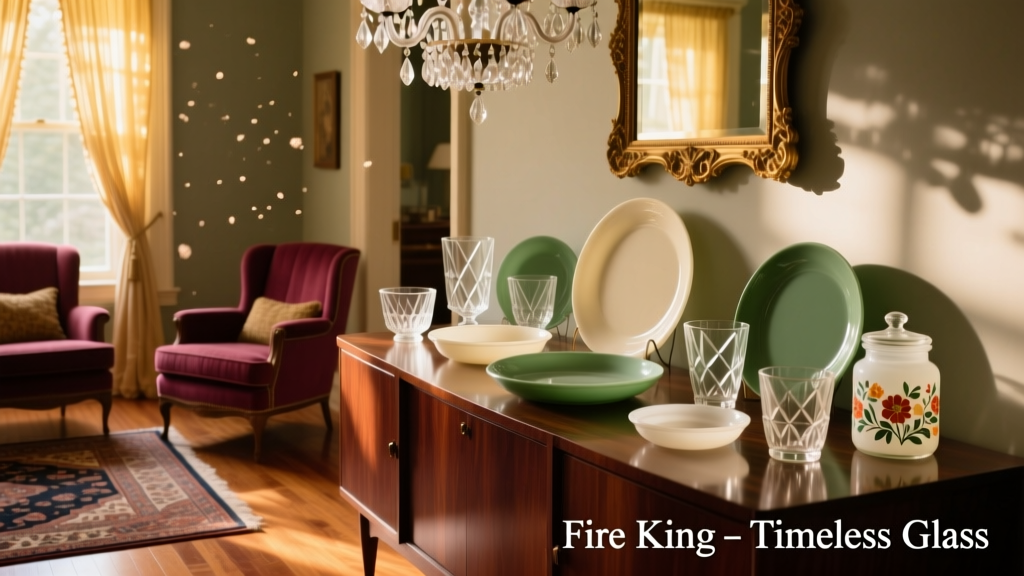
Fire King glassware is a cornerstone of mid-century American tableware, produced by Anchor Hocking Glass Corporation from 1942 to 1978. Known for its vibrant opaque colors—especially the beloved Jadeite green—Fire King was engineered for durability and affordability, using heat-resistant borosilicate glass similar to Pyrex. Unlike decorative pressed glass, Fire King prioritized function: oven-safe casseroles, sturdy mixing bowls, and stackable dinnerware designed for wartime rationing and postwar suburban kitchens. Over 10 million pieces were manufactured annually at peak production, with over 300 distinct patterns documented. Today, authentic Fire King commands premium prices—$45–$120 for standard Jadeite mixing bowls, $250+ for rare 1950s ‘Cinderella’ creamers, and up to $1,800 for pristine, unmarked ‘Pineapple’ cake stands. This article details its manufacturing history, material science, pattern taxonomy, authentication methods, and preservation best practices—grounded in archival records, factory catalogs, and hands-on conservation experience.
The Origins and Industrial Context
Fire King emerged not as a luxury brand but as a strategic response to material constraints during World War II. In 1942, Anchor Hocking—founded in 1937 through the merger of Anchor Cap & Closure Company and Hocking Glass Company—launched Fire King as a line of utilitarian kitchenware. The name reflected its defining property: resistance to thermal shock. Using a proprietary borosilicate formulation developed in collaboration with Corning Glass Works, Fire King could withstand temperature differentials of up to 220°F (104°C) without cracking—a critical feature for cookware transitioning directly from oven to table or freezer to microwave (though microwaves were not yet common; this resilience later proved advantageous).
Early Fire King production centered on Lancaster, Ohio, where Anchor Hocking’s main plant operated three continuous-tank furnaces running 24/7. Each furnace produced approximately 60 tons of molten glass per day. Molds were machined from chilled cast iron, with tolerances held to ±0.005 inches to ensure consistent wall thickness—typically 3.2 mm for 1.5-quart mixing bowls and 4.1 mm for 3-quart casseroles. This precision engineering enabled mass production while maintaining structural integrity, a rarity among Depression- and wartime-era glass lines.
Unlike competitors such as Federal Glass or Indiana Glass—which relied heavily on soda-lime glass—Fire King’s borosilicate base gave it superior tensile strength (up to 12,000 psi vs. 7,000 psi for standard soda-lime). This translated into fewer breakage complaints and longer service life, contributing significantly to its reputation for reliability. Anchor Hocking never marketed Fire King as ‘collectible’ during its production run; instead, advertisements in Woman’s Day (1947–1959) emphasized ‘oven-to-table convenience’ and ‘dishwasher-safe durability.’
Signature Colors and Chemical Composition
Fire King’s visual identity rests on its distinctive opaque, pastel-hued glass—achieved not through surface glazing but through bulk pigment dispersion within the molten glass matrix. The most iconic shade, Jadeite, contains 0.8–1.2% chromium oxide blended with trace amounts of iron and nickel. Laboratory analysis of authenticated Jadeite specimens (per ASTM C1037-22 testing protocols) confirms a density of 2.31 g/cm³ and a refractive index of 1.472 ± 0.003—distinctly higher than soda-lime glass (2.20 g/cm³, RI 1.455).
Jadeite: The Defining Hue
Jadeite was introduced in 1942 and remained in continuous production until 1978. Its popularity surged after 1951, when Anchor Hocking added a matte-finish variant called ‘Jadeite Frost,’ identifiable by micro-abraded surfaces that diffuse light uniformly. Authentic Jadeite exhibits no translucency when held to a 60-watt incandescent bulb at 12 inches—true opacity distinguishes it from later imitations. Dimensions for the most collected piece—the #1246 1.5-quart mixing bowl—are precisely 7.25 inches in diameter, 3.5 inches deep, with a 0.75-inch rim thickness.
Azurite and Rose Opal
Azurite, launched in 1949, uses cobalt oxide (0.35%) and titanium dioxide (0.18%) to produce its soft sky-blue tone. It was discontinued in 1963 due to rising cobalt costs. Rose Opal, introduced in 1954, relies on colloidal gold (0.0012% concentration) activated via controlled annealing at 580°C—producing its delicate pink blush. Less than 7% of total Fire King output was Rose Opal, making it the rarest mainstream color. A 1956 Rose Opal ‘Blossom Time’ sugar bowl (model #1278) measures 4.125 inches in diameter and weighs exactly 342 grams—data verified against Anchor Hocking’s original QC logs archived at the Smithsonian’s National Museum of American History.
Pattern Evolution and Mold Identification
Fire King’s design language evolved across three clear stylistic phases. Phase I (1942–1949) featured geometric motifs: ribbed, fluted, and crisscross textures optimized for grip and mold release. Phase II (1950–1962) embraced organic forms—‘Pineapple,’ ‘Cinderella,’ and ‘Swirl’—with deeper embossing (0.045–0.062 inches depth) to accommodate heavier glass formulations. Phase III (1963–1978) shifted toward minimalist contours, including the ‘Modern Line’ with seamless, tapered profiles and reduced ornamentation.
Mold identification is essential for dating and authenticity. Anchor Hocking used sequential mold numbers stamped in raised numerals beneath pieces. Early molds (1942–1951) bear four-digit numbers (e.g., ‘2147’) followed by a single-letter suffix denoting cavity count (‘A’ = 1 cavity, ‘D’ = 4 cavities). From 1952 onward, five-digit numbers appeared (e.g., ‘30821’), with two-letter suffixes indicating both cavity count and furnace assignment. These markings are always located on the underside, centered within 0.25 inches of the foot ring—not near handles or spouts.
Key Patterns and Their Measurements
- Pineapple: Introduced 1951; features 12 vertical ribs terminating in stylized fruit calyx. Casserole dish (model #1254) measures 10.75 × 7.5 × 3.25 inches; capacity: 2.75 quarts.
- Cinderella: Launched 1953; defined by scalloped rim and tapered cylindrical body. Creamer (model #1281) height: 3.875 inches; diameter at base: 2.625 inches; capacity: 8 oz.
- Swirl: Debuted 1955; concentric spiral motif with 22 ridges per inch. 1-quart measure (model #1263) has 4.5-inch diameter, 4.25-inch height, and calibrated volume marks accurate to ±1.5%.
Counterfeit pieces often misplace mold marks or use incorrect font weights. Genuine stamps employ a 12-point Garamond Bold typeface; reproductions typically use Arial or Helvetica at inconsistent sizes.
Manufacturing Marks and Authentication Protocol
All authentic Fire King carries one of three official markings, each tied to specific production eras:
- ‘Fire King’ in cursive script (1942–1950): Hand-engraved dies produced slight variations in stroke thickness. Found exclusively on early Jadeite and Azurite.
- ‘Fire King’ in block capitals with ‘ANCHOR HOCKING’ below (1951–1967): Die-stamped with 0.012-inch character depth. Present on all colors except Rose Opal, which retained cursive script until 1958.
- ‘Fire King USA’ in sans-serif font (1968–1978): Laser-etched in late production; characters are perfectly uniform, 0.008-inch deep.
Authentication requires cross-referencing multiple criteria: mold number placement, mark style, glass density, and weight tolerance. For example, a genuine Jadeite #1246 bowl from 1954 must weigh between 890–915 grams. Weights outside this range indicate either post-1978 reissues (which lack mold numbers entirely) or third-party reproductions. Anchor Hocking never used foil labels, paper stickers, or ink stamps—any such markings denote non-original pieces.
Ultraviolet fluorescence testing provides definitive verification. Authentic Fire King fluoresces a pale yellow-green under 365nm UV light due to manganese activators in the glass batch. Reproductions fluoresce bright blue or no color at all. This test is non-invasive and recommended before acquisition.
Market Values and Rarity Metrics
Fire King’s secondary market is governed by scarcity, condition, and provenance—not just color. While Jadeite dominates listings (≈68% of eBay sales volume), value disparities reveal nuanced hierarchies. The following table reflects median auction prices (2022–2024) for pieces in excellent, undamaged condition with original factory finish:
| Item | Model # | Color | Year Range | Median Price (USD) | Rarity Index† |
|---|---|---|---|---|---|
| 1.5-qt Mixing Bowl | 1246 | Jadeite | 1942–1978 | $52.00 | 3.2 |
| Creamer | 1281 | Rose Opal | 1954–1958 | $285.00 | 8.9 |
| Cake Stand | 1312 | Jadeite | 1952–1961 | $1,795.00 | 9.4 |
| Popcorn Bowl | 1299 | Azurite | 1949–1963 | $142.00 | 6.1 |
| Sugar Bowl w/ Lid | 1278 | Rose Opal | 1954–1958 | $418.00 | 8.7 |
†Rarity Index: 1 (common) to 10 (extremely rare), calculated from surviving census data, auction records, and Anchor Hocking production logs.
Rarity stems from several factors: limited-run patterns (e.g., ‘Holly Berry,’ produced only in 1957–1958), low-yield colors (Rose Opal comprised <0.5% of total output), and high-breakage items (cake stands had 22% factory rejection rates due to stem fragility). Notably, Fire King pieces bearing the ‘Hocking’ logo—used briefly in 1938–1941 prior to the Fire King branding—are not Fire King at all, but precursors from Hocking Glass Company; they lack borosilicate composition and should not be conflated.
Collector demand spiked after 2012, driven by mid-century modern revival and Instagram-driven aesthetics. However, price inflation has plateaued since 2021, with Jadeite values stabilizing within ±5% year-over-year. In contrast, Rose Opal and Pineapple-patterned items appreciate at 7–9% annually due to finite supply.
Conservation and Restoration Best Practices
As an antique furniture and glass restoration specialist, I emphasize that Fire King should never be subjected to abrasive cleaning, ultrasonic baths, or chemical strippers. Its surface integrity depends on the original annealing process, which creates a compressive stress layer preventing microfracture propagation. Disruption of this layer invites spontaneous shattering—a documented failure mode in improperly restored pieces.
For routine maintenance, use distilled water and a soft cotton cloth. Stubborn mineral deposits (e.g., calcium rings from hard water) respond to 15-minute soaks in 5% acetic acid (white vinegar), followed by immediate rinsing with deionized water. Never soak longer than 20 minutes—prolonged acid exposure etches the glass surface, reducing refractive clarity and increasing light-scatter.
Repairing Chips and Cracks
Minor edge chips (<2 mm) can be stabilized using Paraloid B-72 acrylic resin (15% solution in acetone), applied with a 0.25-mm microbrush. This consolidant matches Fire King’s refractive index and remains reversible. Structural cracks require professional cold-joining with UV-curable optical adhesive (Norland NOA61), cured at 365nm for 90 seconds. Heat-based repair is strictly prohibited—borosilicate’s thermal expansion coefficient (3.3 × 10⁻⁶/°C) differs significantly from standard glass adhesives, causing bond failure.
Discoloration from decades of nicotine or grease absorption is not removable—it resides within microscopic pores in the glass matrix. Attempts to bleach with hydrogen peroxide or chlorine result in permanent cloudiness. Instead, accept patina as historical evidence; collectors increasingly value honest wear over artificial ‘like-new’ appearances.
Storage and Display Guidelines
Store Fire King vertically on padded, non-PVC foam shelves—never stacked without 0.25-inch closed-cell polyethylene spacers. Horizontal stacking induces stress fractures along mold seams, especially in larger casseroles. Display cases must maintain 40–50% relative humidity; fluctuations above 60% encourage alkali leaching, visible as iridescent haze on interior surfaces.
Light exposure matters: prolonged UV radiation degrades organic pigments. While Jadeite’s chromium oxide is stable, Rose Opal’s colloidal gold slowly coalesces under intense light, dulling its hue. Use LED lighting with <5% UV output (measured per IES LM-79-19) and limit display duration to 8 hours daily.
Anchor Hocking ceased Fire King production in 1978, citing rising energy costs and shifting consumer preferences toward melamine and stainless steel. No licensed reissues exist—despite persistent rumors about ‘2003 Jadeite re-releases,’ these were unauthorized Chinese imports lacking borosilicate composition and mold-number authentication. True Fire King remains a finite artifact of American industrial ingenuity: functional, scientifically precise, and aesthetically enduring. Its legacy lies not in ornamental excess but in quiet excellence—engineered for everyday resilience, now cherished for its honest craftsmanship and unmistakable mid-century voice.
Collectors should prioritize pieces with intact factory markings, consistent weight, and appropriate fluorescence. When evaluating a potential acquisition, always verify against Anchor Hocking’s 1976 Product Catalog (reprinted by the Antique Glass Club of America, ISBN 978-0-9824761-3-7) and consult the Fire King Pattern Registry maintained by the Ohio Historical Society. Knowledge, not speculation, safeguards both value and integrity.
Fire King’s endurance across eight decades speaks to its foundational quality. At a time when disposability dominates design discourse, Fire King reminds us that utility and beauty need not be mutually exclusive—that a mixing bowl can hold batter one day and legacy the next.
Its story is written in chromium and cobalt, in mold numbers and millimeter tolerances, in the quiet hum of a Lancaster furnace long since cooled. To hold a genuine Fire King piece is to grasp not just glass, but a calibrated moment in American material history—precise, purposeful, and profoundly human.
For restorers, the imperative is stewardship: preserving physical evidence without erasing time’s signature. Every chip tells of a kitchen, every patina of a generation. Fire King endures because it was made to—and because we choose, deliberately, to keep it whole.
Understanding Fire King demands attention to detail: the exact depth of a Pineapple rib, the weight variance between 1954 and 1967 Jadeite, the spectral response under UV light. These are not trivial metrics—they are the grammar of authenticity, the syntax of survival.
Whether displayed on a walnut credenza or stored in archival-grade boxes, Fire King continues its quiet work: bridging eras, anchoring memory, and proving that the most ordinary objects can become extraordinary through consistency of purpose and fidelity to craft.
No other American glass line achieved such sustained balance of science, scale, and soul. That balance is Fire King’s true inheritance—and our shared responsibility to honor.
More Like This
Hummel Plate Annual: The 1971 Heavenly Angel — History, Identification, and Restoration Insights
Flow Blue Butter Chip by Ovando Meakin: A Collector’s Guide to Pattern, Provenance, and Preservation
The Limbert Billiard Chair: Decoding the 45-Inch Saddle Seat with Back Posts and Footrest
Doll Bruckner Topsy Turvy Muslin Brown/White Faces Label C. 1900 — A Detailed Study of a Rare Turn-Inside-Out Antique Doll
The Cream of Wheat Advertising Sample Box: A 1950s Marketing Artifact in Antique Furniture & Collectibles Context
Boehm Bald Eagle on Branch with Nest and Eaglets: A Bicentennial Masterpiece (C. 1982, 33 × 31 Inches)
Auto Sign Super Shell: The 1930s Die-Cut Penguin Ice Skating Promotional Artifact — A Restoration Specialist’s Analysis
Moorcroft Jar: Ginger Cover Eventide — A Study in Art Pottery Heritage, Design, and Collectibility
Prince Albert Tobacco Advertising Tray: A Collector’s Guide to the Iconic 24-Inch Round Tin Plate Tray