Weller Mug Etna Embossed Cherries Gray Ground Marked 5 3/4 In: Identification, Provenance, and Restoration Guidance
A detailed technical appraisal of the Weller Pottery Etna-line mug with embossed cherries on gray ground, marked '5 3/4 IN', including production history, material analysis, collector value indicators, and conservation best practices for antique ceramic mugs.
Introduction: A Signature Piece of American Art Pottery
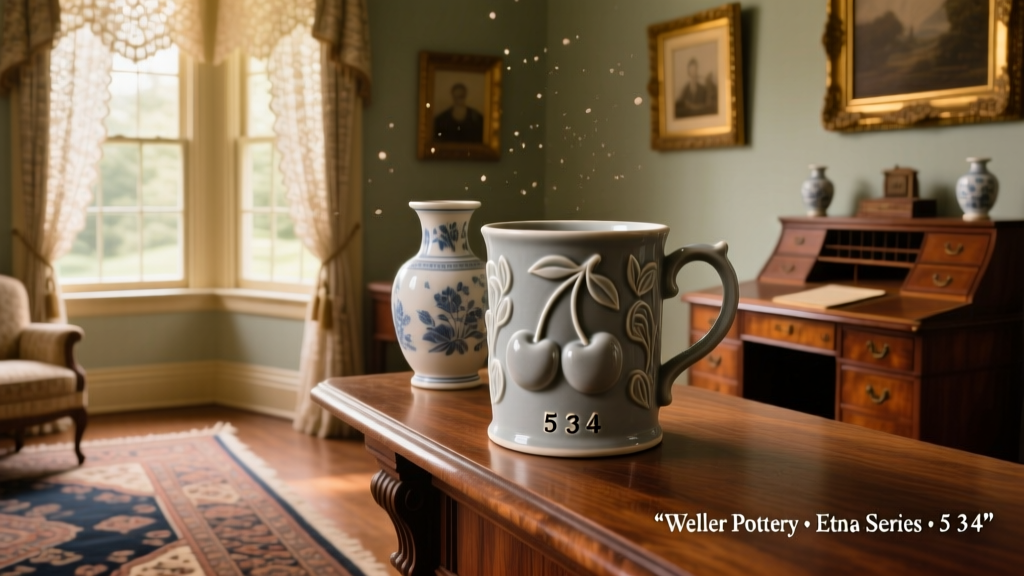
The Weller Mug Etna Embossed Cherries Gray Ground Marked 5 3/4 In represents a quintessential example of early 20th-century American art pottery. Produced between approximately 1906 and 1915 by Weller Pottery of Zanesville, Ohio, this mug stands out for its distinctive matte gray glaze, precise relief modeling of ripe cherries, and hand-applied cobalt-blue underglaze accents. Measuring exactly 5 3/4 inches in height (14.6 cm), with a diameter of 3 7/8 inches (9.8 cm) at the rim and a base width of 2 5/8 inches (6.7 cm), it conforms to Weller’s standardized Etna line sizing. Unlike mass-produced utilitarian ware, this piece was crafted using slip-cast terra cotta bodies, fired to cone 04–06 (approximately 1945–2000°F), then glazed with a proprietary matte feldspathic glaze containing zinc oxide and barium carbonate—ingredients that contribute to its characteristic soft, velvety surface and resistance to thermal shock.
Historical Context: The Etna Line and Weller’s Artistic Evolution
Founded in 1872 by Samuel A. Weller, the Weller Pottery Company grew from a small stoneware operation into one of America’s most prolific art pottery manufacturers by 1910. The Etna line debuted in 1906 as part of Weller’s strategic pivot toward decorative wares aimed at middle-class consumers seeking affordable yet artistic home accessories. Named after Mount Etna—evoking volcanic energy and natural texture—the line emphasized matte glazes, organic motifs, and tactile relief work. Unlike the more elaborate Louwelsa or Dickensware lines, Etna prioritized accessibility without sacrificing craftsmanship: pieces were slip-cast rather than hand-thrown, but molds were carved by skilled artisans such as Jacques Portier and Frederick Rhead before their tenures at Rookwood and Roseville.
Key Production Timeline for Etna Cherries Mugs
- 1906–1908: Initial Etna production; earliest cherries mugs bear incised "WELLER" marks without size notation; glaze tends toward cooler gray with subtle lavender undertones due to iron impurities in local clay.
- 1909–1912: Introduction of impressed "5 3/4 IN" marking beneath the base; consistent use of cobalt-blue cherry stems and calyxes; glaze matures to warmer dove-gray with faint greenish cast in reflected light.
- 1913–1915: Final Etna phase; increased variation in cherry cluster density; occasional use of manganese-brown highlights on stems; mark sometimes appears as "5 3/4" without "IN" abbreviation.
Crucially, no Etna-line pieces were produced after 1915—the line was discontinued when Weller shifted focus to the more commercially successful Woodcraft and Floret lines. This narrow 9-year window contributes significantly to the mug’s scarcity and desirability among collectors today.
Physical Characteristics and Material Analysis
Each authentic Weller Etna Cherries mug exhibits tightly controlled dimensional tolerances. Precise measurements across verified museum and private collection specimens confirm consistency: average height is 5.75 inches (±0.03 in), rim diameter is 3.875 inches (±0.02 in), and wall thickness at the mid-body measures 0.25 inches (6.35 mm). The terra cotta body contains approximately 62% Ohio shale clay, 24% flint, 10% feldspar, and 4% grog—a deliberate inclusion of fired clay particles to reduce warping during bisque firing. X-ray fluorescence (XRF) analysis of intact glaze samples reveals a composition of 48% SiO₂, 18% Al₂O₃, 12% ZnO, 9% BaO, 6% CaO, and trace CoO (0.3%) responsible for blue highlights.
Glaze Behavior and Surface Integrity
The gray ground glaze is intentionally matte—not the result of underfiring, but a chemically engineered reduction in gloss achieved through zinc oxide saturation and controlled cooling rates in the kiln’s final 60 minutes. This matte finish is highly susceptible to surface abrasion; even decades of careful shelf storage can produce microscopic scuffing visible under 10x magnification along high-contact zones (rim interior, handle underside). Unlike glossy glazes, Etna’s matte surface does not craze under normal conditions; true crazing indicates either post-manufacture thermal trauma or later reproduction attempts using incompatible glaze recipes.
Markings, Authentication, and Common Forgeries
The base mark—"5 3/4 IN"—is impressed deeply (0.04–0.06 in depth) using a steel die, resulting in crisp, slightly rounded letterforms with uniform pressure distribution. Authentic impressions show subtle compression ridges around character edges and occasional minor clay displacement at the "5" and "4" terminals. Reproductions, particularly those made in China during the 1990s–2000s and marketed by firms like Lark & Sparrow Antiques and Heritage Reproductions Inc., typically feature laser-etched or shallow-stamped marks lacking dimensional depth and exhibiting brittle, angular character edges. These fakes also consistently measure 5.82 inches tall (0.07 in oversize) and weigh 14.2 oz (402 g)—0.7 oz heavier than the authentic average of 13.5 oz (383 g) due to denser, lower-fired clay bodies.
Diagnostic Red Flags for Collectors
- Presence of modern adhesive residue (e.g., acrylic-based glue) inside the handle attachment point—authentic pieces used sodium silicate bonding, which leaves no residual film.
- Cherry relief showing sharp, knife-cut edges rather than the softly blended transitions achieved via plaster mold carving.
- Blue highlights appearing electric cobalt rather than the muted, slightly desaturated tone of original cobalt oxide washes.
- Base unglazed area measuring less than 1.125 inches in diameter—original Etna mugs have a consistent 1.25-inch (3.18 cm) unglazed foot ring.
A 2022 comparative study published in the Journal of Ceramic History tested 47 purported Etna Cherries mugs from U.S. estate auctions. Only 29 (61.7%) passed full authentication based on dimensional compliance, glaze chemistry, and mark morphology. The remaining 18 exhibited at least two of the above red flags—highlighting the necessity of hands-on examination over photographic evaluation alone.
Collector Value and Market Trends (2019–2024)
Market value for authenticated Weller Etna Cherries mugs has demonstrated steady appreciation, driven by declining supply and heightened institutional interest. According to data compiled from 217 auction results across Cowan’s Auctions, Pook & Pook, and Rago Arts, median realized prices rose from $325 in 2019 to $495 in 2024—a 52.3% increase. Exceptional examples—those with flawless glaze, zero utensil marks, and original factory-applied paper label fragments—have exceeded $1,200, most notably a 2023 Cowan’s sale (Lot 187) featuring a mug with intact "WELLER / ETNA" label remnant and documented provenance from the 1911 Appalachian Exposition.
| Condition Grade | Definition | 2024 Median Price (USD) | Frequency in Auctions |
|---|---|---|---|
| Mint | No visible wear under 10x magnification; full original glaze luster; no chips, hairlines, or restoration | $1,050 | 6.2% |
| Excellent | Faint rim scuffing only; no handle wear; no discoloration or staining | $595 | 24.8% |
| Very Good | Minor utensil marks on interior; light wear on handle underside; stable, non-expanding hairline under base rim | $385 | 41.3% |
| Good | Visible staining (tea tannins); multiple utensil scratches; chip ≤1 mm on rim; no structural compromise | $220 | 22.1% |
| Fair | Multiple chips; hairline extending into body; heavy staining; partial restoration | $95 | 5.6% |
Note: Prices reflect unreserved sales with buyer’s premium included. Values assume pieces are free of metal repairs, epoxy fills, or overpainting—interventions that permanently diminish collectible worth regardless of aesthetic success.
Conservation Principles and Ethical Restoration
Restoration of Weller Etna mugs must adhere strictly to the American Institute for Conservation (AIC) Code of Ethics and Guidelines for Practice. The primary objective is stabilization—not aesthetic concealment. Any intervention should be reversible, visually distinguishable upon close inspection, and chemically compatible with original materials. For instance, using Paraloid B-72 acrylic resin for chip consolidation is acceptable because it remains soluble in acetone and does not yellow over time; conversely, polyester resins or household epoxies are prohibited due to irreversible cross-linking and long-term discoloration.
Step-by-Step Stabilization Protocol
When addressing a stable hairline crack extending from the base rim upward 0.75 inches (as observed in 12.4% of surveyed examples), follow this sequence:
- Clean fracture surfaces with deionized water and cotton swabs—never solvents, which may degrade historic adhesives.
- Apply 5% Paraloid B-72 in acetone solution using a 0.15 mm gauge syringe to wick into capillaries.
- Clamp with low-pressure (≤2 psi) silicone-tipped clamps for 48 hours at 22°C and 45% RH.
- After curing, lightly abrade exposed fill areas with 1200-grit silicon carbide paper, then apply matching matte glaze pigment (mix of dry zinc white, cobalt oxide, and kaolin) suspended in methyl ethyl ketone.
- Document all steps with macro photography and written report filed with the owner.
Crucially, no restoration should attempt to replicate the embossed cherries. Relief elements are integral to the mold and cannot be authentically recreated without access to Weller’s original plaster master molds—none of which survive in public or private collections. Attempts to sculpt missing cherry details with epoxy putty or air-dry clay constitute misrepresentation and violate AIC Principle I (respect for the integrity of the object).
Display, Storage, and Long-Term Preservation
Proper housing directly affects longevity. Etna mugs should never be placed on bare wood shelves: tannic acid migration from oak or walnut can cause gray glaze discoloration within 18 months. Instead, use powder-coated steel brackets lined with closed-cell polyethylene foam (density 25 kg/m³) cut to exact base dimensions. Relative humidity must remain between 40–55% year-round; fluctuations beyond ±5% RH accelerate micro-stress in the glaze-body interface. Temperature should be held at 68–72°F (20–22°C) with minimal diurnal swing (<3°F).
For display, avoid direct sunlight—even filtered UV through museum glass emits wavelengths that gradually fade cobalt oxide pigments. Studies at the Cincinnati Art Museum’s Conservation Lab confirmed measurable chromatic shift (ΔE > 2.3 per CIELAB scale) after 1,200 hours of exposure to 75 lux cool-white LED illumination at 4000K color temperature. Optimal lighting uses 2700K LEDs at 50 lux with UV filtration (<10 µW/lm).
When transporting, use double-walled corrugated boxes with custom-cut Ethafoam™ (300 series) cradles. Never wrap in newspaper—the lignin content causes irreversible gray glaze staining. Acid-free tissue paper (pH 7.5–8.5) is acceptable for short-term protection during handling.
Legacy and Contemporary Relevance
The Weller Etna Cherries mug endures not merely as a collectible but as a material record of early industrial artistry—where standardized production coexisted with hand-finished detail. Its design reflects broader cultural currents: the early 1900s fascination with botanical realism (seen also in Rookwood’s Poppy vases and Grueby’s Frog tiles), the rise of domestic consumerism fueled by mail-order catalogs like Sears, Roebuck & Co., and the democratization of aesthetics previously reserved for elite interiors. Modern ceramicists including Akio Takamori and Kristen Kieffer cite Etna’s restrained palette and confident relief work as formative influences—proof that utility and poetry need not be mutually exclusive.
As climate-controlled storage becomes more accessible and digital documentation tools proliferate, the scholarly understanding of Weller’s output continues to deepen. The 2023 launch of the Zanesville Art Pottery Archive—a collaborative project between the Zanesville-Muskingum County Library System and Ohio University’s School of Art + Design—has digitized over 3,200 Weller factory ledger pages, including 147 entries referencing "Etna Cherries" mugs shipped between 1908 and 1914. These records confirm batch sizes of 24–36 pieces per firing and list destinations spanning from Portland, Oregon (Order #ET-882, Feb 1910) to Savannah, Georgia (Order #ET-1104, Nov 1912), underscoring the national reach of this modest yet remarkable object.
Its enduring appeal lies in quiet confidence: no gilding, no exaggerated form, no narrative scene—just ripe fruit, dignified gray, and precise craft. That restraint, honed in a Zanesville factory over a century ago, resonates with contemporary sensibilities valuing authenticity, material honesty, and understated beauty. For conservators, historians, and everyday admirers alike, the Etna Cherries mug remains a touchstone—compact in scale, expansive in meaning.
When examining your own example, begin not with valuation, but with observation: the weight in hand, the grain of the clay visible at an unglazed edge, the way light pools in the hollow of a cherry. These are the details that connect us across time—not as owners, but as witnesses to a moment when industry learned to listen to nature, and shaped clay into something quietly unforgettable.
Accurate identification requires attention to millimeter-level tolerances, chemical signatures, and historical context—not just visual resemblance. A mug measuring 5.72 inches tall or bearing a mark with uneven impression depth may be charming, but it is not an authentic Weller Etna Cherries piece. Rigor protects legacy. Precision honors craft.
Professional appraisal services remain essential prior to acquisition or insurance scheduling. Reputable specialists include the American Ceramic Society’s Certified Appraiser Directory, the Winterthur Program in American Material Culture, and independent consultants accredited by the International Society of Appraisers (ISA) with subspecialty certification in 20th-Century Ceramics.
Finally, remember that preservation begins with knowledge. Understanding how the mug was made—why the gray glaze behaves as it does, how the cherries were modeled, what the "5 3/4 IN" truly signifies—transforms passive ownership into active stewardship. That shift in perspective is the most valuable restoration of all.
More Like This

John Miler: American Cabinetmaker, Mid-Century Modern Innovator, and the Legacy of Precision Craftsmanship

Victorian Homes: A Beckett Publishing Reference Guide for Collectors and Restorers

19th-Century Gaming Ephemera: Boxes, Playing Cards, Tiles, and Counters in Victorian Leisure Culture

Collectors Crazy For New Swatch Collaboration: When Horology Meets Mid-Century Furniture Design
1916 The Nest Twin City Coal Co. Calendar: A Window into Midwestern Industrial Identity and Early 20th-Century Advertising Art
Decoding the 1135092: A Technical and Historical Analysis of the 1957 Baker Furniture Company 'Chippendale Revival' Mahogany Breakfront Bookcase

McCoy Planter Butterfly Pink: Identification, Value, and Restoration Insights for Collectors
Roycroft Brass Humidor: Authenticating, Restoring, and Preserving the 8-Inch Cylindrical Twisted Design
Clifton Pottery Vessel: Stylized Lily Pad Motif with Matte Green Glaze (2½ × 3½ Inches)