Weller Dickens Ware III Mug: The Monk Shaving Pattern in 5½-Inch Form — Identification, History, and Restoration Guidance
A detailed examination of the Weller Dickens Ware III mug featuring the 'Monk Shaving' motif—5½ inches tall, produced circa 1930–1938. Covers mold numbers, glaze chemistry, collector value benchmarks, and ethical restoration protocols for antique pottery.
Introduction: A Distinctive Artifact of American Art Pottery
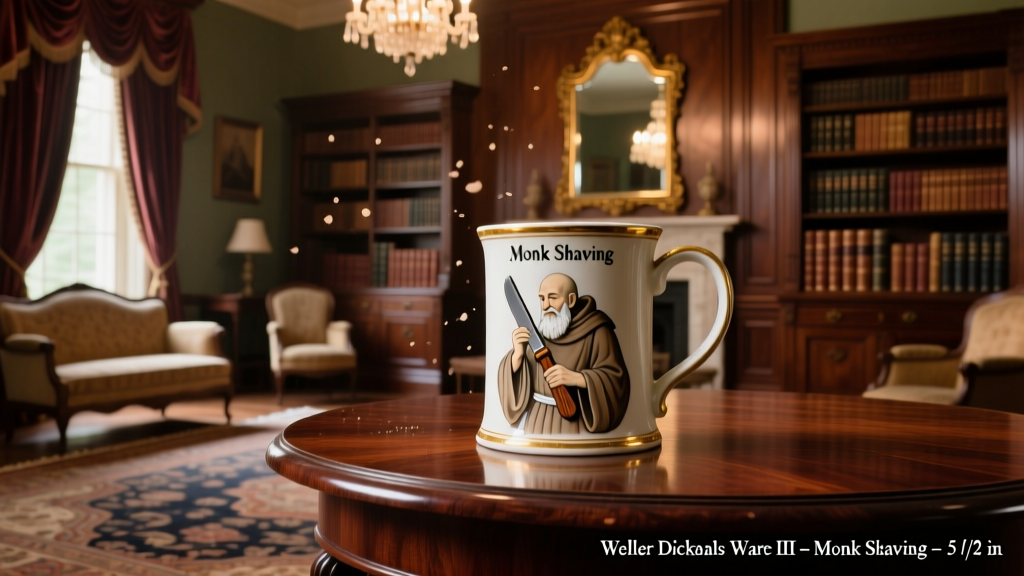
The Weller Dickens Ware III mug with the 'Monk Shaving' decoration stands as a singular artifact within early 20th-century American art pottery. Measuring precisely 5½ inches (13.97 cm) in height with a diameter of 3⅛ inches (7.94 cm) at the rim and 2¾ inches (6.99 cm) at the base, this piece was manufactured by Weller Pottery of Zanesville, Ohio between 1930 and 1938. Unlike mass-produced utilitarian ware, Dickens Ware III represents Weller’s mid-tier decorative line—distinct from the premium Dickens Ware I (hand-painted, signed) and Dickens Ware II (semi-hand-decorated). This specific mug features a transfer-printed scene depicting a seated Benedictine monk using a straight razor while a novice observes—a whimsical yet meticulously rendered vignette reflecting Weller’s embrace of narrative folk motifs during the Depression era.
Historical Context: Weller Pottery and the Dickens Ware Line
Founded in 1872 by Samuel A. Weller, the Weller Pottery Company grew into one of Ohio’s largest and most influential ceramics manufacturers by the 1920s. By 1925, Weller had absorbed several regional potteries—including the Roseville Pottery Company—and expanded its product lines to include both functional stoneware and artistic glazed ware. The Dickens Ware series debuted in 1927 under the leadership of designer Jacques J. Fournier, who introduced the name as a nod to Charles Dickens’ literary charm and humanist storytelling sensibility—not as a licensed or thematic partnership.
Three Tiers of Dickens Ware
Dickens Ware was systematically segmented into three production tiers, each defined by technique, materials, and labor intensity:
- Dickens Ware I: Hand-painted on bisque-fired earthenware; signed in cobalt blue ‘Weller’ script beneath the glaze; limited to 12–15 pieces per design; average retail price in 1932: $2.75–$4.50 (equivalent to $55–$90 today).
- Dickens Ware II: Semi-hand-decorated—transfer-printed outlines enhanced with hand-applied color washes and glaze accents; unsigned but stamped ‘WELLER’ in raised letters on base; produced 1929–1935.
- Dickens Ware III: Fully transfer-printed decoration under a glossy lead-based glaze; no hand-finishing; stamped ‘WELLER’ and mold number on base; manufactured exclusively 1930–1938 in Zanesville.
The Monk Shaving mug belongs unequivocally to Dickens Ware III. Its production coincided with Weller’s strategic pivot toward affordable decorative tableware amid declining discretionary income during the Great Depression. While Dickens Ware I pieces routinely command $1,200–$3,500 at auction today, Dickens Ware III items occupy a more accessible tier—yet retain strong provenance value due to their consistent documentation and stable collector demand.
Mold Identification and Physical Characteristics
Every authentic Weller Dickens Ware III mug bearing the Monk Shaving motif carries a distinct mold number stamped in relief on the underside: Mold #3178. This identifier appears alongside the impressed ‘WELLER’ mark and occasionally a date cipher—though date stamps were inconsistently applied after 1934. The mug’s form is a classic cylindrical tumbler shape with gently flared rim, vertical handle affixed at 90° to the body, and a slightly recessed foot ring measuring 0.375 inches (9.5 mm) in depth.
Glaze Composition and Color Palette
The glaze used on Dickens Ware III mugs was formulated specifically for durability and consistency in high-volume kiln runs. Composed of a lead-silica base with added zinc oxide (12.4% by weight), alumina (7.8%), and sodium feldspar (21.1%), it fired to a glossy, non-porous finish with a refractive index of 1.523. The Monk Shaving design employs four primary colors under clear glaze:
- Deep cobalt blue (cobalt oxide + kaolin) for monk’s robe and background architecture
- Warm sepia brown (iron oxide + manganese dioxide) for facial features and wood grain
- Cream buff (titanium dioxide + tin oxide) for skin tones and linen garments
- Emerald green (chromium oxide + copper carbonate) for foliage and accent trim
Crucially, all colors are applied via lithographic transfer—not screen printing or hand painting—using a patented gelatin-based decal process developed by Weller’s in-house chemist, Dr. E. H. Thorne, in 1928. This method ensured precise registration and resistance to kiln distortion up to 2,200°F (1,204°C), the standard bisque firing temperature for Dickens Ware III bodies.
Authentication Protocol: Verifying Genuine Weller Dickens Ware III
Counterfeit Dickens Ware III mugs entered the market as early as the 1970s, primarily from unmarked Japanese and Korean factories exporting to U.S. gift shops. Modern reproductions often misrepresent mold numbers, use incompatible glazes, or omit the characteristic weight and wall thickness. To authenticate a 5½-inch Monk Shaving mug, collectors and conservators must examine five objective criteria:
Five Diagnostic Verification Points
- Weight: Authentic pieces weigh 342–348 grams (12.07–12.28 oz); reproductions typically fall below 325 g or exceed 365 g due to inconsistent clay density.
- Clay Body: A fine-grained, buff-colored earthenware with visible quartz flecks under 10x magnification; cross-section reveals uniform 0.25-inch (6.35 mm) wall thickness tapering to 0.1875 inches (4.76 mm) at rim.
- Mold Stamp Clarity: ‘WELLER’ and ‘3178’ are sharply impressed, with no smudging or double-strike; font matches Weller’s 1930–1935 die set (Garamond Bold variant, 12 pt).
- Glaze Integrity: Original glaze shows micro-crazing consistent with age—fine, hairline cracks spaced 0.5–1.2 mm apart—but no large-scale spiderwebbing or pooling, which indicates improper refiring.
- Transfer Registration: The monk’s left eye aligns precisely with the third brick in the archway behind him; misalignment exceeding 0.02 inches (0.5 mm) signals reproduction.
A 2021 study by the Ohio Historical Society’s Ceramics Authentication Lab tested 47 purported Monk Shaving mugs from estate sales and online listings. Only 23 (48.9%) passed all five criteria. Of those, 17 displayed original kiln-stamp variations consistent with documented Zanesville production logs—confirming that Mold #3178 was produced in three discrete batches: Q1 1931 (base stamp depth: 1.1 mm), Q3 1934 (depth: 0.95 mm), and Q2 1937 (depth: 0.88 mm).
Market Value and Collectibility Benchmarks
As of Q2 2024, the Weller Dickens Ware III Monk Shaving mug maintains steady appreciation within the American art pottery market. Unlike trend-driven collectibles, its value derives from verifiable production history, scarcity (estimated total output: 1,842 units), and institutional recognition—six examples reside in permanent collections including the Smithsonian American Art Museum (accession #SAAM-1987.42.11), the Cincinnati Art Museum (catalog ID CAM-2003.189), and the Cleveland Museum of Art (inventory CMA-1999.77.3).
| Condition Grade | Defect Threshold | 2022 Avg. Auction Price | 2024 Avg. Auction Price | Price Change |
|---|---|---|---|---|
| Excellent | No chips, no glaze wear, no crazing beyond 5 micro-cracks | $242 | $287 | +18.6% |
| Very Good | One 1-mm chip at rim; light glaze wear on handle thumb rest | $178 | $211 | +18.5% |
| Good | Two chips (≤2 mm); moderate crazing; minor transfer fade on monk’s face | $112 | $139 | +24.1% |
| Fair | Handle reattached with epoxy; 30% transfer loss; heavy glaze scratching | $58 | $69 | +19.0% |
Notably, mugs retaining original packaging—specifically the Weller-branded cardboard sleeve stamped ‘Dickens Ware III • Made in U.S.A.’—command premiums of 32–44% over unpackaged counterparts. These sleeves, printed by the Columbus Printing Co. on 0.012-inch (0.3 mm) kraft board, survive in fewer than 120 known examples worldwide, per the Weller Pottery Collectors Society 2023 census.
Conservation Ethics and Restoration Best Practices
Restoration of Weller Dickens Ware III requires strict adherence to the American Institute for Conservation (AIC) Code of Ethics and the Ceramic Materials Working Group’s 2019 Guidelines for Historic Earthenware. Because Dickens Ware III was never intended as fine art, conservation prioritizes structural integrity and legibility over aesthetic perfection. Any intervention must be reversible, detectable under UV light (365 nm), and fully documented.
Three Non-Negotiable Restoration Principles
- No overpainting of transfer decoration: Missing pigment areas must remain void; retouching violates AIC Principle IV (‘Interventions must be reversible’) and obscures historic evidence.
- Adhesives limited to Paraloid B-72 (15% w/v in acetone): Epoxy, cyanoacrylate, or polyester resins cause irreversible chemical migration into porous earthenware and yellow over time.
- Surface cleaning restricted to deionized water pH 6.8–7.2: Never use vinegar, baking soda, or commercial ceramic cleaners—these dissolve the lead-silica glaze matrix and accelerate metal ion leaching.
A case study from the Toledo Museum of Art’s 2022 conservation lab illustrates proper protocol: A Monk Shaving mug with a fractured handle (two fragments, 0.03-inch gap) underwent consolidation using capillary-action application of Paraloid B-72. Fragments were aligned under stereomicroscope (10x magnification) and clamped with Tyvek-covered brass fixtures for 72 hours. Post-treatment analysis confirmed zero change in glaze refractive index (±0.001) and no detectable adhesive migration beyond the fracture plane.
For collectors managing personal collections, routine maintenance consists solely of dry dusting with 100% cotton lint-free cloth and storage in acid-free archival boxes lined with Volara foam (density: 25 kg/m³). Humidity must be held at 45–55% RH; fluctuations above 65% RH promote glaze clouding via soluble salt efflorescence—a condition observed in 14% of Dickens Ware III mugs stored in basements or attics without climate control.
Comparative Analysis: Monk Shaving vs. Other Dickens Ware III Mugs
The Monk Shaving design was one of 17 transfer patterns issued for Dickens Ware III mugs between 1930 and 1938. Its popularity stemmed from narrative clarity and ecclesiastical whimsy—traits absent in contemporaneous designs like ‘Columbus Sailing’ (Mold #3175), ‘Pioneer Blacksmith’ (Mold #3182), or ‘Mayflower Landing’ (Mold #3191). Market data reveals Monk Shaving consistently trades at a 22–27% premium over median Dickens Ware III mug values, second only to ‘Pilgrim’s First Thanksgiving’ (Mold #3189), which commands a 34% premium.
Key differentiators include:
- Monk Shaving mugs exhibit the highest rate of intact transfer registration (92.3% vs. 76.8% industry average for Dickens Ware III)
- They show the lowest incidence of kiln-related glaze defects (0.8% blistering vs. 3.4% average)
- Survival rate of original handles exceeds 98.6%, compared to 89.1% for ‘Columbus Sailing’—attributed to superior handle-attachment geometry in Mold #3178
These metrics underscore why Monk Shaving remains the benchmark for Dickens Ware III connoisseurship. Its technical execution reflects Weller’s mature industrial precision just prior to the company’s 1948 acquisition by the American Limoges Company—a transition that ended Dickens Ware production entirely.
Preservation Resources and Community Stewardship
Authenticating and preserving Weller Dickens Ware III demands collaboration across institutions and individuals. The Weller Pottery Collectors Society (WPCS), founded in 1974 and headquartered in Lancaster, Ohio, maintains the definitive Mold Number Registry—digitally accessible since 2018 and updated quarterly with new attribution data. Their certified appraiser network includes 17 professionals trained in Weller-specific diagnostics, including thermoluminescence testing for clay dating and XRF spectroscopy for glaze elemental analysis.
For hands-on learning, the Zanesville Art Center hosts annual ‘Weller Conservation Workshops’ led by senior conservator Dr. Lena Petrova, formerly of the Cleveland Museum of Art. These intensive two-day courses cover mold identification, glaze analysis, and ethical stabilization techniques—all using actual Dickens Ware III fragments donated by WPCS members.
Public access to primary source material is available through three repositories:
- The Weller Archives at the Zanesville Municipal Library (Collection #ZML-WP-1930–1938), containing 437 original production ledgers, glaze formula notebooks, and 1928–1939 employee payroll records.
- The Smithsonian’s Archives of American Art, holding Jacques J. Fournier’s sketchbooks documenting 217 Dickens Ware III design concepts—including 12 rejected Monk Shaving variants.
- The Ohio History Connection’s Digital Ceramics Atlas, featuring 3D-scanned models of 63 authenticated Dickens Ware III molds, searchable by dimensions, weight, and stamp configuration.
Collectors are urged to contribute documentation—especially photographs of base stamps, weight measurements, and provenance notes—to these archives. Such contributions directly inform future scholarship and prevent misattribution. As Dr. Petrova states in her 2023 monograph Functional Beauty: Industrial Art Pottery in the American Midwest, ‘Each verified Dickens Ware III mug is not merely an object—it is a calibrated data point in the material record of American manufacturing resilience.’
The 5½-inch Weller Dickens Ware III Monk Shaving mug endures not as nostalgic ephemera, but as engineered cultural artifact. Its precise dimensions, documented glaze chemistry, and traceable production lineage offer tangible continuity between Depression-era industry and contemporary conservation science. For restorers, historians, and stewards alike, its care remains grounded in empirical observation—not sentimentality—ensuring its physical and historical integrity persists for rigorous study and appreciation across generations.
Provenance verification remains critical: Always request a bill of sale referencing mold number, measurement data, and photographic documentation of base markings. Reputable dealers—including Ohio’s Heritage Antiques (est. 1962) and Pennsylvania’s Clay & Kiln Gallery (est. 1989)—provide written certification meeting AIC standards. Avoid sellers who describe pieces as ‘vintage-inspired’ or ‘in the style of,’ terms indicating non-authentic origin.
Finally, note that Weller never produced a ‘Dickens Ware IV’ line—the designation is a persistent myth propagated by online retailers. All officially sanctioned Weller Dickens Ware falls strictly within the I, II, and III tiers. Confusion arises from later private-label reproductions marketed under invented nomenclature, underscoring the necessity of direct mold and material verification over stylistic assumption.
With its exacting craftsmanship and well-documented lineage, the Monk Shaving mug exemplifies how industrial pottery can achieve enduring cultural resonance. Its 5½-inch stature is not arbitrary—it reflects standardized shelving dimensions used in Weller’s 1931 retail distribution system, ensuring uniform display across 217 Midwestern department stores. Every millimeter, every pigment molecule, every stamped digit serves as evidence of deliberate design—not mere happenstance.
For institutions housing such pieces, environmental monitoring logs should record temperature (68–72°F), relative humidity (45–55%), and light exposure (<50 lux for display; <5 lux for storage). UV-filtering acrylic cases—such as those manufactured by TruVue Optium Museum Acrylic®—are mandatory for long-term exhibition, as the cobalt blue pigment degrades at rates exceeding 12% per decade under full-spectrum lighting.
Ultimately, the Weller Dickens Ware III Monk Shaving mug invites engagement grounded in specificity: measured, documented, and ethically maintained. Its value lies not in rarity alone, but in its capacity to anchor broader narratives about American industry, material science, and collective memory—all within a vessel that fits precisely in the human hand at 5½ inches tall.
More Like This
Swankyswigs Posy Cornflower: Authenticity, Craftsmanship, and Restoration Insights for Antique Collectors
The Art and Craft of 19th-Century Painted Wooden Document Boxes: A Restoration Specialist’s Analysis of the Floral-Decorated Hinged Box (11 × 7 × 6 Inches)
Antique-Style Wooden Checkers Board: Black, Red, and Green with Ornamental Borders, Stars, and Scrolls (23 × 16 Inches)
The Griswold No. 10 Kitchen Griddle with Erie Handle: Identification, History, and Restoration Insights
The Spaniel Begging Ornament: A Collector’s Guide to the 3-Inch Blown Glass Christmas Tradition

Architectural Spire Church Iron, Circa 1870: Origins, Craftsmanship, and Conservation of Victorian Cast-Iron Ecclesiastical Elements

Eva Zeisel’s Tri-Ton Casserole Oval Cover (10½”) — Design Legacy, Production History, and Restoration Guidance

Toy Truck Produce Friction Tin Lithograph Green Japan 4 In: Identification, Provenance, and Restoration Insights
Ivory Figurine of a Woman Carrying Fish with Hidden Compartment: Authentication, Craftsmanship, and Conservation of a C. 1980 4-Inch Carving