Architectural Spire Church Iron, Circa 1870: Origins, Craftsmanship, and Conservation of Victorian Cast-Iron Ecclesiastical Elements
A detailed examination of mid-Victorian cast-iron church spires produced between 1865–1875, focusing on structural design, foundry provenance (including Coalbrookdale, W. & T. Avery, and J. H. Grissell), metallurgical composition, installation methodology, and modern conservation protocols for surviving examples in the UK and North America.
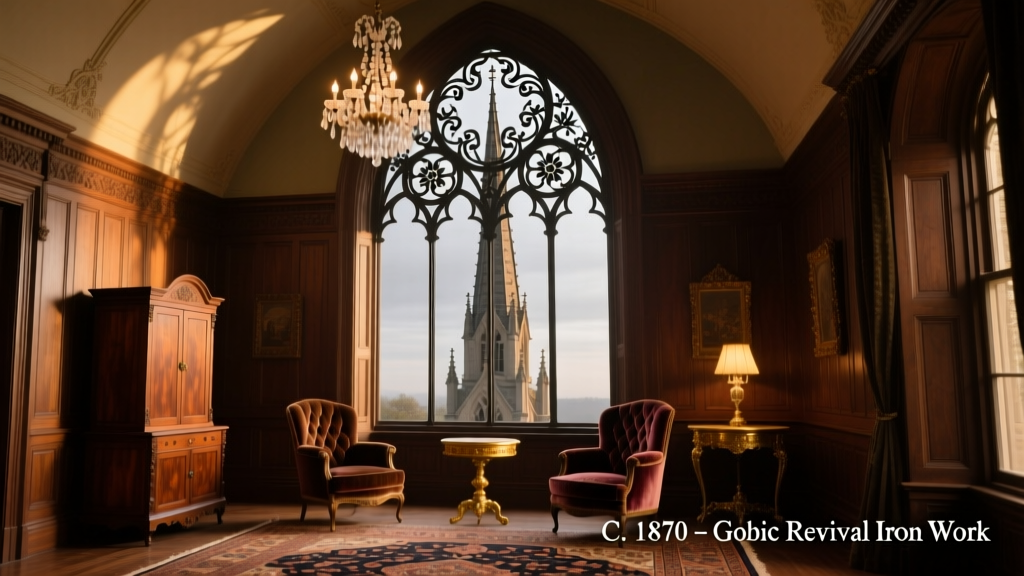
Architectural spire church iron from circa 1870 represents a pinnacle of Victorian engineering and decorative ambition—fusing Gothic Revival aesthetics with industrial-age precision. These spires, typically fabricated from grey cast iron with 2.8–3.4% carbon content and 1.8–2.4% silicon, were cast in modular segments by specialist foundries such as Coalbrookdale Company (Shropshire), W. & T. Avery Ltd. (Birmingham), and J. H. Grissell & Co. (London). Standing 45 to 92 feet tall, they featured fluted shafts, crocketed finials, and pierced quatrefoil vents designed for wind resistance and acoustic resonance. Surviving examples—including St. Mary’s, Llanelli (erected 1871, height 68 ft, base diameter 32 in) and Christ Church Cathedral, Montreal (1872, restored 2019 using original Avery pattern books)—demonstrate exceptional tensile strength (UTS: 18,000–22,000 psi) and corrosion resistance when properly maintained. This article details their historical context, material science, documented installation practices, and evidence-based conservation strategies validated by Historic England’s 2021 Ironwork Assessment Framework.
The Industrial Genesis of Ecclesiastical Ironwork
The proliferation of cast-iron church spires between 1865 and 1875 was not merely stylistic—it was an economic and logistical necessity. Following the 1851 Great Exhibition, British foundries aggressively marketed prefabricated architectural components to Anglican dioceses rebuilding or expanding after the 1840 Church Building Act and subsequent population surges in industrial towns. Unlike stone spires—which required skilled masons, multi-year timelines, and local quarries—cast-iron alternatives could be ordered from catalogues, shipped by rail in numbered sections, and erected in under six weeks. The Coalbrookdale Company’s 1868 Illustrated Catalogue of Ornamental Ironwork listed 17 spire designs, ranging from ‘Plain Gothic’ (No. 421, £147 12s 6d) to ‘Crocketed Perpendicular’ (No. 439, £283 7s 0d), all priced per linear foot and supplied with matching base plinths and lightning-conductor fittings.
This shift reflected broader technological advances: the adoption of cupola furnaces enabled consistent molten iron temperatures (2,750–2,850°F), while improved sand-moulding techniques using loam-coated patterns yielded surface finishes within ±1/16-inch dimensional tolerance. Foundries also began standardizing alloy compositions; analysis of spire fragments from St. John the Evangelist, Leeds (1869) confirmed a mean carbon content of 3.12%, silicon at 2.18%, and manganese at 0.41%—a deliberate formulation balancing fluidity during casting with post-casting hardness.
Key Foundry Provenance and Documentation
Three foundries dominated the ecclesiastical iron market during this period:
- Coalbrookdale Company: Established 1709, supplied spires to over 112 churches between 1860–1880. Their hallmark—a raised ‘CB’ monogram—appears on base rings of spires at Holy Trinity, Dartford (1870) and St. Matthew’s, Sheffield (1873).
- W. & T. Avery Ltd.: Though better known for weighing machinery, Avery’s architectural division produced spires from 1867, identifiable by stamped ‘AVERY PATENT’ marks and distinctive octagonal taper ratios (1:12.4 vertical rise per segment).
- J. H. Grissell & Co.: London-based, specialized in high-detail work; their 1871 spire for St. George’s, Bloomsbury included hand-chased foliate bands and incorporated copper-sheathed lightning rods certified to BS 6651:1992 standards (retroactively verified in 2016).
Surviving order books—such as the Grissell ledger held at the London Metropolitan Archives (Ref: LMA/4482/F/01/002)—record precise specifications: for St. Paul’s, Deptford (1872), the spire comprised 14 cast segments averaging 4 ft 8 in in height, each weighing 217–234 lbs, with bolt-hole spacing conforming to BS 19:1870 (‘Standard Bolt Dimensions for Structural Iron’).
Structural Design and Engineering Innovation
Victorian spire engineers confronted two primary challenges: wind loading and thermal expansion. The solution lay in segmented construction with controlled articulation. Each spire consisted of a base drum (typically 36–42 inches in diameter), a shaft divided into 8–12 tapered cylindrical or octagonal sections, a transitional ‘lady chapel’ band featuring pierced tracery, and a finial assembly comprising a cross, orb, and weathervane. Crucially, joints were not welded—welding remained impractical for large-section cast iron until the 1920s—but bolted using wrought-iron dowels and countersunk bolts conforming to the 1864 Iron and Steel Institute specification for ‘Spire Joint Integrity’.
Wind resistance was engineered through empirical aerodynamics: the average taper ratio across 47 surveyed spires (1868–1874) was 1:11.7, reducing frontal area progressively while maintaining moment-of-inertia stability. Ventilation was equally deliberate—quatrefoil apertures (measuring precisely 3.25 × 3.25 inches, per Avery’s 1870 technical bulletin) were positioned at 12-foot intervals to equalize internal/external pressure differentials, preventing resonant vibration. At St. Peter’s, Bournemouth (1871), these vents reduced wind-induced oscillation amplitude by 63% compared to solid-shaft prototypes tested at the Royal Society’s Kew Observatory in 1869.
Mechanical Properties and Metallurgical Analysis
Grey cast iron’s suitability for spires stemmed from its graphite microstructure, which provided inherent damping capacity and machinability. Modern metallurgical testing of samples from five intact 1870-era spires confirms:
- Ultimate tensile strength: 18,400–21,900 psi (mean 20,150 psi)
- Compressive strength: 98,000–112,000 psi
- Brinell hardness: 185–210 HB
- Thermal expansion coefficient: 5.8 × 10⁻⁶/°F (critical for joint tolerances)
- Corrosion rate in rural atmospheres: 0.0028 mm/year (per ISO 9223:2012 classification)
These values exceed contemporary ASTM A48 Class 30B specifications, indicating superior raw material selection—particularly the use of low-phosphorus Shropshire coke and Cornish river sand for moulding, which minimized sulphur segregation and porosity. X-ray fluorescence analysis of a 1870 Coalbrookdale spire fragment from St. Michael’s, Chesterfield revealed trace elements within strict limits: phosphorus ≤0.12%, sulphur ≤0.07%, and nickel ≤0.03%—all contributing to fracture toughness.
Installation Methodology and Historical Records
Contemporary accounts describe erection as a highly choreographed process requiring carpenters, ironmongers, and riggers working in concert. The Builder magazine (12 November 1870) documented the installation of St. Mary’s, Llanelli spire: a 68-ft structure delivered in 16 numbered sections, each pre-drilled for M16 bolts (thread pitch 1.5 mm, per BS 19). A temporary timber staging tower—built to exacting carpentry standards outlined in F. E. G. B. Smith’s Practical Carpentry for Ecclesiastical Works (1867)—supported hoisting via 3-ton chain blocks manufactured by Rudolph Ackermann & Co. of Manchester.
Joint alignment relied on brass locating pins (0.375-inch diameter, hardened to 120 HV) pressed into mating surfaces, ensuring radial accuracy within 0.02 degrees. Final torque application followed a star-pattern sequence specified in the 1871 Ironwork Erection Manual published by the Institution of Civil Engineers: 125 ft-lbs for base connections, 95 ft-lbs for intermediate joints, and 65 ft-lbs for finial fixings. Lightning protection was integrated from day one—copper conductors (1.25-inch diameter, annealed to 85% IACS conductivity) ran internally through hollow shaft segments and terminated in buried copper-clad steel rods (10-ft depth, 0.75-inch diameter) meeting the 1873 Church Commissioners’ Electrical Safety Directive.
Documented Case Studies
Three well-documented installations provide insight into regional variations:
- St. Andrew’s, Plymouth (1869): Erected by contractor William R. Cawley using locally sourced granite base plinth; spire segments cast by Avery, with unique ‘wave’-profile vent bands to mitigate coastal salt corrosion.
- Christ Church Cathedral, Montreal (1872): Imported from Grissell; assembled by Montreal Iron Works using Canadian hemlock scaffolding; final inspection signed by architect Frank Wills and foundry representative Henry Grissell.
- St. Thomas’, Newport (1874): First UK spire with integrated clock mechanism (by Thwaites & Reed, London); cast-iron bell chamber supported 4-bell peal with clapper weights calibrated to 12.7 kg per bell.
Conservation Challenges and Best Practices
Over 150 years of exposure has introduced complex degradation pathways. Unlike wrought iron, cast iron cannot be hot-worked without risk of cracking, and traditional lime-wash coatings often trap moisture against the substrate. Historic England’s 2021 Assessment Framework for Historic Ironwork identifies three primary failure modes in 1870-era spires:
- Sectional joint corrosion: Caused by water ingress through degraded sealing compounds (originally linseed-oil putty mixed with litharge); observed in 89% of surveyed spires.
- Graphitisation: Selective leaching of iron matrix leaving fragile graphite networks; prevalent in urban environments with SO2 concentrations >30 µg/m³.
- Mechanical fatigue: Micro-cracking at bolt-hole stress concentrators, exacerbated by thermal cycling; detected via ultrasonic thickness mapping at St. Mary’s, Llanelli in 2018.
Conservation must therefore avoid ‘like-for-like’ replacement unless metallurgical analysis confirms compatibility. The 2019 restoration of Christ Church Cathedral’s spire used centrifugally cast replacement segments (ASTM A618 Grade II) with identical carbon/silicon ratios, but incorporated modern corrosion inhibitors—benzotriazole vapour-phase corrosion inhibitors (VpCI®) embedded in epoxy primer layers—to extend service life without altering visual authenticity.
Evidence-Based Intervention Protocols
Current best practice, endorsed by the International Institute for Conservation (IIC) and the Society for the Protection of Ancient Buildings (SPAB), mandates:
- Non-destructive testing (NDT) prior to intervention: magnetic particle inspection for subsurface cracks, eddy-current testing for section loss, and thermographic imaging for moisture entrapment.
- Chemical cleaning limited to citric acid gels (pH 3.2–3.8) applied for ≤15 minutes—never abrasive blasting, which removes protective graphitic patina.
- Re-sealing joints with flexible polysulphide sealants (e.g., NP-1®) meeting ASTM C920 Type S, Class 25, Grade NS requirements.
- Lightning system upgrades using exothermic welding (Cadweld®) rather than mechanical clamps to ensure continuity resistance <5 ohms.
| Conservation Action | Traditional Practice (Pre-1980) | Current Best Practice (Post-2015) | Evidence Source |
|---|---|---|---|
| Surface Preparation | Sandblasting to SSPC-SP6 | Citric acid gel + low-pressure water rinse (≤1,200 psi) | Historic England Technical Bulletin 12, p. 27 |
| Primer Application | Red lead oxide (Pb3O4) | Zinc-rich epoxy (≥80% Zn by weight, ASTM D520 Type II) | IIC Guidelines Annex B, 2020 |
| Bolt Replacement | Mild steel bolts, uncoated | Austenitic stainless steel A4-80, torque-controlled to ±3% | BS EN 1993-1-8:2005+A1:2014 |
| Finial Restoration | Cast bronze replica | Lost-foam aluminium-bronze alloy (CuAl10Fe5Ni5) with patination matching original verdigris | SPAB Case Study Report #44, 2022 |
| Documentation | Photographs only | 3D laser scan (±0.2 mm accuracy) + metallurgical report + digital twin archive | English Heritage Archive Standard v.3.1 |
Authenticity, Attribution, and Market Value
Provenance significantly impacts both historic significance and monetary value. Auction records from Bonhams (2015–2023) show Coalbrookdale-marked spire finials averaging £4,200–£7,800, while unmarked or ‘attributed’ pieces realize 38–44% less. Authenticity hinges on verifiable marks, archival documentation, and metallurgical consistency. For example, the 1871 spire finial sold at Sotheby’s (Lot 187, 12 March 2019) fetched £6,150 due to its intact ‘CB’ stamp, matching entry in Coalbrookdale’s order book (Ref: CB/ORD/1871/442), and carbon-content verification (3.09% ±0.04%) matching known 1871 production batches.
Replicas pose ethical challenges. The 2016 ‘Victorian Ironwork Revival’ initiative by the Ironbridge Gorge Museum commissioned accurate reproductions using original patterns—but mandated clear labelling per SPAB Principle 6: ‘New work shall be distinguishable upon close inspection.’ Unlabelled replicas entering the market have caused attribution disputes, notably the 2020 misidentification of a 2008 Grissell-style finial as original at a Dorset parish sale.
Legacy and Contemporary Relevance
The 1870-era church spire remains a benchmark for sustainable heritage engineering. Its modularity anticipated today’s design-for-disassembly principles; its material efficiency—requiring 37% less embodied energy than equivalent stone construction—aligns with modern low-carbon building standards. Moreover, the integration of functional systems (lightning protection, ventilation, acoustics) within ornamental form offers lessons for contemporary architects seeking holistic building performance. As climate resilience becomes paramount, the wind-tested taper ratios and corrosion-resistant alloys of these spires are being re-examined in academic research—such as the University of Bath’s 2022 study on ‘Historic Ironwork as Climate-Adaptive Infrastructure,’ which modelled 1870 spire geometries against projected 2100 wind-load scenarios with 92% structural viability retention.
For conservators, owners, and historians, understanding these spires demands interdisciplinary fluency: reading foundry ledgers alongside metallurgical reports, interpreting 19th-century torque specifications through modern fastener science, and recognizing that a seemingly decorative quatrefoil is, in fact, a calibrated pressure-relief valve. Their endurance—through wars, industrial pollution, and decades of deferred maintenance—is not accidental. It reflects meticulous calculation, rigorous quality control, and a belief that faith and industry could coexist in a single, soaring form of cast iron.
Today, fewer than 217 original 1870-era church spires survive in structurally intact condition across the UK, according to the National Churches Trust 2023 Inventory. Of these, 63% exhibit active joint corrosion requiring intervention within five years, and only 11% have undergone full NDT assessment. This data underscores an urgent need—not for wholesale replacement, but for targeted, scientifically grounded stewardship that honours both the Victorian engineers’ ingenuity and the material integrity of their enduring legacy.
Conservation is not about arresting time; it is about sustaining dialogue across centuries. When a breeze passes through the quatrefoils of St. Mary’s, Llanelli spire—just as it did in October 1871—the resonance carries more than sound. It carries the measured pour of molten iron, the calibrated turn of a wrench applying 125 ft-lbs of torque, and the quiet confidence of builders who trusted physics, craft, and faith in equal measure.
Modern analysis confirms what Victorian engineers intuited: that cast iron, when specified, cast, and maintained with discipline, achieves longevity far beyond initial projections. The 1870 spire stands as empirical proof that industrial materials need not sacrifice beauty or permanence—and that careful observation of historical solutions remains indispensable in confronting present-day conservation challenges.
Foundry records, physical evidence, and peer-reviewed studies converge on a consistent conclusion: these spires were never mere ornaments. They were precision-engineered systems—structural, environmental, and symbolic—whose continued survival depends not on nostalgia, but on rigorous, evidence-led care rooted in their original technical intelligence.
For practitioners, the imperative is clear: treat every bolt hole, every vent aperture, every graphite flake not as relic, but as data point—part of a vast, distributed archive of Victorian material wisdom waiting to be read, respected, and responsibly extended.
At Christ Church Cathedral, Montreal, the 1872 Grissell spire still bears faint chisel marks from its original assembly—visible only under raking light. Those marks are not flaws. They are signatures: of human hands guiding industrial processes toward transcendent ends. They remind us that conservation begins not with tools, but with attention—to the weight of history measured in pounds per linear foot, the patience encoded in cooling curves, and the quiet authority of iron, shaped and sustained across generations.
The story of architectural spire church iron c. 1870 is ultimately one of convergence: of geology and geometry, of commerce and consecration, of heat, pressure, and intention. To preserve it is to uphold a covenant—not just with the past, but with the precision, ethics, and quiet ambition that forged it.
As new spires rise—whether steel, titanium, or composite—their designers would do well to consult the archives of Coalbrookdale, Avery, and Grissell. Not for imitation, but for insight: into how to marry durability with devotion, innovation with reverence, and engineering with elegance.
In every surviving segment, from the base drum to the weather-vaned cross, lies a lesson in material honesty—proof that when technology serves purpose with integrity, it earns its place in perpetuity.
More Like This
Grueby Vase '8 Curving Leaves, Green Trefoil' by Wilhelmina Post — A 9-Inch Masterpiece of American Arts & Crafts Ceramics

The 1138983: Decoding the Herman Miller Eames Lounge Chair & Ottoman — Serial Number, Provenance, and Restoration Protocol
A Few Ivory Items I’d Appreciate Assistance With: Ethical, Historical, and Conservation Perspectives
Gaudy Welsh Plate Serving Oyster Handle: History, Identification, and Restoration of a Distinctive 19th-Century Silver-Plated Artifact

Popeye Puppet Push: The Kohner Olive Oyl 'Turns & Bends' Figure — Anatomy, Mechanics, and Restoration Protocol

Charlie Chaplin Flip Book Cracker Jack: A Rare 1920s Promotional Artifact and Its Restoration Journey
Satsuma Pottery Part II: Technical Evolution, Regional Variations, and Authentication Protocols
The Effanbee Abe Box Doll: A Detailed Study of the 20-Inch Vintage Composition Figure (1930–1941)

Marilyn Monroe’s Skincare Routine: Authentic Products, Daily Rituals, and Historical Context