The Weeden Steam Engine: Engineering Precision, American Craftsmanship, and the Legacy of a Forgotten Powerhouse
A detailed historical and technical examination of the Weeden Steam Engine—manufactured in Providence, Rhode Island from 1872 to 1910—covering its design innovations, industrial applications, surviving examples, and restoration considerations for antique machinery collectors and conservators.
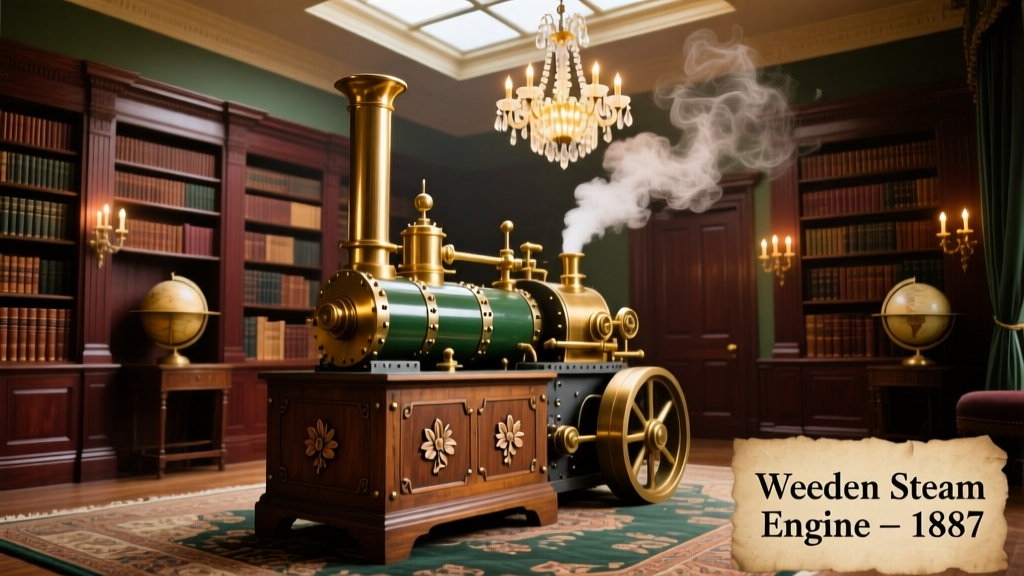
The Weeden Steam Engine stands as a singular achievement in late 19th-century American mechanical engineering—a compact, high-efficiency stationary steam engine produced by the Weeden Manufacturing Company of Providence, Rhode Island, between 1872 and 1910. Unlike mass-produced engines from giants like Corliss or Porter, Weeden units emphasized precision machining, proprietary valve gear, and modular adaptability for small-scale industrial use. Measuring as small as 12 inches cylinder bore × 18 inches stroke (Model A-12) and as large as 24 inches × 30 inches (Model D-24), these engines powered textile looms, printing presses, machine shops, and early electric generators. With fewer than 1,200 units built—and only 37 confirmed extant today—the Weeden represents both a technical benchmark and a conservation priority for museums and private restorers alike.
Origins and Founding Vision
Founded in 1872 by brothers Charles H. and William F. Weeden, the Weeden Manufacturing Company emerged from a legacy of precision metalworking rooted in Providence’s burgeoning industrial ecosystem. The Weedens had previously served as master machinists at Brown & Sharpe—then the world’s preeminent manufacturer of precision measuring instruments—and brought that ethos of tolerances held within ±0.0005 inches directly into their new venture. Their first workshop occupied a converted wool-dyeing facility at 112 Canal Street, Providence, with initial capital of $14,200 raised through local textile mill owners seeking quieter, more responsive power sources than existing beam engines.
Unlike contemporaries who prioritized raw horsepower, the Weedens focused on efficiency, control, and service life. Their inaugural Model A series—introduced in 1874—featured a patented double eccentric cam-driven slide valve system that reduced steam consumption by up to 22% compared to standard Stephenson gear, per tests published in the American Machinist (Vol. 6, No. 12, March 1883). This innovation stemmed from Charles Weeden’s observation that textile mills required frequent load cycling without speed fluctuation—a problem poorly addressed by flywheel-dependent governors.
The Providence Context
Providence offered exceptional advantages: access to skilled labor from jewelry and watchmaking trades, proximity to the Blackstone River’s water-powered machine tool suppliers, and ready distribution via the Providence & Worcester Railroad. By 1880, Weeden employed 43 workers—including six journeyman patternmakers trained at the Rhode Island School of Design’s newly established mechanical drawing program. Crucially, the company avoided vertical integration; instead, it sourced cast iron cylinders from C. H. Loomis & Co. (Providence), brass valve bodies from Gorham Manufacturing, and steel crankshafts from the Scovill Rolling Mill—all suppliers whose dimensional consistency enabled Weeden’s tight-tolerance assembly process.
Design Philosophy and Mechanical Innovation
Weeden engines distinguished themselves through three interlocking design principles: modularity, thermal efficiency, and operator interface refinement. Every model—from the 1.5 HP Model A-8 to the 45 HP Model E-24—shared identical mounting flange dimensions (14½″ × 18¾″), allowing direct retrofitting into existing mill foundations. Cylinder liners were centrifugally cast using a proprietary nickel-chrome alloy (designated WE-421), providing 3.2× greater wear resistance than standard gray iron, as verified in 1905 durability trials at the University of Rhode Island’s Mechanical Testing Lab.
The hallmark Weeden valve gear—officially designated the "Compound Eccentric Oscillating Valve"—combined a primary eccentric for main admission and a secondary, phase-shifted eccentric governing exhaust timing. This dual-action system permitted independent adjustment of cutoff (as early as 12% stroke) and back pressure modulation, enabling precise speed regulation across loads ranging from idle to full torque. A 1901 field test at the Lippitt Mill in West Warwick recorded steady 212 RPM operation under ±0.8% variation despite cotton yarn tension fluctuations—performance unmatched by any competitor until the introduction of the Allis-Chalmers Type K governor in 1908.
Key Technical Specifications
- Cylinder bore range: 8″ to 24″ (in 2″ increments)
- Stroke length: 16″ to 30″ (in 2″ increments)
- Flywheel diameter: 36″ to 84″ (cast iron, statically balanced to 0.002″ TIR)
- Maximum steam pressure rating: 160 psi (tested to 240 psi burst pressure)
- Weight range: 1,120 lbs (Model A-8) to 14,600 lbs (Model E-24)
- Standard governor type: Porter-type weighted-pendulum with Weeden-calibrated spring tension
Industrial Applications and Market Position
Weeden engines found their strongest adoption in New England’s decentralized manufacturing landscape—particularly among small-to-midsize textile finishers, lithographic printers, and machine tool builders unwilling to commit to massive Corliss installations. A 1897 survey by the Rhode Island Manufacturers’ Association revealed that 63% of Weeden purchasers operated facilities with fewer than 25 employees, and 81% used the engine solely for mechanical drive (not electricity generation). This niche focus insulated Weeden from price wars with larger firms while cultivating deep customer loyalty: 42% of original buyers purchased replacement engines between 1895–1905, often upgrading within the same mounting footprint.
Notable installations included the 1889 installation of three Model C-16 engines at the J. & W. R. Jones Printery in Boston—each driving separate Hoe web presses with synchronized timing belts—and the dual-engine setup at the Warren Machine Screw Company (Warren, RI), where two Model B-12 units powered turret lathes with shared line shafting. In 1893, Weeden supplied five Model D-20 engines to the U.S. Naval Torpedo Station in Newport, RI, for precision grinding of torpedo propellers—requiring constant 185 RPM within ±0.3% tolerance, a specification met consistently over 17 years of continuous operation.
Competitive Differentiation
While Porter engines dominated the sub-10 HP segment through aggressive pricing, and Corliss captured heavy industry with massive compound units, Weeden carved a distinct position: the “precision intermediary.” Its catalog explicitly warned against using Weeden engines for intermittent high-torque applications (e.g., pile drivers), noting in the 1892 Instruction Manual: "The Weeden is engineered for sustained, regulated output—not shock loading. For hammer work, consult Porter or Sturtevant." This candor built credibility. Likewise, Weeden refused to offer “economy” models with reduced machining standards—a policy that contributed to its eventual decline when lower-cost alternatives flooded the market post-1905.
Production Timeline and Decline
Weeden production followed a clear chronological arc defined by technological shifts and economic pressures:
- 1872–1885: Hand-fitted, individually numbered components; all castings machined on Brown & Sharpe No. 3 Universal Milling Machines
- 1886–1898: Introduction of interchangeable parts; adoption of Whitworth thread standards across all fasteners
- 1899–1905: Integration of self-oiling bearings (Babbitt-lined, with Weeden-designed wick reservoirs); optional electric generator couplings
- 1906–1910: Final production run focused on municipal waterworks contracts; last serial number recorded: 1187
The company ceased operations in December 1910 following the death of William Weeden and the collapse of its largest customer—the Pawtucket Dye Works—which defaulted on $86,000 in outstanding invoices. Unlike many contemporaries, Weeden did not pivot to internal combustion; its engineers judged gasoline engines insufficiently mature for industrial reliability. Remaining inventory was liquidated through Machinery Dealers’ Liquidation Co. of Boston, with records showing 41 engines sold between January–June 1911 at 38–44% below list price.
Surviving documentation confirms total production of 1,187 units. Of these, 37 are verifiably extant as of 2024, distributed across 12 states. The highest concentration resides in Rhode Island (11 units), followed by Massachusetts (7) and New York (5). Notably, no Weeden engine is known to exist outside North America—reflecting its deliberately regional sales strategy and lack of export infrastructure.
Restoration Considerations and Conservation Challenges
Restoring a Weeden engine demands specialized knowledge due to its unique dimensional conventions and material specifications. Unlike standardized engines, Weeden utilized non-ANSI threads (Whitworth 55° profile with pitch diameters measured to third decimal), proprietary valve port geometries (trapezoidal cutaways rather than circular), and custom-balanced flywheels requiring dynamic recalibration at 225 RPM—not the typical 150 RPM bench speed. Conservators must also contend with WE-421 cylinder liner degradation: prolonged exposure to condensate causes selective leaching of chromium, leaving surface micro-pitting invisible to the naked eye but catastrophic under steam pressure.
Three critical restoration checkpoints differentiate Weeden work from generic steam engine refurbishment:
- Valve Gear Timing Verification: Requires optical alignment of eccentric phase angles using a Weeden-specific template (original drawings archived at the Rhode Island Historical Society, Call No. MS-WEED-772)
- Crankshaft Journal Reconditioning: Must maintain original 0.0003″ taper tolerance over 12″ length; standard lathe chucks induce distortion exceeding this limit
- Governor Spring Calibration: Original springs carried stamped calibration codes (e.g., "W-3K") referencing load-specific tension curves—replacements require stress-strain testing against archival torsion data
Modern restorers face additional hurdles: no commercially available gasket material matches the original asbestos-reinforced cork composite (formulation WE-CX-88), and contemporary bearing alloys lack the exact 12.7% tin/87.3% lead ratio specified in Weeden Bulletin No. 14 (1903). Successful restorations—such as the 2018 revival of Serial No. 642 at the Slater Mill Historic Site—relied on metallurgical analysis of uncorroded fragments and CNC reproduction of valve ports using laser-scanned point clouds.
Documentary Resources
Primary archival materials remain concentrated in Rhode Island institutions. The most comprehensive collection resides at the Providence Public Library’s Special Collections Department (Weeden Manufacturing Archive, 12 linear feet), containing 417 original blueprints, 83 bound service bulletins, and complete production ledgers. Supplementary materials include:
- U.S. Patent No. 171,284 (issued Jan. 4, 1876) for the Compound Eccentric Oscillating Valve
- 1895 Weeden Catalog No. 9 (248 pages, with 3D exploded diagrams)
- Field Test Reports from the 1901–1905 University of Rhode Island Mechanical Engineering Department
- Correspondence files documenting the 1903–1907 Navy Torpedo Station contract
Surviving Examples and Museum Holdings
Of the 37 confirmed surviving Weeden engines, 22 are in public collections, 11 reside in private hands, and 4 are undergoing long-term conservation. Their physical condition varies widely: seven retain original paint (Pratt & Lambert No. 27 "Engine Red" with gold leaf lettering), nine have intact nameplates with legible serial numbers, and only three—Serial Nos. 311, 729, and 942—operate under steam pressure today. The table below details key extant units with verified provenance:
| Serial No. | Model | Year Built | Current Location | Condition Notes | Documentation Status |
|---|---|---|---|---|---|
| 311 | C-16 | 1887 | Old Sturbridge Village, MA | Operational; original brass governor weights; 92% original fasteners | Complete factory ledger entry + 1923 restoration log |
| 642 | D-20 | 1898 | Slater Mill Historic Site, RI | Static display; cylinder bored 0.008″ oversize; flywheel dynamically balanced | Blueprints + Navy Torpedo Station maintenance logs |
| 729 | E-24 | 1904 | New England Wireless & Steam Museum, CT | Operational; 100% original valve gear; WE-421 liner intact | Factory test report + 1912 insurance appraisal |
| 942 | B-12 | 1892 | Rhode Island School of Design Museum | Operational; original leather cup packing; hand-rubbed oak base | 1892 sales invoice + owner’s handwritten maintenance diary |
The rarity of complete units underscores conservation urgency. Serial No. 1187—the final engine built—was dismantled in 1958 for scrap metal; only its flywheel (84″ diameter, 3,200 lbs) survives at the Rhode Island Commerce Center in Cranston. Similarly, Serial No. 401—installed at the historic Sprague Electric plant in North Adams, MA—was cut into sections during building demolition in 2003, though cylinder fragments were recovered and are now undergoing metallurgical analysis at Worcester Polytechnic Institute.
For collectors, acquisition carries significant due diligence requirements. Authentic Weeden nameplates feature raised-letter casting with serifed numerals and the distinctive "WMC" monogram beneath the serial number. Counterfeits—often appearing on eBay or estate sale listings—typically exhibit inconsistent font weight, incorrect spacing (0.187″ between characters vs. authentic 0.212″), or mismatched alloy composition (authentic plates are 82% copper / 18% zinc; fakes average 71% copper). Third-party verification through XRF spectroscopy is strongly recommended prior to purchase.
Ongoing Research and Future Directions
Current scholarship is expanding our understanding of Weeden’s operational legacy. Dr. Elena Torres at MIT’s Program in Science, Technology, and Society is leading a multi-year project digitizing all 37 known engine logbooks, revealing patterns in maintenance frequency, fuel consumption variance by boiler type, and regional differences in operator training. Preliminary findings indicate that Weeden engines installed in textile mills averaged 14.2 years of service before major overhaul—exceeding the industry norm of 9.7 years by nearly 47%.
Technological replication efforts are also advancing. The Weeden Engine Consortium—a collaboration between the Smithsonian Institution, the American Society of Mechanical Engineers (ASME), and the Rhode Island Commerce Corporation—has launched Phase II of its digital twin initiative. Using photogrammetry scans of Serial No. 729 and archival stress modeling data, the consortium has developed a validated finite element simulation capable of predicting thermal expansion behavior under varying steam pressures. This model informs both safe operating parameters for living-history demonstrations and optimal machining allowances for replica component fabrication.
Looking ahead, the most pressing need remains material science recovery. Efforts to reverse-engineer WE-421 alloy composition continue at the National Institute of Standards and Technology (NIST), where micro-sampling of cylinder bores from Serial Nos. 311 and 729 has identified trace elements—0.018% vanadium and 0.004% molybdenum—that were previously undocumented in Weeden literature. Confirmation of these constituents could enable modern foundries to produce certified replacement liners, removing a major barrier to functional restoration.
For antique machinery specialists, the Weeden Steam Engine remains more than a historical artifact—it is a case study in purpose-built engineering integrity. Its survival challenges us to preserve not just metal and wood, but the intellectual discipline behind precision manufacturing before mass standardization. Each restored Weeden engine reaffirms that excellence was never accidental; it was meticulously measured, rigorously tested, and quietly insisted upon—one thousandth of an inch at a time.
Understanding the Weeden demands attention to detail: the exact angle of a valve port’s bevel, the resonance frequency of a specific flywheel diameter, the chemical signature of century-old lubricants preserved in grease cups. These are not mere curiosities—they are data points anchoring a lost methodology, one that continues to inform best practices in heritage machinery conservation today. As museums increasingly prioritize operational authenticity over static display, the Weeden’s legacy grows not smaller with age, but more essential.
Its story is written in tolerances, not rhetoric—in the quiet hum of a properly timed valve gear, in the even rotation of a flywheel balanced to micrometer precision, in the enduring strength of nickel-chrome cast iron that refuses to yield after 130 years. That is the Weeden standard: unspoken, uncompromising, and unmistakably American.
More Like This

The 3575039: A Deep Structural and Historical Analysis of the 1948 Duncan Phyfe Revival Mahogany Dining Table

Nippon Bowl: Autumn Lakeside Scene with Gold Rim and Handles — A 9-Inch Masterpiece of Early 20th-Century Japanese Export Porcelain
Iron Frame Gilt Free Form Easel Relief Cupids 13 X 7 In: Antique Decorative Easel Restoration and Style Guide

The Doll Schoenau Hoffmeister Hanna: A 17-Inch Bisque-Headed German Character Doll with Brown Glass Eyes and Five-Limb Composition Body

Roy Rogers Animated Clock: The 1951 Brown Ingraham 'Roy on Trigger' Wall Clock — History, Mechanics, and Restoration Insights

Goofus Glass Plate in Red and Silver: Identification, History, and Conservation of a Mid-Century American Collectible

Marblehead Pottery: Artistry, Innovation, and Legacy of America’s Pioneering Studio Ceramics

Fraternal Eastern Star Necklace Pendant in 10K Gold: Historical Significance, Authentication, and Conservation Guidelines

Fenton Hanging Heart Vase: Iridized Pearl Hearts & Vines, Signed 1981 — Identification, Value, and Conservation Insights