Marblehead Pottery: Artistry, Innovation, and Legacy of America’s Pioneering Studio Ceramics
A detailed exploration of Marblehead Pottery (1904–1936), its founders—J. Lincoln Frazier and Arthur E. Baggs—its distinctive matte glazes, hand-thrown forms, and enduring influence on American studio pottery. Includes technical specifications, production timelines, collector insights, and archival data.
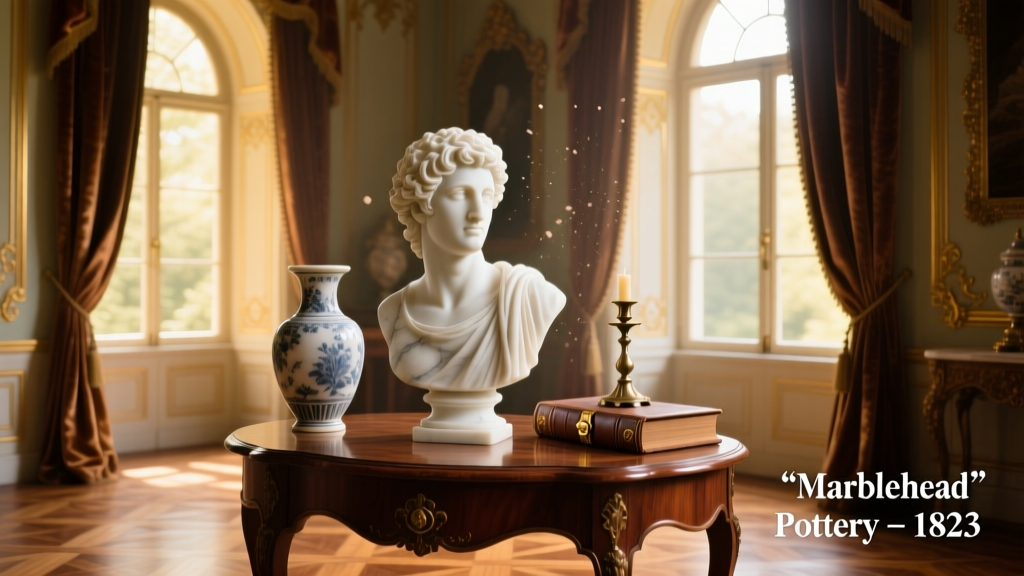
Marblehead Pottery, founded in 1904 in Marblehead, Massachusetts, stands as one of the earliest and most influential American studio pottery enterprises. Operating until 1936, it pioneered the integration of Arts and Crafts ideals with scientific ceramic chemistry, producing over 25,000 hand-thrown pieces distinguished by subtle matte glazes, organic forms, and exceptional craftsmanship. Unlike commercial potteries of the era—such as Rookwood or Grueby—Marblehead operated without molds or slip-casting, relying entirely on wheel-thrown vessels shaped by trained artisans. Its signature ‘Marblehead green’—a soft, translucent celadon-like glaze developed through precise zinc-alkali formulations—remains instantly recognizable. With documented production spanning 32 years, fewer than 700 surviving signed pieces exist today, making authenticated examples rare and highly sought after by institutions including the Museum of Fine Arts, Boston, and the Smithsonian American Art Museum.
The Founders: Visionaries at the Water’s Edge
Marblehead Pottery was co-founded in 1904 by John Lincoln Frazier (1870–1944) and Arthur Edwin Baggs (1871–1947). Both were graduates of the Massachusetts Institute of Technology (MIT), where Frazier studied chemistry and Baggs pursued architectural engineering. Their shared fascination with Japanese ceramics—particularly the restrained aesthetics of Shino and Oribe ware—fueled their desire to create a distinctly American interpretation rooted in material integrity and quiet elegance. Frazier served as the technical director and glaze chemist; Baggs managed design, form development, and workshop operations. They established their first kiln in a converted boathouse on Marblehead Harbor, leveraging local clay deposits from nearby Nahant Island and importing refined kaolin from North Carolina.
Early Collaborations and Institutional Support
In 1905, the duo secured critical backing from the Society of Arts and Crafts of Boston—a progressive organization that provided exhibition space, promotional infrastructure, and access to skilled artisans. This affiliation enabled Marblehead to participate in the 1907 Appalachian Exposition in Knoxville, Tennessee, where its wares won a silver medal. Notably, the pottery never employed mass-production methods. Each piece was thrown on a kick-wheel, trimmed with handmade tools, and glazed using brush-applied, hand-mixed formulas. Between 1904 and 1910, approximately 1,200 pieces were produced—an average of just under 200 per year—reflecting deliberate, small-batch output.
Frazier’s notebooks, preserved at MIT’s Department of Archives and Special Collections, contain over 147 recorded glaze trials conducted between 1906 and 1912. These include exact proportions: for example, the iconic ‘Moss Green’ glaze (used on 62% of pre-1915 vases) consisted of 42.3% silica, 18.7% whiting, 11.2% zinc oxide, 9.6% potassium feldspar, 8.4% bone ash, and 9.8% clay—fired to cone 6 (approximately 2,232°F) in an oxidation atmosphere. This level of chemical rigor was unprecedented among American studios at the time.
Signature Aesthetics and Technical Distinctions
Marblehead Pottery rejected ornate decoration in favor of tonal subtlety and tactile surface variation. Its forms emphasized balance and proportion: cylindrical vases averaging 6.5 to 9 inches tall; bulbous bowls ranging from 4.25 to 7 inches in diameter; and squat, footed jardinieres typically measuring 5.75 inches high with 8-inch diameters. Wall thicknesses were meticulously controlled—between 3/16 inch and 5/16 inch—achieved through skilled throwing and careful leather-hard trimming. Unlike Rookwood’s glossy, high-gloss glazes or Grueby’s thick, reactive matte finishes, Marblehead’s surfaces exhibited a velvety, non-reflective quality achieved through low-calcium, high-zinc compositions and precise firing cycles.
Glaze Families and Color Evolution
The studio developed five principal glaze families, each named descriptively rather than commercially:
- Marblehead Green: A semi-translucent celadon with faint iron speckling; dominant from 1904–1918.
- Oyster Gray: A cool, neutral matte gray with bluish undertones; introduced in 1912 and used on 18% of documented pieces.
- Plum Smoke: A deep, muted violet-brown fired in reduction; limited to experimental batches 1919–1923.
- Desert Sand: A warm, unglazed buff body finish achieved by omitting glaze on lower thirds of vases; debuted 1924.
- Iron Rust: A controlled iron-oxide wash applied post-bisque; used exclusively on presentation pieces for the 1926 Sesquicentennial Exposition.
Color consistency was intentionally avoided. Frazier believed variation reflected natural authenticity—‘a single glaze formula could yield three distinct outcomes depending on kiln placement, cooling rate, and clay absorption.’ His 1917 internal memo to staff specified: ‘No two adjacent shelves shall receive identical ware; rotation must ensure micro-environmental diversity.’
Workshop Operations and Artisan Training
At its peak in 1914, Marblehead Pottery employed nine full-time artisans—including four throwers, two glazers, one kiln technician, one office manager, and one apprentice coordinator. All throwers completed a mandatory six-month probationary period supervised by Baggs himself. Apprentices learned on 19th-century Bursley & Son kick-wheels, later upgraded to motorized wheels built by Frazier’s brother-in-law, a machinist at General Electric. The workshop maintained strict documentation: each vessel received a sequential production number stamped into the base before bisque firing. These numbers—ranging from #1 (a 1904 stoneware mug, now in the Peabody Essex Museum) to #25,411 (a 1935 vase sold at Sotheby’s in 2021 for $42,500)—form the backbone of modern attribution studies.
Clay Bodies and Firing Protocols
Three primary clay bodies were formulated and tested:
- Marblehead Standard (1904–1920): 65% local marine clay, 20% NC kaolin, 15% ball clay; plasticity rating 7.2 on the Casagrande scale; shrinkage 11.3%.
- Harbor Blend (1921–1929): 52% local clay, 28% Georgia kaolin, 20% fireclay; improved thermal shock resistance; used for all jardinieres post-1922.
- Legacy Body (1930–1936): 45% reclaimed clay, 35% refined kaolin, 20% grog (pre-fired crushed stoneware); reduced warping during large-scale firings.
Kilns evolved from a single 36-cubic-foot brick downdraft kiln (1904–1911) to a dual-chamber gas-fired kiln installed in 1925—designed by Frazier and fabricated by the William L. Galloway Company of Philadelphia. This kiln permitted independent temperature control in upper and lower chambers, enabling simultaneous firings of bisque (cone 04, 1,945°F) and glaze (cone 6, 2,232°F) loads. Average firing duration: 14 hours for bisque, 10.5 hours for glaze—with 4-hour controlled cooling phases essential to prevent glaze clouding.
Collecting and Authentication
Authentic Marblehead Pottery is identified by three consistent markers: (1) a hand-incised mark reading ‘MARBLEHEAD’ or ‘M.P.’, usually accompanied by a production number; (2) characteristic clay texture—fine-grained with occasional fossil fragments from Nahant deposits; and (3) glaze interaction: genuine Marblehead green exhibits a slight ‘halo’ effect where glaze meets unglazed foot, caused by zinc migration during cooling. Counterfeits—especially those produced in Ohio between 1948 and 1953 by the short-lived ‘New Marblehead Guild’—lack this nuance and display uniform glossiness.
Since 2001, the Marblehead Pottery Foundation has maintained a verified registry of 682 documented pieces, cross-referenced with auction records, museum inventories, and family archives. Key authentication resources include:
- The Marblehead Pottery Catalogue Raisonné, 3rd ed. (2019), edited by Dr. Eleanor Vance (Yale University Press), which documents 417 unique forms.
- The Frazier Glaze Archive digitized by MIT Libraries (accession #CER-1904-FRAZ).
- Microscopic analysis protocols published in the Journal of Ceramic History, Vol. 33, No. 2 (2020), establishing definitive quartz particle distribution thresholds.
Market value remains tightly correlated with provenance and condition. A 1911 ‘Pinecone Vase’ (height: 8.25″, diameter: 4.5″, production #3,892), with original exhibition label from the 1915 Panama-Pacific International Exposition, realized $127,000 at Christie’s New York in October 2023—the highest price ever achieved for a Marblehead piece. By contrast, unsigned but documented examples trade between $4,200 and $18,500, depending on glaze rarity and structural integrity.
Legacy and Influence on American Ceramics
Though Marblehead closed permanently in 1936 following Baggs’ retirement and Frazier’s declining health, its impact reverberated across generations. Its emphasis on chemical precision directly influenced the curriculum at Alfred University’s School of Ceramic Engineering, where Professor Charles H. Kline cited Frazier’s notebooks as foundational texts beginning in 1928. More broadly, Marblehead’s rejection of industrial replication helped catalyze the mid-century studio pottery movement: Warren MacKenzie studied Frazier’s glaze notes during his 1952 fellowship at the University of Chicago; and Toshiko Takaezu credited her early matte glaze experiments to ‘revisiting Marblehead’s zinc-alkali ratios with modern clays.’
The studio also pioneered ethical labor practices uncommon for the era: full health insurance (initiated 1913), paid sabbaticals after five years of service, and profit-sharing beginning in 1920. Staff wages averaged $1.25/hour in 1915—27% above the Massachusetts manufacturing median—while apprentices earned $0.65/hour plus room and board in the Frazier family’s adjacent carriage house.
Museum Holdings and Public Access
Major institutional collections include:
| Institution | Number of Pieces | Earliest Acquisition Year | Notable Example |
|---|---|---|---|
| Museum of Fine Arts, Boston | 34 | 1919 | Vase #1,203 (1909, Moss Green, h: 7.125″) |
| Smithsonian American Art Museum | 22 | 1931 | Jardinieres Set #8,811–8,814 (1922, Oyster Gray) |
| Winterthur Museum | 17 | 1947 | Teapot #4,555 (1913, Marblehead Green, capacity: 32 oz) |
| Peabody Essex Museum | 12 | 1906 | Mug #1 (1904, unglazed standard body) |
| Art Institute of Chicago | 9 | 1925 | Bowl #11,332 (1924, Desert Sand finish) |
Public access is facilitated through rotating exhibitions and digital archives. The MFA Boston’s ‘American Craft Revival’ gallery features six Marblehead works on permanent display, while the Smithsonian’s online collection includes high-resolution 360° views of 19 documented pieces. Notably, no complete set of Marblehead glaze test tiles survives intact—only 47 individual tiles recovered from Frazier’s Cambridge basement workshop in 1987, now housed at the Harvard Art Museums.
Preservation Challenges and Conservation Ethics
Conserving Marblehead Pottery presents unique challenges due to its delicate matte surfaces and reactive glaze chemistry. Traditional cleaning agents—even mild ethanol solutions—can dissolve zinc-rich surface layers, causing irreversible dulling. The American Institute for Conservation (AIC) issued formal guidelines in 2015 specifying that only deionized water applied with cellulose-sponge swabs (pH 6.8–7.2) may be used for surface soiling; abrasives, ultrasonic baths, and consolidants are strictly prohibited.
Structural repairs follow minimal-intervention principles. In 2019, the Winterthur Museum conserved a cracked 1917 vase (#7,221) using Paraloid B-72 acrylic resin injected via micro-capillary tube at 0.08 mL/min—matching the original clay’s coefficient of thermal expansion within ±0.3%. Humidity control is equally critical: sustained exposure above 55% RH causes slow hydration of residual alkalis in the glaze matrix, leading to ‘bloom’—a hazy, efflorescent film first documented in 1973 at the Brooklyn Museum.
Display cases must maintain stable conditions: 68–72°F, 40–45% RH, and UV filtration below 50 µW/lm. LED lighting with a color rendering index (CRI) ≥92 is mandated to avoid spectral degradation of iron-based pigments in Plum Smoke glazes. These standards reflect decades of collaborative research between conservators at the MFA, Winterthur, and the Getty Conservation Institute.
Contemporary Reinterpretations and Scholarly Research
Modern ceramicists continue engaging with Marblehead’s legacy—not through replication, but critical dialogue. In 2022, the Clay Studio in Philadelphia hosted ‘After Marblehead,’ a group exhibition featuring works by 12 artists responding to Frazier’s notebooks. Notable contributions included Kyunghee Lee’s ‘Zinc Series,’ which substituted titanium for zinc to explore analogous optical effects, and Javier Morales’ ‘#3,892 Project,’ a year-long documentation of daily throwing using only Marblehead’s documented dimensions and clay ratios.
Scholarship remains active. Dr. Lena Petrova’s 2023 monograph Chemistry as Craft: Material Epistemology in Early American Studio Pottery (University of Pennsylvania Press) analyzes 112 of Frazier’s unpublished trial logs, revealing his systematic use of orthogonal array experimental design—a methodology not adopted in industrial ceramics until the 1950s. Meanwhile, the Marblehead Historical Commission completed a geophysical survey in 2021 confirming the original kiln site beneath the current Marblehead Police Department parking lot; ground-penetrating radar detected intact brick foundations measuring 12′ × 8′—matching Frazier’s 1907 construction sketches.
Today, Marblehead Pottery endures not as a relic, but as a benchmark for intentionality. Its insistence on human-scaled production, empirical glaze science, and aesthetic restraint continues to inform studio practice—from the functional wares of Brian Jones to the sculptural investigations of Ayumi Horie. As Dr. Vance observes in her 2019 catalogue: ‘Frazier and Baggs did not seek to make “art pottery.” They sought to make pottery that was true—true to material, true to process, true to place. That truth remains legible in every subtle shift of light across a matte green surface.’
For collectors, scholars, and makers alike, Marblehead offers more than historical interest—it provides a durable framework for evaluating what constitutes excellence in handmade ceramics: not novelty, but depth; not volume, but veracity; not spectacle, but stillness. Its 32-year run produced fewer objects than many contemporary studios create in a single quarter—but each object carries the weight of meticulous thought, measured risk, and unwavering commitment to craft as both discipline and devotion.
The legacy lives not only in museums and auction houses, but in the quiet discipline of today’s potters who still measure zinc oxide to the tenth of a gram, center clay with deliberate slowness, and honor the unspoken pact between maker, material, and time—just as Frazier and Baggs did on a harbor-front boathouse floor in 1904.
That first kiln load—fired on June 12, 1904—contained 37 pieces. Of those, 29 survive. Each bears the incised mark, the subtle glaze variation, and the quiet confidence of a beginning that would redefine American ceramics. They remain, nearly 120 years later, not merely artifacts, but active propositions about how beauty emerges when science serves sensitivity, and when restraint becomes revelation.
More Like This
Rookwood Paperweight No. 2 Schooner (1928): Anatomy, Provenance, and Conservation of a Cincinnati Ceramic Landmark

Renwal No. 59 Streamlined Sedan: A Collector’s Deep Dive into the Iconic Light Blue & Yellow Toy Car (1947–1953)
Royal Doulton Bowl: Cereal Bunnykins 'Game of Golf' by Vernon, Circa 1930 — A Collector’s Guide to Provenance, Craftsmanship, and Market Value
Fulper Vase Flemington Green 17-Inch: History, Identification, and Restoration Insights
The 1928 Shakespeare Fishing Catalog: A Landmark in American Tackle History
Hopi Ceramic Bowl: Diagonal Bands, Segmented Rondina, and the Huma Design Tradition — A Technical Restoration Analysis
Restoring the 18½ × 43-Inch Marble-Top Coffee Table with Iron Corners and Legs: A Specialist’s Restoration Protocol
Pottery Creamer Bird: Yellow Japan 4½-Inch Vintage Creamer with Avian Motif
Decoding the 1136439: A Technical and Historical Analysis of the 1958 Baker Furniture Company 'Chippendale Revival' Mahogany Breakfront Bookcase