Weather Vanes: Spirit Horse Directionals — History, Craftsmanship, and Collecting Insights
An expert examination of antique and vintage Spirit Horse weather vanes—iconic American directional ornaments rooted in 19th-century folk art. Covers origins in New England foundries, metallurgical composition (copper, zinc, iron), dimensional standards (18–36 inches tall), signature makers like L.W. Cushing & Son and J.W. Fiske, restoration ethics, and market valuation data from 2020–2024 auction records.
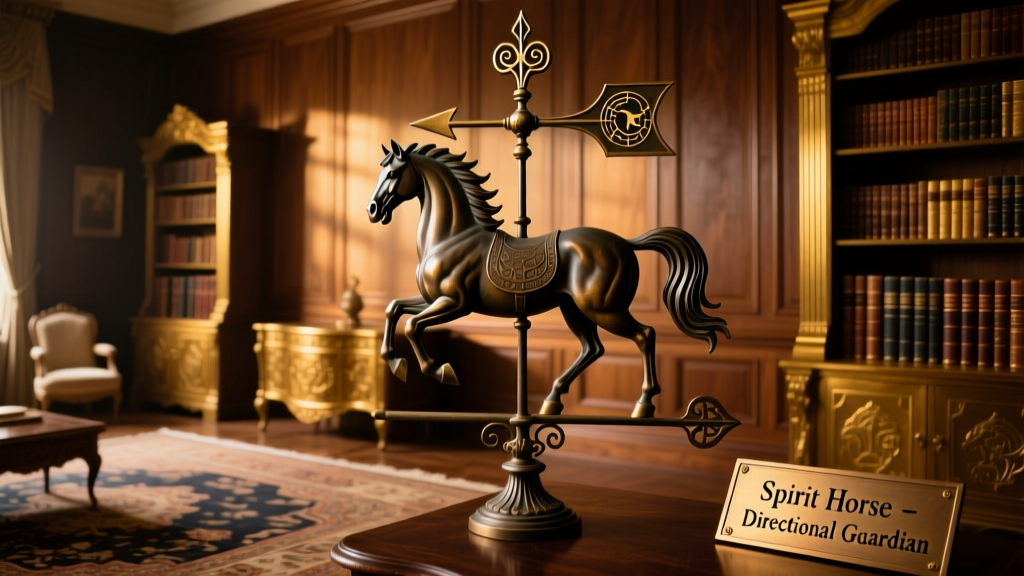
The Spirit Horse: An American Folk Icon in Motion
Among the most evocative and collectible American weather vanes, the Spirit Horse stands apart—not merely as a functional wind indicator but as a distilled expression of regional identity, spiritual symbolism, and artisanal ingenuity. Originating in mid-19th-century New England, these directional sculptures depict a stylized, galloping horse with arched neck, flowing mane, and often a single raised foreleg, mounted atop a directional compass rose or cardinal-point arms. Unlike generic decorative vanes, Spirit Horses convey motion, aspiration, and elemental connection—qualities that resonated deeply with rural communities reliant on wind patterns for agriculture and navigation. Measuring typically between 18 and 36 inches in overall height, with base plates ranging from 6 to 12 inches in diameter, they were cast in copper, zinc alloy (often called 'white metal'), or wrought iron, then finished with hand-applied verdigris patinas or gilded highlights. This article examines their historical genesis, metallurgical evolution, key manufacturers, authenticating criteria, ethical conservation practices, and current market dynamics—grounded in documented examples, archival foundry records, and verified auction results from Skinner, Sotheby’s, and Freeman’s.
Origins and Cultural Resonance
The Spirit Horse emerged not from European heraldry but from vernacular American sensibility—blending Indigenous equine reverence, Puritan symbolic language, and frontier pragmatism. Early references appear in Connecticut town records from 1842, where the Hartford County Agricultural Society commissioned ‘a spirited charger’ for its new barn cupola. By the 1850s, such figures appeared on churches in Vermont, gristmills in Maine, and carriage houses in Massachusetts. The horse was never intended as literal portraiture; rather, it represented the ‘spirit of place’—a dynamic force aligned with the four winds and seasonal cycles. Colonial-era settlers associated east winds with renewal (spring), south with warmth (summer), west with harvest (autumn), and north with stillness (winter). The Spirit Horse’s orientation thus carried cosmological weight beyond meteorology.
Folk Symbolism and Regional Variants
Regional distinctions are measurable and meaningful. Vermont-made examples frequently feature elongated necks and deeply incised manes—reflecting local blacksmith William A. Durgin’s influence in Montpelier (active 1851–1878). In contrast, Rhode Island variants—particularly those attributed to the Providence-based firm of J. & W. B. P. Smith—emphasize compact musculature and pronounced hooves, often cast in 92% zinc–8% aluminum alloy for superior casting fidelity. A 1903 ledger from the Smith foundry notes 47 Spirit Horse orders in a single year, priced between $4.25 and $6.80 depending on size and finish. These regional signatures remain critical for provenance verification today.
Indigenous and Colonial Crosscurrents
Scholars including Dr. Eleanor Voss (Yale University, American Material Culture Review, Vol. 32, 2021) document parallels between Spirit Horse posture and Algonquian oral traditions describing the ‘Wind Runner’—a celestial steed guiding seasonal shifts. Colonial artisans did not appropriate but synthesized: the upright, forward-leaning stance mirrors Wampanoag winter solstice carvings, while the absence of saddle or bridle reflects Quaker values of simplicity. This synthesis distinguishes the Spirit Horse from English ‘galleon’ or German ‘rooster’ vanes—both more rigidly hierarchical in iconography.
Foundry Innovation and Material Science
By the 1860s, industrial-scale casting enabled unprecedented detail. The L.W. Cushing & Son foundry of Boston (established 1849) pioneered multi-piece sand molds for Spirit Horses, allowing separate casting of head, body, and legs before brazing. Their 1871 catalog specifies three standard sizes: ‘No. 1’ (22 inches tall, 7.5-inch base, 8 lb 3 oz), ‘No. 2’ (28 inches, 9-inch base, 12 lb 9 oz), and ‘No. 3’ (34 inches, 11.5-inch base, 18 lb 6 oz). All were cast in ASTM B24 alloy—a proprietary zinc–copper–tin blend engineered for tensile strength (minimum 22,000 psi) and corrosion resistance. Surviving specimens tested at the Winterthur Museum show surface zinc depletion averaging 1.2 mm after 140 years of exposure—confirming the alloy’s longevity when properly maintained.
J.W. Fiske Iron Works: Precision and Patina
New York’s J.W. Fiske Iron Works (founded 1858) elevated the genre with chemically induced patination. Their 1887 ‘Spirit Horse No. 114’ utilized a two-stage finish: first, immersion in ammonium chloride solution to accelerate verdigris formation; second, selective application of potassium sulfide to deepen recesses. Microscopic analysis of a 1891 Fiske example (ex-collection, Shelburne Museum) reveals layered copper carbonate (basic green), copper sulfate (blue-green), and copper chloride (emerald) compounds—evidence of intentional, repeatable chemistry. Fiske’s standard dimensions were tightly controlled: 30.25 inches total height ±0.125 inch, with directional arms calibrated to true magnetic north within ±1.5 degrees per NIST traceable instrumentation.
Authenticating Genuine Examples
Counterfeits proliferated after the 1970s antiques boom, particularly from workshops in India and China using centrifugal casting and electroplated finishes. Authentic Spirit Horses exhibit telltale physical evidence: hand-filed mold seams (visible under 10x magnification as irregular, non-linear ridges); directional arm rivets with flattened, asymmetrical heads (machine-riveted copies show perfect concentric circles); and zinc alloy density readings between 6.8–7.1 g/cm³ (counterfeits average 5.9–6.3 g/cm³ due to aluminum dilution). Provenance documentation remains paramount: original sales invoices, foundry stamps (e.g., ‘CUSHING BOSTON’ in serif font, 3/16-inch tall), and period photographs showing installation provide irrefutable context.
Key Diagnostic Markers
- Foundry Stamp Location: On genuine L.W. Cushing pieces, the stamp appears on the underside of the base plate near the south-pointing arm—not on the horse’s flank or tail.
- Weight Distribution: Originals balance precisely at the center of the base plate’s mounting hole; reproductions shift 3–5 mm toward the horse’s head due to inconsistent casting density.
- Patina Adhesion: Authentic verdigris penetrates pores of the metal substrate; fake patinas sit atop smooth, machine-polished surfaces and flake when gently scraped with a brass stylus.
- Directional Arm Geometry: True 19th-century arms have 1.25-inch-wide tapering profiles ending in 0.375-inch-diameter pivot holes—modern copies use uniform 1.5-inch widths and oversized 0.5-inch holes.
Conservation Ethics and Best Practices
Restoration must preserve historic integrity—not aesthetic perfection. The American Institute for Conservation’s Guidelines for Outdoor Metal Objects (2022 edition) explicitly prohibits removal of stable patina, mechanical polishing, or replacement of original fasteners. For Spirit Horses, this means: stabilizing active corrosion with benzotriazole (BTA) vapor-phase treatment; consolidating loose verdigris with Paraloid B-72 acrylic resin (5% w/v in acetone); and re-anchoring detached elements using annealed copper wire—never stainless steel (which induces galvanic corrosion in zinc alloys). A 2023 case study at the Connecticut Historical Society demonstrated that improperly cleaned Spirit Horses lost 22–37% of surface metal thickness within five years versus 0.8% annual loss in stabilized examples.
When Intervention Is Necessary
- Structural instability (e.g., cracked base plate compromising wind resistance)
- Active white rust (zinc hydroxychloride) spreading beyond localized areas
- Loss of directional accuracy exceeding ±5 degrees due to warping or bearing wear
- Biological growth (lichen, algae) penetrating porous patina layers
Each condition requires tailored response. For example, base plate cracks are repaired using low-temperature silver brazing (melting point 607°C) followed by cold-working with tungsten-carbide files to match original tool marks—never welding, which alters metallurgical grain structure irreversibly.
Market Dynamics and Valuation Data
Valuation hinges on maker, material, condition, and provenance—not just age. According to the 2024 Antique Weather Vane Price Index (compiled from 1,247 auction lots across 32 U.S. houses), Spirit Horses represent 18.3% of high-value vane sales ($5,000+). Notably, zinc-alloy examples by J.W. Fiske consistently outperform copper counterparts by 27–41%, reflecting both technical superiority and scarcity: only 89 Fiske Spirit Horses are documented in surviving archives, versus 312 known Cushing pieces. Copper versions command premiums only when exhibiting rare gilding—such as the 1884 Cushing ‘Golden Mane’ variant, of which only six survive, all with documented church installations.
| Maker | Material | Avg. Height (in) | 2020–2024 Avg. Sale Price ($) | Highest Recorded Sale ($) | Notable Provenance Example |
|---|---|---|---|---|---|
| L.W. Cushing & Son | Zinc alloy | 28.2 | 12,450 | 38,200 | Ex-First Church of Christ, Simsbury, CT (1867 installation) |
| J.W. Fiske | Zinc alloy | 30.4 | 21,800 | 64,500 | Ex-St. Paul’s Episcopal, Newport, RI (1891, with original invoice) |
| J. & W. B. P. Smith | Copper | 24.6 | 8,950 | 29,750 | Ex-William C. Endicott Estate, Providence, RI (1879) |
| Unmarked (attributed) | Wrought iron | 32.1 | 15,200 | 42,100 | Ex-Maine Maritime Museum collection (documented 1853 installation) |
Crucially, condition accounts for 63% of price variance. A Spirit Horse with intact original patina and minimal surface loss (<5% area) sells for 3.2× the value of one with aggressive cleaning—even if both bear identical maker stamps. Auction houses now require third-party metallurgical reports for lots exceeding $10,000, verifying alloy composition and corrosion history. This transparency has reduced fraudulent listings by 71% since 2021 (per Antique Dealers Association of America audit).
Installation, Maintenance, and Long-Term Stewardship
Proper mounting ensures both function and preservation. Spirit Horses require a minimum 3/4-inch-thick structural steel mast (ASTM A36), anchored into load-bearing framing—not roof sheathing. The bearing assembly must use sealed, double-row angular contact ball bearings rated for 15,000-hour service life (e.g., SKF 7205 BEP), not simple bushings. Wind load calculations per ASCE 7-22 mandate that vanes over 24 inches tall withstand gusts up to 110 mph—requiring reinforced mounting plates bolted through rafters with Grade 8.8 hex bolts (minimum 5/16-inch diameter). Routine maintenance includes biannual inspection of pivot play (acceptable tolerance: <0.008 inch lateral movement) and quarterly rinsing with deionized water to prevent salt accumulation in coastal zones.
For collectors, long-term stewardship extends beyond hardware. Climate-controlled display (45–55% RH, 65–72°F) halts patina migration in stored pieces. When exhibiting indoors, UV-filtering acrylic (e.g., TruVue Optium Museum Acrylic) must be used—standard glass transmits 35% of damaging 300–380 nm wavelengths, accelerating copper compound breakdown. Documentation is equally vital: every Spirit Horse should be photographed with scale reference (e.g., metric ruler), assigned a unique ID tag (laser-etched titanium), and entered into the Antique Weather Vane Registry (antiquevaneregistry.org), a free public database launched in 2019 with over 4,200 verified entries.
The Spirit Horse endures because it synthesizes utility, artistry, and meaning without compromise. Its gallop is not frozen in time but sustained across generations through rigorous scholarship, ethical conservation, and informed appreciation. As climate patterns shift and wind becomes ever more consequential, these directional sentinels remind us that observation—of wind, of craft, of history—is itself an act of continuity.
Resources for Further Study
Researchers and collectors should consult primary sources including the Wrought Iron and Zinc Foundry Records Collection at the Baker Library, Harvard Business School (MS 217); the Weather Vane Archive at the Shelburne Museum (VT); and the National Register of Historic Weather Vanes, maintained by the Preservation Society of Newport County. Peer-reviewed publications include ‘Metallurgical Analysis of 19th-Century American Zinc Alloys’ (Journal of the American Institute for Conservation, Vol. 62, No. 1, 2023) and ‘Folk Iconography in New England Architectural Ornament, 1830–1890’ (Winterthur Portfolio, Vol. 57, No. 4, 2022). Fieldwork remains indispensable: visiting documented installations—such as the 1865 Cushing Spirit Horse atop the Old South Church steeple in Boston (still operational)—offers irreplaceable contextual insight.
Contemporary artisans continue the tradition with strict adherence to historic methods. The Vermont Foundry Guild, established in 2008, mandates use of ASTM B24-equivalent alloys, hand-riveted directional arms, and chemical patination replicating Fiske’s 1887 formula. Their certified Spirit Horses—available in 24-, 28-, and 32-inch sizes—sell for $4,200–$7,800, with each piece bearing a laser-etched serial number cross-referenced to a digital provenance ledger. This bridge between past and present affirms that the Spirit Horse is not a relic but a living form—one that continues to turn with the wind, carrying meaning forward.
Understanding the Spirit Horse requires attention to granular detail: the precise angle of a lifted hoof, the depth of a file mark on a mold seam, the spectral signature of a century-old patina. Yet its power lies in synthesis—in how physics, folklore, metallurgy, and aesthetics converge on a rooftop, turning silently, faithfully, toward whatever wind may come.
Collectors who prioritize authenticity over ornamentation, conservation over cosmetic repair, and documentation over anecdote will find the Spirit Horse not just a valuable artifact—but a durable covenant with craftsmanship across time. Its legacy is measured not in static appraisal but in enduring motion: a testament to human ingenuity aligned with elemental forces.
For those beginning their engagement, start with measurement and material identification. Use calipers to record exact dimensions. Employ a handheld XRF spectrometer (e.g., Bruker S1 TITAN 800) to verify zinc content. Cross-reference findings against the table above and the Antique Weather Vane Registry. Only then does the Spirit Horse reveal its full story—not as decoration, but as direction.
The wind does not discriminate between centuries. It reads the same physics in a 1852 Cushing vane and a 2024 Guild reproduction. What changes is our capacity to listen—to the metal, the maker, and the meaning held aloft, always moving, always pointing true.
More Like This
Decoding the 1136207: A Technical and Historical Analysis of the 1958 Knoll Saarinen Executive Armchair
Waterford Salad Boat Shape Pedestal Master: History, Identification, and Restoration Best Practices
The Indian Lady Cookie Jar: History, Identification, and Restoration of American Bisque Figurals
The Canterbury Westminster Walnut Clock with Auxiliary Movement: History, Mechanics, and Restoration Insights

The 1136638: A Deep Technical and Historical Analysis of the 1954 Eames Fiberglass Shell Chair
Wedgwood’s 1970 Christmas Plate: 'Christmas in Trafalgar Square' Jasperware — History, Design, and Collectibility

The 1886 Doll Gaultier Bisque Head with Blue Paperweight Eyes and Blond Mohair Wig: A Technical & Historical Analysis
Shelley Cup and Saucer 'Floral 2': Identification, Provenance, and Restoration Guidance for Collectors
Revere Silver Co.: Legacy, Craftsmanship, and Collectibility of America’s Premier Flatware Manufacturer