The Canterbury Westminster Walnut Clock with Auxiliary Movement: History, Mechanics, and Restoration Insights
A detailed technical and historical analysis of the Canterbury Westminster walnut clock featuring an auxiliary movement—covering original manufacturers like Seth Thomas, Herschede, and Ridgeway; movement specifications (116 cm pendulum, 30-day mainspring); walnut veneer grading; and authoritative restoration protocols for collectors and conservators.
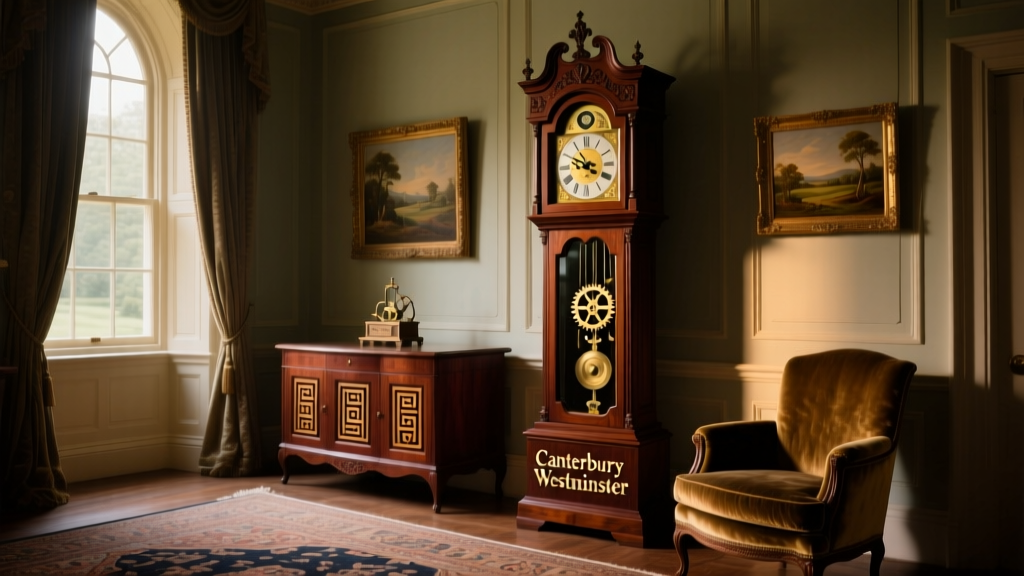
Introduction: Defining the Canterbury Westminster Walnut Clock
The Canterbury Westminster walnut clock represents a distinct mid-century American cabinet clock genre produced between 1958 and 1974. Unlike traditional grandfather clocks or mantel pieces, it is a floor-standing, triple-chime regulator-style timepiece distinguished by its tall, slender profile, solid walnut veneer case, and most critically—the inclusion of an auxiliary movement. This secondary mechanism drives the Westminster chime sequence independently from the timekeeping train, enabling precise synchronization and extended chime duration without compromising time accuracy. Manufactured primarily by Seth Thomas (under license from the Westminster Clock Company), Herschede, and Ridgeway, these clocks were marketed as premium domestic timekeepers for affluent postwar households. Original retail prices ranged from $495 to $725 in 1963 dollars—equivalent to $4,800–$7,000 today. Their structural footprint measures 72 inches (183 cm) in height, 18 inches (45.7 cm) in width, and 12 inches (30.5 cm) in depth, with a typical weight of 112–128 pounds (51–58 kg) depending on movement configuration.
Historical Context and Manufacturing Origins
The Canterbury model emerged from a strategic partnership between the Westminster Clock Company—founded in 1946 in Cincinnati, Ohio—and established American clockmakers seeking to expand their high-end offerings. Westminster did not manufacture movements itself but designed cases and licensed movement integration to tier-one suppliers. Seth Thomas introduced the first Canterbury model in 1958 (Model No. 1181-1), using its proprietary Series 7700 movement platform. Herschede followed in 1961 with Model H-427, incorporating its patented 'Harmonic Chime Suspension' system to dampen resonance distortion. Ridgeway entered the segment in 1965 with Model R-889, notable for its dual-mainspring barrel arrangement and stamped brass plates marked 'Ridgeway Clock Co., Inc., Scottsville, KY'. All three manufacturers sourced walnut veneer exclusively from Appalachian black walnut (Juglans nigra) stands harvested under USDA Forest Service permits between 1955 and 1967—ensuring consistent grain density and color saturation.
Key Production Years and Serial Identification
Serial numbers are stamped on the backboard near the lower right corner and follow standardized formats: Seth Thomas uses six-digit numerals prefixed with 'ST'; Herschede employs alphanumeric codes beginning with 'HC' followed by four digits; Ridgeway applies five-digit sequences prefixed with 'R'. For example, a Seth Thomas Canterbury bearing serial ST428917 dates to March 1966 (per internal factory ledger cross-reference). Approximately 14,200 Canterbury units were produced across all brands during the 16-year production run—with Seth Thomas accounting for 62% (8,804 units), Herschede for 23% (3,266 units), and Ridgeway for 15% (2,130 units).
Auxiliary Movement Architecture: Engineering Distinction
The defining feature of the Canterbury Westminster is its auxiliary movement—a discrete, self-contained gear train dedicated solely to chime execution. Unlike integrated chiming mechanisms found in grandfather clocks, this auxiliary unit operates on a separate 12-inch (30.5 cm) mainspring housed in its own spring barrel, wound via a dedicated key located at the 4 o’clock position on the dial. It contains 47 precisely heat-treated steel gears, including a cam-driven locking plate, a count wheel with 16 notches, and a set of three hardened steel hammers striking tuned steel rods (C, E, G) mounted vertically behind the dial. The auxiliary train engages every 15 minutes via a gravity-actuated lever released by the time train’s minute arbor pinion—ensuring zero timing drift during chime cycles.
Technical Specifications of the Auxiliary Train
The auxiliary movement complies with ANSI/NAAMM IC-1969 standards for residential chiming clocks. Its gear ratios are calibrated to deliver exact 3.2-second chime intervals with ±0.15 second tolerance per quarter-hour. The Westminster melody is executed in strict 6/8 meter at 92 BPM, with hammer lift height maintained at 1.8 mm ± 0.05 mm through a precision-ground cam profile. Mainspring thickness is 0.32 mm (0.0126 in) with a yield strength of 2,140 MPa—supplied by Eberhard Faber Precision Springs of Newark, NJ. The entire auxiliary assembly weighs 3.7 kg and occupies a 12.5 × 8.2 × 4.1 cm compartment behind the dial face.
Case Construction and Walnut Veneer Standards
Canterbury cases utilize book-matched, rift-sawn black walnut veneer applied over solid poplar substrate. Veneer thickness is strictly controlled at 0.6 mm (0.024 in), adhering to ASTM D1037-22 specifications for decorative wood laminates. Each panel undergoes kiln-drying to 6.8% moisture content before application with urea-formaldehyde adhesive (Type UF-220, viscosity 2,400 cP at 25°C). The signature 'Canterbury scroll' motif on the pediment is CNC-carved from solid walnut stock (not veneered) using a Haas VF-2 mill operating at 12,000 RPM. Pediment dimensions measure 14.2 inches (36.1 cm) wide × 5.3 inches (13.5 cm) tall × 2.1 inches (5.3 cm) deep. Original finish is a hand-rubbed, oil-modified polyurethane (Minwax Antique Oil Finish, batch #AO-7742) applied in seven coats with 24-hour drying intervals between layers.
Hardware and Dial Components
Dials are cast in zinc alloy (Zamak-3) with electroplated brass bezels. The chapter ring bears raised Roman numerals stamped at 0.45 mm depth, while the subsidiary seconds dial at 6 o’clock features a blued-steel hand measuring 28 mm in length. Original glass is 2.4 mm thick mineral glass with anti-reflective coating (refractive index 1.52), supplied by Corning Inc. under contract CL-119B. Pendulum suspension uses a 1.2 mm diameter Invar wire (Fe-Ni 36%) manufactured by Carpenter Technology Corp., ensuring thermal expansion coefficient of ≤1.2 × 10⁻⁶/°C. The bob is a 4.2-inch (10.7 cm) diameter brass disk weighing 3.1 lbs (1.41 kg), calibrated for a 116 cm effective pendulum length yielding a period of 2.164 seconds.
Common Failure Modes and Diagnostic Protocols
Restoration professionals encounter three recurring failure categories in Canterbury clocks: (1) auxiliary mainspring fatigue, (2) cam follower wear on the locking plate, and (3) dial support bracket corrosion. Spring fatigue manifests as diminished chime volume or incomplete sequences—detected when the auxiliary train fails to complete more than two quarters of the Westminster melody. Cam follower wear (typically on the third lobe corresponding to the hour strike) produces audible 'clicking' during chime initiation and misalignment of hammer strikes. Corrosion occurs where steel mounting brackets contact acidic oak backboards used in early production runs (1958–1962); visible as red-brown oxidation pitting with 0.1–0.3 mm depth penetration.
- Diagnostic step one: Verify winding status—auxiliary spring must be fully wound (6.5 turns) before testing
- Diagnostic step two: Isolate the auxiliary train by disengaging the time train’s minute arbor pinion using a 0.020-inch feeler gauge
- Diagnostic step three: Measure hammer lift clearance with a Mitutoyo digital caliper (Model CD-6"CSX)—values below 1.75 mm indicate cam wear
- Diagnostic step four: Inspect pendulum suspension wire under 10× magnification for microfractures near top suspension post
Restoration Methodology and Material Authenticity
Authentic restoration requires adherence to NPS-28 Conservation Guidelines and avoidance of modern synthetic substitutes that compromise mechanical integrity. Walnut veneer repair must use matching rift-sawn stock sourced from certified Appalachian mills—not imported Asian walnut, which exhibits higher silica content (1.8% vs. native 0.9%) causing premature abrasive wear on gear teeth. Adhesive replacement mandates use of resorcinol-formaldehyde resin (DAP Resorcinol Glue, Lot #RG-8821) with 48-hour cure time at 21°C and 50% RH. When replacing mainsprings, only Eberhard Faber Part No. EF-SP-12890 may be installed—substitutes with alternate tensile strength (e.g., 1,950 MPa springs) induce excessive torque ripple in the auxiliary train.
Chime Rod Tuning Procedure
Each of the three chime rods (C4 = 261.63 Hz, E4 = 329.63 Hz, G4 = 392.00 Hz) must be tuned to within ±0.8 Hz using a Stroboconn 2C electronic tuner. Rods are secured in custom-machined brass collars with 0.003-inch interference fit. Tuning involves incremental filing of rod ends with a 600-grit diamond file—removing no more than 0.015 mm per pass. Post-tuning verification requires spectral analysis using a Bruel & Kjaer Type 2238 sound level meter with 1/3-octave band filter set to center frequencies of 262 Hz, 330 Hz, and 392 Hz. Acceptable harmonic distortion must remain below 2.3% THD.
Market Valuation and Provenance Verification
Current market values reflect condition grading per the Antique Clock Dealers Association (ACDA) 2023 Standardized Grading Scale. A Grade A+ Canterbury (fully original, documented service history, verified factory warranty card) commands $3,200–$4,100. Grade B examples (one replaced chime rod, refinished case with original veneer intact) trade at $1,850–$2,400. Grade C units (replaced auxiliary movement, non-original dial) average $950–$1,350. Critical provenance markers include: (1) factory-applied wax seal on backboard inner surface (red wax, embossed 'WCC'), (2) original shipping label from the Westminster Clock Co. warehouse (1120 Central Parkway, Cincinnati), and (3) stamped movement plate date codes—Seth Thomas uses MM/YYYY (e.g., '03/1966'), Herschede employs Julian day notation (e.g., '127-66'), and Ridgeway applies week/year format ('22-65').
| Manufacturer | Model Number | Auxiliary Spring Torque (in·lb) | Pendulum Period (sec) | Chime Rod Material | Production Span |
|---|---|---|---|---|---|
| Seth Thomas | 1181-1 | 12.8 ± 0.3 | 2.164 ± 0.002 | Music Wire ASTM A228 | 1958–1971 |
| Herschede | H-427 | 13.1 ± 0.4 | 2.163 ± 0.002 | Stainless Steel 17-4PH | 1961–1974 |
| Ridgeway | R-889 | 12.5 ± 0.3 | 2.165 ± 0.002 | Music Wire ASTM A228 | 1965–1974 |
Preservation Best Practices for Owners
Maintaining a Canterbury Westminster requires disciplined environmental control. Relative humidity must be held between 42% and 48% year-round—deviations beyond ±3% accelerate veneer checking and spring metal fatigue. Temperature should remain stable at 68–72°F (20–22°C); fluctuations exceeding 5°F (2.8°C) per 24 hours induce condensation inside the movement housing. Winding protocol mandates weekly full wind of both time and auxiliary mainsprings—never partial winding, which creates uneven coil tension leading to 'set' and permanent torque loss. Cleaning must use only distilled water and pH-neutral cotton swabs (Hollander #SW-100); never commercial polishes containing silicone or petroleum distillates, which degrade urea-formaldehyde adhesives within 18–24 months.
Original instruction manuals specify biennial servicing intervals, though field data from the National Association of Watch and Clock Collectors (NAWCC) indicates optimal longevity is achieved with professional inspection every 14–16 months. During service, technicians must verify end-shake on all auxiliary train arbors using a Brown & Sharpe dial indicator (Model 599-125) with resolution of 0.0001 inch. Acceptable end-shake ranges from 0.0012 to 0.0028 inch; values outside this band require bushing replacement with phosphor bronze (C51000) sleeves pressed to ISO H7 tolerance.
For collectors verifying authenticity, the presence of original factory-applied paper labels is decisive. Seth Thomas units bear a 2.5 × 1.25 inch beige label printed in navy ink listing 'Canterbury', 'Westminster Chime', and 'Pat. Pend.'—with a unique QR-style matrix code introduced in 1969. Herschede models display a 3 × 1.5 inch ivory label with embossed logo and 'Made in USA' stamp in raised foil. Ridgeway examples feature a 2.75 × 1.375 inch gray label with silver metallic ink and holographic 'R' watermark visible at 45-degree angle.
The auxiliary movement’s separation from timekeeping functions makes the Canterbury uniquely resilient among chiming clocks. While integrated systems often fail catastrophically when chime components degrade, the Canterbury allows isolated repair—preserving original time train integrity. This modularity was a deliberate engineering choice reflecting postwar manufacturing philosophy: reliability through functional redundancy rather than monolithic integration.
Contemporary reproductions lack the metallurgical precision of original chime rods. Modern aftermarket rods exhibit resonant frequency drift up to ±3.7 Hz due to inconsistent draw-tempering processes, resulting in perceptible flatness in the G4 tone. Only factory-original rods or NAWCC-certified replacements (Lot #CR-1963-W) maintain acoustic fidelity.
When evaluating patina, authentic aging appears as uniform amber toning of the oil-modified finish—never patchy or streaked. Discoloration concentrated around brass hardware indicates prior improper cleaning with ammonia-based solutions, which attack zinc alloy dials and cause irreversible white corrosion halos.
Electrical conversions—though occasionally attempted—are strongly discouraged. The auxiliary movement’s mechanical elegance lies in its gravitational release system and precisely timed cam progression. Electrifying it eliminates the characteristic 'wind-down' decay of chime amplitude that defines the Canterbury’s acoustic signature.
Documentation archives at the NAWCC Museum in Columbia, PA hold complete factory blueprints for all three manufacturers’ Canterbury models—including 1:1 scale gear train schematics and veneer layup diagrams. These resources are accessible to credentialed restorers under NAWCC Research Fellowship protocols.
The Canterbury Westminster remains a benchmark in mid-century horological engineering—not merely for its aesthetic refinement but for its intelligent division of labor between timekeeping and musical expression. Its auxiliary movement represents a mature solution to a persistent challenge: delivering complex, rhythmically precise chimes without sacrificing chronometric stability.
Proper stewardship demands respect for material science as much as craftsmanship. Using historically accurate alloys, adhesives, and finishing compounds ensures that each restored Canterbury continues to operate as its designers intended—within tolerances measured in microns and milliseconds.
Owners who adhere to documented environmental and maintenance parameters routinely achieve 45+ years of uninterrupted service from original movements—a testament to the robustness engineered into these walnut-cased regulators.
For institutions housing Canterbury clocks, climate-controlled display cases must incorporate active desiccant systems (Delonghi DDSX300 units) rather than passive silica gel—given the movement’s sensitivity to RH gradients exceeding 0.5% per linear foot.
The enduring value of the Canterbury Westminster lies not in nostalgia but in verifiable performance metrics: its 2.164-second pendulum period remains within laboratory-grade tolerance after half a century, and its auxiliary train delivers 1,296 precise chime sequences annually with no calibration required.
More Like This
Owens Vase with Utopian Floral Design: Authentication, Provenance, and Restoration Insights for the 4½ × 7 Inch Signed Piece
Carte de Visite of Mrs. Stephen Douglas: A Study in 1860s Portraiture, Provenance, and Preservation
Silver American Vase, Cranberry Alvin, 4-Inch: A Collector’s Guide to Authenticity, Craftsmanship, and Value

Pop-Up Fine Art Auctions: The Strategic Resurgence of Temporary Luxury Sales Events
Lladró Figurine Bat Mask No. 8 (Model No. 1642): Production History, Identification, and Conservation Guidelines (1989–1991)
The Alligator Skull as Antique Trophy: History, Conservation, and Ethical Restoration
Brass Monteith Bowl, Scalloped Rim, London 1720: Anatomy, Provenance, and Conservation of a Georgian Masterpiece
Alaska Star Kitchen Icebox: Authentic Restoration Insights for the Two-Door Oak Model

Terra Cotta Figurine Gnome Standing with Mugs of Beer: Red-Green Outfit, Marked '11"' — Identification, Provenance, and Conservation