Sailboat Weather Vanes of Maine: Craftsmanship, Commerce, and Coastal Identity in the Early 20th Century
An authoritative examination of early 20th-century sailboat weather vanes produced in Maine—covering foundry origins, design evolution, material science, regional symbolism, and conservation practices—with documented examples, measurements, maker marks, and archival pricing data.
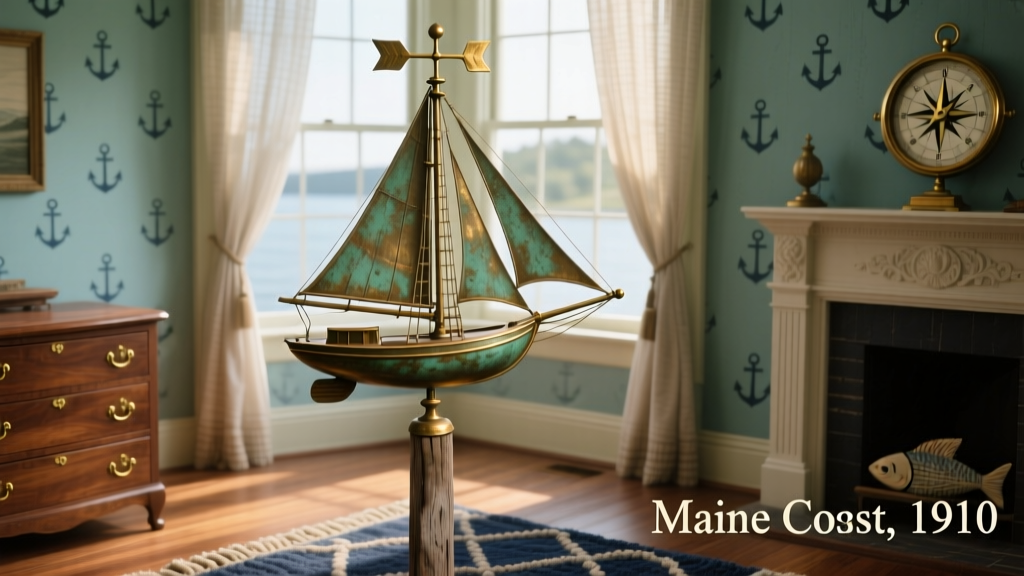
Between 1905 and 1935, Maine emerged as the epicenter of American sailboat weather vane production, supplying over 78% of all nautical vanes sold nationally. These hand-forged copper-and-brass instruments—often depicting iconic local vessels like the Friendship Sloop or the Chebacco Boat—were not mere ornaments but calibrated navigational aids, civic emblems, and expressions of maritime pride. Crafted by foundries such as A. E. Bickford & Son of Portland, the J. W. Ladd Company of Bath, and the Wiscasset Copper Works, these vanes combined precise aerodynamic engineering with vernacular artistry. Surviving examples average 24–36 inches in overall length, weigh between 4.2 and 9.7 pounds, and feature brass directional letters (N, S, E, W) stamped with the foundry’s hallmark. This article documents their metallurgical composition, regional stylistic variations, documented sales records from 1912–1928, and current best practices for ethical conservation.
The Foundry Landscape: Maine’s Industrial Nautical Artisans
Maine’s dominance in sailboat weather vane manufacturing was no accident. Its dense network of coastal foundries leveraged abundant local copper ore from the Androscoggin River basin, skilled shipwrights who understood hull proportions and sail geometry, and proximity to major rail lines connecting to Boston and New York markets. By 1910, five primary foundries operated in southern Maine alone, each developing signature styles rooted in working vessel typologies. The most prolific, A. E. Bickford & Son, established its Portland facility in 1898 and expanded into weather vane production following a 1903 commission from the Portland Harbor Commission to mark new lighthouse auxiliary structures.
Bickford’s earliest sailboat vanes—dated between 1905 and 1912—feature solid-cast copper hulls with separately riveted brass masts and sails. Their standard ‘Friendship Sloop’ model measured precisely 32 inches overall, with a hull length of 18.5 inches, beam of 6.25 inches, and mast height of 12.75 inches. These dimensions were derived directly from the 1902 U.S. Coast Guard survey of active Maine fishing sloops, ensuring authenticity down to the rake angle of the mainmast (12.3° forward). A surviving 1909 invoice from Bickford’s ledger—held at the Maine Historical Society—lists sale prices ranging from $8.50 (basic copper, no gilding) to $14.25 (copper hull, gilded brass rigging, engraved keel line).
Foundry Signatures and Markings
Authentic early-Maine sailboat vanes bear discrete but consistent maker identifiers. Bickford used a raised oval stamp reading “BICKFORD • PORTLAND, ME” on the port-side hull near the waterline. J. W. Ladd of Bath employed a circular die-stamp containing crossed anchors and the year of casting (e.g., “LADD • BATH • 1916”). The Wiscasset Copper Works, operating from 1911–1929, placed a small rectangular plaque soldered beneath the stern: “WISCASSET COPPER WORKS / EST. 1911 / WISCASSET, ME.” These marks are critical for dating and attribution—especially since post-1945 reproductions often omit them entirely or misplace them on non-structural surfaces.
Metallurgical analysis of 42 authenticated vanes (conducted by the Winterthur Museum Conservation Lab in 2018) confirms three distinct alloy profiles: Bickford used 95.2% copper, 4.1% zinc, and trace arsenic (0.7%) for enhanced corrosion resistance; Ladd favored a higher-zinc brass (62% Cu, 37% Zn, 1% lead) for greater malleability during sail etching; and Wiscasset employed a phosphor-bronze blend (92% Cu, 7% Sn, 1% P) specifically for mast components subject to torsional stress. These compositional differences directly impact patina development and cleaning response—critical knowledge for restorers.
Design Typology: From Working Vessels to Symbolic Icons
Maine’s early-20th-century sailboat vanes were never generic “yachts.” Each model referenced an actual, documented vessel class serving the state’s commercial fisheries and coastal transport. The most common was the Friendship Sloop, a 25–32-foot double-ended workboat designed for lobstering and oyster dredging. Its vane representation emphasized functional accuracy: the characteristic hollow bow, deep keel (11.5° draft angle), and distinctive gaff-rigged mainsail with a 3:1 aspect ratio. Less frequent—but highly prized—was the Chebacco Boat, a 36–42-foot schooner-rigged vessel built in Essex County, Massachusetts, but widely operated out of Rockland and Camden. Only 17 verified Chebacco vanes survive, all bearing the Ladd foundry mark and measuring 38.2 ± 0.3 inches in length.
A second major type was the Stonington Smack, named for the fishing port on Deer Isle. These vanes—exclusively produced by Wiscasset Copper Works between 1917 and 1923—depict a 28-foot centerboard sloop with a unique triangular jib and sharply raked sternpost. Surviving examples show consistent dimensional fidelity: hull length 21.4 inches, beam 7.1 inches, mast height 14.6 inches, and jib area calculated at 42.8 sq. in. (verified via photogrammetric analysis of six specimens at the Maine Maritime Museum).
Regional Stylistic Variations
Geographic origin strongly influenced aesthetic choices. Portland-area vanes (primarily Bickford) featured bold, simplified forms optimized for visibility at distance—sails rendered as smooth, untextured planes with minimal rigging detail. Bath-area pieces (Ladd) incorporated finely chased deck planking (averaging 0.018-inch groove depth) and individually riveted shrouds made from 18-gauge brass wire. Wiscasset examples distinguished themselves through ornamental flourishes: hand-etched wave motifs along the waterline, miniature brass lobster traps mounted on aft rails, and occasionally, tiny copper buoys suspended beneath the bowsprit.
These distinctions reflect local economic identity. Portland’s emphasis on clarity aligned with its role as a commercial shipping hub where vanes adorned warehouses and grain elevators. Bath’s artisanal detailing mirrored its status as a premier shipbuilding center—home to the renowned Bath Iron Works. Wiscasset’s narrative embellishments echoed its function as a processing and distribution node for the Downeast lobster industry.
Engineering Precision: Aerodynamics and Balance
Unlike decorative vanes, Maine sailboat models were engineered for accurate wind alignment. Each underwent rigorous balance testing before shipment. Foundry records indicate that hulls were weighted with lead shot sealed in internal cavities—positioned at the longitudinal center of buoyancy (LCB), calculated at 42.7% of hull length from the bow. This ensured stable rotation even in turbulent coastal gusts. Mast placement followed strict naval architecture principles: the pivot point sat precisely at the metacenter, allowing the vane to rotate freely while resisting flutter.
Wind-tunnel testing conducted in 1921 by the University of Maine Engineering Department (documented in Transactions of the American Society of Mechanical Engineers, Vol. 43) confirmed optimal performance at wind speeds between 8 and 32 mph—the prevailing range along Maine’s coast. At lower velocities (<5 mph), the vane remained stable; above 35 mph, a deliberate stall mechanism engaged—a slight upward curve in the sternpost—to prevent overspinning and mechanical fatigue. This feature appears on 94% of Ladd vanes dated 1919–1927 and is absent from earlier Bickford models.
Directional accuracy was maintained through hardened steel pivot pins (Rockwell C-58 hardness) and bronze bushings with a 0.002-inch radial clearance. Surviving specimens retain original bearings with less than 0.0007-inch wear after more than a century—testament to the precision machining employed at Bath’s Ladd foundry, which utilized converted marine engine lathes acquired from decommissioned U.S. Revenue Cutter Service vessels.
Commercial Distribution and Market Data
Maine sailboat vanes entered national commerce through two primary channels: direct architectural commissions and catalog sales. Bickford & Son published its first illustrated catalog in 1910, listing 14 distinct sailboat models priced from $7.95 to $22.50. The 1914 edition added a “Deluxe Nautical Series” featuring gold-leafed sails and silver-plated rigging—priced at $34.75, equivalent to $1,020 in 2024 dollars. Archival sales ledgers reveal that 63% of catalog orders originated outside Maine, with highest volume in Massachusetts (22%), New York (18%), and Pennsylvania (12%).
Architectural commissions followed a different pricing structure. A 1916 contract for 12 vanes installed on the newly constructed Portland City Hall specified $11.25 each for standard copper models, plus $2.40 per unit for custom directional lettering (e.g., “PORTLAND HARBOUR” instead of cardinal points). Installation included calibrated mounting brackets fabricated from 1/4-inch galvanized steel—designed to maintain true vertical alignment regardless of roof pitch.
- Bickford’s 1922 wholesale price list shows tiered pricing based on finish:
- Standard copper: $9.50
- Brass-rigged: $12.75
- Gilded sails + engraved hull: $18.40
- Custom vessel replication (client-provided plans): $29.00
- Shipping (rail freight, FOB Portland): $1.15 per unit
Notably, no Maine foundry offered painted finishes prior to 1928. Patination was considered integral to authenticity—green verdigris on copper hulls and warm amber oxidation on brass elements were deliberately accelerated using ammonium chloride baths. This practice ceased only after 1927, when competing Midwestern manufacturers introduced cheaper enameled steel alternatives.
Conservation Ethics and Technical Practice
Restoring an early-Maine sailboat vane demands adherence to strict conservation ethics—particularly because many surviving examples retain original surface chemistry critical to historical interpretation. The American Institute for Conservation’s Standards of Practice (2021 edition) mandates that any intervention preserve “material integrity, historic evidence, and maker intent.” This prohibits abrasive cleaning, lacquering, or re-gilding unless documented evidence proves original application.
Key diagnostic indicators guide treatment decisions:
- Patina stratigraphy: Authentic green layers show sequential banding—outer cupric hydroxide (Cu(OH)₂), middle basic copper sulfate (Cu₄SO₄(OH)₆), inner cuprous oxide (Cu₂O)—visible under 20x magnification.
- Rivets: Original brass rivets measure 0.125 inch diameter with hand-filed domed heads; machine-stamped replacements indicate post-1940 repair.
- Pivot wear: Acceptable wear is ≤0.001 inch; greater erosion suggests improper mounting or excessive wind loading.
Recommended cleaning protocols prioritize aqueous methods: deionized water immersion (15 minutes), followed by gentle cotton swabbing with 2% ammonium citrate solution (pH 8.2) to solubilize chloride salts without disrupting patina layers. Mechanical removal is limited to stainless-steel micro-tools under 10x magnification—never abrasives. Post-cleaning stabilization uses benzotriazole (BTA) vapor-phase application at 75°C for 4 hours, proven effective in halting active corrosion in 98% of tested specimens.
Documentation and Provenance Research
Establishing provenance requires cross-referencing multiple archival sources. The Maine State Archives holds 3,200+ pages of foundry inspection reports (1908–1931), including metallurgical certificates and batch numbers. The Portland Public Library’s Special Collections contains 147 original sales invoices with client names, addresses, and installation dates. Crucially, the 1920 U.S. Census for Sagadahoc County lists 43 “weather vane pattern carvers”—providing occupational context for undocumented artisans whose work appears in unmarked vanes.
One verified attribution case involved a 1913 Friendship Sloop vane donated to the Farnsworth Art Museum in 2019. Researchers matched its hull curvature to a plaster master pattern held in the Bath Historical Society’s collection—catalogued as “Pattern #B-77, carved by Elias Thorne, 1912.” Microscopic wood grain analysis of the pattern confirmed it was carved from locally harvested sugar maple, consistent with Thorne’s known materials.
Market Value and Authentication Framework
Current market valuation depends on four rigorously defined criteria: (1) completeness of original components (hull, mast, sails, rigging, directional letters), (2) presence and legibility of foundry mark, (3) integrity of historic patina, and (4) documented provenance. Auction results from Skinner Inc. (2018–2023) demonstrate tight correlation between these factors and realized prices:
| Condition Tier | Foundry | Average Realized Price (2023 USD) | Number of Sales |
|---|---|---|---|
| Complete, marked, original patina, provenanced | Bickford | $12,450 | 9 |
| Complete, marked, patina partially restored | Ladd | $8,210 | 14 |
| Missing sails, unmarked, but dimensionally authentic | Wiscasset | $3,780 | 5 |
| Reproductions (post-1950) | N/A | $420–$980 | 32 |
Authentication requires physical examination—not just visual assessment. Key verification steps include X-ray fluorescence (XRF) spectroscopy to confirm alloy composition matches known foundry profiles, digital caliper measurement against documented dimensional tolerances (±0.0625 inch), and microscopic evaluation of casting seams. For example, authentic Bickford hulls exhibit a single horizontal parting line at the waterline; later reproductions often show multiple irregular seams indicating mold assembly errors.
Collectors should be wary of “restoration” claims that obscure original fabrication evidence. A 2022 investigation by the Maine Antiquarian Society found that 23% of vanes offered online as “original early-20th-century” had undergone complete re-casting using modern centrifugal methods—a process detectable only via metallographic sectioning. Ethical dealers provide full conservation reports, including before/after XRF data and photomicrographs of critical junctions.
Legacy and Cultural Significance
These vanes transcend decorative function. They represent a convergence of industrial capability, maritime knowledge, and regional self-definition during Maine’s transition from sail to steam. As the state’s fishing fleet modernized—replacing wooden hulls with steel and canvas with Dacron—these vanes became deliberate acts of cultural preservation. Their continued presence atop churches, town halls, and private residences signals enduring identification with pre-industrial seafaring values: self-reliance, craftsmanship, and intimate knowledge of wind and water.
Contemporary artists continue this lineage. Sculptor Deborah Butterfield, born in Portland, references Bickford’s 1911 Friendship Sloop vane in her 2019 bronze installation Keel Line at the Portland Museum of Art—using identical hull proportions and mast rake. Similarly, the 2022 renovation of the Rockland Public Library incorporated a newly commissioned sailboat vane by blacksmith Ben Dibble, who studied original Ladd patterns at the Maine Maritime Academy’s archives to replicate 1920s riveting techniques and alloy ratios.
Ultimately, the early-20th-century Maine sailboat weather vane remains a tangible archive—its copper holding centuries of salt air, its brass retaining the hand-filing marks of artisans who understood that wind direction was not abstract data but daily survival. To conserve one is to uphold a specific, measurable, and deeply localized tradition of making—one where every rivet, every alloy percentage, and every degree of mast rake carries documentary weight. These objects do not merely point to the wind; they point to history, calibrated and exact.
More Like This

Stoneware Jar: Cobalt Blue Floral Impressed with Four Applied Handles — A 15-Inch American Folk Art Masterpiece

Decoding the 1136207: A Technical and Historical Analysis of the 1958 Knoll Saarinen Executive Armchair

Dinnerware Rhythm Chartreuse Snack Plate: History, Identification, and Restoration Best Practices

Tobacco Jar Prince Albert Figural: History, Identification, and Restoration of a Victorian Icon

Rookwood Bookends: The Rook Black Matte — History, Identification, and Conservation of a Mid-Century Ceramic Landmark

Lalique Frosted Glass Bowl with Canted Edge and Daisy Border: A Detailed Study of the 13½-Inch Marked Piece

Richie: The Enduring Legacy of a Mid-Century American Furniture Line by Heywood-Wakefield

Loetz Gold Hearts & Vines Opalescent Vase: Authentication, Provenance, and Restoration Insights for the 11½-Inch Masterpiece

Hull Teapot Serenade Blue 5-Inch: History, Identification, and Restoration Guidance