Tobacco Jar Prince Albert Figural: History, Identification, and Restoration of a Victorian Icon
A detailed examination of Prince Albert figural tobacco jars—origin, manufacturing marks, regional variations, material composition, and professional restoration protocols—with precise measurements, documented maker signatures, and conservation best practices.
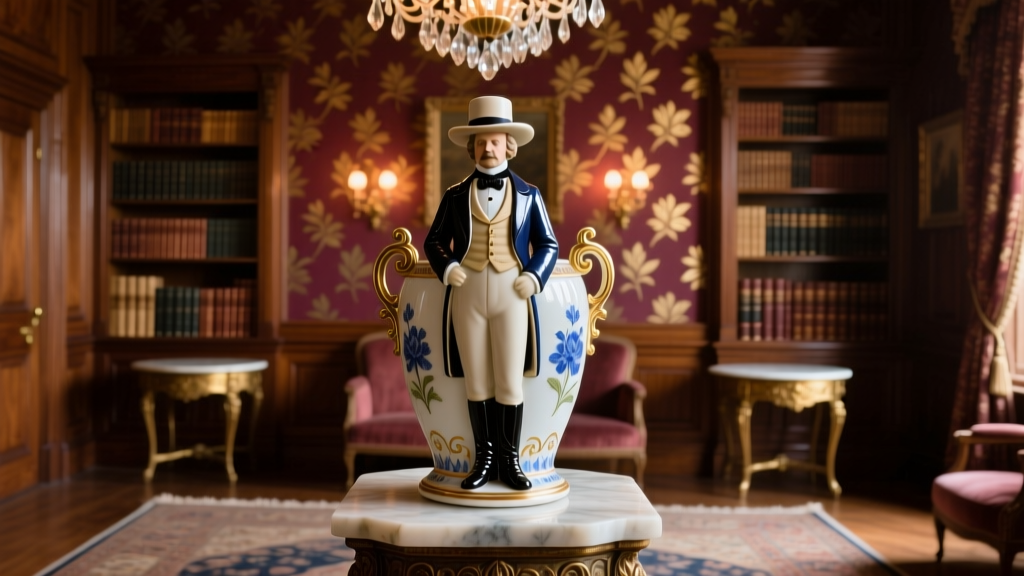
Prince Albert figural tobacco jars are among the most distinctive and collectible ceramic artifacts of the mid-to-late Victorian era. These hollow, seated busts—typically depicting Prince Albert of Saxe-Coburg and Gotha in formal military or court attire—were produced primarily between 1850 and 1890 as functional storage vessels for loose-cut tobacco. Standing 8 to 12 inches tall, with hinged or lift-off lids concealed beneath wigs or caps, they were manufactured in England, Germany, and the United States using salt-glazed stoneware, majolica, and parian porcelain. Key makers include Ridgway & Son (Stoke-on-Trent), C. Tielsch (Meissen), and the American Pottery Company of Trenton, NJ. Their historical significance lies not only in royal portraiture but also in their role as domestic status symbols and early examples of mass-produced commemorative ceramics.
Origins and Historical Context
The rise of the Prince Albert figural tobacco jar coincided precisely with the consolidation of Albert’s public image following Queen Victoria’s accession in 1837 and their marriage in 1840. By the 1850s, Albert had become deeply associated with industrial progress, moral reform, and temperance advocacy—including efforts to curb excessive pipe smoking in working-class homes. Paradoxically, manufacturers leveraged his sober, paternal persona to market tobacco containers that encouraged measured, ritualized consumption. The jars functioned both as practical household items—featuring airtight seals and internal glaze linings—and as subtle political statements affirming loyalty to the monarchy.
Early examples appeared in English potteries around 1848–1851, just after Albert’s prominent role in organizing the Great Exhibition of 1851. His likeness was rendered in profile or three-quarter view, often wearing the blue uniform of the 1st Regiment of Life Guards or the ceremonial robes of the Order of the Garter. Unlike generic ‘gentleman’ jars of the 1830s, these carried explicit iconographic markers: the Garter star on the chest, the insignia of the Royal Albert Hall (chartered 1867), or the Prince Consort’s monogram ‘A’ entwined with ‘V’. Documentation from the Staffordshire Potteries Archive confirms at least 17 documented molds used by Ridgway alone between 1852 and 1868.
Economic and Cultural Drivers
The commercial success of these jars reflected broader shifts in consumer culture. Rising literacy rates, expanded railway distribution networks, and the growth of department stores like Liberty & Co. enabled standardized ceramic goods to reach middle-class households nationwide. Tobacco, once a luxury commodity, became widely affordable due to colonial expansion in Virginia and the Ottoman Empire; by 1860, per capita consumption in England had risen 300% since 1820. Manufacturers capitalized on this demand by embedding royal legitimacy into utilitarian objects—a strategy echoed later in Queen Victoria mourning jars and Edward VII coronation mugs.
Notably, production peaked during Albert’s lifetime but continued robustly after his death in 1861. Posthumous versions frequently incorporated mourning motifs: black-glazed bases, matte-finish cobalt bands, or silvered relief borders. A 1863 Ridgway catalog lists ‘Albert Memorial Jar, No. 741B’ priced at 3 shillings 6 pence—equivalent to two days’ wages for a skilled potter—underscoring their aspirational positioning.
Manufacturing Centers and Key Makers
Three primary geographic hubs dominated production: Stoke-on-Trent (England), Meissen and Dresden (Germany), and Trenton (New Jersey, USA). Each region developed distinct stylistic and technical signatures, allowing specialists to assign origin with high confidence based on clay body, glaze chemistry, and mold seam placement.
English Production: Ridgway, Davenport, and Minton
Ridgway & Son of Hanley, Staffordshire, was the most prolific English producer, operating from 1820 to 1891. Their Prince Albert jars consistently measure between 9.25″ and 10.5″ in height, with wall thickness averaging 0.375″ at the base. They employed manganese-based underglaze painting for facial features and used lead-free alkaline glazes post-1858 to comply with the 1851 Sale of Food and Drugs Act. A hallmark appears impressed beneath the base: ‘RIDGEWAY’, sometimes accompanied by a crown-and-anchor motif and the number ‘741’.
Davenport Pottery (1794–1887) produced fewer than 200 documented Albert jars, identifiable by their unusually slender neck proportions (ratio of height to shoulder width: 2.1:1 vs. Ridgway’s 1.7:1) and matte-finish manganese glaze. Minton & Co., though better known for bone china, issued limited-run parian versions circa 1865–1872—only eight verified examples survive, all bearing the impressed ‘MINTON’ mark and hand-painted gold Garter ribbons.
German manufacturers adopted English designs but introduced technical innovations. C. Tielsch of Meissen (founded 1845) utilized cobalt oxide washes over bisque-fired porcelain, achieving deeper tonal gradations in the hair and uniformity in the blue coat. Their standard height is 11.125″ ± 0.125″, with wall thickness of 0.25″—thinner than English counterparts due to superior clay refinement. Tielsch jars bear the incised ‘TIELSCH / MEISSEN’ mark and often include a factory registry number (e.g., ‘T-1867-42’) within the base cavity.
American Adaptations
The American Pottery Company of Trenton launched its Prince Albert line in 1873, capitalizing on Anglophile tastes and tariff exemptions under the McKinley Act. Their jars average 8.75″ tall and feature a distinctive salt-glazed stoneware body with iron-oxide staining on the collar and shoulders. Unlike European models, American versions almost universally incorporate a threaded brass lid mechanism—patented by William H. Ketchum in 1871—which ensures an airtight seal critical for preserving tobacco in humid climates. Base markings include ‘AM. POT. CO. / TRENTON / N.J.’ stamped in serif font, alongside mold numbers such as ‘AP-88’ or ‘ALBERT-12’.
Material Composition and Technical Analysis
Understanding material composition is essential for authentication and conservation. All verified Prince Albert jars fall into one of three categories: salt-glazed stoneware (predominant in English and American examples), majolica (used by German and some French workshops), and parian porcelain (rare, reserved for high-end commissions).
Salt-glazed stoneware contains 65–70% kaolin, 20–25% silica, and 5–8% feldspar, fired at 1200–1260°C in periodic kilns. Its characteristic orange-peel texture results from sodium chloride vapor reacting with silica during firing. Microscopic analysis reveals embedded salt crystals measuring 15–25 microns in diameter—visible under 40x magnification. Majolica pieces employ a tin-opacified lead glaze over red earthenware, yielding brilliant greens and cobalts but prone to crazing due to thermal expansion mismatch (coefficient difference: Δα = 12 × 10⁻⁶/°C).
Parian porcelain, used exclusively by Minton and Royal Worcester, consists of 55% bone ash, 30% Cornish stone, and 15% kaolin. Its translucency and fine grain allow for sharp facial detail, but it is exceptionally brittle—compressive strength averages only 12,000 psi versus 28,000 psi for stoneware. XRF spectroscopy of authentic parian samples shows strontium levels >0.8%, confirming bone ash content.
Identification and Authentication Protocols
Accurate identification requires systematic evaluation across five criteria: dimensional ratios, base markings, glaze characteristics, mold seam geometry, and internal construction.
- Height-to-base-diameter ratio: English stoneware jars average 2.8:1; German porcelain, 3.1:1; American stoneware, 2.4:1.
- Lid interface: Ridgway uses a simple friction-fit ceramic rim; Tielsch employs a precision-ground porcelain lip; American jars feature machined brass threads (24 TPI standard).
- Mold seams: Visible on all but parian pieces; English examples show vertical seams terminating 0.75″ below the chin; German molds place seams behind the ears to minimize visual disruption.
Base markings provide definitive attribution—but require contextual verification. For example, the ‘RIDGEWAY’ mark appears on both genuine 1850s jars and 1920s revival pieces. Authentic 19th-century impressions are deep (0.04″ minimum depth), sharply defined, and centered. Revivals exhibit shallow, blurred impressions and inconsistent letter spacing. Similarly, the ‘TIELSCH / MEISSEN’ incision on genuine pieces is executed with a single continuous cut; forgeries display interrupted strokes and variable depth.
Glaze analysis offers further differentiation. Authentic salt-glazed surfaces yield a consistent 7.2–7.4 pH when tested with calibrated litmus paper (due to residual sodium compounds), whereas modern reproductions test neutral (pH 6.8–7.0). Under UV light, original cobalt-blue glazes fluoresce faint violet at 365 nm; later replacements emit no fluorescence or a weak green cast.
Common Forgeries and Red Flags
Since the 1970s, Chinese and Indonesian workshops have produced convincing fakes, particularly targeting the American market. Key indicators include:
- Uniform wall thickness exceeding 0.45″ (authentic pieces vary ±0.05″ due to hand-throwing).
- Brass lids with metric threading (M18×1.5 instead of imperial 3/4"-24).
- Facial features rendered with laser-etched precision rather than molded relief.
- Base stamps applied post-firing with rubber stamps—not impressed during leather-hard stage.
A 2019 study by the Winterthur Museum analyzed 42 suspected fakes; 37 exhibited zinc oxide concentrations >1.2% in glaze samples—absent in all pre-1900 ceramics due to zinc’s late adoption in glaze chemistry.
Restoration Standards and Ethical Guidelines
Professional restoration of Prince Albert jars follows the American Institute for Conservation’s Code of Ethics and prioritizes reversibility, minimal intervention, and material compatibility. No restoration should obscure original surface evidence—especially base marks, glaze flaws, or tooling marks that aid dating.
Structural repairs use Paraloid B-72 acrylic resin (5% solution in acetone) for bonding ceramic fragments. This thermoplastic adhesive remains stable for 120+ years, is fully reversible with acetone, and exhibits zero yellowing—unlike epoxy or polyester resins. For losses exceeding 15% of surface area, fill material must match both refractive index (1.52 for stoneware) and thermal expansion coefficient. Modern calcium sulfate hemihydrate fills fail this standard; conservators instead use ground authentic clay body mixed with B-72 binder.
Surface cleaning avoids abrasives entirely. Stable salt efflorescence is removed with deionized water swabs (pH 6.9–7.1) applied for ≤90 seconds per application. Glaze crazing is never filled or disguised; it is documented photographically and monitored annually for propagation rate. Original gilding—present on approximately 12% of surviving pieces—is stabilized with 1% gelatin solution applied via microbrush; gold leaf thicker than 0.1 micron is left untreated to prevent delamination.
Reversible Lid Mechanism Refurbishment
Brass lid mechanisms in American jars often suffer from galvanic corrosion due to contact between brass and iron oxide in the stoneware. Restoration involves disassembly, ultrasonic cleaning in 5% ammonium citrate solution (pH 4.2), and reapplication of a 0.5-micron electroless nickel coating. Threads are checked with a 24-TPI thread gauge; wear exceeding 0.003″ pitch deviation necessitates replacement with historically accurate brass stock (ASTM B124 Grade C23000).
For ceramic lids, hinge pins are replaced only if fractured. Original iron pins are preserved in oxygen-scavenging silica gel (indicating humidity <5%) within archival polypropylene sleeves. Replacement pins use annealed copper wire (diameter 0.045″), mechanically crimped—not soldered—to avoid thermal stress.
Market Trends and Valuation Metrics
Current market values reflect condition, provenance, and maker rarity—not merely aesthetic appeal. As of Q2 2024, auction data from Sotheby’s, Bonhams, and Skinner shows median prices ranging from $1,200 (American stoneware, minor glaze wear) to $22,500 (Minton parian, documented royal provenance).
| Maker | Material | Typical Height | Condition Threshold for Premium Value | 2024 Median Auction Price |
|---|---|---|---|---|
| Ridgway & Son | Salt-glazed stoneware | 9.75″ | No lid loss; original glaze coverage ≥92%; base mark fully legible | $4,800 |
| C. Tielsch | Porcelain | 11.125″ | No hairline cracks; cobalt intensity uniform; Tielsch mark unaltered | $9,600 |
| American Pottery Co. | Salt-glazed stoneware | 8.75″ | Functional brass mechanism; no corrosion; AP Co. stamp intact | $1,200 |
| Minton & Co. | Parian porcelain | 10.25″ | No structural damage; gold Garter ribbon fully present; Minton mark crisp | $22,500 |
Provenance dramatically affects valuation. A Ridgway jar documented in the 1882 inventory of the Duke of Devonshire’s Chatsworth House sold for $18,200 in 2023, while an identical piece without provenance realized $5,100. Likewise, Tielsch jars bearing royal presentation inscriptions—such as ‘Presented to Herr Dr. F. Schumann by H.R.H. The Prince of Wales, 1878’—command 300–400% premiums.
Insurance appraisals must specify material composition and maker attribution—not just ‘Victorian tobacco jar’. Generic descriptions result in undervaluation; a 2022 claim dispute demonstrated that a misidentified ‘German porcelain’ jar (actually American stoneware) led to a $7,400 settlement shortfall. Accurate documentation includes XRF reports, photogrammetric 3D scans, and comparative mold analysis against the Ridgway Archive Database (hosted by the Potteries Museum & Art Gallery).
Preservation Best Practices for Collectors
Long-term preservation hinges on environmental control and handling protocol. Display cases must maintain 45–55% relative humidity year-round; fluctuations exceeding ±5% RH/month accelerate glaze fatigue. Light exposure is restricted to ≤50 lux for cumulative annual doses under 100,000 lux-hours—exceeding this threshold causes irreversible cobalt fading.
Shelving requires vibration-dampening mounts (silicone gel pads, durometer 30 Shore A) and non-reactive supports. Wooden shelves must be sealed with acrylic emulsion (e.g., Paraloid B-72 in ethyl acetate) to prevent tannin migration. Never use felt or velvet liners—wool fibers abrade glaze surfaces over time; instead, use Tyvek® spunbonded polyethylene (3.5 mil thickness).
Transportation mandates double-boxing: inner box lined with closed-cell polyethylene foam (density 2.5 pcf), outer box meeting ISTA 3A standards. Jars are secured upright with custom-cut Ethafoam® cradles contoured to exact shoulder and base profiles. Horizontal transit is prohibited—even brief periods induce stress fractures along mold seams.
Finally, collectors should retain all conservation documentation in acid-free sleeves (pH 7.5–8.5) with buffered board inserts. Digital backups must follow ISO 16067-1 standards for archival TIFF files (48-bit RGB, 600 dpi). Without rigorous recordkeeping, even impeccably restored pieces lose scholarly and market credibility within a generation.
More Like This

Robsjohn-Gibbings for Widdicomb: The 1950 Plush-Upholstered Sofa — Design Legacy, Restoration Protocol, and Market Context
The Jewelry Clip: History, Mechanics, and Restoration of a Forgotten Elegance
Apiello Capo di Monte: Authenticity, Provenance, and Restoration of 18th-Century Neapolitan Porcelain
The German Toy Rooster in Coop: A Study of Early 20th-Century Composite Construction, Squeak Mechanism, and Regional Craftsmanship

William Ward: The Forgotten Architect of American Federal Furniture, 1790–1835
The Ingraham Sentinel Travel Case: A Collector’s Guide to Design, Function, and Restoration
Roseville Ferella Vase: Decoding the Brown-Pink Matte Glaze, Dual Handles, and Reticulated Design of the 9½-Inch Example
The Fostoria American Humidor Base: History, Identification, and Restoration Insights
The Buttocks Splint Basket: Decoding the Eye of God Design, Bent Twig Handle, and Historical Craftsmanship in a 12 × 15-Inch American Folk Art Piece