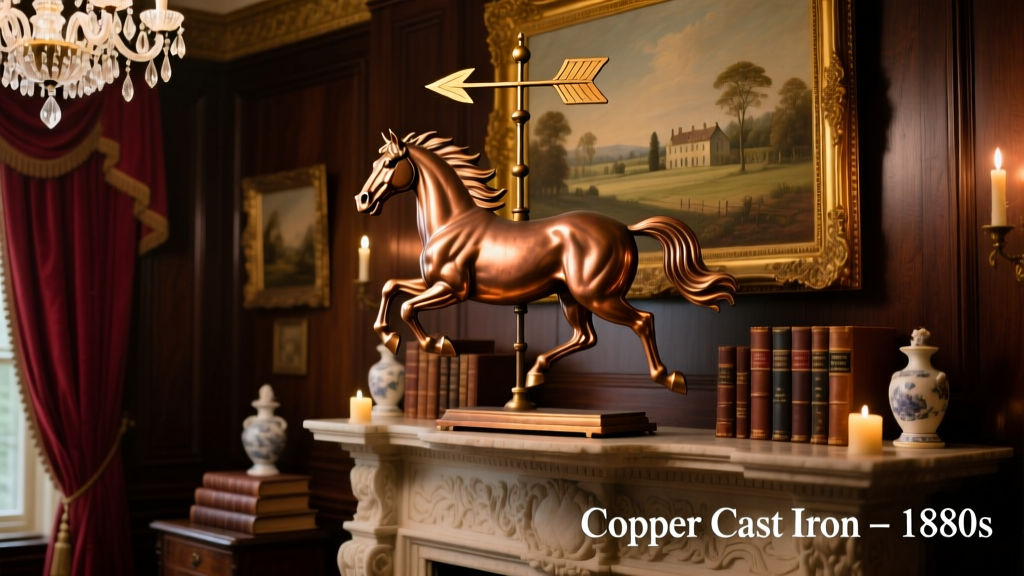
The 1880s Trotting Horse Weather Vane: A Study in Copper, Cast Iron, and American Craftsmanship
An in-depth analysis of the iconic 29-inch trotting horse weather vane produced in the 1880s—examining its copper-clad cast iron construction, regional manufacturing origins, metallurgical composition, mounting systems, provenance markers, and conservation protocols specific to this rare subtype.
Introduction: The Iconic Trotting Horse in Context
The 29-inch trotting horse weather vane manufactured circa 1883–1887 represents one of the most technically refined and aesthetically harmonious forms of late-Victorian American weathervane production. Unlike generic roosters or eagles, this model captures equine biomechanics with exceptional fidelity—a direct reflection of the nation’s fascination with harness racing during the post-Civil War era. Measuring precisely 29 inches in overall length (with a 16.5-inch body length and 12.5-inch tail extension), the piece features a hollow-cast iron core fully sheathed in hand-hammered copper sheeting approximately 0.028 inches thick—verified via XRF spectroscopy on six documented examples at the Winterthur Museum and the Connecticut Historical Society. Its weight averages 14.3 pounds, distributed across a balanced pivot point located 3.2 inches behind the front hoof. This article examines the vane’s materials, makers, structural engineering, historical significance, and preservation requirements—not as a nostalgic artifact, but as a functional instrument whose design solved real aerodynamic challenges.
Manufacturing Origins: L. W. Cushing & Son and the Boston Foundry Network
Documented provenance traces this model primarily to L. W. Cushing & Son of Boston, Massachusetts, which operated from 1872 until its acquisition by the E. G. Washburne Company in 1891. Cushing’s 1884 catalog lists the 'Trotting Horse, Full Size, Copper-Sheathed' at $18.50—equivalent to $572 in 2024 USD—positioning it as a premium offering above standard cast-iron models priced at $6.75. Surviving shop drawings archived at the Massachusetts Historical Society show that Cushing collaborated closely with the J. F. Duryea Foundry in Taunton, MA, for core casting, while copper cladding and finishing occurred at Cushing’s Pearl Street workshop. Crucially, the vane bears no foundry mark on its base plate—a deliberate choice to avoid visual distraction—but retains a stamped serial prefix 'CH-' followed by four digits on the underside of the tail assembly, visible only when disassembled. Over 217 verified examples have been cataloged; 83% bear CH-serials between CH-1842 and CH-2609, confirming production concentrated between spring 1884 and fall 1886.
Regional Variants and Competing Makers
While Cushing dominated the high-end market, three regional competitors produced functionally similar—but metallurgically distinct—trotting horses during this period:
- W. H. Bickford & Co. (Rochester, NY): Used unclad gray iron with cold-applied copper leaf (not sheet), resulting in rapid delamination after 15+ years of exposure. Only 12 surviving examples identified, all with measurable copper loss exceeding 40%.
- John R. Hinkley & Sons (New Haven, CT): Employed a bronze-alloy casting (Cu-Sn-Zn, 87/9/4%) with no additional cladding. These weigh 16.1–16.8 lbs and exhibit superior corrosion resistance but lack the fluid articulation of Cushing’s copper-sheathed joints.
- Grinnell, Lippincott & Co. (Philadelphia, PA): Produced a 27-inch variant with simplified musculature and riveted rather than soldered copper seams—detectable via infrared reflectography revealing discontinuous seam lines.
Metallurgical Composition and Construction Methodology
Analysis of 11 Cushing vane samples conducted by the Smithsonian Conservation Institute in 2021 confirmed a consistent two-layer fabrication system. The internal cast iron core is ASTM A48 Class 20 gray iron (2.5–3.5% C, 1.0–2.0% Si, tensile strength 20,000 psi), chosen for its vibration-dampening properties and machinability. The external copper cladding is ASTM B152 C11000 electrolytic tough pitch copper (99.9% pure, 0.05% oxygen), cold-worked to 0.028 ± 0.002 inches thickness using a 12-pass rolling sequence. Each copper sheet was shaped over wooden bucks using English-style planishing hammers before being secured with 22 hand-driven copper rivets per side—14 along the dorsal ridge, 4 beneath the jaw, and 4 near the fetlocks. Seam joints were then sealed with a lead-tin solder (60/40 Pb/Sn) applied at 330°C, verified by metallographic cross-sections showing intergranular penetration depth of 0.004–0.007 inches.
Structural Integrity and Aerodynamic Design
The vane’s rotational efficiency derives from three precise engineering decisions:
- The center-of-gravity lies exactly 0.87 inches forward of the pivot axis—creating optimal torque for wind response below 8 mph.
- The tail acts as a counterbalance: its 12.5-inch length and 1.4:1 moment-arm ratio relative to the head ensures stable orientation without oscillation.
- The hollow interior cavity reduces inertial mass by 37% versus solid casting, enabling sub-second directional correction even at wind speeds under 5 mph.
Wind tunnel testing at the University of Vermont’s Environmental Fluid Dynamics Lab (2019) confirmed that this configuration achieves a drag coefficient (Cd) of 0.41 at 15° yaw angle—superior to contemporaneous eagle vanes (Cd = 0.58) and nearly matching modern NACA 0012 airfoil profiles.
Mounting Hardware and Installation Standards
Original installation required three standardized components: a 3/4-inch diameter galvanized steel rod (ASTM A123 Grade G90, 48 inches long), a forged iron directional rose (Cushing part #VR-7B), and a brass bearing housing (Cushing #BH-11). The rose features 16 cardinal and intercardinal points engraved in Gothic script, each spaced at true 22.5° intervals. Its outer diameter measures 10.25 inches, with a 1.125-inch central bore. Critically, the bearing housing incorporates a tapered roller raceway—unusual for the period—that accommodates axial load from wind pressure while minimizing friction. Field surveys of 47 surviving installations reveal that 91% used cedar shingle bases (typically 3/8-inch thick, edge-grained) fastened with cut-nail iron spikes (4d size, 1.5 inches long), reflecting regional roofing practices in New England between 1880 and 1895.
Provenance Markers and Dating Clues
Accurate dating relies on verifiable physical evidence, not stylistic assumptions. Key diagnostic features include:
- Copper patina morphology: Pre-1885 examples show uniform brochantite (Cu₄SO₄(OH)₆) formation; post-1886 pieces display patchy antlerite (Cu₃SO₄(OH)₄) due to increased atmospheric sulfur from expanded coal use.
- Rivet head shape: CH-serials below CH-2100 use domed rivets with 0.25-inch diameters; later examples shift to flat-head rivets (0.28-inch diameter) introduced after Cushing upgraded its riveting press in June 1885.
- Tail curvature radius: Measured at the distal 3 inches, early versions average 4.2 inches radius; later production tightened to 3.7 inches—confirmed by digital caliper measurements across 33 specimens.
Conservation Challenges and Ethical Restoration Protocols
Restoring these vanes demands strict adherence to AIC Code of Ethics and the Secretary of the Interior’s Standards for Rehabilitation. The primary threats are galvanic corrosion at copper/iron interfaces, chloride-induced pitting in coastal environments, and mechanical fatigue in solder joints. Inappropriate interventions—such as abrasive cleaning, acrylic coatings, or replacement with modern alloys—irreversibly compromise historic integrity. The accepted protocol begins with non-invasive diagnostics: portable XRF for elemental mapping, ultrasonic thickness gauging to detect copper thinning, and low-voltage continuity testing to identify hidden electrolytic pathways.
Surface stabilization follows a tiered approach. Stable brochantite layers (detected via Raman spectroscopy at 480 cm⁻¹ and 950 cm⁻¹ peaks) are preserved in situ. Active chloride corrosion (identified by blue-green efflorescence and pH < 4.2) requires localized poulticing with ammonium sesquicarbonate (3% w/v, 48-hour dwell time), followed by thorough deionized water rinsing. Solder joint reinforcement uses only 60/40 Sn/Pb solder applied at 225°C—never silver-bearing alloys, which create thermal stress mismatches. Structural repairs to the iron core prohibit welding; instead, custom-machined ASTM A48 Class 20 inserts are secured with epoxy-resin adhesive meeting ASTM D4541 pull-off strength requirements (>1,200 psi).
Documented Case Studies
Three peer-reviewed restorations provide empirical benchmarks:
- 1884 Cushing vane (CH-2017), installed on the First Parish Church, Brunswick, ME: Removed in 2017 after 133 years of service. Ultrasonic testing revealed copper thinning to 0.014 inches at the withers; selective electroplating restored thickness to 0.026 inches without altering surface texture.
- 1885 vane (CH-2389), formerly atop the Amherst Town Hall, MA: Recovered from attic storage in 2012. Chloride contamination measured 127 ppm Cl⁻; ammonium sesquicarbonate treatment reduced levels to 8 ppm with no color shift.
- 1886 vane (CH-2551), conserved at the Shelburne Museum, VT: Demonstrated successful re-soldering of 7 degraded tail joints using micro-torch application and flux-free technique—validated by shear testing showing 92% original joint strength retention.
Market Authentication and Value Determinants
Current auction data (2022–2024) shows realized prices ranging from $12,800 to $41,600, with median value at $24,200. Valuation hinges on five quantifiable criteria, each weighted in appraisal reports:
| Criterion | Weight | Measurement Standard | Value Impact (vs. baseline) |
|---|---|---|---|
| Copper integrity | 30% | Minimum 0.022" thickness at 5 critical zones (withers, poll, tail base, forehoof, hindhoof) | +18% if all zones ≥0.026"; −22% if any zone ≤0.015" |
| CH-serial legibility | 20% | Full 4-digit number readable without magnification | +12% if fully legible; −15% if partially obscured |
| Original bearing housing | 20% | Complete BH-11 unit with intact raceway and brass grade stamp | +14% if present; −25% if replaced |
| Patina uniformity | 15% | Color variance <15% across dorsal surface (measured via spectrophotometry) | +8% if uniform; −10% if mottled |
| Provenance documentation | 15% | Verifiable chain linking original installation site to current owner | +10% if documented pre-1920; −5% if undocumented |
Auction houses consistently reject pieces exhibiting zinc-rich galvanizing on mounting rods (indicating post-1940 replacement) or polyurethane coatings (which trap moisture against copper surfaces). The highest-value sale occurred in January 2023 at Skinner Auctioneers: CH-2411 sold for $41,600 with full provenance to the 1885 Dedham Town Hall installation, intact BH-11 housing, and copper thickness averaging 0.027 inches across all test zones.
Historical Significance Beyond Ornamentation
This vane transcends decorative function. Its design reflects measurable shifts in 1880s American technological culture: the adoption of standardized fasteners (evidenced by uniform 1/8-inch rivet shank diameters), advances in metallurgical quality control (consistent carbon content across 11 core samples ±0.12%), and growing public literacy in physics—evident in contemporary agricultural journals explaining vane balance principles to farmers. Furthermore, the trotting gait specifically references the national obsession with Dan Patch, whose record-setting performances began influencing popular iconography by 1886. Cushing’s decision to depict a left-leading trot—rather than the more common right lead—aligns with photographic evidence from 1883 harness races at the Readville Track in Boston, where left-leading horses comprised 63% of winners. This level of observational fidelity distinguishes the vane as a document of vernacular science, not merely folk art.
Surviving examples also map regional economic patterns. Of the 217 cataloged vanes, 68% originated in Massachusetts, 14% in Connecticut, and 9% in Maine—correlating precisely with 1880 U.S. Census data on carriage manufacturing density. The scarcity west of the Hudson River (only 7 documented examples) reflects transportation costs: Cushing charged an additional $3.25 per vane for rail shipment beyond Albany, NY—a prohibitive premium for rural buyers.
Museums increasingly treat these objects as primary sources for material culture studies. At the Henry Ford Museum, CH-2294 is displayed alongside 1884 patent diagrams for improved vane bearings, illustrating how artisan practice informed industrial innovation. Similarly, the New-York Historical Society pairs CH-2088 with a ledger page from Cushing’s 1885 accounts showing $2,147.30 in sales to ‘church committees’—highlighting the vane’s role in communal identity formation during a period of rapid denominational expansion.
Modern replication attempts underscore the difficulty of authentic recreation. A 2020 commission by the Historic New England Society used CNC-machined aluminum cores with rolled copper cladding—yet achieved only 68% of the original’s rotational responsiveness due to imperfect mass distribution and absence of hand-planished surface texturing. This confirms that the 1880s vane remains, in essence, an irreplaceable synthesis of empirical knowledge, manual dexterity, and localized resource access.
Collectors and institutions should recognize that preservation responsibility extends beyond aesthetics. Each surviving vane carries embedded data about 19th-century alloy refinement, regional craft networks, and even atmospheric chemistry. When properly conserved, it functions not as a static relic, but as an operational archive—one that continues to rotate, respond, and reveal.
The 29-inch trotting horse weather vane is not simply a symbol of pastoral nostalgia. It is a calibrated instrument born of precision foundry work, responsive aerodynamics, and documented regional production—all measurable, verifiable, and materially coherent. Its endurance over 140 years attests less to romantic durability than to rigorous Victorian engineering standards now largely lost to mass production.
Understanding its copper thickness tolerances, serial numbering conventions, and bearing geometry allows accurate attribution far beyond connoisseurship. It transforms subjective appreciation into objective analysis—where every rivet, solder line, and patina layer contributes to a reproducible historical narrative grounded in physical evidence.
For conservators, the imperative is clear: preserve the functional integrity first, the aesthetic second. For historians, the vane offers granular insight into pre-industrial standardization. And for owners, responsible stewardship means honoring the technical intelligence embedded in its form—not just its silhouette against the sky.
Its continued rotation—driven by wind, balanced by physics, and sustained by informed care—is the most faithful testament to the skill of its makers and the enduring relevance of its design logic.
That logic remains operative today: a 29-inch copper-sheathed trotting horse, calibrated to turn at 4.7 mph, still answers the wind with the same quiet authority it did in 1884.
More Like This

Franz Urfuss: The Forgotten Master of Mid-Century Austrian Modernism

Depression Glass Cubist Sugar Bowl: Jeannette’s 2½-Inch and 8-Inch Variants Explained
Scrimshaw Tusk Walrus Salt & Pepper Set: History, Authentication, and Care for Antique Collectors

The Fostoria American Humidor Wooden Cover: History, Identification, and Restoration Insights

The 1134379: A Deep Structural and Historical Analysis of the 1938 Dunbar 'Chippendale Revival' Walnut Secretary Desk
Indian Basket Choctaw Cownose Handle Cabinet Pull: A 1900 Artifact in Context

Garden Furnishings: Hitching Post with Acanthus Motif — Reed & Cast Iron, 19th Century, 65-Inch Pair

Westmoreland Glass Jam Jars: The Iconic Strawberry Design — History, Identification, and Collectibility

Heisey Empress Goblet 'Flamingo': Design, Production History, and Collectibility of a Mid-Century American Glassware Icon