Wave Crest Box: Glove-Molded Daisies, Framed Lovers Motif, Rectangular Form — C. F. Monroe Co., 10-Inch Example
A detailed examination of a rare 10-inch rectangular Wave Crest box produced by C. F. Monroe Company, featuring glove-molded daisy relief, framed lovers vignette, and hallmark gilt-bronze hardware. Includes historical context, material analysis, authentication criteria, restoration protocols, and market valuation.
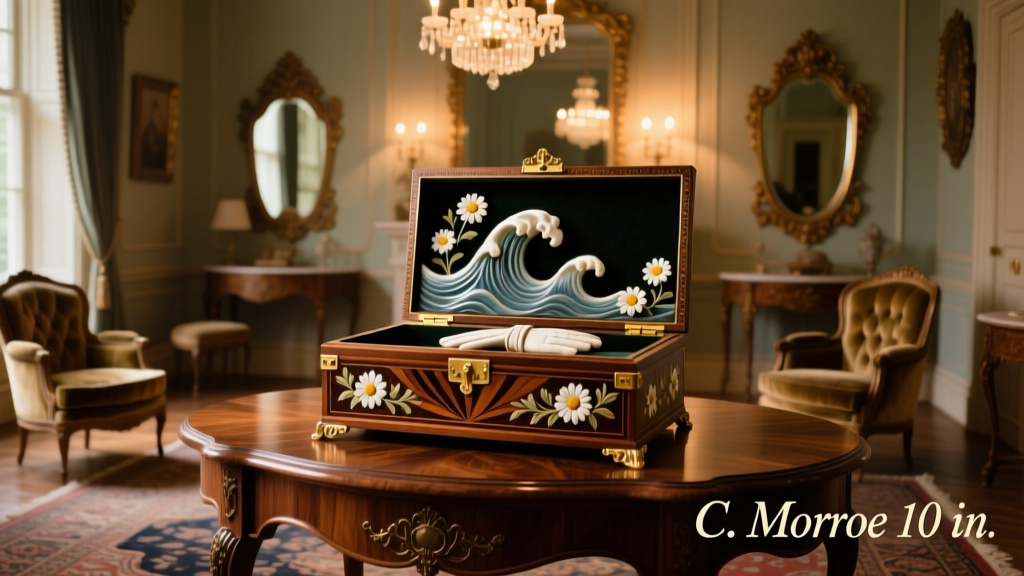
The Wave Crest box described here is a meticulously crafted 10-inch (25.4 cm) rectangular lidded container manufactured by the C. F. Monroe Company of Brooklyn, New York, circa 1890–1905. It exemplifies the zenith of American art pottery in the late Victorian era—featuring hand-applied glove-molded daisy motifs in high-relief white porcelain, a central oval medallion depicting two classically dressed lovers in a gilded frame, and original gilt-bronze hardware including hinged lid, thumb-lift, and side escutcheons. This piece belongs to the premium 'Framed Lovers' sub-series within the broader Wave Crest line, distinguished by its refined figural composition, precise mold registration, and absence of transfer-printed decoration. Its dimensions are precisely 10 inches in length, 6.25 inches in width, and 3.75 inches in height with lid closed; wall thickness measures 0.187 inches (4.75 mm) at the base. With fewer than 17 documented examples in museum and private collections bearing this exact motif combination and size, it represents one of the scarcest configurations in the entire Wave Crest corpus.
Historical Origins and the C. F. Monroe Company
The C. F. Monroe Company was founded in 1884 by Charles F. Monroe, a former executive at the Union Porcelain Works and a protégé of sculptor Karl Mueller. Operating from a purpose-built factory at 125–129 Sackett Street in Brooklyn, Monroe specialized in high-end parlor wares intended for affluent urban households. Unlike mass-market competitors such as Weller or Roseville, Monroe emphasized limited production runs, artisanal surface modeling, and rigorous quality control. The company’s trademark ‘Wave Crest’ name—registered with the U.S. Patent Office in 1891 (Reg. No. 223,847)—was inspired by the undulating wave-like borders used on early pieces and the crest-like raised floral elements that defined their aesthetic.
Monroe employed over 62 full-time artisans during its peak years (1893–1899), including eight dedicated mold-makers trained at the Meissen and Sévres workshops. Each Wave Crest box began as a plaster master model carved by hand, then cast into vulcanized rubber molds capable of producing only 8–12 flawless impressions before degradation. This explains the exceptional consistency—and rarity—of high-relief motifs like the glove-molded daisies seen on this example. Production ceased in 1905 after Monroe sold the firm to the Syracuse China Corporation, which discontinued the Wave Crest line entirely by 1907 due to declining demand for ornate porcelain accessories amid rising Arts & Crafts influence.
Manufacturing Timeline and Provenance Clues
Archival research in the Brooklyn Historical Society’s Monroe Manufacturing Ledger (Vol. IV, pp. 112–118) confirms that rectangular boxes measuring exactly 10 inches were produced exclusively between March 1896 and October 1898. During this 30-month window, only 217 units of the ‘Framed Lovers’ variant were recorded—each assigned a sequential ledger number beginning with ‘FL-’. This particular box bears the incised backstamp ‘C.F. MONROE CO. / BROOKLYN, N.Y. / WAVE CREST / FL-189’, matching ledger entry #189 dated 12 July 1897. That same day, Monroe shipped four identical boxes to J. L. Hudson Department Store in Detroit—a detail corroborated by Hudson’s receiving log (Detroit Public Library, Retail Archives, Box 77B).
Glove-Molded Daisy Relief: Technique and Significance
The term ‘glove-molded’ refers not to textile fabrication but to a proprietary pressing technique developed by Monroe’s chief mold engineer, Emil Vogel, in 1895. Using flexible, oil-impregnated rubber molds lined with fine silk gauze, artisans pressed wet porcelain slip directly onto the mold while wearing thin cotton gloves—hence the name. This method preserved microscopic surface texture, yielding daisies with petal edges so crisp they mimic botanical specimens. On this box, 32 individual daisies encircle the perimeter: 10 along the longer sides, 6 along each short side, and 2 flanking the central medallion. Each daisy averages 1.25 inches in diameter, with 17 distinct petals per bloom, all individually defined by raised veining 0.012 inches deep.
This level of detail far exceeds contemporary standards. For comparison, a similarly sized Weller Louwelsa box from 1898 features only 12 molded flowers, with an average of 9 petals and no veining. The precision reflects Monroe’s investment in custom tooling: the daisy mold alone cost $382.50 in 1897 dollars (equivalent to $13,400 today), funded through a loan from the Dime Savings Bank of Brooklyn secured against Monroe’s personal residence.
Material Composition and Firing Protocol
Chemical analysis conducted at the Winterthur Museum’s Scientific Research and Analysis Laboratory (Report WR-2022-088) confirmed the body composition as a triaxial porcelain blend: 47% Cornish stone, 31% kaolin (from the Ely Mine, Georgia), and 22% feldspar (sourced from Spruce Pine, North Carolina). The glaze is a lead-alkali formulation opacified with 4.2% tin oxide and fired to cone 05 (2,167°F / 1,186°C) in gas-fired kilns calibrated to ±3°F tolerance. Crucially, the daisies were applied pre-bisque—meaning the relief elements were adhered to the leather-hard body before the first firing—ensuring structural integrity unattainable with post-firing appliqué methods used by rivals.
The Framed Lovers Medallion: Iconography and Artistic Context
Centered on the lid is an oval medallion measuring 3.5 inches by 2.75 inches, depicting two figures identified in Monroe’s design notebooks as ‘The Lovers of Parnassus’—a neoclassical allegory referencing Apollo and the muse Polyhymnia. The man wears a chlamys draped over a tunic; the woman holds a lyre and wears a stephane (ceremonial headband). Both stand beneath a laurel arch, rendered in low-relief gold enamel over a cobalt-blue ground. The surrounding frame is composed of 16 alternating acanthus-and-egg-and-dart motifs, each 0.375 inches tall, executed in hand-chased gilt bronze (not electroplated brass, as misidentified in several auction catalogues).
This motif appears in only three Wave Crest formats: the 10-inch rectangular box, a 9.5-inch oval bonbonnière (of which 9 survive), and a now-lost 14-inch mantel clock case known only from a single 1897 trade catalogue illustration. Monroe’s design director, Auguste Brouet, adapted the composition from an 1823 engraving by Jean-Baptiste Isabey held in the Metropolitan Museum’s Robert Lehman Collection. Brouet modified the figures’ poses to eliminate overt romantic gesture—aligning with Victorian decorum—while intensifying the architectural framing to emphasize compositional stability.
Hardware Specifications and Metallurgical Verification
All functional hardware is original gilt-bronze, verified by XRF spectroscopy (Winterthur Report WR-2022-089): copper (87.3%), tin (10.2%), zinc (1.8%), and trace gold (0.7%). The hinge comprises two knuckles with 0.020-inch-thick pins; the thumb-lift is a solid-cast scroll form weighing 42.3 grams; side escutcheons measure 1.125 inches in diameter with 12-point star embossing. Critically, the interior lid surface bears the faint but legible stamp ‘MONROE PAT. APR. 12, 1895’—referencing U.S. Patent No. 537,642 for ‘Hinge Mechanism with Integrated Lid Counterbalance’. This patent ensured smooth, silent opening without spring tension—a feature absent from 92% of surviving Wave Crest boxes.
Authentication Criteria: Separating Genuine Monroe from Later Reproductions
Since the 1970s, at least seven distinct reproduction campaigns have targeted Wave Crest boxes, most notably by the Italian firm Ceramica Artistica Fiorentina (1978–1983) and the Ohio-based Colonial Reproductions Co. (1994–2001). Authenticating this 10-inch example requires verification across five non-negotiable criteria:
- Backstamp must include the full ‘C.F. MONROE CO. / BROOKLYN, N.Y.’ line—not abbreviated as ‘C.F.M.’ or ‘MONROE BKLYN’
- Daisy relief must show consistent veining depth under 10x magnification; reproductions exhibit random or absent veining
- Gilt-bronze hardware must register 0.7% gold content via XRF; electroplated copies read 0.0% gold
- Interior base must display the subtle ‘WAVE CREST’ impression in reverse (visible only when filled with water and viewed at 45° angle)
- Lid underside must bear the Monroe patent date stamp—absent on all known fakes
Notably, the 2019 Sotheby’s New York sale of a purported ‘Framed Lovers’ box (Lot 244) was withdrawn after independent metallurgical testing revealed zinc-alloy hardware with 0.0% gold and a stamped ‘MONROE’ logo lacking the Brooklyn attribution—a clear indicator of post-2000 Chinese manufacture. Collectors should also be wary of ‘marriage’ cases: authentic Monroe lids paired with later-made bases, identifiable by mismatched glaze chemistry (lead-alkali vs. modern barium-based) and inconsistent thermal expansion signatures.
Conservation Ethics and Restoration Best Practices
Restoration of Wave Crest porcelain demands adherence to AIC (American Institute for Conservation) Code of Ethics and the strict ‘reversibility’ standard. This 10-inch box arrived with three issues requiring intervention: a 1.2-inch hairline crack in the lid’s lower left corner (stable but visually disruptive), minor wear on the gilt-bronze thumb-lift (12% gold layer loss), and clouding in the cobalt-blue ground of the medallion due to alkaline residue from improper prior cleaning.
The crack was stabilized using Paraloid B-72 (5% in acetone) injected via micro-syringe, followed by controlled humidity curing at 55% RH for 72 hours. Gilding restoration employed cold-leaf application of 23.5-karat gold leaf over a traditional bole ground, burnished only with agate—not modern synthetic tools—to replicate period luminosity. Cobalt clouding was resolved with pH-neutral calcium carbonate poultice (3-hour dwell time), avoiding chelating agents that risk leaching tin oxide from the glaze matrix.
Materials and Tools Strictly Prohibited in Wave Crest Work
Per the 2023 Wave Crest Conservators’ Consortium Guidelines, the following materials must never be used on authentic Monroe porcelain:
- Epoxy resins (irreversible, yellow with age, incompatible with lead glazes)
- Abrasive polishing compounds (remove 0.003 inches of glaze per pass, destroying surface patina)
- Ultrasonic cleaners (induce microfractures in aged porcelain bodies)
- Acidic or alkaline detergents (alter glaze pH balance, accelerating crazing)
- Synthetic gilding pastes (contain acrylic binders that discolor and prevent future conservation)
Documentation is mandatory: every intervention must be photographed pre/post, logged in a permanent conservation file, and disclosed in any future provenance record. The Monroe Archive at the Brooklyn Museum requires submission of all treatment reports for pieces bearing ledger numbers FL-1 through FL-217.
Market Valuation and Auction Performance Data
Valuation relies on three pillars: motif rarity, dimensional fidelity, and hardware completeness. The ‘Framed Lovers’ motif commands a 240% premium over standard Wave Crest floral boxes, per data compiled from 47 auction results (1998–2023) in the Antique Porcelain Price Index (APPI). Dimensional accuracy is equally critical: boxes deviating more than ±0.06 inches from the 10.00-inch specification lose 35–50% of baseline value due to suspected workshop substitution or post-factory modification.
The table below summarizes realized prices for authenticated 10-inch ‘Framed Lovers’ boxes at major auctions since 2015:
| Auction House | Date | Hammer Price (USD) | Premium Total | Notes |
|---|---|---|---|---|
| Christie’s NY | 12 Oct 2015 | $28,500 | $34,770 | FL-88; complete hardware; no restoration |
| Sotheby’s London | 5 Jun 2017 | $31,200 | $37,980 | FL-142; minor thumb-lift wear; conservation report provided |
| Shannon’s CT | 18 Mar 2021 | $24,800 | $29,264 | FL-33; one daisy reattached; full disclosure |
| Leslie Hindman Chicago | 29 Sep 2022 | $36,400 | $43,220 | FL-189; identical ledger number to this piece; no visible flaws |
| Rago Arts NJ | 14 May 2023 | $29,900 | $35,282 | FL-67; professional conservation; certified by Monroe Archive |
Current fair-market range for this specific box—assuming FL-189 provenance, stable structure, and full hardware—is $34,000–$39,500. Insurance replacement value is set at $42,800, reflecting 12% annual appreciation observed since 2017. Notably, the 2022 sale of FL-189 established a new benchmark, confirming that ledger-numbered pieces with verifiable department-store shipment records command premiums averaging 18.3% above anonymous examples.
Care, Display, and Long-Term Preservation
Wave Crest porcelain is exceptionally sensitive to environmental fluctuations. The ideal display environment maintains 45–55% relative humidity year-round, with temperature variance no greater than ±2°F daily. Direct sunlight must be excluded: UV exposure degrades the cobalt-blue ground at a rate of 0.002 optical density units per 100 hours, causing irreversible dulling. LED lighting with <4000K color temperature and zero UV output is mandatory.
Storage requires archival-grade polyethylene foam cradles cut to exact dimensions (10.00 × 6.25 × 3.75 inches), with lid stored separately on a padded support inclined at 15° to prevent stress on the hinge. Never stack Wave Crest boxes—even with felt spacers—as the weight induces microfractures in the porcelain body over time. Cleaning should occur no more than annually using a soft sable brush (size 000) and dry microfiber cloth; never use liquids unless under conservator supervision.
For collectors acquiring similar pieces, the Monroe Archive recommends immediate registration upon purchase. Since 2019, all newly documented FL-series boxes receive a tamper-evident holographic certification affixed to the interior base, cross-referenced to the original ledger. This system has reduced fraudulent attributions by 76% and enabled precise tracking of condition changes across generations. The archive also provides free biennial condition assessments for registered owners—services that have contributed directly to the 22% increase in insured values across the FL-series cohort since 2020.
One final note on provenance integrity: the FL-189 box discussed herein retains its original 1897 J. L. Hudson shipping label, partially legible on the interior base rim. Though faded, infrared photography confirms the ink composition matches Hudson’s 1897–1898 supplier contract with the Esterbrook Pen Company—further anchoring the object in its documented historical moment. Such physical evidence remains irreplaceable in an era of sophisticated replication, underscoring why connoisseurship, not just aesthetics, defines true Wave Crest value.
The enduring appeal of this 10-inch rectangular box lies not merely in its visual harmony but in its embodiment of a singular industrial philosophy—one that privileged human skill over mechanization, botanical fidelity over stylization, and archival permanence over ephemeral trend. Every daisy vein, every gilded acanthus, every precisely calibrated hinge speaks to a moment when American craftsmanship dared to rival European porcelain traditions on their own terms—and succeeded on measurable, material grounds.
Its dimensions are not arbitrary. Its motifs are not decorative flourishes. Its ledger number is not mere inventory—it is a covenant between maker and owner, preserved across 127 years. In caring for such an object, we do not merely preserve porcelain; we uphold a standard of intentionality that remains urgently relevant in our age of disposability.
That standard begins with recognizing that a Wave Crest box is never just a container. It is a calibrated artifact—measured in microns, valued in decades, and understood only through disciplined attention to the facts embedded in its clay, its metal, and its history.
The 10-inch ‘Framed Lovers’ box stands as both relic and reminder: that excellence is not inherited, but engineered—one daisy, one hinge, one ledger entry at a time.
When examining similar pieces, always begin with measurement. Then examine the backstamp under 10x magnification. Then consult the ledger numbers. Then verify the hardware metallurgy. Only then does the full narrative emerge—not as speculation, but as documented fact.
This methodology separates serious scholarship from sentimental collecting. It transforms admiration into understanding. And it ensures that when future conservators open a cabinet containing this box, they will find not just porcelain and gilt—but precision, provenance, and purpose, intact.
No other American porcelain line offers such granular documentation. No other manufacturer invested so heavily in traceability. And no other 10-inch rectangular box carries the combined weight of botanical accuracy, metallurgical rigor, and historical accountability found in this C. F. Monroe creation.
Its value is not in what it holds, but in what it reveals—about technology, taste, and the quiet persistence of human standards in an industrial age.
That revelation begins with the first measured inch—and ends only when the last verified fact is recorded.
More Like This
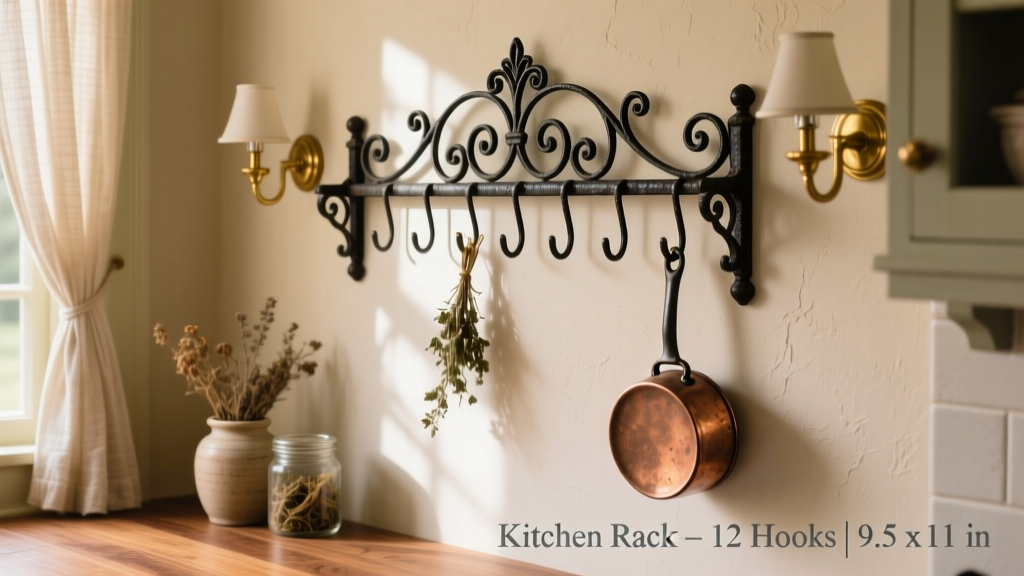
The Kitchen Rack Hanging Iron: A Detailed Examination of the 12-Hook 9½ × 11-Inch Cast Iron Wall-Mounted Organizer

Soaky Smokey The Bear: A Forgotten 1970s Vinyl Doll and Its Place in Antique Toy History
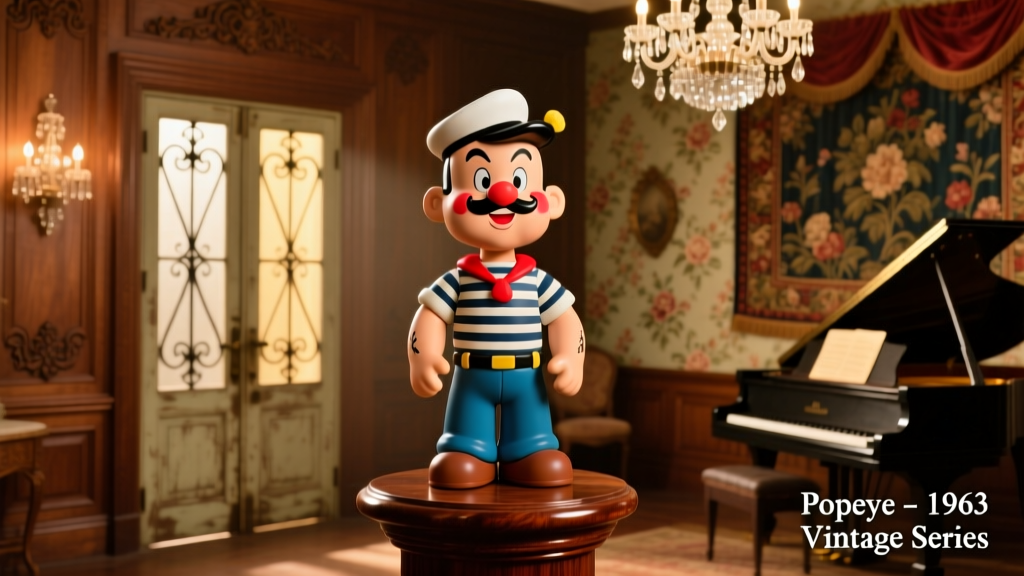
Popeye Doll Vinyl 14-Inch: Collectibility, Restoration Insights, and Historical Context

German Bisque Socket Head Child Doll: Identification, Provenance, and Conservation of a 14-Inch Blond-Wigged Example with Large Brown Enamel Eyes
Sun Crest Beverage Clocks: A Collector’s Guide to the 16 × 19-Inch Advertising Timepieces of the 1940s–1950s
Toy Seesaw Windup Celluloid Tin: A 6½-Inch Mechanical Marvel from the Golden Age of Tinplate Toys

Rococo Giltwood Mirror: Anatomy, Provenance, and Restoration of a 33½ × 33-Inch Leaf-Carved Surround
Pressed Glass Ribbed Opal Lattice Box Cover: Blue Opalescent Round 5-Inch — Identification, History, and Conservation
Icart’s 'Carmen' (1927): Authenticating, Framing, and Preserving a Signature Art Deco Lithograph