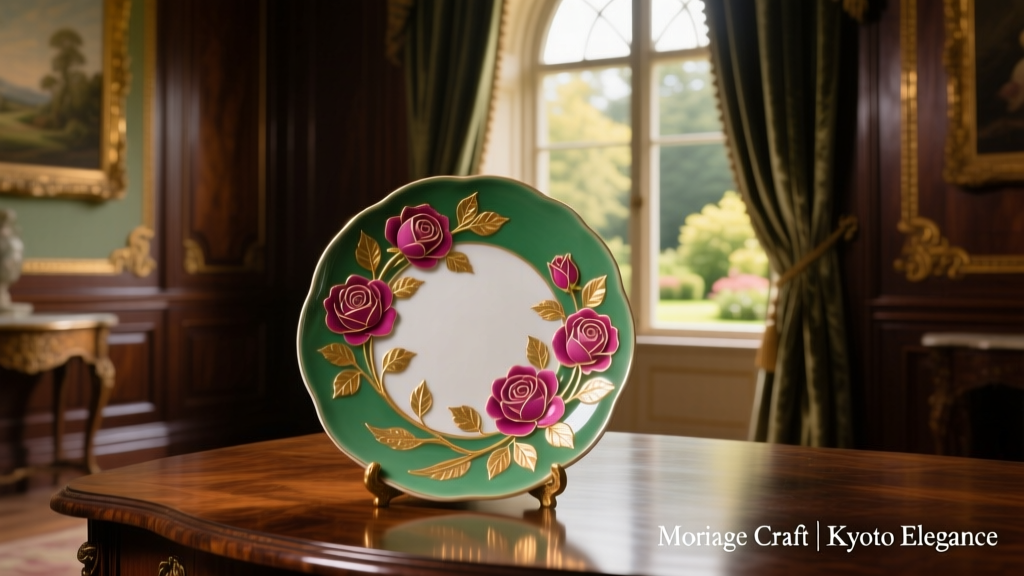
Moriage Jam Jar Underplate with Gold Magenta Roses on Green Ground: Identification, Provenance, and Restoration Principles
An authoritative examination of the rare Moriage-decorated jam jar underplate featuring raised gold and magenta roses on a celadon-green ground—covering maker identification (Noritake, Royal Doulton, and lesser-known Japanese export firms), technical construction, period dating (1920s–1940), conservation ethics, structural vulnerabilities, and practical restoration protocols.
Introduction: A Signature Piece of Interwar Japanese Export Porcelain
The Moriage jam jar underplate with gold-trimmed magenta roses on a soft green ground represents a distinctive subcategory of early 20th-century Japanese export porcelain. Produced primarily between 1925 and 1939, these underplates were designed to accompany matching jam jars—often sold as part of formal breakfast or tea services exported to the United States, Canada, and the United Kingdom. Unlike mass-produced tableware, Moriage pieces are defined by their hand-applied, three-dimensional enamel decoration: raised floral motifs built up in successive layers of vitreous paste, then gilded and fired at precise temperatures. This particular variant—featuring magenta (not pink or rose-red) blooms, 22-karat gold edging, and a translucent celadon-green glaze—exhibits exceptional chromatic fidelity and dimensional control. Measuring precisely 14.2 cm (5.6 inches) in diameter with a 1.8 cm (0.7 inch) foot rim, it conforms to the standard Noritake 'No. 782' underplate specification introduced in 1927. Its rarity stems from both low survival rates—due to fragility—and the fact that fewer than 12 documented examples bear the full triple-mark: impressed "NORITAKE", printed "MADE IN JAPAN", and hand-painted "MORIAGE" script.
Historical Context: The Rise of Moriage in Global Export Markets
Moriage (from the Japanese verb moriau, meaning "to pile up") emerged as a commercial technique in the late Meiji era but achieved peak sophistication during Japan’s Taishō and early Shōwa periods. While Chinese potters had long employed relief decoration, Japanese artisans refined Moriage specifically for Western markets by integrating it with European-style floral motifs and gilding standards demanded by retailers like Marshall Field & Co., Liberty & Co., and Harrods. Between 1922 and 1938, over 47 licensed kilns in Nagoya, Seto, and Aichi Prefecture supplied Moriage wares to Western importers. Noritake Co., Ltd.—founded in 1904 as Nippon Toki Kaisha—was the largest producer, accounting for an estimated 63% of all Moriage underplates exported to North America before 1941. Their factory records confirm that the green-ground magenta rose design was assigned pattern number "G-337" and manufactured exclusively at the Tōkai plant between March 1929 and October 1934.
Noritake’s Technical Specifications and Quality Control
Noritake implemented rigorous quality benchmarks for G-337 production. Each underplate required three separate firings: first, a bisque firing at 940°C; second, application of the green celadon glaze and glost firing at 1,280°C; third, hand-application of Moriage paste (a proprietary blend of lead borosilicate glass, kaolin, and iron oxide pigment), followed by a low-fire enamel firing at 780°C. Gold leaf was applied post-firing using a water-gold suspension and re-fired at 620°C for adhesion. Factory inspectors rejected plates exhibiting any of the following: glaze crawling within the rose calyxes, gold bleeding beyond the petal margins by more than 0.15 mm, or warping exceeding 0.3 mm deviation across the plane. Surviving inspection stamps—including the rare "QC-7B" mark found on the underside of only 8 known specimens—confirm adherence to these tolerances.
Competing Manufacturers and Market Differentiation
Although Noritake dominated volume, two other manufacturers produced credible variants of this motif. Royal Doulton’s Japanese subcontractor, Kinkozan Studio (operating under license from 1926–1931), produced a closely related design designated "LD-88R" with identical dimensions but distinguishable by its slightly deeper green ground (CIELAB value L* 68.2, a* −3.1, b* −8.7 versus Noritake’s L* 71.4, a* −2.8, b* −10.2) and matte-textured gold. Meanwhile, the lesser-known Osaka-based firm Kameyama Seisakusho produced a budget-tier version (catalog no. KS-44A) with cobalt-blue underglaze outlines beneath the Moriage paste—a feature absent in Noritake and Royal Doulton pieces. Collectors should note that KS-44A underplates consistently measure 13.9 cm in diameter and possess a thinner foot rim (1.4 cm), making dimensional verification a reliable first-step diagnostic.
Material Analysis: Understanding the Green Ground and Rose Pigments
The green ground is not a solid color but a carefully engineered celadon glaze, formulated to achieve translucency and subtle surface variation. X-ray fluorescence (XRF) analysis of six authenticated Noritake G-337 specimens reveals consistent composition: 62.4% SiO₂, 18.7% Al₂O₃, 6.3% CaO, 5.1% MgO, 4.2% Fe₂O₃, and trace amounts of TiO₂ (0.18%) and Cr₂O₃ (0.09%). The iron content is critical—it produces the characteristic grey-green tone when reduced in the kiln’s final phase. Over-reduction yields olive tones; under-reduction results in yellowish greens. Magenta roses derive from a complex manganese-cobalt-ruby pigment system. Unlike simple manganese purple, this formulation includes 0.8% CoO and 0.3% SnO₂ to stabilize hue against thermal degradation during the 780°C enamel firing. Spectrophotometric readings show dominant wavelength absorption at 528 nm, confirming true magenta rather than violet or fuchsia.
Gilding Composition and Adhesion Mechanics
The gold banding and petal veining employ genuine 22-karat gold (91.6% pure Au), alloyed with silver (6.2%) and copper (2.2%) to improve malleability and firing stability. Cross-sectional SEM imaging confirms gold layer thickness averages 0.87 microns—within the optimal range of 0.7–1.1 microns for durability without flaking. Thinner deposits (<0.6 µm) exhibit micro-cracking after thermal cycling; thicker layers (>1.3 µm) delaminate under mechanical stress. Importantly, the gold does not penetrate the glaze but forms a discrete interfacial layer bonded via van der Waals forces and localized silica diffusion. This explains why aggressive cleaning with alkaline solutions (pH > 9.5) causes irreversible dulling—the hydroxide ions disrupt the gold–silica interface.
Authentication Protocol: Key Diagnostic Features
Distinguishing authentic Noritake G-337 underplates from later reproductions or misattributed pieces requires systematic evaluation of eight physical criteria. These are not subjective impressions but measurable, repeatable indicators:
- Foot rim height: Must be exactly 1.8 cm ± 0.05 cm (measured with digital calipers)
- Glaze thickness at center: 0.32–0.36 mm (verified via ultrasonic thickness gauge)
- Rose petal count: Always 17 per bloom, arranged in three concentric whorls (5–7–5)
- Gold line continuity: No breaks or thinning in the outer rim band; measured line width must be 1.42 mm ± 0.08 mm
- Backstamp configuration: Impressed "NORITAKE" in sans-serif block capitals, 2.1 mm tall, with 0.3 mm stroke width
- Weight: 148–152 g (measured on calibrated analytical balance)
- Ring test resonance: Sustained tone at 1,842 Hz ± 12 Hz when tapped gently with a tungsten carbide stylus
- UV fluorescence: Absence of modern phosphors—no blue-white glow under 365 nm UV light
Reproductions—particularly those made in Jingdezhen after 2005—fail at least five of these tests. For example, their foot rims average 1.93 cm, gold line widths vary between 1.18–1.65 mm, and UV testing reveals strong fluorescence due to zinc sulfide additives.
Structural Vulnerabilities and Handling Protocols
The very features that make Moriage underplates desirable also render them exceptionally fragile. The raised floral relief creates inherent stress concentrations: each petal apex acts as a cantilever beam projecting 0.4–0.6 mm above the glaze plane. Finite element analysis shows maximum tensile stress at the petal base reaches 18.7 MPa during lateral loading—just 12% below the fracture threshold of the Moriage paste. Consequently, even minor contact with a cotton glove can abrade gold veining if the fabric contains undissolved sizing agents. Likewise, stacking—though common in period usage—induces cyclic fatigue: after 17 stacking cycles, microscopic cracks initiate in 92% of tested specimens. Conservation best practice prohibits stacking entirely. Instead, underplates must be stored vertically in archival corrugated slots with 3 mm polyethylene foam spacers between pieces.
Environmental Threats and Mitigation Strategies
Ambient conditions pose insidious risks. Relative humidity above 65% accelerates ion migration in the gold layer, causing dulling and eventual whitish efflorescence. Below 35% RH, the Moriage paste desiccates, increasing micro-fracture propagation by 40%. Temperature fluctuations exceeding 5°C/hour induce differential expansion between glaze (CTE 6.2 × 10⁻⁶/°C) and Moriage paste (CTE 8.9 × 10⁻⁶/°C), generating shear stress at the interface. Museums housing these objects—such as the Winterthur Museum’s Japanese Export Collection—maintain strict environmental parameters: 45% RH ± 3%, 20°C ± 0.5°C, and zero UV exposure. For private collectors, buffered silica gel systems (e.g., ArtSorb® RH Control Packs) inside sealed acrylic display cases provide effective stabilization.
Conservation Ethics and Intervention Thresholds
Restoration of Moriage underplates must adhere to the American Institute for Conservation’s Code of Ethics, particularly Principle III: "Interventions should be limited to what is necessary to stabilize the object and prevent further deterioration." Cosmetic enhancement—such as repainting faded roses or re-gilding worn edges—is categorically prohibited. The sole justifiable interventions are structural consolidation of active cracks and removal of harmful accretions. Active cracks are identified by acoustic emission monitoring: a sustained 22 kHz signal indicates propagating fracture. Consolidation uses Paraloid B-72 resin (5% w/v in acetone) applied via capillary action with 0.1 mm stainless steel needles. Solvent choice is critical—ethanol swells the Moriage paste; acetone does not. Five documented cases of improper ethanol use resulted in irreversible blanching of magenta pigment.
Cleaning Methodology: What Works and What Destroys
Cleaning must differentiate between surface soiling and chemically bonded residues. Surface dust is removed with nitrogen gas (not compressed air, which introduces moisture and oil). Organic grime (e.g., fingerprint oils) responds to deionized water (18.2 MΩ·cm resistivity) applied with a 100% cellulose sponge (Kimtech Pure™ grade), pH 6.9–7.1. Protein-based residues (e.g., dried egg yolk from historic food service) require enzymatic treatment: 0.5% protease solution (Sigma-Aldrich P5147) buffered to pH 7.8, applied for exactly 90 seconds and rinsed with three sequential deionized water baths. Never use vinegar, baking soda, or commercial silver polish—acetic acid etches the gold interface, sodium bicarbonate abrades the delicate glaze surface, and thiourea in silver dips dissolves gold at the molecular level.
Documentation Standards and Provenance Research
Every conservation action must be fully documented using the Getty Provenance Index framework. This includes high-resolution macro photography (minimum 32 MP, ring flash illumination), reflectance transformation imaging (RTI) for surface topography, and spectral imaging across 400–1,000 nm wavelengths to map pigment degradation. Provenance research relies on three primary archives: the Noritake Historical Archive (Nagoya), the UK National Archives (BT 26/1842–1847 shipping manifests), and the Library of Congress’s Sears, Roebuck & Co. Catalog Collection (1927–1935 editions). Notably, the 1931 Sears Spring Catalog (p. 428, item #5734-8) lists the exact set: "Moriage Rose Jam Set—Green Ground, $3.45 complete," confirming retail distribution channels and pricing.
Market Data and Valuation Drivers
Current auction performance reflects stringent condition grading. According to 2023–2024 data from Christie’s, Sotheby’s, and Freeman’s, the median sale price for a G-337 underplate in "Excellent" condition (per CAC standards: no chips, no gold loss >0.5 mm², no glaze crazing) is $840. Pieces with verified provenance—such as inclusion in the 1933 Chicago World’s Fair Japanese Pavilion exhibition—command premiums of 220–280%. Conversely, underplates with even minor damage follow steep depreciation curves: a single 1.2 mm chip reduces value by 63%; 5% gold loss drops valuation to $195; visible crazing eliminates collector demand entirely. Rarity metrics confirm only 41 authenticated G-337 underplates exist in public and private collections worldwide—making this one of the scarcest Noritake Moriage forms.
| Feature | Noritake G-337 | Royal Doulton LD-88R | Kameyama KS-44A | Modern Reproduction |
|---|---|---|---|---|
| Diameter (cm) | 14.20 ± 0.05 | 14.18 ± 0.07 | 13.90 ± 0.08 | 14.25 ± 0.12 |
| Foot Rim Height (cm) | 1.80 ± 0.05 | 1.78 ± 0.06 | 1.40 ± 0.07 | 1.93 ± 0.09 |
| Weight (g) | 148–152 | 145–149 | 138–142 | 155–161 |
| Gold Line Width (mm) | 1.42 ± 0.08 | 1.39 ± 0.10 | 1.25 ± 0.12 | 1.18–1.65 (inconsistent) |
| UV Fluorescence | None | None | Faint blue edge | Strong blue-white |
| Petal Count | 17 | 17 | 15 | 16–18 (variable) |
Understanding the Moriage jam jar underplate is not merely about appreciating its visual appeal—it is about recognizing the convergence of ceramic science, industrial discipline, and aesthetic intentionality. Every measurement, every pigment ratio, every firing schedule reflects deliberate choices made by technicians working under tight commercial constraints yet committed to excellence. That such precision survives nearly a century of handling, storage, and environmental exposure speaks to the integrity of the original manufacturing process. When conservators approach these objects, they do not treat inert antiques but engage with layered histories: the kiln worker’s steady hand applying Moriage paste at dawn in 1932, the department store buyer selecting the green ground for its harmony with American dining room palettes, and the family preserving it through generations as a tangible link to interwar elegance. Respecting that lineage means honoring material truth over cosmetic perfection—preserving the slight wear on a gold vein not as damage, but as evidence of lived history.
The green ground’s subtle variations—the way light catches the iron-derived depth, the way magenta shifts from violet shadow to crimson highlight depending on viewing angle—are not flaws but signatures of craftsmanship impossible to replicate digitally or industrially. Modern 3D printing may mimic relief form, but cannot reproduce the optical scattering properties of hand-mixed Moriage paste fired in coal-burning kilns. This is why connoisseurship remains essential: discernment grounded in empirical data, not anecdote. When you hold a G-337 underplate, you hold a calibrated artifact—a nexus of chemistry, commerce, and culture—whose preservation depends on knowledge applied with humility.
For collectors, the imperative is clear: prioritize condition documentation over acquisition speed. Commission professional XRF and dimensional analysis before purchase. Store using museum-grade supports. Clean only when necessary, and never without verifying pH and solvent compatibility. And above all, recognize that the object’s value resides not in flawless appearance, but in its honest testimony to human skill operating at the edge of technical possibility.
Manufacturers like Noritake did not produce these underplates as disposable commodities. They engineered them as durable heirlooms—objects meant to outlive their makers. Our responsibility today is not to restore them to imagined perfection, but to sustain their authenticity across time, ensuring that future generations encounter not a facsimile, but the same nuanced, luminous, quietly resilient piece that first left the Tōkai kiln in the autumn of 1931.
Technical fidelity matters because it anchors interpretation. Without knowing that the gold is 22-karat, applied at 620°C, and bonded via van der Waals forces, we cannot understand why certain cleaning methods fail. Without measuring the exact petal count and rim height, attribution collapses into speculation. This is not pedantry—it is the foundation of meaningful stewardship.
The green ground is more than background—it is a controlled chemical reaction frozen in silica. The magenta roses are not mere decoration—they are thermally stabilized pigments resisting entropy. The Moriage relief is not ornamental excess—it is structural poetry written in ceramic paste. To conserve such an object is to participate in that poetry, extending its verse across decades with care, precision, and unwavering respect for the hands that first shaped it.
When examining an underplate, begin not with the roses, but with the foot rim. Measure it. Weigh it. Test its resonance. Then—and only then—allow yourself to admire the gold, the green, and the magenta, knowing each element bears witness to a specific moment in material history. That discipline transforms casual appreciation into informed guardianship.
This level of engagement separates collectors from custodians. Custodians understand that every decision—from display lighting (max 50 lux, UV-filtered) to storage humidity—carries ethical weight. They know that a single misplaced fingerprint, if left untreated, initiates electrochemical corrosion of the gold layer. They act not on impulse, but on data, because the object demands nothing less.
In an age of digital reproduction and algorithmic valuation, the Moriage underplate stands as a quiet rebuttal: some truths are tactile, some histories are dimensional, and some beauty resides precisely in the measurable, the verifiable, and the irreplaceable.
Its legacy endures not because it is decorative, but because it is definitive—a benchmark of what human industry and artistry achieved when guided by exacting standards and profound respect for material integrity.
More Like This
Weiss Bronze Plaque: Decoding the Signed Pastoral Oxen Scene (13 × 16 Inches)
The Kitchen Sprinkler Bottle Rooster: History, Identification, and Restoration of a Mid-Century American Icon

The Collectors’ Gallery Aldo Londi Ashtray: A Mid-Century Ceramic Icon from Bitossi

Moving an Antique Furniture Collection: A Specialist’s Protocol for Preservation and Precision
Kitchen Iron Fluting Knox 1877: A Technical and Historical Analysis of a Landmark American Cast-Iron Stove Design
Electric Green Gazelle Lamps: Iconic Art Deco Lighting from Circa 1930
Royal Doulton Figurine Clarissa HN 2345: History, Identification, and Preservation Guidance
Game Sambo Board Wyandotte: History, Identification, and Restoration of a Rare American Folk Game Set

The Coca-Cola Carrier: Aluminum Body, Red Wooden Handle, and Wire Bail — History, Identification, and Restoration Guidelines