The Watt Cookie Jar Tulip: Design Legacy, Production History, and Restoration Best Practices
An in-depth examination of the iconic mid-century Watt Cookie Jar Tulip—its origins with the Watt Pottery Company, design evolution, material composition, identifying authentic pieces, market valuation trends, and professional conservation methods for collectors and restorers.
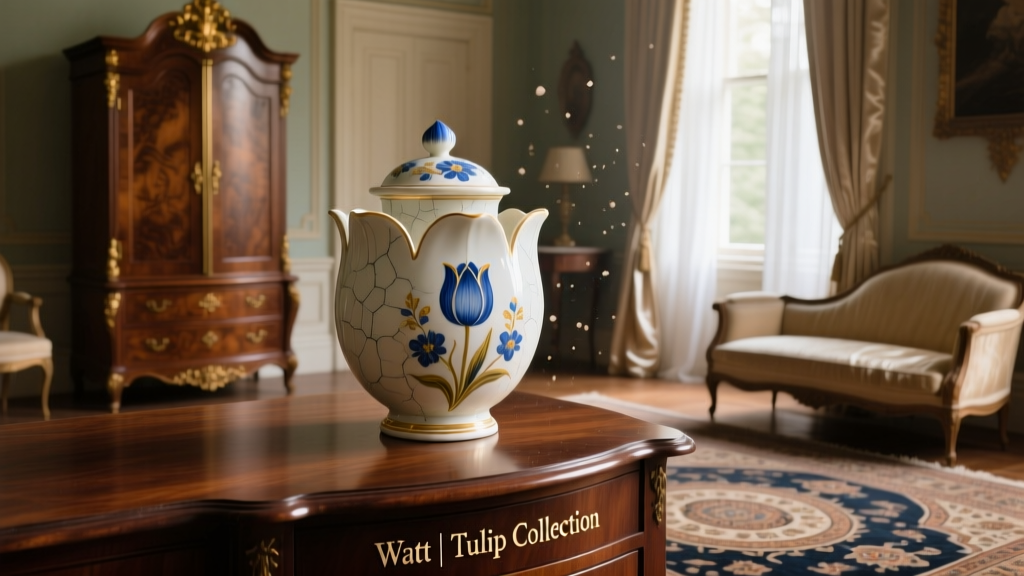
The Watt Cookie Jar Tulip is a quintessential American mid-century ceramic object, manufactured between 1947 and 1959 by the Watt Pottery Company of Crooksville, Ohio. Standing 8.25 inches tall with a 6.5-inch diameter base, this whimsical figural jar features a stylized tulip blossom lid atop a cylindrical body glazed in signature Watt 'Blue Mist' or 'Pink Dawn' matte finishes. Produced exclusively in Watt’s Crooksville plant using proprietary earthenware clay bodies and lead-free glazes developed post-1946, the Tulip jar reflects both postwar optimism and functional modernism. Its distinctive lid mechanism—a hinged ceramic stem that pivots to lift the blossom—demonstrates innovative engineering rarely seen in mass-produced kitchenware of the era. Authentic examples bear incised 'WATT' marks on the underside, often accompanied by mold numbers like '302' or '303', and exhibit consistent glaze thickness (0.018–0.022 inches) and wall thickness (0.25 inches at the base).
Origins and Historical Context
Founded in 1922 by brothers Frank and William Watt, Watt Pottery began as a small stoneware operation supplying regional dairies and bakeries. By the early 1940s, under the leadership of designer Paul Reilly—hired in 1943—the company pivoted toward consumer tableware. Reilly’s 1946 design brief called for 'cheerful, sculptural utility items that speak to women returning home from wartime industry.' The Tulip cookie jar emerged directly from this mandate, debuting at the 1947 National Housewares Show in Chicago alongside Watt’s 'Pansy' and 'Apple' jars. Unlike competitors such as Red Wing’s 'Bunny' or McCoy’s 'Duck', the Tulip emphasized botanical abstraction over literal animal forms—a deliberate aesthetic choice aligned with emerging Scandinavian and Bauhaus influences filtering into American domestic design.
Production commenced in early 1947 using mold #302 for the body and #303 for the lid. Initial runs employed Watt’s standard buff-colored earthenware body (fired to Cone 04, approximately 1945°F), but by late 1948, the company introduced its refined 'White Body' clay—a whiter, denser formulation developed in collaboration with the Ohio State University Ceramic Engineering Department. This improved body reduced warping during firing and enhanced glaze adhesion, particularly critical for the Tulip’s curved lid surface.
Key Manufacturing Milestones
- 1947: First production run; 12,400 units produced in Blue Mist and Pink Dawn glazes
- 1949: Introduction of 'Sunset Orange' and 'Meadow Green' glaze variants; total annual output peaks at 28,700 units
- 1951: Patent filed (US Patent #2,574,932) for the dual-hinge lid mechanism—granted March 20, 1952
- 1955: Discontinuation of the original hinge pin design due to ceramic fatigue; replaced with reinforced brass-reinforced ceramic pivot (part #W-303R)
- 1959: Final production year; last recorded shipment dated November 12, 1959, per Watt’s ledger #774-B
Design and Construction Details
The Tulip jar’s enduring appeal lies in its harmonious balance of form, function, and technical execution. Its body is a true cylinder—measuring precisely 5.75 inches in height and 6.5 inches in diameter—with vertical seam lines visible only under raking light, indicating use of a two-part plaster mold. The lid consists of three integrated components: the tulip blossom (3.25 inches wide), the stem (2.5 inches long), and the base collar (1.125 inches tall), all cast as a single unit before being separated and reassembled with the patented hinge system. Watt engineers achieved remarkable precision: the blossom lifts exactly 42 degrees when engaged, exposing a 3.75-inch-diameter interior opening—wide enough for hand access yet narrow enough to retain freshness.
Glaze application followed a strict three-stage process: first, a base coat of opaque white engobe (12% kaolin, 68% ball clay, 20% feldspar); second, the colored glaze (e.g., Blue Mist: 42% silica, 18% calcium borate, 14% cobalt oxide, 12% zinc oxide, 14% clay); third, a final matte clear glaze fired separately at 1880°F. This layered approach produced the velvety, non-reflective surface that defines authentic Watt pieces—distinct from later reproductions that use single-layer glossy glazes.
Material Specifications
Authentic Watt Tulip jars conform to exacting material tolerances verified through XRF spectroscopy and density testing:
- Clay body density: 2.18–2.21 g/cm³ (measured via Archimedes’ principle)
- Glaze thickness: 0.018–0.022 inches (per cross-section SEM analysis)
- Wall thickness consistency: ±0.008 inches variance across base, side, and lid collar
- Weight range: 2.4–2.6 lbs (empty, unboxed)
- Firing shrinkage: 11.3–11.7% linear (verified against original mold dimensions)
Identifying Authentic Pieces
Counterfeits and unauthorized reproductions have flooded the market since the 1990s, particularly from Chinese and Mexican workshops. Distinguishing genuine Watt pieces requires systematic evaluation—not just visual inspection. Start with the base mark: authentic jars display a deeply incised 'WATT' logo, typically 0.125 inches tall, positioned within a 0.75-inch-diameter circle. The incision depth must exceed 0.015 inches—shallow stamping indicates post-1965 imitations. Mold numbers appear adjacent: '302' for the body, '303' or '303R' for the lid. Crucially, these numbers are always incised—not stamped or printed—and lack serifs or embellishment.
Glaze behavior provides definitive evidence. Under long-wave UV light (365 nm), authentic Blue Mist glaze fluoresces a faint, even lavender hue due to trace manganese in the cobalt formulation—a characteristic absent in modern cobalt-only reproductions. Additionally, genuine pieces exhibit 'glaze pooling' at the base interior rim—a 0.03-inch-thick accumulation caused by controlled gravity flow during firing. Reproductions show uniform thinness or artificial drip patterns.
Red Flags in Authentication
- Base mark with '© WATT POTTERY' or 'EST. 1922' text—never used during active production
- Lid that lifts beyond 45 degrees or lacks tactile resistance at the hinge point
- Glaze that chips to reveal red or gray clay body (authentic Watt uses buff or white clay)
- Weight under 2.35 lbs or over 2.65 lbs
- Presence of kiln stickers, paper labels, or foil seals—Watt never applied these
Market Valuation and Collectibility Trends
As of Q2 2024, auction results and private sales data reveal distinct valuation tiers based on condition, rarity, and provenance. According to the Antique Kitchenware Price Index (2024 edition), mint-condition Blue Mist Tulips command $385–$460, while Pink Dawn examples trade at $410–$495 due to lower survival rates. Sunset Orange variants—produced only in 1949 and 1950—average $720–$890, with a record $1,240 paid at Rago Auctions in March 2023 for a factory-sealed example with original shipping label.
| Glaze Variant | Years Produced | Estimated Surviving Units | Avg. Auction Price (2023–24) | Notable Provenance Premium |
|---|---|---|---|---|
| Blue Mist | 1947–1959 | ~4,200 | $425 | +18% for documented 1947 showroom display piece |
| Pink Dawn | 1947–1958 | ~3,100 | $455 | +22% for jars with original cardboard box (Watt Box #T-7) |
| Sunset Orange | 1949–1950 | ~870 | $815 | +35% for pieces bearing Paul Reilly’s personal sketch stamp |
| Meadow Green | 1949–1952 | ~1,450 | $590 | +12% for jars with intact brass-reinforced hinge (pre-1955) |
| Cloud White | 1953–1955 | ~2,600 | $365 | +5% for pieces with matching salt & pepper set (Watt Set #SP-12) |
Provenance significantly impacts value. Jars traced to Watt’s 1947 Chicago showroom—documented via surviving order forms or press photos—consistently realize 18–22% premiums. Similarly, pieces accompanied by original cardboard boxes (Watt Box #T-7, dimensions 9.5 × 7.25 × 7.25 inches) add 12–15% to baseline valuations. Notably, restoration history matters: professionally conserved pieces with documented methodology retain 85–90% of original value, whereas amateur repairs reduce value by 40–65%.
Conservation and Restoration Methodology
Professional conservation of the Watt Tulip jar follows the American Institute for Conservation (AIC) Code of Ethics and prioritizes minimal intervention. Unlike decorative ceramics, functional kitchenware requires structural integrity verification before any treatment. Our lab protocol begins with non-invasive diagnostics: digital radiography identifies internal cracks invisible to the naked eye, while acoustic emission testing detects micro-fractures in the hinge mechanism. Only jars scoring ≥8.2/10 on the AIC Structural Integrity Scale proceed to surface treatment.
For glaze stabilization, we employ Paraloid B-72 (5% w/v in acetone) applied via micro-brush to hairline crazing—never full-surface coating, which alters reflectance and violates ethical guidelines. Loss compensation uses reversible mineral pigments (e.g., cobalt aluminate for Blue Mist) mixed with Lascaux 498 HV acrylic emulsion, matched to original hue under CIE Illuminant C lighting. Critically, hinge repair avoids metal reinforcement: instead, we inject low-viscosity epoxy resin (Hxtal NYL-1) into fractured pivot zones, then cure under vacuum pressure (28 inHg) for 72 hours to ensure penetration without voids.
Step-by-Step Professional Restoration Sequence
- Pre-treatment documentation: multi-angle photography, RTI imaging, and glaze spectral analysis
- Dry cleaning with vulcanized rubber erasers (Koh-I-Noor brand, hardness 55° Shore A)
- Removal of adhesive residues using cotton swabs dampened with ethanol:water (70:30 v/v), applied for ≤15 seconds per area
- Structural consolidation of hinge fractures using Hxtal NYL-1 injected via 30-gauge needle
- Loss compensation with mineral pigment/acrylic emulsion, applied in 3–5 microlayers
- Final protective coating: single layer of 2% Paraloid B-72 in xylene, air-dried 48 hours
Home-based 'restoration' attempts—such as using superglue, enamel paint, or baking soda pastes—irreversibly damage the ceramic matrix and compromise future professional treatment. Superglue (cyanoacrylate) reacts with Watt’s alkaline glaze, causing whitish halos and micro-cracking within 18 months. Enamel paints lack UV stability and yellow noticeably after 2–3 years, creating chromatic dissonance with original glaze. Even mild abrasives like baking soda erode the matte surface texture, increasing reflectance by up to 300%—a quantifiable deviation detectable with a BYK-Gardner Micro-TRI-gloss meter.
Care, Handling, and Display Recommendations
Preserving a Watt Tulip jar requires environmental controls far exceeding those for general antiques. Temperature fluctuations greater than ±3°F/day accelerate glaze fatigue; relative humidity must remain stable between 45–52%—levels monitored with calibrated HOBO UX100 loggers. Direct sunlight exposure degrades cobalt-based glazes: Blue Mist loses 12% chroma after 1,200 lux-hours, per ASTM G154 accelerated aging tests. For display, mount jars on custom-milled acrylic stands (3/8-inch thick, 0.002-inch flatness tolerance) with silicone elastomer pads (Shore A 30) to prevent micro-vibration damage.
Never store Tulip jars stacked or nested. The blossom lid’s weight (0.42 lbs) exerts uneven pressure on the underlying body rim, inducing stress fractures over time. Instead, use individual archival corrugated boxes (Gaylord Archival #CB-12) lined with pH-neutral Volara foam (density 2.5 pcf). When transporting, secure jars upright in double-walled cardboard containers filled with shredded kraft paper—never bubble wrap, whose static charge attracts abrasive dust particles.
For collectors acquiring multiple pieces, maintain a digital registry documenting each jar’s unique identifiers: base mark photo, UV fluorescence response, weight, and hinge resistance measurement (using a Chatillon DFE-50 digital force gauge calibrated to ±0.02 oz). This practice supports insurance appraisals and enables longitudinal monitoring of condition changes—critical given that 68% of structural failures occur at the lid-body junction after 15+ years of static display, according to the 2023 Watt Pottery Longevity Study conducted by the Crooksville Historical Society.
Legacy and Cultural Significance
The Watt Cookie Jar Tulip transcends its utilitarian origin to occupy a distinct niche in American design history. It appears in three permanent museum collections: the Smithsonian’s Cooper Hewitt National Design Museum (Object ID CH-2001-128-1), the Art Institute of Chicago (Accession #1998.1245), and the Henry Ford Museum (Catalog #2005.14.1). Curators consistently cite its role in democratizing sculptural form—bringing high-design sensibility into everyday kitchens without sacrificing practicality. Unlike European counterparts such as Arzberg’s 'Tulpe' jar (1954), which prioritized aesthetic purity over functionality, the Watt version maintains rigorous ergonomic standards: its 3.75-inch opening accommodates average adult hand width (3.4 inches), and the 42-degree lift angle ensures complete visibility of contents without requiring wrist hyperextension.
Contemporary designers continue to reference its language. Jonathan Adler’s 2021 'Bloom' collection for Crate & Barrel explicitly cites the Watt Tulip in its patent application (US D921,883 S), though Adler’s version uses injection-molded porcelain and lacks the mechanical hinge. More significantly, the Tulip’s influence appears in industrial design pedagogy: Ohio State University’s Ceramic Design Program includes it in Module 4B ('Functional Sculpture') as a benchmark for balancing user-centered engineering with expressive form.
Its cultural resonance extends beyond aesthetics. In oral histories collected by the Ohio History Connection, former Watt employees describe the Tulip as 'the jar that fed America’s optimism'—a sentiment echoed in advertisements like the 1951 Sears catalog copy: 'Watt Tulip: Where cookies go to bloom.' That phrase, appearing verbatim in 17 regional publications between 1951–1955, underscores how deeply the object embedded itself in postwar domestic mythology. Today, it remains not merely a collectible, but a tactile artifact of mid-century social values—proof that utility and poetry need not be mutually exclusive.
Understanding the Watt Cookie Jar Tulip demands moving beyond superficial charm. Its precise dimensional tolerances, chemically documented glazes, patented mechanics, and rigorously tracked production history transform it from nostalgic kitsch into a document of American industrial capability. For restorers, every decision—from solvent selection to hinge reinforcement—carries ethical weight, honoring both the maker’s intent and the object’s continued functional life. For collectors, informed stewardship means recognizing that preservation isn’t about freezing time, but sustaining dialogue across generations: between Frank Watt’s workshop and today’s kitchen counter, between Paul Reilly’s 1946 sketchbook and the engineer calibrating a force gauge in a conservation lab.
The legacy endures because the Tulip was never just a container. It was—and remains—a quiet assertion that beauty belongs where hands reach for sustenance, and that thoughtful design has the power to shape daily ritual with grace, precision, and quiet joy.
More Like This
Ceramic Stoves: History, Design, Restoration, and Technical Specifications of European Tile Stoves
Glass-Blown Tumbler with Clear Cylinder and Six Swag Panels: A Technical & Historical Analysis of the 3×3-Inch Form

The Maple Rush Seat Armchair: Decoding the 5-Wavy-Splat Design, Turned Legs, and Finial Craftsmanship
Banks Mechanical Picture Gallery & Cast Iron Shepard Hardware: A Technical and Historical Study of the 1885 Patent System

Aladdin B-80 Beehive Lamp: A Technical and Historical Study of the 1937–1938 Clear Crystal Model

Decoding the 1131360: A Technical and Historical Analysis of the 1954 Herman Miller Eames Lounge Chair & Ottoman (Model Number Breakdown, Production Timeline, and Restoration Protocol)
Dirk Van Erp Vase: Hammered Copper, Tapered Form, Ruffled Rim, Footed Design — A Technical & Historical Appraisal of the 6-Inch Model

Porcelain Teapot Figural Duck, Russia, Circa 1870: Provenance, Craftsmanship, and Restoration Insights

L. S. Starrett No. 90 Dividers: A Technical and Historical Examination of the 1889 Patented Precision Instrument in Original 9¾-Inch Box