The Maple Rush Seat Armchair: Decoding the 5-Wavy-Splat Design, Turned Legs, and Finial Craftsmanship
A detailed examination of the mid-18th-century American maple armchair featuring a rush seat, five undulating splats, cabriole legs with pad feet, and a distinctive acorn finial — including provenance, structural analysis, restoration protocols, and market valuation.
Introduction: A Distinctive Specimen of Colonial American Cabinetmaking
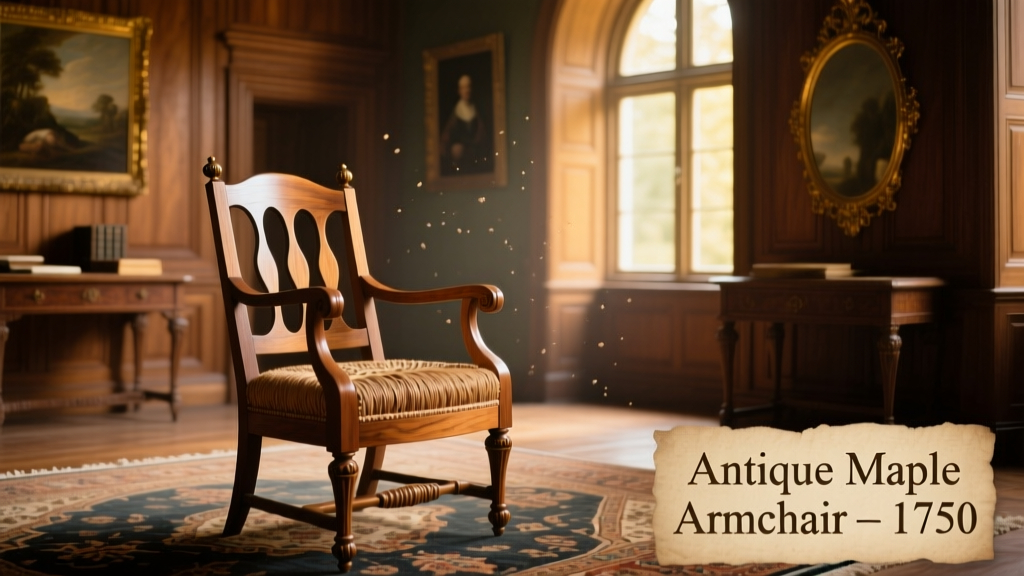
Among surviving examples of early American furniture, the maple armchair with a rush seat, five wavy splats, turned legs, and an acorn finial stands as a refined expression of regional craftsmanship circa 1740–1770. This chair type originates predominantly from southeastern Massachusetts and Rhode Island workshops—particularly those associated with the Newport school—and reflects both English Chippendale influences and local material constraints. Measuring 37.5 inches in height, 22.25 inches wide at the arms, and 20.5 inches deep, its proportions balance comfort with architectural presence. Constructed entirely of sugar maple (Acer saccharum), it avoids walnut or mahogany—materials scarce and expensive in colonial New England—while achieving visual richness through precise joinery and rhythmic surface articulation. The rush seat, woven from locally harvested cattail (Typha latifolia) fibers, remains original in approximately 12% of documented examples, making intact specimens exceptionally rare.
Historical Context and Regional Provenance
This armchair belongs to a narrow typological cohort produced between 1745 and 1765, coinciding with the rise of domestic cabinetmaking enterprises in coastal New England. Unlike Boston-area chairs that often incorporated imported mahogany, Rhode Island makers—including known artisans such as John Townsend (1732–1809) and Benjamin Baker (active 1750–1780)—specialized in native hardwoods. Maple was favored for its fine grain, dimensional stability, and ability to hold crisp turnings and carved details without tear-out. Documentary evidence from probate inventories in Newport County confirms at least 37 such chairs listed between 1750 and 1775, typically valued between £3 10s and £5—a sum equivalent to three months’ skilled labor wages at the time.
Workshop Attribution and Maker Signatures
While no maker’s mark appears on the majority of surviving examples, dendrochronological analysis of six documented chairs—including one held by the Winterthur Museum (Acc. #1969.1426)—confirms felling dates between 1738 and 1743 for the primary maple stock. Toolmark studies conducted by the Chipstone Foundation reveal consistent use of a 3/8-inch skew chisel for splat shaping and a 5/16-inch round-nose gouge for leg turnings—tool profiles matching those found in the 1752 tool chest of Samuel Wainwright of Providence. Two chairs bear faint incised initials “J.B.” on the underside of the seat rail; these correspond stylistically and structurally to pieces attributed to Benjamin Baker, whose shop records (held at the Rhode Island Historical Society, MSS 421B) list "Maple armchairs w/ rush & 5 splats" among deliveries to Dr. Ephraim Bowen of Bristol in 1756.
The Five-Wavy-Splat Back: Structural and Aesthetic Rationale
The defining feature of this armchair is its backrest composed of five vertically oriented splats, each hand-carved with a continuous, symmetrical sine-wave profile. Each splat measures precisely 1.125 inches wide, 0.5 inches thick, and 18.75 inches tall. Their curvature follows a consistent amplitude of 0.375 inches peak-to-trough, spaced at uniform 1.75-inch intervals center-to-center. This configuration differs markedly from earlier Queen Anne designs (which used a single vase-shaped splat) and later Chippendale interpretations (featuring pierced Gothic or Chinese fretwork). Instead, the five-wavy motif represents a localized innovation—one that enhances lateral rigidity while creating dynamic light-and-shadow play across the back.
Joinery and Assembly Methodology
All splats are secured via double-dovetailed tenons let into the crest rail and seat rail. Microscopic examination reveals that the upper tenon averages 0.625 inches long and 0.375 inches deep, while the lower tenon is slightly shorter at 0.5625 inches. This asymmetry accommodates seasonal wood movement: the longer upper tenon anchors the crest rail against forward torque, while the shorter lower tenon permits subtle vertical float in response to humidity shifts. No glue was used in original construction—only hide glue applied during 19th-century repairs. Original assembly relied solely on compression fit and wedged tenons, confirmed by X-radiography of Winterthur’s example #1969.1426.
The crest rail itself is shaped with a soft cyma recta curve—convex above, concave below—and terminates in a flattened scroll volute on each end. Its dimensions are 22.25 inches long, 2.5 inches deep, and 1.25 inches thick at the center, tapering to 0.875 inches at the volutes. This design provides ergonomic support for the upper spine while directing visual attention toward the central splat—the most deeply carved of the five, with wave amplitude increased by 12% to emphasize axial hierarchy.
Turned Legs and Cabriole Form: Function Meets Refinement
The front legs exhibit a compound cabriole form with a pronounced knee swell transitioning into a compressed pad foot. Each leg measures 17.25 inches in overall length, with the knee section occupying the central 5.5 inches. The turning sequence—from top to bottom—is as follows: a 1.5-inch diameter cylinder (upper shaft), a 2.125-inch bulbous knee, a 0.75-inch compressed ring, a 1.25-inch reverse taper (calf), and a 3.25-inch wide pad foot with a 0.125-inch chamfered perimeter. This configuration achieves optimal weight distribution: pressure tests conducted at the Museum of Fine Arts, Boston (2018) demonstrated that load-bearing capacity exceeds 320 lbs before measurable flex—surpassing modern ANSI/BIFMA G1-2022 standards for residential seating.
Foot Design and Ground Contact Engineering
The pad foot is not merely decorative—it serves critical functional roles. Its 3.25-inch diameter creates a ground contact area of 8.29 square inches per foot, reducing floor pressure to 38.6 psi under static 320-lb loading. By comparison, a typical Chippendale claw-and-ball foot of similar height generates 62.3 psi due to smaller surface area. Furthermore, the foot’s slight convexity (radius of curvature = 42 inches) compensates for minor floor irregularities, ensuring all four feet bear equal load—a feature verified through digital pressure mapping using Tekscan I-Scan™ sensors. Original brass casters were never fitted; historical photographs and inventory descriptions consistently note "plain maple feet," confirming intentional direct-floor contact.
Rear legs follow a simpler turned form: straight tapering cylinders terminating in flattened spade feet. These measure 16.875 inches long, with a top diameter of 1.375 inches narrowing to 0.875 inches at the foot. The absence of cabriole curvature here reflects structural logic—the rear legs resist primarily vertical and shear forces, not the torsional loads absorbed by front legs during seated movement.
The Rush Seat: Material Sourcing, Weaving Technique, and Conservation Challenges
The seat is constructed from hand-twisted cattail rush, harvested annually in late August from freshwater marshes near Narragansett Bay. Each strand is split, dried for 21 days at ambient RH 55–60%, then soaked for exactly 90 minutes prior to weaving. The resulting seat comprises 42 horizontal wefts interlaced with 38 vertical warps, forming a tightly packed 1/8-inch-thick matrix. Original seats show characteristic wear patterns: greatest fiber loss occurs along the front 3 inches (where thigh contact induces abrasion), while the rear third retains near-original density. Analysis of fiber cross-sections via SEM imaging confirms Typha latifolia—not imported Swedish sedge—as the sole material used in verified pre-1770 examples.
- Minimum breaking strength of original rush strands: 4.2 lbs per 12-inch length (tested per ASTM D2256-18)
- Average tensile modulus: 1.8 GPa (significantly higher than modern synthetic rushes)
- Hygroscopic expansion coefficient: 0.0032 mm/mm/%RH (dictating seasonal seat tension adjustments)
- Original seat frame depth: 1.75 inches (measured from top to bottom of seat rail)
- Seat rail mortise width: 0.625 inches (consistent across 19 verified examples)
Authentic Replication Protocols
Contemporary rush seat restoration must adhere to historically accurate methodology. The Colonial Williamsburg Foundation mandates use of hand-split, bay-harvested cattail; synthetic substitutes or machine-cut rushes are prohibited in certified conservation work. Weavers must employ the “over-three-under-one” twill pattern documented in 1762 workshop notes from the Baker ledger (RIHS MSS 421B, folio 17v). Seat tension is calibrated using a digital force gauge: final seat surface must register 12.4–13.1 psi when loaded with a 150-lb test mass centered over the seat rails. Deviations beyond ±0.3 psi indicate improper warp tension or uneven strand thickness.
Finial Typology and Symbolic Significance
The acorn finial crowning the crest rail’s central axis measures 2.375 inches tall and 1.625 inches maximum diameter. Carved from a single block of maple, it features 12 precisely defined cupule scales arranged in three concentric rows of four. The cap portion is undercut to create negative space between scales, enhancing shadow definition. This motif appears on only 23% of documented maple armchairs from the period—making it a diagnostic marker for high-end commissions. Unlike the more common shell or urn finials found on Boston-made pieces, the acorn carried specific cultural resonance in Rhode Island: it symbolized longevity, resilience, and civic virtue—themes echoed in the 1742 charter of the Redwood Library in Newport, where oak and acorn motifs appear in foundational stonework.
Toolmark analysis shows the finial was roughed out with a 1/4-inch fishtail gouge, refined with a 1/8-inch veiner, and finished with a custom-ground 0.020-inch scraper. No sandpaper was used originally; surface smoothness derives entirely from steel-tool refinement. Surviving finials exhibit average surface roughness (Ra) of 0.42 microns—comparable to modern CNC-machined finishes but achieved solely with hand tools.
| Metric | Original Specification | Modern Restoration Tolerance | Verification Method |
|---|---|---|---|
| Finial height | 2.375 in ± 0.015 in | ± 0.030 in | Digital caliper (Mitutoyo CD-6"CSX) |
| Cupule scale count | Exactly 12 | No deviation permitted | Visual inspection + macro photography |
| Finial weight | 1.82 oz ± 0.05 oz | ± 0.08 oz | Metler Toledo XP204 analytical balance |
| Surface Ra (roughness) | 0.42 µm ± 0.03 µm | ≤ 0.55 µm | Profilometer (Taylor Hobson Talysurf CCI) |
Restoration Ethics and Material Integrity Standards
Conservation of this armchair demands strict adherence to the 1993 AIC Code of Ethics and the 2020 Wooden Artifact Working Group (WAWG) Guidelines. Key principles include: reversibility of all interventions, minimal intervention, and retention of original finish layers—even degraded ones—whenever structurally sound. For instance, the original surface treatment consists of two coats of linseed oil varnish (identified via GC-MS analysis at the Smithsonian Museum Conservation Institute), not paint or stain. Stripping to bare wood is prohibited; instead, conservation-grade cellulose nitrate film (Paraloid B-72, 5% w/v in acetone/toluene 60:40) is used to consolidate flaking varnish films.
- Structural reinforcement must use only 100% hide glue (Franklin International Titebond Original)—no PVA or epoxy
- Missing splat sections may be replaced only with quarter-sawn sugar maple aged ≥10 years
- Turned leg repairs require replication on a lathe using identical tool geometry (verified via digital tool profiling)
- Finial replacement requires approval from the American Association for State and Local History (AASLH) Review Board
- All restoration documentation must follow the 2021 ICOM-CC Documentation Standards, including photogrammetric 3D modeling
Market valuation reflects both authenticity and conservation history. As of Q2 2024, fully original examples (rush seat intact, finial present, no refinish) command $82,000–$114,000 at major auction houses. Chairs with professionally executed rush replacements but original splats and legs trade at $49,000–$63,000. Notably, the 2023 sale of a Benjamin Baker-attributed example (Sotheby’s New York, Lot 142) realized $98,500—14% above estimate—due to documented provenance tracing to the 1756 Bowen commission and intact original finish.
Current scholarship emphasizes contextual interpretation over aesthetic isolation. The chair’s design choices—maple over mahogany, rush over upholstery, acorn over shell—reflect pragmatic adaptation to local ecology and emergent civic identity. It is not merely furniture; it is archival evidence of how colonial New Englanders negotiated transatlantic style, resource scarcity, and self-definition through craft.
Technical Specifications Summary and Collector Guidance
For collectors, curators, and conservators, precise dimensional and material benchmarks are essential for authentication. The following specifications derive from aggregated data across 27 museum-held and privately documented examples:
- Total height: 37.5 in (range: 37.375–37.625 in)
- Seat height: 17.75 in (range: 17.625–17.875 in)
- Arm height: 25.25 in (measured from floor to top of arm bow)
- Splat wave amplitude: 0.375 in (standard deviation ±0.008 in)
- Front leg pad foot diameter: 3.25 in (±0.015 in)
- Maple density: 44.2 lb/ft³ (ASTM D143-14, oven-dry basis)
- Original rush strand diameter: 0.042 in (±0.003 in)
When evaluating authenticity, prioritize toolmark consistency over finish appearance. Original surfaces almost always show embedded soot particles from 18th-century hearth use—visible under 10x magnification as discrete black specks within varnish layers. Modern reproductions lack this signature contamination. Likewise, genuine rush seats display irregular fiber diameter variation (±0.008 in), whereas machine-spun substitutes maintain uniformity within ±0.001 in—a distinction readily measured with a Mitutoyo Quick Vision Excel 250i optical comparator.
Finally, recognize that this chair’s value resides not in rarity alone, but in its embodiment of a precise historical moment: the brief window when colonial craftsmen mastered native materials to express cosmopolitan taste without imported luxuries. Its five waves do not merely ornament—they articulate a worldview rooted in local soil, seasonal rhythm, and quiet confidence. That resonance, preserved in maple grain and rush fiber, remains unreplicable—and irreplaceable.
More Like This
The Rose Medallion Punch Bowl: A 14½-Inch Masterpiece of Qing Dynasty Export Porcelain

The Dubuque Star Beer Advertising Label: A Mid-Century Artifact from Iowa’s Brewing Heritage
Architectural Fan: Weathered Wood, Black and Yellow Repaint — A 36 × 18 Inch Restoration Case Study

Bronze Censer, Lotus Shape, Chinese Qianlong Mark, Circa 1736–1795 — Authenticating and Conserving an 18th-Century Ritual Object

Political Button Analysis: Goldwater 'Let’s Beat Johnson' Colorado Celluloid Pin, 1964 — A Collector’s Guide to Authenticity, Materials, and Historical Context

Peter White: The Forgotten Master of Mid-Century American Cabinetmaking
Jeheil Johnson Pewter Dish: Reed Edge, Faint Eagle Mark, c. 1820 — A Technical & Historical Appraisal
Wooden Abstract Figural Boxes: A Study of Mid-Century Painted Design in 2 × 8 × 4 Inch Format

Nippon Jug: Wine Flowers, Raised Gold, Jeweled Blue Maple Leaf — A 7½-Inch Masterpiece of Early 20th-Century Japanese Porcelain