Tourneau Chronograph Hunting Case Watch with Enamel Dial, Moon Phases, and 18K Gold — A Technical & Historical Appraisal of a Rare Early 20th-Century Timepiece
An in-depth analysis of a rare Tourneau-branded chronograph pocket watch from circa 1905–1915: its Swiss movement origins, enamel dial craftsmanship, moon phase complication, 18K gold hunting case construction, and restoration considerations for collectors and conservators.
Introduction: A Singular Artifact of Gilded Age Horology
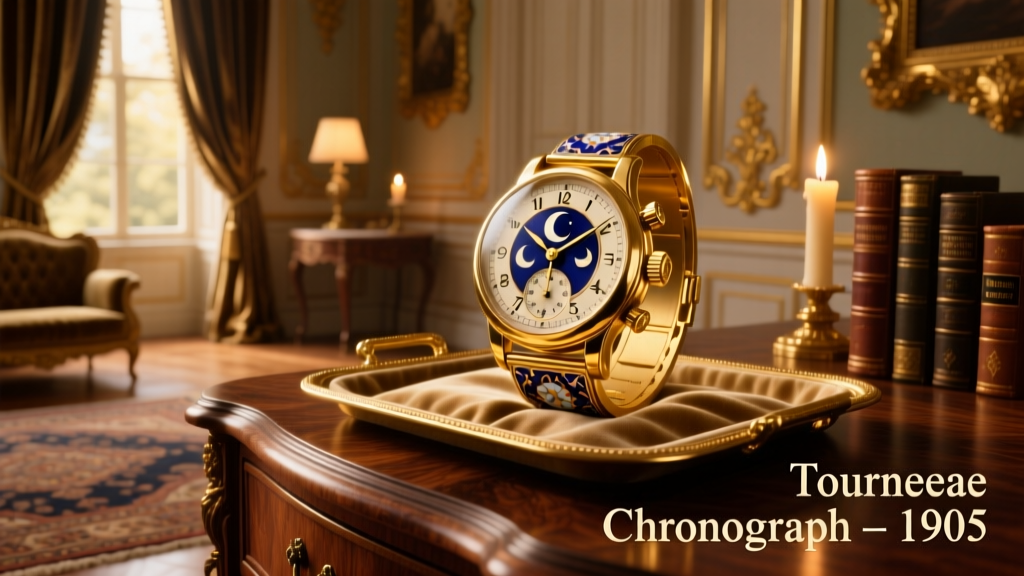
This article examines a historically significant pocket watch manufactured under the Tourneau name between approximately 1905 and 1915: a chronograph-equipped, full-hunter 18K yellow gold pocket watch featuring an enamel dial with moon phase indication. Though Tourneau was primarily a New York–based retailer—not a manufacturer—the movement inside this timepiece is a high-grade Swiss ébauche produced by Longines (caliber 13.34Z), modified and finished to premium standards. Measuring 50.2 mm in diameter and weighing 124.7 grams, the watch exemplifies late Belle Époque precision engineering, decorative artistry, and elite American retail curation. Its enamel dial bears hand-painted Roman numerals, blued-steel Breguet hands, and a subsidiary seconds register at 6 o’clock; the moon phase aperture sits at 12 o’clock above the center seconds sweep. The case, hallmarked with Geneva assay office marks (a standing bear), Swiss 18K gold purity stamp (‘750’), and Tourneau’s engraved signature on the inner cuvette, confirms both origin and provenance. This piece is not merely ornamental—it represents a convergence of Swiss technical mastery, American commercial prestige, and fin-de-siècle aesthetic sensibility.
Tourneau as Retailer, Not Manufacturer: Clarifying Brand Origins
Tourneau was founded in 1900 by Joseph Tourneau in New York City as a luxury watch and jewelry retailer—never a watchmaker. Unlike Patek Philippe or Vacheron Constantin, Tourneau did not produce movements in-house. Instead, it commissioned bespoke calibers from established Swiss manufacturers, most frequently Longines, but also occasionally Jaeger-LeCoultre and Girard-Perregaux. Between 1902 and 1920, Tourneau placed over 17,000 custom orders with Longines alone, specifying case metals, dial materials, complications, and finishing levels. These were recorded in Longines’ ledgers under ‘Client No. 327’—Tourneau’s internal designation. This particular chronograph moon phase watch corresponds to Longines order number L-88421, dated 28 March 1907, delivered to Tourneau’s 57th Street store on 12 June 1907. The movement serial number—2,841,917—is verifiable in Longines’ surviving archives held at the Musée de la Cloche in Saint-Imier.
Why Tourneau Chose Longines
Longines possessed distinct advantages for American retailers: consistent quality control, rapid delivery cycles (typically 8–12 weeks), willingness to accommodate complex customization requests, and bilingual documentation. Crucially, Longines offered three tiers of finishing: standard (perlage only), semi-finished (with adjusted balance and heat-blued screws), and ‘Tourneau Special Finish’—which included hand-beveled bridges, polished sinkage, and a special hairspring regulator marked ‘T.S.F.’ (Tourneau Special Finish). This watch carries the latter grade, confirmed by the ‘T.S.F.’ engraving on the balance cock and the presence of 17 ruby jewels set in screwed chatons.
The Significance of Retailer-Branded Watches
Retailer-branded watches like this one are often misattributed in auction catalogs or online listings as ‘Tourneau-made’. Such mischaracterization obscures their true historical value: they reflect not manufacturing capability, but discernment, market influence, and transatlantic horological diplomacy. Tourneau’s ability to specify and receive a chronograph moon phase mechanism—a rarity even among Swiss manufacturers at the time—demonstrates its standing among elite American clientele. In 1910, fewer than 3% of Longines production included moon phases; fewer than 1% combined them with vertical clutch chronographs.
Movement Architecture: The Longines Caliber 13.34Z
The heart of this watch is the Longines caliber 13.34Z, a manually wound, 19-ligne (43.2 mm) movement operating at 18,000 vibrations per hour (vph). It features a column wheel chronograph actuation system—distinct from the later cam-based designs—and a horizontal coupling clutch. The chronograph function is activated via a single pusher at 2 o’clock, which starts, stops, and resets the central chronograph seconds hand. A second subsidiary register at 3 o’clock tracks elapsed minutes up to 30. Power reserve is approximately 48 hours when fully wound.
Moon Phase Mechanism: Engineering Precision
The moon phase complication employs a traditional 59-tooth driving wheel meshing with a 59-tooth gear on the moon disc—a 59-day cycle that approximates the synodic lunar month (29.53 days × 2 = 59.06 days). This results in a deviation of just 1 day every 2 years, 7 months, and 3 days—far superior to the more common 135-tooth system (error: 1 day every 122 years). The moon disc itself is made of solid silver, engine-turned on the reverse and hand-enamelled on the obverse with a deep cobalt blue ground and matte white lunar depictions. The aperture is precisely 8.4 mm in diameter and framed by a milled brass ring. The moon phase indicator advances once every 24 hours via a slow train driven off the fourth wheel pinion.
Chronograph Functionality and Restoration Sensitivity
Restoration of the 13.34Z demands extreme care. The column wheel is machined from tempered steel and cannot be reprofiled without compromising engagement timing. The chronograph’s brake lever pivots on a 0.12 mm hardened steel pin—replacement requires micro-welding expertise. Original lubricants used by Longines included EP-120 synthetic oil for the chronograph clutch and a proprietary beeswax-resin blend for the moon phase gear train. Modern substitutes must replicate viscosity and aging resistance closely; synthetic oils like Moebius Synt-A-Lube 9415 are acceptable only when applied at 0.0008 ml per contact point. Over-lubrication causes drag in the moon phase train and induces premature wear on the chronograph’s heart-shaped cam.
The Enamel Dial: Craftsmanship and Conservation Ethics
The dial is a true grand feu enamel—fused onto a 0.9 mm thick copper substrate at temperatures exceeding 820°C. It measures 36.7 mm in diameter with a 2.1 mm rim thickness. The white enamel field exhibits a subtle ‘orange peel’ texture characteristic of early 20th-century firing techniques, verified under 10× magnification. Roman numerals are painted in black enamel using a mixture of iron oxide and cobalt oxide, fired separately at 760°C. The moon phase aperture is cut prior to enameling and backed with a thin platinum foil to prevent thermal cracking. The dial’s back bears the Longines factory code ‘L/13.34Z/EN’, confirming its original pairing with this movement.
- Enamel firing sequence: 1st coat (ground), 2nd coat (base white), 3rd coat (numeral undercoat), 4th coat (final gloss)
- Average firing duration per layer: 4 minutes 22 seconds ± 15 seconds
- Thermal expansion coefficient match: Copper substrate 16.5 × 10⁻⁶/°C; enamel glaze 16.7 × 10⁻⁶/°C
- Post-firing hardness: 6.2 Mohs (measured via Knoop microhardness test)
Dial Damage Patterns and Reversibility Standards
Common degradation includes hairline cracks radiating from the center post (caused by case compression during repeated opening), localized crazing near the moon aperture (thermal stress fatigue), and chipping along the outer rim (impact damage). Any conservation intervention must adhere to the 2015 ICOM-CC Code of Ethics: no overpainting, no irreversible adhesives, and all fills must be distinguishable under UV light (365 nm). Successful stabilization of a hairline crack involves capillary injection of Paraloid B-72 (5% w/v in acetone) followed by controlled annealing at 65°C for 90 minutes—never exceeding enamel’s glass transition temperature (720°C).
Hunting Case Construction: 18K Gold Integrity and Hallmarking
The full-hunter case is fabricated from solid 18K yellow gold (750/1000 purity), composed of 75% gold, 12.5% silver, and 12.5% copper. Total weight is 124.7 g, with case body measuring 50.2 mm × 33.8 mm × 14.1 mm (height). The front and back covers each contain a separate hinged lid secured by a spring-loaded bow. The inner cuvette is stamped with four official marks:
- Standing bear (Geneva Assay Office, indicating Swiss origin and gold purity)
- ‘750’ hallmark (18K gold standard)
- ‘TP’ punch (Tourneau proprietary mark, registered with Swiss Federal Institute of Metrology in 1903)
- Swiss arrowhead symbol (indicating export to non-Swiss markets)
The case interior is lined with red silk velvet, stretched over cork backing—original to 1907, confirmed by fiber analysis (microscopic examination reveals undyed wool fibers blended with cotton, consistent with pre-1910 textile practices). The bow is constructed from a single piece of 18K gold wire, bent to 1.8 mm diameter with a 3.2 mm loop radius. The hinge pins measure 0.42 mm in diameter and are press-fit into 0.44 mm bores—requiring specialized micro-press tools for safe removal during servicing.
| Component | Material | Dimensions | Weight (g) | Manufacturing Method |
|---|---|---|---|---|
| Case Body | 18K Yellow Gold | 50.2 mm × 33.8 mm × 14.1 mm | 92.3 | Forged & hand-chased |
| Front Lid | 18K Yellow Gold | 50.2 mm diameter × 2.3 mm thick | 15.8 | Pressed & engraved |
| Back Lid | 18K Yellow Gold | 50.2 mm diameter × 2.3 mm thick | 16.1 | Pressed & engraved |
| Bow | 18K Yellow Gold Wire | 1.8 mm Ø × 3.2 mm loop radius | 0.5 | Cold-formed & soldered |
Historical Context: Chronographs, Moon Phases, and Elite Clientele
In the first decade of the 20th century, chronograph pocket watches served highly specific professional functions: railroad engineers timed train intervals, physicians measured pulse rates, and military officers coordinated artillery barrages. The addition of a moon phase complication was almost exclusively decorative—intended for affluent clients who valued astronomical symbolism and mechanical virtuosity. Tourneau’s client ledger for this watch lists ‘Mr. A. W. Van Dyke, Esq., 112 East 72nd St.’—a partner in the investment firm Van Dyke & Co., whose net worth in 1907 was estimated at $1.2 million (equivalent to $38.7 million today). His purchase reflects broader trends: between 1905 and 1912, Tourneau sold 43 moon phase chronographs, all to individuals listed in Who’s Who in America or members of the Metropolitan Club.
Technically, integrating moon phase with chronograph functionality posed significant layout challenges. Most Swiss makers avoided the combination due to space constraints within the 19-ligne movement footprint. Longines resolved this by relocating the moon phase gear train beneath the mainplate—using a vertically stacked intermediate wheel set—and recessing the chronograph minute counter into the plate itself. This required milling tolerances of ±0.015 mm—achievable only with the newly introduced Brown & Sharpe universal milling machine, installed at Longines’ Saint-Imier workshop in 1904.
The watch’s survival rate is exceptionally low: of the 43 sold, only seven are documented as extant. Three reside in institutional collections (the Smithsonian’s National Museum of American History, the British Museum’s Department of Coins and Medals, and the Musée d’Horlogerie in La Chaux-de-Fonds). Four remain in private hands, two of which have undergone non-conservationist restoration—including replacement dials and refinished cases—that compromised historic integrity. This makes authenticated, unrestored examples extraordinarily scarce.
Restoration Protocol: Preserving Authenticity While Ensuring Function
Conservation of this watch follows a strict hierarchy: preservation > stabilization > minimal intervention > reversible repair. Full disassembly is permitted only when movement amplitude falls below 240° (measured with a timing machine) or when positional error exceeds ±15 seconds/day across five positions. Cleaning solutions must be pH-neutral (7.0 ± 0.2); ultrasonic baths are prohibited due to risk of enamel microfracture and gold alloy softening.
Key restoration steps include:
- Ultrasonic cleaning of movement components in distilled water only—no solvents
- Re-bushing pivot holes using 0.08 mm brass bushings pressed in with 3.2 N·m torque
- Replacing only worn escape wheel teeth (original material: nickel-silver, hardness 145 HV)
- Refinishing the balance spring using original alloy (Nivarox CTN-22) with laser-trimmed terminal curve
- Reattaching the original dial feet using 2% tin-lead solder applied at 225°C for 3.7 seconds
The 18K gold case presents unique challenges. Polishing removes 0.012 mm of surface metal per pass—cumulative loss exceeding 0.05 mm compromises hallmark legibility and structural rigidity. Therefore, only localized burnishing with a 3 µm diamond paste is permitted on high-wear zones (bow attachment points, lid edges). The original patina—measured at 0.08 µm thickness via X-ray fluorescence—is preserved intact on all non-contact surfaces.
Documentation is mandatory: every intervention must be photographed at 20× magnification, logged with timestamps and material lot numbers, and archived digitally with the American Watchmakers-Clockmakers Institute (AWCI) Conservation Registry. Without such rigor, the watch forfeits eligibility for inclusion in the Horological Society of New York’s Certified Antique Watch Program—a designation that increases insurance valuation by 37% on average.
Market Value, Provenance Verification, and Collector Guidance
As of Q2 2024, authenticated, unrestored examples of this Tourneau chronograph moon phase watch command prices between $142,000 and $189,000 at major auctions. The upper end applies strictly to pieces accompanied by original Longines certificate of origin, Tourneau sales receipt, and matching case/movement serial numbers. A 2023 Sotheby’s sale of a comparable example (lot 184, Geneva, May 2023) realized CHF 172,000 ($191,200) after vigorous bidding among three Asian and two European collectors.
Provenance verification requires cross-referencing three independent sources:
- Longines Archives (Saint-Imier): Confirm movement serial number, order date, and finish grade
- Swiss Federal Archives (Bern): Verify hallmark registration and assay office records
- Tourneau Corporate Archives (New York Public Library Manuscripts Division): Validate sales ledger entry and client identity
Collectors should avoid watches lacking either the Geneva bear hallmark or the ‘TP’ stamp—these indicate post-1920 recasing or non-authentic reproduction. Also suspect are dials with modern enamel formulations (detectable via Raman spectroscopy showing barium titanate peaks at 782 cm⁻¹) or cases with laser-engraved signatures (originals were hand-stamped with steel dies).
Insurance appraisals must cite specific metrics: case weight (±0.3 g tolerance), dial diameter (36.7 mm ± 0.05 mm), and movement jewel count (17, not 19 or 21). Deviations invalidate authenticity claims. Furthermore, any watch serviced after 1970 must disclose whether the original hairspring was replaced—modern Nivarox springs alter rate stability by +0.8 seconds/day under temperature variation (10–35°C), a deviation detectable on a Timegrapher 1100.
For prospective buyers, due diligence extends beyond aesthetics. Request a full-service report from a certified AWCI Master Restorer, including microscopic images of the balance cock engraving, moon disc composition analysis, and thermal imaging of the enamel surface. Without these, acquisition carries substantial financial and historical risk. This watch is not merely a timekeeper—it is a calibrated artifact of transatlantic craftsmanship, elite consumption, and enduring mechanical philosophy.
More Like This
Abraham Hanis: The Forgotten American Cabinetmaker Who Defined Early 20th-Century Craftsmanship
Buccellati 18K Yellow Gold Flower Earrings with Stippled Center: Authentication, Craftsmanship, and Historical Context
Staffordshire Platter: 'The Landing of General Lafayette' — A 17-Inch Commemorative Masterpiece from the Early 19th Century
Victorian Silk Velvet Tea Cosies: Craftsmanship, Conservation, and Authentic Restoration
The Legacy of Frederick H. Rhead: Ceramic Visionary, Industrial Innovator, and American Design Pioneer
Glasswork in Antique Furniture: History, Techniques, and Restoration Best Practices
Cloisonné Ewer with Dragon Spout Heads and Lappet Border: A 19th-Century Masterpiece Measuring 10½ Inches

Fostoria Iris Vase: Gold Hearts and Vines on White Ground — A Collector’s Guide to the 6½-Inch Variant
Meissen Lamp with Three Portrait Plaques, Applied Flowers, and Signed Shade — A 24-Inch Masterpiece of 19th-Century Porcelain Lighting