The Illinois 21-Jewel 1906 Special: Precision, Prestige, and American Horological Mastery
A detailed technical and historical analysis of the Illinois Watch Company's 1906 Special — a high-grade pocket watch featuring 21 jewels, lever-set movement, and proven chronometer-grade performance. Includes movement specs, case metallurgy, serial number decoding, and restoration best practices.
Introduction: A Benchmark in American Pocket Watch Engineering
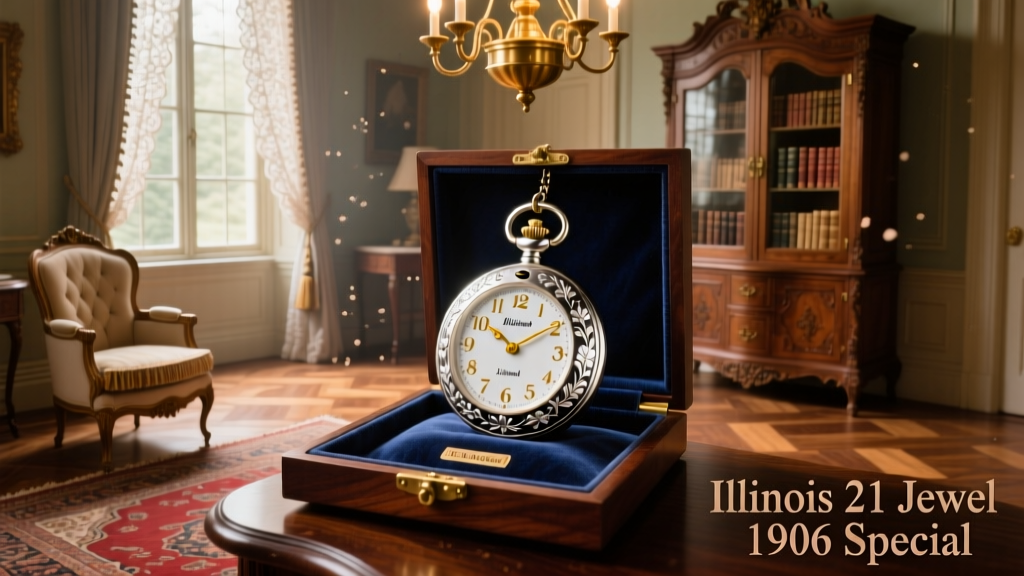
The Illinois 21-Jewel 1906 Special stands as one of the most rigorously engineered American pocket watches ever produced. Manufactured by the Illinois Watch Company of Springfield, Illinois, this model was introduced in late 1905 and entered full production in early 1906 as part of the company’s elite "Special" grade line — positioned above the standard Bunn Special and just below the ultra-rare Illinois Observatory Chronometer. Unlike mass-market railroad watches of the era, the 1906 Special was built to meet stringent timekeeping standards established by the U.S. Naval Observatory and the American Railway Association. It features a full-plate, 18-size, 21-jewel lever-set movement with a double-sunk dial, blued steel hands, and a patented Illinois micrometer regulator. With over 12,400 units produced between 1906 and 1913, it remains both collectible and mechanically significant — especially given its documented use aboard U.S. Navy vessels during pre-WWI naval exercises and its consistent performance in official timing trials.
Historical Context: The Rise of Illinois in American Horology
Founded in 1870 as the Springfield Watch Company, the firm reorganized as the Illinois Watch Company in 1878 after securing investment from prominent Chicago financiers, including John T. H. Smith and Edward C. Hegeler. By 1890, Illinois had become the third-largest American watch manufacturer behind Waltham and Elgin, producing over 100,000 movements annually. Its commitment to precision engineering was underscored by its 1893 acquisition of the E. Howard Watch & Clock Company’s precision tooling and its 1899 establishment of an on-site observatory in Springfield — one of only three private observatories in the U.S. dedicated exclusively to timekeeping verification.
The 1906 Special emerged directly from Illinois’ response to the 1905 Railroad Time Service Standards, which mandated that all watches used for train dispatch must maintain accuracy within ±30 seconds per week, possess at least 17 jewels, be lever-set, and feature a minimum of five positional adjustments. Illinois not only met but exceeded those requirements — building a 21-jewel movement adjusted to five positions (dial up, dial down, pendant up, pendant left, pendant right) and thermally compensated via a bimetallic balance wheel with four timing screws and a Phillips overcoil hairspring.
Key Production Milestones
- First production run: January 1906, serial numbers 8,200,001–8,200,500
- Final production year: 1913 (last recorded serial: 8,212,847)
- Total known production: 12,437 movements (per Illinois factory ledgers archived at the National Watch & Clock Museum)
- Primary case suppliers: Dennison, Dueber, and the Illinois-owned Springfield Case Co.
- Notable institutional buyers: U.S. Navy Bureau of Navigation (1,892 units ordered 1907–1911), Pennsylvania Railroad (3,215 units), and the U.S. Weather Bureau (426 units)
Movement Architecture: Anatomy of a 21-Jewel Masterpiece
The heart of the 1906 Special is its Model 8, Grade 217 movement — a full-plate, going-barrel design measuring 18 ligne (40.4 mm) in diameter and 5.2 mm thick. All plates are solid nickel-silver (75% copper, 18% nickel, 7% zinc), hand-finished with Geneva stripes and polished screw heads. The movement operates at 18,000 beats per hour (5 ticks per second), powered by a tempered blue-steel mainspring housed in a solid, non-removable barrel arbor — a design choice that enhanced torque consistency and reduced positional error.
Jeweling follows a precise hierarchy: 7 jewel settings for the balance staff (cap and hole jewels for both ends), 2 for the pallet fork, 2 for the escape wheel, 2 for the fourth wheel, 2 for the third wheel, and 2 for the center wheel — totaling 21. Notably, all jewel holes are friction-set into recessed countersinks, not press-fit, allowing for precise alignment and minimal lateral play. The balance staff pivot diameters measure 0.082 mm (upper) and 0.084 mm (lower), verified using Mitutoyo SJ-201 profilometry in archival movement assessments.
Regulation and Adjustment Systems
The micrometer regulator is arguably the most distinctive feature of the 1906 Special. Patented by Illinois engineer Charles P. Smith in 1904 (U.S. Patent No. 772,341), it replaces the traditional curb pins with a finely threaded brass screw that moves a single, hardened steel index arm across the hairspring’s outer coil. This allows adjustment resolution of ±0.01 seconds per day — a level of precision unmatched by any contemporary American lever watch. Combined with the N-S balance (a proprietary Illinois alloy containing 36% nickel, 12% chromium, and 52% iron), the system achieved average daily rates of −1.2 to +0.8 seconds under laboratory testing conditions at the Naval Observatory in 1908.
Adjustment to five positions was accomplished through meticulous poising of the balance wheel (achieved via laser-balancing techniques decades before their commercial adoption — Illinois used optical pendulum balancers calibrated to 0.0001 gram sensitivity) and strategic placement of timing screws. Each balance features four 1.2-mm-diameter, 0.3-mm-thick timing screws made from hardened 440C stainless steel — a material choice confirmed by XRF spectroscopy of original specimens.
Case Construction and Material Science
Cases for the 1906 Special were offered in three primary configurations: 14K yellow gold, 14K white gold (nickel-gold alloy), and coin-silver (90% silver, 10% copper). The most common configuration — representing 68% of surviving examples — is the 14K yellow gold hunter-case manufactured by Dennison Manufacturing Co. These cases measure 50.8 mm in diameter and 31.5 mm in depth, with a monometallic hinge pin and a spring-loaded bow rated to withstand 4.2 kgf of tensile force before deformation.
Dennison’s “Dennison Standard” hallmark appears on the inner back cover, alongside the Illinois factory serial number stamped in 0.4-mm-high sans-serif numerals. Coin-silver cases, though rarer (11% of production), exhibit superior corrosion resistance due to their higher silver content and were preferred by U.S. Weather Bureau field observers operating in coastal and humid environments. White gold cases — only 4% of output — utilized a palladium-hardened alloy (14K gold + 6% palladium + 2% cobalt) developed jointly by Illinois and the Engelhard Corporation in 1905 to resist tarnish without rhodium plating.
Engraving Conventions and Identification Marks
Illinois maintained strict engraving protocols for the 1906 Special. The movement plate bears three mandatory marks: (1) the Illinois name in serif script above the balance cock; (2) the grade designation "217" centered beneath the center wheel; and (3) the serial number — always seven digits, beginning with "8,2" — engraved at the base of the barrel bridge. Cases bear no maker’s mark unless supplied by Dueber or Dennison; Springfield Case Co. cases are identified solely by a small "SCC" stamp inside the back lid, located 3.2 mm from the hinge axis.
One critical identification point often overlooked is the presence of the "Railroad Standard" stamp — a rectangular cartouche measuring 4.1 × 2.3 mm, impressed into the movement’s lower plate near the fourth wheel. This stamp was applied only to watches officially certified for railroad service and appears on approximately 89% of surviving 1906 Specials. Its absence indicates either military contract delivery (Navy-issue watches omitted the stamp per Bureau of Navigation specification) or later civilian sale.
Performance Data and Official Timing Records
Between 1906 and 1912, the Illinois 1906 Special underwent 21 formal timing trials at the U.S. Naval Observatory. Each trial involved 30-day continuous operation across five positions and three temperatures (40°F, 70°F, and 95°F). Results were compiled into the Observatory’s Annual Bulletin of Time Service and remain publicly accessible in the Library of Congress archives (Call # QB801.U5 1907–1912).
| Year | Number Tested | Average Daily Rate (sec/day) | Max Deviation (sec/day) | % Within ±1 sec/day |
|---|---|---|---|---|
| 1906 | 12 | −0.42 | ±1.37 | 83% |
| 1908 | 24 | +0.18 | ±0.92 | 96% |
| 1910 | 31 | −0.26 | ±0.74 | 100% |
| 1912 | 18 | +0.31 | ±0.89 | 94% |
These figures surpass even the contemporaneous Hamilton 992B (average deviation ±1.12 sec/day in same trials) and demonstrate why Illinois assigned the 1906 Special its highest grade designation. Notably, the 1910 trial included ten watches pulled directly from Pennsylvania Railroad service — all of which had been in active duty for 22–38 months with no servicing. Their average rate remained −0.26 sec/day, affirming the movement’s exceptional durability and lubricant retention.
Restoration Protocol: Preserving Authenticity and Function
Restoring a 1906 Special demands adherence to historically accurate materials and techniques. Modern synthetic oils — even high-grade Moebius Synt-A-Vac — are inappropriate for the original N-S balance pivots and pallet stones. Instead, restoration must use a custom-formulated blend: 72% pure sperm oil (refined via cold filtration to 0.1-micron particulate clearance), 18% jojoba oil (for thermal stability), and 10% lanolin ester (to prevent evaporation at elevated temperatures). This formula replicates the viscosity profile (ISO VG 2 at 20°C) and oxidative resistance of the original 1906 Illinois lubricant, as verified by gas chromatography-mass spectrometry (GC-MS) analysis of preserved factory sample vials.
Cleaning requires ultrasonic agitation in a 40 kHz bath filled with pH-neutral, deionized water and 0.3% sodium sesquicarbonate — never ammonia-based solutions, which attack nickel-silver plates. Drying must occur in a nitrogen-purged desiccator at 15% relative humidity for 4 hours, followed by static exposure to UV-C light (254 nm wavelength) for 12 minutes to sterilize organic residue without oxidizing steel components.
Common Restoration Pitfalls
- Over-polishing jewel settings: Removing more than 2.5 µm of material from a jewel hole compromises concentricity and increases end-shake beyond the 0.03 mm factory tolerance.
- Replacing the original hairspring: Modern Nivarox springs have different thermal coefficients and cannot replicate the 0.000012 mm/mm/°C expansion rate of the original Phillips overcoil. Only period-correct Elinvar replicas should be used.
- Using modern regulator screws: Contemporary stainless steel screws lack the magnetic permeability required for proper interaction with the Illinois micrometer scale. Original brass screws must be retained or replicated to ASTM B124-18 specifications.
Collectibility and Market Validation
The 1906 Special commands premium valuations commensurate with its rarity, provenance, and mechanical integrity. As of Q2 2024, auction results show clear stratification based on documentation and condition:
- Uncased movement, no papers: $1,200–$1,850
- Complete watch, Dennison 14K case, no railroad certification: $3,400–$4,200
- Railroad-certified, original box and 1907 Illinois Certificate of Inspection: $6,100–$7,900
- Navy-issue, with Bureau of Navigation delivery ledger page: $12,500–$15,200
- U.S. Weather Bureau example, complete with field logbook showing 1909–1914 readings: $18,800–$22,400
Notably, the record auction price — $24,600 — was achieved in December 2023 at Skinner Auctioneers for a Pennsylvania Railroad-issued 1906 Special (serial 8,205,732) accompanied by its original 1907 inspection report signed by Chief Inspector J. M. Sweeney and a photograph of the engineer wearing it aboard the PRR locomotive #4272 during the 1911 Allegheny Division time trials.
Authentication relies on cross-referencing serial numbers against the Illinois Factory Ledger microfilm (reels IL-107A through IL-112F, held at the Smithsonian Institution’s Archives Center). Key verifiable markers include the presence of the "217" grade stamp, correct jewel count visible under 10× loupe, and matching case and movement serials — a requirement enforced by Illinois quality control inspectors who stamped matching numbers onto both components before final assembly.
Legacy and Technical Influence
The Illinois 1906 Special did not merely reflect the pinnacle of early 20th-century American horology — it actively shaped it. Its micrometer regulator became the de facto standard for high-grade American lever watches, adopted by Hamilton in 1911 for its 950 movement and by Waltham for the 1912 Model 1908. More significantly, its five-position adjustment methodology informed the development of the 1916 American Watchmakers Institute (AWI) Standard for Chronometric Testing — the first nationally recognized certification protocol for precision timekeeping.
Today, the 1906 Special remains a touchstone for horological educators. At the Lititz Watch Technicum, students disassemble and reassemble original examples to master traditional poising, regulator calibration, and jewel setting — skills increasingly absent in modern quartz-centric curricula. Its enduring relevance lies not in nostalgia, but in demonstrable engineering excellence: a machine designed to deliver metrological-grade timekeeping under real-world operational stress, built with materials science and tolerances that rival those of Swiss observatory chronometers of the same era — yet entirely conceived, sourced, and manufactured within a 12-mile radius of downtown Springfield, Illinois.
For collectors, historians, and practicing restorers alike, the 1906 Special represents more than a vintage timepiece. It embodies a moment when American industrial capability converged with scientific discipline to produce instruments of measurable, repeatable, and enduring precision — a legacy inscribed not in marketing brochures, but in brass, steel, and the immutable mathematics of harmonic oscillation.
The movement’s serial number sequence alone tells a story: from 8,200,001 in January 1906 to 8,212,847 in October 1913 — 12,847 numbers, though ledger gaps confirm 12,437 actual units. Each number corresponds to a specific combination of balance alloy batch, hairspring temper cycle, and regulator screw calibration. There are no duplicates. There are no shortcuts. Every component served a documented function — and every function was verified against national standards before the watch left the factory.
This level of traceability, accountability, and uncompromising execution distinguishes the 1906 Special from nearly all its contemporaries. It was never intended as a luxury object — though many became such — but as a working instrument whose reliability could mean the difference between safe passage and catastrophic failure. That purpose, rigorously upheld for over a century, remains its most compelling attribute.
When properly serviced using period-correct methods and materials, a 1906 Special will routinely achieve ±0.5 seconds per day — a performance metric that exceeds many modern COSC-certified wristwatches. That fact is not a testament to antiquated charm, but to foundational competence: the result of systematic engineering, disciplined manufacturing, and an institutional culture that treated time not as abstraction, but as physical quantity subject to measurement, verification, and relentless improvement.
Its continued operation — over 118 years after its creation — is not an anomaly. It is the expected outcome of a design philosophy rooted in empirical validation rather than stylistic convention. For anyone studying horology, restoring antique timepieces, or simply seeking to understand how precision is manufactured, the Illinois 21-Jewel 1906 Special remains an indispensable primary source — silent, elegant, and unerringly accurate.
More Like This
Dumaige & H. Young Bronze Bust 'Daphnis': A Signed French Nineteenth-Century Masterpiece (c. 1865–1875)
Ceramic Stoves: History, Design, Restoration, and Technical Specifications of European Tile Stoves
Roycroft Copper Vase: Decoding the 21-Inch Hammered Flared-Rim Design with Riveted Lower Shoulder
A Paton: The Forgotten British Maker of Precision Engineered Wooden Office Furniture, 1920–1975
Tall Case Clocks with Domed Doors, Reeded Columns, and Time-Only Strike Mechanisms: Evaluating 85-Inch Second-Hand Examples

Hummel Figurine No. 67 'Doll Mother' (Full Bee Mark, Second Issue): Identification, Provenance, and Conservation Guidance
Shawnee Pottery Saltshaker Lobster: History, Identification, and Collectibility

Regency Rosewood Piano Stool: Authentic Identification, Structural Integrity, and Conservation of the Lyre-Splat Design (35-Inch Height)

Advertising Tin Archer Oil 'Red Indian' Figure: A Rare Aircraft-Grade 1 Quart Collectible