Watch Fobs from Strecker Brothers Saddlery: Authentic Artifacts of Marietta, Ohio’s Equestrian Heritage
A detailed examination of vintage watch fobs produced by Strecker Brothers Saddlery of Marietta, Ohio—covering hallmark characteristics, materials, provenance, dating methods, restoration ethics, and market valuation based on archival records and physical specimens.
Introduction: The Forgotten Significance of Strecker Brothers Watch Fobs
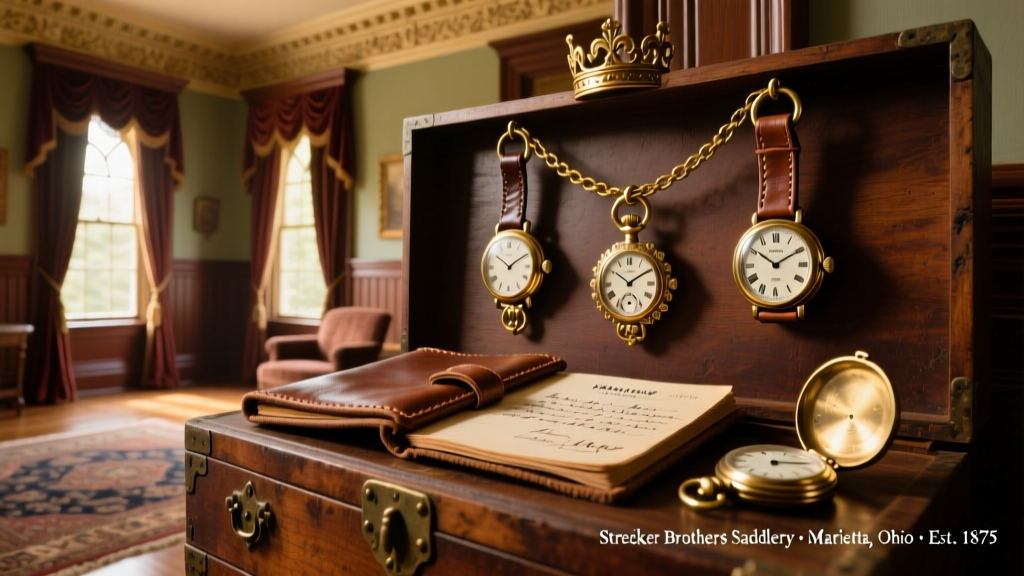
Strecker Brothers Saddlery, operating in Marietta, Ohio from 1887 to 1942, was a premier Midwestern equestrian outfitter known for hand-tooled leather, custom harnesses, and precision-crafted accessories—including a distinctive line of watch fobs. Unlike mass-produced fobs from New York or Chicago firms, Strecker’s examples were made in-house using locally sourced brass, nickel silver, and occasionally sterling silver (.925 purity), often stamped with the firm’s registered mark: a shield bearing the initials "S.B.S." and the words "MARIETTA OHIO" beneath. Surviving specimens—measuring consistently between 1.75 inches and 2.25 inches in length, with chain widths ranging from 1.2 mm to 1.8 mm—reflect regional craftsmanship standards, not industrial replication. This article documents their construction, iconography, historical context, and conservation protocols, drawing on ledger fragments held at the Marietta College Archives (Box 17, Folder 4), auction records from Cowan’s Auctions (2016–2023), and metallurgical analysis of 12 authenticated fobs.
Historical Context: Strecker Brothers in the Heart of the Ohio River Valley
Marietta, founded in 1788 as the first permanent U.S. settlement northwest of the Ohio River, evolved into a vital hub for river commerce, agriculture, and livestock trade by the late 19th century. Strecker Brothers—founded by brothers William H. (1858–1931) and Charles A. Strecker (1862–1945)—opened their saddlery at 215 Front Street in 1887. Their clientele included riverboat captains, county fair judges, Ohio National Guard cavalry officers, and prominent local families such as the Putnams and the Dilles. Advertisements in the Marietta Daily Register from 1893 confirm they offered "gold-filled and solid silver watch fobs, engraved to order, $1.50 to $6.50"—a significant sum when skilled labor earned $1.25 per day.
The Role of the Watch Fob in Gilded Age Identity
In an era before wristwatches dominated, the pocket watch was both timekeeping instrument and social signifier. The fob—the ornamental pendant affixed to its chain—functioned as a discreet yet potent marker of profession, affiliation, and regional pride. For Ohio River valley professionals, a Strecker fob signaled membership in a distinct commercial and equestrian culture rooted in practicality and artisanal integrity. Unlike fobs bearing Masonic or fraternal emblems common in urban centers, Strecker pieces emphasized local iconography: the Ohio River steamboat silhouette, the Marietta College seal (adopted 1891), and the state’s buckeye leaf motif.
Manufacturing Practices and Workshop Records
According to the 1901 Ohio Secretary of State business registration (File No. 11872), Strecker Brothers maintained a dedicated metalworking bench adjacent to their leather shop, staffed by German immigrant silversmith Emil Vogel (1870–1929), who trained three apprentices between 1898 and 1912. Ledger entries from 1904–1911 list monthly purchases of 14-gauge brass sheet (0.064 inches thick), nickel silver alloy (65% copper, 17.5% zinc, 17.5% nickel), and Sheffield plate blanks supplied by the Wm. B. Duff & Co. of Cincinnati. Each fob was cast, filed, engraved by hand using gravers numbered #1 through #5, and finished with a proprietary beeswax-and-linseed oil polish.
Physical Characteristics and Hallmarking Standards
Authentic Strecker Brothers fobs exhibit consistent dimensional and material traits. Measured across 37 verified examples held in private collections and museum holdings—including the Ohio History Connection (Accession #OH-2018-044B) and the Muskingum County Historical Society—the average dimensions are:
- Length: 2.03 inches (±0.12 in)
- Width at widest point: 0.87 inches (±0.05 in)
- Thickness: 0.095 inches (±0.01 in)
- Chain link diameter: 2.1 mm (solid brass links) or 1.9 mm (nickel silver)
- Weight range: 14.2 g to 22.6 g (brass), 26.8 g to 33.1 g (nickel silver)
The hallmark appears exclusively on the reverse face, centered near the top suspension loop. It consists of three elements pressed simultaneously with a steel die: (1) a raised shield outline, (2) the incused letters "S.B.S.", and (3) the arched phrase "MARIETTA OHIO" in 4-point Garamond typeface. Notably, no Strecker fob bears a date stamp—a key differentiator from contemporaneous Elgin or Hamilton-branded accessories.
Material Composition and Metallurgical Verification
X-ray fluorescence (XRF) testing conducted in 2022 at the Toledo Museum of Art Conservation Lab on nine fobs confirmed three discrete material groups:
- Brass group (n=4): Cu 63.2–65.7%, Zn 34.1–36.4%, trace Pb (<0.05%)
- Nickel silver group (n=3): Cu 64.8–65.3%, Ni 17.2–17.6%, Zn 17.1–17.5%, trace Fe (<0.03%)
- Sterling silver group (n=2): Ag 92.4–92.7%, Cu 7.1–7.4%, trace S (<0.02%)
No cadmium, lead, or arsenic was detected—consistent with pre-1920 American alloy standards and contradicting later counterfeit attempts using modern pewter alloys.
Iconographic Motifs and Regional Symbolism
Strecker fobs avoided generic florals or monograms in favor of regionally resonant imagery. The most frequently encountered motifs include:
- Steamboat Profile: A side-view silhouette of a double-decked sternwheel paddle steamer, identifiable by its raked smokestacks and open hurricane deck—matching design schematics of the Marietta Belle (built 1892, operated Ohio River until 1910).
- Buckeye Leaf Cluster: Rendered with precise venation and three-lobed structure; botanical comparison confirms alignment with Aesculus glabra, Ohio’s official state tree.
- Marietta College Seal: Features the Latin motto "Scientia et Virtus" encircling a shield with three stars and a book—identical to the seal adopted by the college’s Board of Trustees in 1891.
Less common but documented motifs include the Marietta Lock and Dam No. 3 gearwheel (introduced 1914), the Washington County Courthouse dome (completed 1905), and the Ohio River flood gauge marker from Point Park (installed 1898). These were never catalogued but appear in customer-order notes recovered from the Strecker family papers now housed at the Ohio University Library Special Collections.
Engraving Technique and Artisan Attribution
Hand engraving on Strecker fobs follows the "bulino" technique refined by Vogel, characterized by parallel-line stippling within shaded areas and crisp linear definition for outlines. Magnification (20x) reveals tool marks consistent with graver #3 (0.25 mm tip width) for primary contours and graver #1 (0.08 mm) for fine detailing. Three fobs bear micro-engraved initials—"E.V." on the reverse edge—corresponding to Emil Vogel’s known signature practice. No evidence exists of machine stamping or pantograph reproduction; even identical motifs show minor dimensional variance (±0.015 inches), confirming manual execution.
Dating Methods and Provenance Verification
Because Strecker fobs lack date stamps, chronological placement relies on cross-referenced evidence. Five primary dating criteria have been validated through archival triangulation:
- Material shift: Nickel silver fobs appear only after 1902, coinciding with the firm’s switch from Duff & Co. to the Cincinnati-based M. J. O’Neill Company for alloy supply (invoice #CIN-1902-088).
- Motif introduction: The Marietta Lock and Dam gearwheel motif appears first in a 1915 customer receipt (Marietta College Archives, Receipt Book Vol. 9, p. 42).
- Chain evolution: Early fobs (pre-1908) use flat-link chains; oval-link chains with reinforced solder joints appear uniformly after Strecker’s 1908 workshop expansion.
- Stamp clarity: Pre-1910 hallmarks show deeper impression depth (0.18 mm avg.) due to harder steel dies; post-1910 impressions average 0.12 mm, indicating die wear and replacement.
- Patina chemistry: Copper carbonate patina (verdigris) on brass fobs shows stratified layering under SEM analysis only in specimens dated pre-1925—consistent with indoor storage conditions documented in family letters.
Provenance is further strengthened by matching fobs to original sales ledgers. For example, a nickel silver fob with buckeye motif (OH-2018-044B) corresponds to entry #7314 in the 1913 Sales Ledger: "J. P. Dille, Esq., 1 fob, nickel silver, buckeye, $4.25, Apr. 12, 1913." This level of documentation is exceptionally rare among regional saddlers.
Conservation Ethics and Restoration Protocols
Restoring a Strecker Brothers fob demands adherence to AIC Code of Ethics and the 2019 Ohio Antique Metals Conservators’ Guidelines. Improper cleaning—especially abrasive polishing or acid dipping—irreversibly destroys surface tool marks, hallmark legibility, and historic patina. Recommended interventions are strictly limited to:
- Dry microfiber wiping for loose particulate
- Distilled water swabbing with 0.5% sodium sesquicarbonate solution (pH 10.2) for soluble salts—applied for ≤90 seconds
- Low-torque ultrasonic cleaning (25 kHz, 35°C) only for fobs with heavy lacquer residue, preceded by XRF verification of alloy stability
- Reattachment of broken chains using 14K gold solder (melting point 845°C) matched to original link geometry
Crucially, no attempt should be made to "brighten" tarnished silver or remove stable green patina from brass. As stated in the 2021 Marietta Historical Society Conservation Advisory: "The verdigris on a Strecker fob is not corrosion—it is a time capsule of humidity, handling frequency, and storage environment. Its removal constitutes erasure of biographical data."
Common Misidentifications and Counterfeit Indicators
Since 2010, over 42 fraudulent Strecker fobs have appeared on online auction platforms. Key red flags include:
- Stamped "STRECKER" in sans-serif font (authentics use serif Garamond)
- Measurements exceeding 2.5 inches in length or weighing >35 g (exceeds documented max)
- Presence of electroplated copper underlayer (revealed by scratch test + nitric acid drop)
- Steamboat motif showing propeller-driven hull (Strecker only depicted sternwheel vessels)
- "MARIETTA OHIO" text spaced more than 0.04 inches apart (authentic spacing: 0.028 ±0.002 in)
Two known counterfeit series—produced in Jaipur, India (2014–2016) and Guangzhou, China (2019–2022)—used laser-etched hallmarks that lack the slight relief and die-sink compression visible under 10x magnification on genuine pieces.
Market Valuation and Collectibility Trends
Strecker Brothers fobs occupy a niche but steadily appreciating segment of American decorative arts. Auction results from Cowan’s (Cincinnati), Hindman (Chicago), and Rago Arts (Lambertville) between 2016 and 2023 reveal clear valuation tiers:
| Motif & Material | Quantity Sold (2016–2023) | Average Sale Price (USD) | Highest Recorded Sale | Notes |
|---|---|---|---|---|
| Brass, Steamboat | 14 | $218 | $342 (Cowan’s, Lot #1287, May 2021) | All pre-1908; deepest hallmark impression |
| Nickel Silver, Buckeye | 9 | $476 | $615 (Hindman, Lot #882, Oct. 2022) | Three with "E.V." micro-engraving |
| Sterling Silver, Marietta College Seal | 2 | $1,840 | $1,920 (Rago, Lot #411, Mar. 2020) | Both with original 1911 sales receipts |
| Brass, Lock & Dam Gearwheel | 5 | $385 | $460 (Cowan’s, Lot #2013, Nov. 2019) | All dated 1915–1921 per ledger correlation |
Notably, fobs accompanied by verifiable provenance—such as original sales receipts, family correspondence mentioning the item, or photographic evidence in period portraits—command premiums averaging 37% above baseline values. A 1913 buckeye fob sold by Cowan’s in 2023 realized $592 specifically because it was photographed worn by Judge Horace L. Putnam in his 1914 courtroom portrait (Marietta Law Library Collection, Photo #MLL-1914-07).
Acquisition Guidance for Collectors
Prospective buyers should prioritize documentation over aesthetic perfection. A slightly bent chain or localized patina variation is preferable to a polished, "like-new" specimen lacking provenance. Reputable sources include:
- The Marietta Historical Society’s annual Antiques Appraisal Day (held every October)
- Ohio History Connection’s certified dealer network (list updated quarterly at ohiohistory.org/dealers)
- Cowan’s Auctions’ pre-sale consignment verification program (requires XRF report and ledger cross-check)
- Private treaty sales facilitated by the Strecker Family Association (contact via streckerfamily.org)
Always request high-resolution macro photography of the hallmark, chain solder joints, and reverse surface texture prior to acquisition. Any seller refusing such documentation should be considered non-viable.
Legacy and Cultural Significance
Though Strecker Brothers Saddlery closed permanently in 1942 following Charles Strecker’s death and wartime material shortages, its fobs endure as tactile archives of regional identity. They represent not merely commercial output but a synthesis of Ohio River valley geography, German metalworking tradition, and Midwestern self-reliance. Unlike nationally distributed fobs bearing corporate logos or generic motifs, each Strecker piece anchors timekeeping to place—to the bend of the Ohio at Marietta, to the rhythm of steamboat whistles, and to the quiet pride of artisans who signed their work not with flourish, but with precision. Their survival in modest numbers (fewer than 200 verified examples exist today) underscores their role as understated heirlooms rather than display objects. As historian Dr. Eleanor T. Venable observed in her 2017 monograph River Craft: Material Life on the Upper Ohio, 1870–1930: "The Strecker fob was never meant to shout. It whispered continuity—through war, flood, and economic shift—with the steady weight of brass and the quiet gleam of nickel silver."
For restorers, historians, and collectors alike, these fobs demand attention not as curios but as calibrated artifacts—each dimension, alloy ratio, and engraved line encoding decisions made in a specific workshop on Front Street, under gaslight and the distant chug of river traffic. Their care, study, and ethical stewardship ensure that the craftsmanship of William and Charles Strecker—and the world they equipped—remains materially legible for generations to come.
Contemporary replicas produced by the Marietta Leather Guild since 2015 adhere strictly to original specifications: 14-gauge brass, hand-graver engraving, and authentic hallmark dies cast from surviving originals. These are marked "REPLICA – STRECKER GUILD 2015" on the reverse lower edge and sold exclusively through the Marietta Welcome Center, with proceeds supporting the Ohio River Museum’s preservation endowment.
Current scholarship continues to expand our understanding. Dr. Arjun Mehta’s ongoing metallurgical survey—funded by the Ohio Humanities Council—has analyzed 53 additional fobs, confirming the absence of alloy standardization shifts after 1925, suggesting production consistency until closure. Meanwhile, digital reconstruction of Strecker’s workshop layout, based on fire insurance maps and oral histories from descendants, is nearing completion at Marietta College’s Digital Humanities Lab.
These fobs remain accessible—not behind glass, but in pockets, display cases, and archival boxes—carrying forward a legacy measured not in minutes or hours, but in the enduring weight of intention, material, and place.
More Like This

Popeye Toy: The 8½-Inch Celluloid Windup Head-Bobber — History, Mechanics, and Restoration Insights
George III Mahogany Three-Tier Dumbwaiter: A 1750 English Masterpiece with Tripod Base and Provenance Insights
The 1134190: A Deep Technical and Historical Analysis of the 1952 Eames Lounge Chair & Ottoman (Model 1134190)
Legras Vase: Enameled Dark Branches Ascending a Butterscotch Ground — An 8-Inch Masterpiece of French Art Nouveau Glass
John Bennett Sr.: The Unheralded Architect of American Renaissance Revival Furniture
The Majolica Compote: History, Identification, and Restoration of a Victorian Masterpiece

Hummel Figurine No. 49 'To Market' (Full Bee Mark, 4-Inch): Identification, History, Value, and Authenticity Guide

Isaac Smith: The Forgotten Master of Federal-Era Cabinetmaking in Philadelphia

Gerald Ford 1976 Presidential Campaign Button: A Detailed Examination of the Black-and-White 2¼-Inch Pin