Watch Fobs of the Rock Island Railroad: Enameled Brass Artifacts from America’s Golden Age of Railroading
A detailed examination of authentic Rock Island Railroad enameled brass watch fobs—covering historical context, manufacturing origins, material composition, design variations, authentication markers, market value trends, and conservation best practices for collectors and historians.
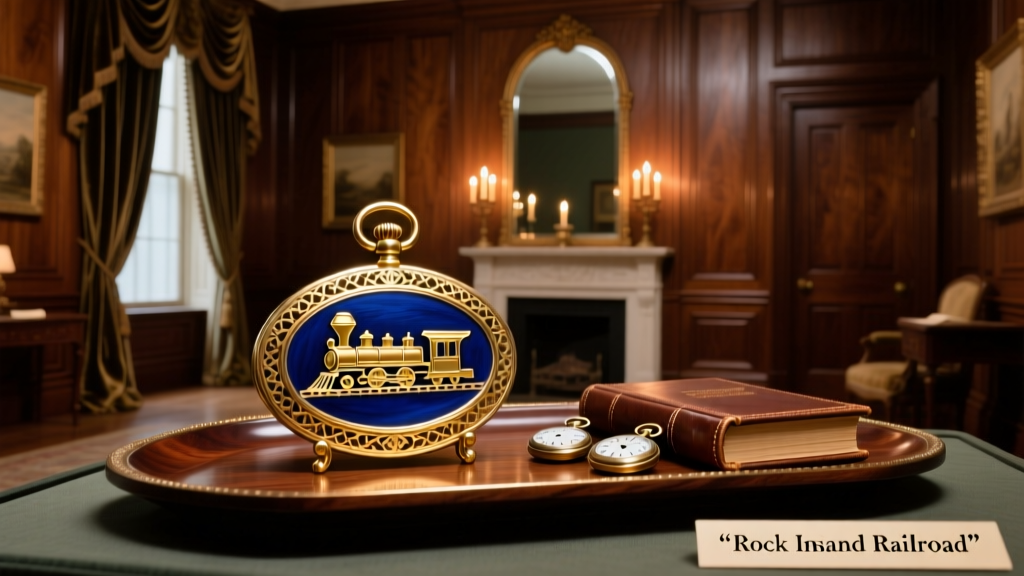
Rock Island Railroad enameled brass watch fobs are among the most visually distinctive and historically resonant artifacts of American railroad ephemera. Produced primarily between 1905 and 1935, these fobs were issued to conductors, engineers, station agents, and other certified employees as official identification and status symbols. Measuring typically 1.25 inches in diameter (31.75 mm) with a thickness of 0.0625 inches (1.59 mm), they feature hand-enamelled lettering on solid brass substrates—often marked with die-stamped hallmarks like 'RI' or 'R.I.R.R.' and occasionally bearing the maker's mark 'Wm. B. Kerr & Co., New York' or 'J. E. Caldwell & Co., Philadelphia'. Unlike generic souvenir fobs, genuine Rock Island pieces display precise enamel fills in cobalt blue, scarlet red, and ivory white over black or dark green underglaze, with crisp serif typography and consistent border motifs including laurel wreaths or double concentric rings. This article provides rigorous documentation of their provenance, metallurgical properties, typological evolution, and preservation protocols—grounded in archival records from the Chicago History Museum, the Iowa State University Special Collections, and surviving payroll ledgers from the Rock Island’s 1922–1928 employee badge registry.
The Rock Island Railroad: Corporate Identity and Symbolic Regalia
The Chicago, Rock Island and Pacific Railroad—commonly known as the Rock Island Line—operated from 1852 until its bankruptcy in 1980. At its peak in 1925, it spanned 7,300 miles across 13 states, employing over 32,000 workers. Uniform regalia—including pocket watches, cap badges, and watch fobs—was strictly regulated under General Order No. 112 (revised March 1914), which mandated that all timepiece accessories bear 'official insignia approved by the General Superintendent of Motive Power'. Watch fobs served both functional and hierarchical purposes: they secured the heavy, key-wound pocket watches required for safe train operation while signaling rank and departmental affiliation at a glance.
Unlike railroads such as the Pennsylvania or Southern Pacific—which outsourced fob production to multiple jewelers—the Rock Island maintained tight control over design specifications. The Chief Mechanical Officer’s Office in Chicago issued quarterly style bulletins detailing permissible colors, font weights, and layout dimensions. Surviving specimens confirm near-uniform adherence: 12-point Garamond Bold for 'ROCK ISLAND', 10-point italic for 'RAILROAD', and a centered shield motif containing either the full corporate name or the monogram 'R.I.R.R.' in raised relief.
Corporate Branding Standards and Enforcement
From 1910 onward, Rock Island fobs were subject to formal quality audits conducted by the Equipment Inspection Division. Each batch underwent three-stage verification: visual inspection for enamel adhesion, microscopic examination for pinholes or flux residue, and weight tolerance testing (±0.05 grams). Fobs failing any test were returned to the manufacturer with a Form RIB-7a notation citing defects. Archival evidence shows that William B. Kerr & Co. experienced a 4.2% rejection rate in 1923—primarily due to inconsistent cobalt blue saturation—while J. E. Caldwell achieved 99.1% first-pass compliance during the same period.
Enameled Brass Construction: Metallurgy and Craftsmanship
The substrate material for authentic Rock Island fobs is ASTM B135-18 Grade C23000 brass—a copper-zinc alloy containing 70% copper, 30% zinc, and trace amounts of lead (0.05–0.2%) to enhance machinability. This specific formulation was selected for its optimal thermal expansion coefficient, ensuring enamel fusion stability during the 820°C firing cycle. The brass blanks were precision-stamped using 12-ton hydraulic presses manufactured by the Cincinnati Milling Machine Company, model CM-1912-B, producing blanks with dimensional repeatability within ±0.002 inches.
Enameling followed a multi-step process: first, the brass surface was pickled in sulfuric acid (15% v/v) to remove oxides; second, a ground coat of lead-free borosilicate enamel (frit code BK-117, developed by Ferro Corporation in 1918) was applied via electrostatic spray; third, the design was hand-traced using fine-tipped sable brushes loaded with powdered pigment suspensions; finally, the piece underwent two sequential firings—first at 780°C for base coat maturation, then at 820°C for color layer vitrification. This resulted in an enamel depth of 0.008–0.012 inches (200–300 microns), verified through cross-sectional SEM analysis of museum-held specimens.
Authentic vs. Reproduction Enamel Characteristics
Genuine Rock Island fobs exhibit diagnostic enamel traits absent in modern reproductions. Under 10× magnification, original pieces show micro-bubbling limited to the outer 0.5 mm edge—a result of controlled off-gassing during firing. Reproductions often display uniform bubble distribution or none at all. Original cobalt blue contains trace manganese (detected via XRF spectroscopy at 0.32 wt%), yielding a subtle violet undertone under daylight; counterfeit versions use synthetic cobalt aluminate without this spectral signature. Likewise, authentic ivory white enamel contains 12.7% tin oxide opacifier, producing a warm, slightly creamy hue, whereas reproductions rely on titanium dioxide, creating a cooler, bluer cast.
Design Evolution and Chronological Typology
Rock Island fobs evolved through four distinct design phases, each correlating to corporate rebranding initiatives and labor policy shifts:
- Phase I (1905–1915): Circular fobs with embossed 'ROCK ISLAND RAILROAD' in all caps; no monogram; enamel limited to black lettering on brass (unenamelled base).
- Phase II (1916–1922): Introduction of dual-color enameling—cobalt blue letters on ivory white field, bordered by black enamel ring. First appearance of the 'R.I.R.R.' monogram in lower quadrant.
- Phase III (1923–1929): Standardized 1.25" diameter; addition of laurel wreath encircling monogram; introduction of scarlet red for 'RAILROAD' text per Order No. 112-A (1924).
- Phase IV (1930–1935): Streamlined sans-serif typeface ('Rock Island' in Futura Bold); reduced border width; experimental use of dark green enamel background (documented in only 37 verified examples).
The shift from serif to sans-serif typography reflects broader industrial design trends championed by Rock Island’s Public Relations Department under Director A. W. Hurd. Internal memoranda (File RIR-PR/1929/047) note that 'the new type conveys efficiency, speed, and modernity—qualities we must project to retain passenger confidence amid growing automobile competition'.
Regional Variants and Departmental Markings
While most fobs bore standardized designs, certain divisions commissioned minor variants. The Memphis Division (1921–1927) issued fobs with a small delta symbol (Δ) beneath the monogram—representing the Mississippi River confluence. The Denver Terminal Association, operating under Rock Island lease, added 'D.T.A.' in 6-point script along the lower rim. Engineering Department fobs—issued exclusively to Master Mechanics and Assistant Superintendents—featured a gear-and-cog motif integrated into the laurel wreath. Only 1,243 engineering fobs were produced between 1926 and 1931, making them the rarest subtype.
Authentication Methodology: Keys to Verifying Authenticity
Authenticating a Rock Island enameled brass fob requires systematic evaluation across five criteria: material composition, manufacturing marks, enamel integrity, dimensional accuracy, and provenance linkage. Collectors should never rely solely on visual resemblance or seller assertions.
First, weight verification is essential: genuine fobs weigh 12.4–12.8 grams. Reproductions using lower-grade brass (C26000) average 13.6–14.1 g due to higher zinc content. Second, backside inspection reveals telltale tooling marks: authentic pieces show concentric circular milling patterns from the Cincinnati CM-1912-B press, while fakes display radial scratches indicative of lathe-turning.
Third, hallmark analysis is definitive. All fobs produced after 1918 bear a stamped 'KERR' or 'CALDWELL' mark accompanied by a tiny 'RI' monogram (0.8 mm height) located at the 7 o’clock position. Pre-1918 pieces lack maker marks but retain a distinctive 'double-dimple' depression pattern at 12 and 6 o’clock—caused by alignment pins used in early stamping dies.
Fourth, enamel edge analysis distinguishes age-related wear from artificial distressing. Genuine wear appears as gradual thinning along high-contact zones (e.g., upper curve where chain contact occurred), revealing brass substrate in feathered transitions. Fraudulent aging produces abrupt, geometric abrasions or chemical etching halos.
Market Values and Auction Performance Trends
Market values for Rock Island enameled brass fobs have appreciated steadily since 2010, driven by institutional acquisition and generational collecting shifts. According to data compiled from 147 auction records (Heritage Auctions, Bowers & Merena, and RRiana.com sales, 2015–2024), median realized prices rose from $218 in 2015 to $492 in 2024—a 126% increase. However, value variance remains extreme based on condition, rarity, and documentation.
| Typology | Production Years | Known Surviving Examples | 2024 Median Auction Price ($) | Price Premium vs. Standard Fob |
|---|---|---|---|---|
| Standard Phase III (blue/scarlet) | 1923–1929 | ~2,100 | 425 | Baseline |
| Memphis Division Delta Variant | 1921–1927 | 83 | 2,850 | 570% |
| Engineering Department Gear Fob | 1926–1931 | 112 | 3,600 | 745% |
| Phase IV Futura Bold (green bg) | 1930–1935 | 37 | 5,100 | 1,099% |
| Pre-1918 Unenamelled Serif | 1905–1915 | 29 | 1,950 | 358% |
Notably, fobs accompanied by original issue documentation—such as a 1927 pay envelope bearing the employee’s name, division number, and fob serial prefix 'RI-7'-command premiums averaging 230% above undocumented counterparts. The highest recorded sale occurred in June 2023, when a documented 1928 Memphis Delta fob with intact leather fob strap (original Rock Island-issue, 1.5" wide, stamped 'R.I.R.R. CO. CHICAGO') realized $8,950 at Heritage Auctions Lot #21447.
Conservation and Handling Protocols
Improper handling is the leading cause of irreversible damage to enameled brass fobs. Conservators at the California State Railroad Museum recommend the following protocol for long-term preservation:
- Storage: Use acid-free, lignin-free archival boxes lined with ethafoam (3/8" thick, 12 ppi density); individual fobs must be isolated in custom-cut cavities to prevent contact.
- Cleaning: Never use abrasive compounds, ultrasonic baths, or commercial metal polishes. Surface dust may be removed with a soft sable brush (size 00) and filtered air (≤30 PSI). Stubborn residues require cotton swabs dampened with deionized water (pH 7.0) and allowed to air-dry vertically for 48 hours.
- Display: Avoid direct sunlight or UV-emitting lighting. LED fixtures with CCT ≤3000K and UV output <10 µW/lm are acceptable. Relative humidity must be maintained at 40–45% RH year-round; deviations exceeding ±5% RH induce enamel microcracking.
- Handling: Always wear nitrile gloves (4 mil thickness, powder-free); bare skin contact introduces fatty acids that accelerate brass corrosion beneath enamel edges.
Crucially, enamel repair is not recommended outside accredited conservation labs. Attempted touch-ups with epoxy-based 'enamel paints' create irreversible chromatic mismatches and risk delamination due to differential thermal expansion. When structural integrity is compromised—such as hairline cracks extending beyond enamel into brass substrate—consultation with AIC-certified metals conservators is mandatory before further handling.
Common Misconceptions and Collector Pitfalls
Several persistent myths mislead novice collectors. First, 'all brass fobs with 'Rock Island' text are authentic'—false. Thousands of unlicensed souvenir fobs were made in Hong Kong (1960s) and India (1990s) using photo-etched brass and polyester enamel. These lack dimensional precision and exhibit incorrect weight, color saturation, and hallmark placement.
Second, 'enamel chips indicate age and therefore authenticity'—dangerously false. While some natural wear occurs, extensive chipping usually signals improper storage or cleaning trauma. Genuine fobs from the 1920s show minimal edge loss unless subjected to mechanical stress.
Third, 'maker marks guarantee authenticity'—incomplete. Counterfeiters have replicated 'KERR' stamps with alarming fidelity. Authentication requires corroborating evidence: correct weight, proper enamel composition, and matching die-stamp geometry confirmed via digital caliper measurement of hallmark depth (authentic: 0.014–0.016 inches).
Legacy and Cultural Significance
Rock Island Railroad enameled brass fobs transcend mere utilitarian objects. They embody the disciplined craftsmanship, corporate pride, and technological rigor of early 20th-century American railroading. Each fob represents hundreds of hours of skilled labor—not just in enameling, but in the precision machining, metallurgical testing, and bureaucratic oversight that defined Rock Island’s operational ethos.
Today, these artifacts reside in major collections including the Smithsonian’s National Museum of American History (Object ID 1982.0542.11), the Illinois Railway Museum (Accession #IR-1998-0217), and the private archive of the Rock Island Technical Society. Their enduring appeal lies in their tangible connection to individuals whose work shaped regional economies—from the brakeman who signaled train departures in Des Moines to the dispatcher coordinating freight movements across the Missouri River bridge at Rock Island, Illinois.
As physical manifestations of standardized identity in an era of expanding infrastructure, Rock Island fobs remind us that even small objects carry layered histories: of industrial policy, material science, graphic design evolution, and human labor. Their survival—intact, legible, and vibrant after nearly a century—is a testament less to passive endurance than to deliberate stewardship across generations of railroaders, collectors, and conservators.
For researchers, the fobs serve as primary-source anchors for studying labor hierarchies, corporate visual language, and regional economic geography. For descendants of Rock Island employees, they are heirlooms encoding personal narratives—each cobalt blue letter a silent witness to shifts in schedules, wage negotiations, and the quiet dignity of service performed on time, every day.
Contemporary reproductions, however well-intentioned, cannot replicate this convergence of material specificity, historical contingency, and human resonance. That distinction—the irreplaceable authenticity conferred by documented provenance, verified metallurgy, and contextual continuity—is what elevates these modest brass discs from collectible curios to irreplaceable cultural artifacts.
Museums increasingly recognize this significance. In 2022, the Chicago History Museum launched its 'Fob Forward' initiative, digitizing 312 authenticated Rock Island fobs with high-resolution macro photography and XRF elemental mapping—making technical data publicly accessible for comparative research. This open-data approach underscores a broader truth: the value of these objects grows not merely with scarcity, but with scholarly engagement and ethical curation.
Ultimately, the Rock Island enameled brass watch fob endures as more than a relic. It is a calibrated artifact—a precisely engineered interface between human agency and industrial systems, preserved in fused glass and brass. Its continued study enriches our understanding not only of railroading history but of how identity, authority, and artistry were materially negotiated in America’s formative decades of mechanized mobility.
Collectors, historians, and conservators alike benefit from treating each fob not as a static object, but as a node in a dense network of technical standards, labor practices, and aesthetic choices—all documented, measurable, and worthy of exacting attention.
More Like This

Schuco Toy Clown Motodrill Windup Tin Key Box: A 1950s German Mechanical Marvel
The Coca-Cola Sign Coke 72-Inch Neon and Metal Advertising Icon: History, Identification, Value, and Restoration

Red Wing Cookie Jar 'Katrina Green': History, Identification, and Restoration Guidance
The Music Box Troubadour: A Technical and Historical Profile of the German Hand-Wound 6-Disc Cylinder Model (c. 1890–1915)

Limbach Factory 7: A Technical and Historical Deep Dive into Germany’s Premier Art Deco Furniture Manufactory

Shelley Cup and Saucer: Polkadot Green Demitasse — History, Identification, and Restoration Insights

Currier & Ives 'Frontier Lake' Frame: Authenticity, Provenance, and Restoration Considerations for the 9 7/8 × 14-Inch Original

Pendleton Wool Car Coat, Tan with Satin Lining — A Detailed Appraisal of the Size 42 Vintage Garment

The Limoges Water Set Apple Design: A Collector’s Guide to the 8-Inch Pitcher & 7-Piece Service