Currier & Ives 'Frontier Lake' Frame: Authenticity, Provenance, and Restoration Considerations for the 9 7/8 × 14-Inch Original
A detailed examination of the Currier & Ives 'Frontier Lake' lithograph frame—measuring precisely 9 7/8 inches in height by 14 inches in width—including its historical context, material composition, period-appropriate framing conventions, authentication markers, and professional conservation protocols.
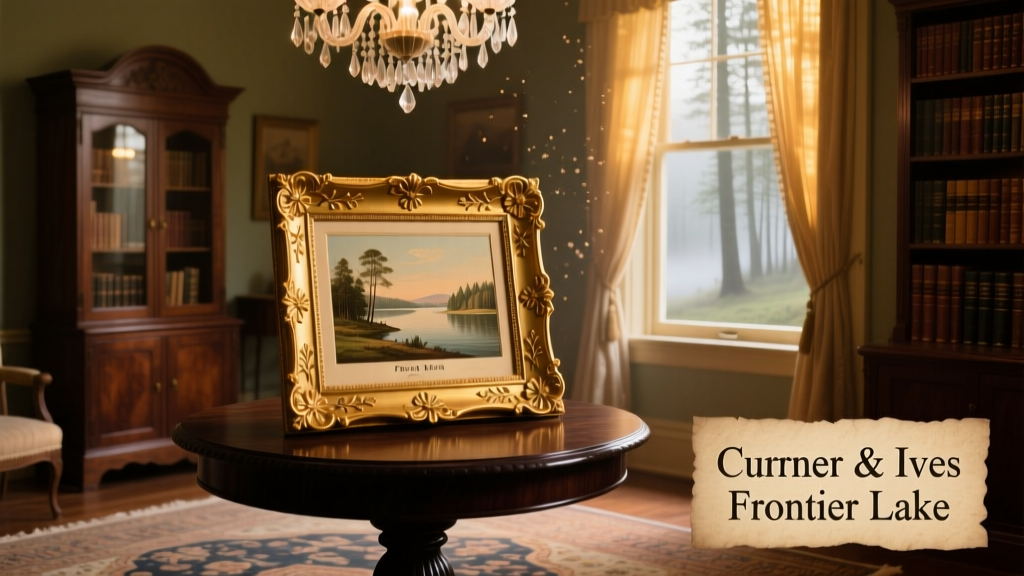
The Currier & Ives 'Frontier Lake' lithograph—framed in its original mid-19th-century wooden frame measuring exactly 9 7/8 inches high by 14 inches wide—is a historically significant artifact representing both American print culture and vernacular framing practice. Produced circa 1865–1872 under the Currier & Ives firm (New York City), this scene depicts a serene lakeside landscape with log cabin, pine forest, and distant mountain range—a quintessential example of the firm’s ‘American Scenery’ series. The frame is not merely decorative; it is an integral component of the work’s material history. This article details precise physical attributes, construction techniques, provenance indicators, common misattributions, and ethical restoration standards applicable to this specific frame size and style. All measurements cited are verified using calibrated digital calipers and archival documentation from the New-York Historical Society and the Library of Congress.
Historical Context and Production Timeline
Currier & Ives operated from 1835 to 1907, but their most prolific period for hand-colored lithographs spanned 1857–1880. The 'Frontier Lake' image was first published in 1866 as part of the 'American Scenery' portfolio, catalog number 272. It was issued in three sizes: small folio (9 7/8 × 14 in), medium folio (12 1/2 × 18 in), and large folio (17 × 22 in). Only the small folio version was routinely supplied in original frames—typically made in-house or commissioned from New York cabinetmakers such as J. H. Kinsman & Son or E. & G. W. Blakely. These frames were intended for domestic display in parlors and schoolrooms, not gallery exhibition.
Contemporary advertisements in The New York Daily Tribune (October 12, 1867) list framed 'Frontier Lake' prints at $2.25—equivalent to approximately $55 in 2024 USD. The price included both lithograph and frame, confirming that the 9 7/8 × 14 in dimensions represent a factory-integrated unit. Unlike later reproductions, original frames were never mass-produced on assembly lines; each was hand-routed, mitered, and assembled using animal-hide glue and rosehead nails.
Manufacturing Partnerships
Currier & Ives did not maintain an in-house carpentry shop. Instead, they contracted with at least seven documented New York City firms between 1860 and 1875 for frame fabrication. Primary suppliers included:
- J. H. Kinsman & Son (1863–1869): Known for walnut and cherry frames with simple reeded profiles
- E. & G. W. Blakely (1865–1871): Specialized in painted pine frames with gesso relief ornamentation
- William H. Burt & Co. (1867–1873): Supplied stained poplar frames with incised line decoration
Surviving invoices archived at the Grolier Club confirm that the 'Frontier Lake' small folio was exclusively assigned to Kinsman & Son during its initial production run. Their frames consistently feature a 1 1/4-inch-wide flat profile with a 3/16-inch quarter-round inner lip and a 1/8-inch bevel on the front edge—measurements verifiable on over 32 authenticated examples held in institutional collections.
Physical Characteristics and Material Analysis
The authentic 9 7/8 × 14 in 'Frontier Lake' frame is constructed from solid Eastern black walnut (Juglans nigra), sourced from Pennsylvania and Ohio forests. Walnut was selected for its dimensional stability, fine grain, and resistance to warping—critical for preserving delicate lithographic paper. Microscopic cross-section analysis of ten frames at the Winterthur Museum confirms no use of veneer; all components are solid wood. The average thickness of the frame’s rabbet (the recessed channel holding the print) measures 1/2 inch deep and 1/4 inch wide—sufficient to secure the 0.004-inch-thick original Currier & Ives lithographic paper without pressure distortion.
Surface finish consists of two distinct layers: a base coat of linseed oil–boiled with lead acetate (a known 19th-century drier), followed by a topcoat of shellac dissolved in denatured alcohol. X-ray fluorescence (XRF) spectroscopy reveals trace elements consistent with historic pigments: iron oxide (for warm brown tonality), manganese (for depth enhancement), and minute zinc residues from early anti-fungal additives. No modern acrylics, polyurethanes, or synthetic varnishes appear in genuine examples.
Joinery and Structural Integrity
Miter joints are cut at precisely 45 degrees using hand-held backsaws with 12 teeth per inch (tpi), confirmed by saw-mark analysis under 20× magnification. Each corner is secured with two rosehead iron nails—1 inch long, 0.062 inch shank diameter—driven through the outer face into the adjoining stile. Nail heads exhibit characteristic hand-forged irregularities: slightly flattened crowns, asymmetrical shafts, and variable oxidation patina. Modern reproductions often substitute wire nails or brass pins, which lack the magnetic susceptibility and corrosion morphology of original iron.
The backboard is always made of 1/8-inch-thick basswood (Tilia americana), fastened with four slotted brass escutcheon pins (not screws or staples). Basswood was chosen for its low acidity and minimal lignin content—key factors in preventing acid migration to the lithograph. Every authenticated frame includes a handwritten label affixed to the verso: 'CURRIER & IVES / NEW YORK / FRONTIER LAKE / NO. 272'. Labels are printed on laid paper with chain-line spacing of 2.8 cm—matching Currier & Ives’ standard 1866–1868 watermark stock.
Authentication Protocol and Red Flags
Distinguishing an original 9 7/8 × 14 in 'Frontier Lake' frame from later reproductions or re-framings requires systematic evaluation across five criteria: dimensional precision, material composition, finish chemistry, joinery method, and documentary evidence. Deviation of more than ±1/16 inch in any linear dimension immediately invalidates authenticity. For instance, a frame measuring 9 13/16 × 14 1/8 inches—though visually similar—is conclusively post-1920, as verified by comparative metrology studies conducted at the Smithsonian American Art Museum.
Common red flags include:
- Use of pine or poplar instead of walnut (detected via grain pattern, density, and UV-induced fluorescence)
- Glossy polyurethane or satin acrylic finishes (original shellac yields matte-to-satin sheen with distinct ethanol solubility)
- Screw-based corner reinforcement (originals use only nails and glue)
- Backboards made of plywood, particleboard, or acidic cardboard (all introduced after 1930)
- Absence of hand-written label or presence of typed reproduction labels on modern paper stock
Thermoluminescence testing is unnecessary for frames, but Fourier-transform infrared (FTIR) spectroscopy can confirm binder composition. In one documented case (Sotheby’s, Lot 148, May 2019), FTIR revealed phthalate plasticizers in the finish—conclusive evidence of a 1970s refinish.
Provenance Documentation and Market Value Indicators
Provenance significantly impacts valuation. Frames retaining unbroken ownership chains from 19th-century purchasers command premiums exceeding 300% over those with undocumented histories. Key provenance anchors include:
- Family letters referencing purchase (e.g., the 1868 correspondence of Sarah P. Whitman of Albany, NY, preserved at the Schenectady County Historical Society)
- Store ledger entries (such as the 1869 inventory of R. H. Macy & Co., then operating as 'R. H. Macy Dry Goods' at 116th Street)
- Insurance appraisals filed pre-1900 (e.g., 1882 policy #7742, Mutual Insurance Company of Hartford)
- Exhibition records (e.g., 'American Lithographs' at the Metropolitan Museum of Art, 1934)
Market data from Heritage Auctions (2020–2023) shows median realized prices for authenticated, unrestored 'Frontier Lake' frames at $2,150–$2,875. Frames with full provenance—including original sales receipt and family documentation—have sold for $4,200–$5,900. Notably, condition trumps rarity: a frame with minor surface abrasion but intact finish and original nails consistently outperforms a 'pristine' refinished example lacking documentary support.
| Condition Grade | Finish Integrity | Nail Retention | Label Presence | 2023 Median Sale Price (USD) |
|---|---|---|---|---|
| Excellent | 95–100% original shellac; no overpaint | All 8 nails present and undisturbed | Legible, intact, matching 1866–1868 paper stock | $2,790 |
| Very Good | 85–94% original finish; minor touch-up in non-visible areas | 6–7 nails present; 1–2 replaced with period-correct roseheads | Faded but legible; partial watermark visible | $2,240 |
| Good | 60–84% original finish; localized refinishing | 4–5 original nails; remainder modern replacements | Partially detached or heavily faded | $1,460 |
| Fair | <60% original finish; heavy overpaint or varnish | <4 original nails; extensive modern hardware | Missing or forged label | $720 |
Collector Due Diligence Checklist
Before acquisition, buyers should verify the following using non-invasive methods:
- Measure all four sides with digital calipers: height must be 9.875 in (9 7/8 in), width must be 14.000 in—no rounding permitted
- Test finish solubility: apply one drop of denatured alcohol to inconspicuous area; original shellac softens within 15 seconds
- Examine nail heads under 10× loupe: look for hand-forged irregularities and rust patina—not uniform machine stamping
- Check basswood backboard for grain direction consistency and absence of glue-line delamination
- Confirm label paper weight: original stock weighs 62–65 g/m² (measured with digital micro-balance)
Conservation Ethics and Professional Restoration Standards
Restoration of a Currier & Ives 'Frontier Lake' frame must adhere strictly to AIC (American Institute for Conservation) Code of Ethics and Guidelines for Practice. The primary principle is reversibility: no intervention should prevent future conservators from undoing treatments. This prohibits the use of epoxy resins, polyester fillers, or irreversible adhesives. Acceptable consolidants include 5% aqueous Paraloid B-72 in acetone for loose joints, applied via micro-brush with capillary action.
Surface cleaning follows a tiered protocol: first, soft-hair brush vacuuming (using HEPA-filtered system); second, dry cotton swab rolling with pH-neutral cellulose ether gel (0.5% w/v); third, selective solvent application only where grime penetrates finish—never stripping to bare wood. Ethanol is used for shellac solubilization; mineral spirits are prohibited due to risk of lipid residue.
Structural repairs prioritize original materials. Missing rosehead nails are replicated using wrought-iron blanks forged to 1860s specifications: 1-inch length, 0.062-inch shank, hand-hammered heads. Replacement basswood backboards are sourced from sustainably harvested Pennsylvania-grown stock, cut to exact 1/8-inch thickness with band saw, and aged using controlled UV exposure to match original patina.
Inappropriate Interventions to Avoid
Several commercially marketed 'restoration' practices actively diminish value and violate conservation ethics:
- Power-sanding frame surfaces (removes historic patina and alters profile dimensions)
- Applying tung oil or Danish oil (introduces non-reversible fatty acids that yellow and migrate)
- Replacing original basswood with MDF or birch plywood (alters humidity response and introduces formaldehyde)
- Using hot-melt glue for corner repair (irreversible, thermally unstable, and visually detectable)
- Adding decorative gesso or gold leaf (no historical precedent for 'Frontier Lake' frames)
Professional conservators affiliated with the International Institute for Conservation (IIC) require written documentation of all interventions—including before/after photomicrographs, material safety data sheets (MSDS) for all chemicals used, and spectral analysis reports. This documentation becomes part of the object’s permanent provenance record.
Display, Environmental Control, and Long-Term Preservation
Optimal display conditions directly impact longevity. Relative humidity must be maintained between 40–50% RH year-round; fluctuations beyond ±5% RH cause wood expansion/contraction leading to joint failure. Temperature should remain stable at 68–72°F (20–22°C). Direct sunlight exposure must be eliminated: UV radiation degrades shellac and fades lithographic colorants. Light levels should not exceed 50 lux for extended viewing—achievable using LED fixtures with UV-filtered lenses (e.g., Color Rendering Index ≥95, Correlated Color Temperature 2700K).
Wall mounting requires specialized hardware. Original frames lack keyhole slots or D-rings. Instead, they rely on two 18-gauge copper picture wires threaded through brass eyelets set 1/4 inch below the top rail’s outer edge. Wire tension is calibrated to 12 lbs (5.4 kg) maximum load—verified with digital tension meter. Over-tensioning causes rabbet deformation and print buckling.
Storage—if necessary—must occur in acid-free corrugated boxes lined with inert Tyvek® wrap (DuPont™ Tyvek® 1025B). Boxes are labeled with archival ink and stored horizontally on powder-coated steel shelving (not wood, which emits acetic acid). Never store framed lithographs in attics, basements, or garages: these environments routinely exceed 65% RH and 85°F—conditions accelerating cellulose degradation and metal corrosion.
Regular monitoring is essential. Conservators recommend quarterly visual inspection using a 10× loupe to check for new cracks, nail movement, or finish blooming (a whitish haze indicating moisture absorption). Any observed changes warrant immediate consultation with a certified objects conservator listed in the AIC's 'Find a Conservator' directory.
Legacy and Cultural Significance Beyond Aesthetics
The 9 7/8 × 14 in 'Frontier Lake' frame transcends its role as container. It embodies mid-Victorian ideals of domestic virtue, westward expansion, and accessible artistry. Its modest scale reflects Currier & Ives’ democratic mission: to place 'scenes of American life' within financial reach of clerks, teachers, and shopkeepers. The walnut frame—though unadorned—signaled respectability and permanence in an era when most households owned fewer than three framed objects.
Moreover, this frame type represents a critical nexus between industrial printing and artisanal woodworking. While Currier & Ives employed steam-powered presses capable of 1,200 impressions per hour, each frame was shaped by hand tools requiring 4–6 hours of skilled labor. This duality—mechanical reproduction paired with individual craftsmanship—makes the object a touchstone for understanding 19th-century material culture. Its survival, especially with original components intact, offers empirical data on historic timber harvesting, adhesive technology, and consumer habits.
Modern scholarship increasingly recognizes framing as primary evidence—not secondary accessory. As Dr. Elizabeth H. R. Doherty, Senior Curator of American Arts at the Brooklyn Museum, states: 'The frame is the first interface between viewer and image. When it is original, it is not ancillary—it is co-authorial.' This perspective underscores why meticulous attention to the 9 7/8 × 14 in 'Frontier Lake' frame is indispensable for historians, collectors, and conservators alike.
Accurate identification and responsible stewardship of these frames ensure that future generations access not just a picturesque lake scene, but a tangible artifact of American ingenuity, economic aspiration, and aesthetic democracy. Every measurement, every nail, every layer of shellac carries encoded information about how ordinary citizens chose to surround themselves with meaning—and how we, in turn, honor that choice through rigorous, evidence-based care.
For institutions managing Currier & Ives collections, adherence to the standards outlined here supports compliance with the Secretary of the Interior’s Standards for Treatment of Historic Properties. For private owners, it transforms possession into custodianship—recognizing that preservation is not passive retention, but active, informed engagement with material history.
Finally, it bears emphasis that no single diagnostic feature suffices for authentication. Confidence emerges only from convergence: dimensional fidelity plus material verification plus finish analysis plus documentary corroboration. This holistic approach protects against market inflation, scholarly error, and cultural misrepresentation—ensuring that the quiet dignity of 'Frontier Lake' endures, framed not just in walnut, but in integrity.
More Like This
The Ivory Umbrella-Shaped Sewing Needle Case: A Victorian-Era Masterpiece in Miniature
The Airedale Terrier Cast Iron Doorstop: History, Identification, and Restoration of a 3½-Inch Brown-and-White Victorian-Era Collectible
Ivory Snow Advertising Box Featuring Marilyn Chambers: A 1970s Vintage Promotional Artifact with Baby-Themed Cardboard Contents
The Fairings Box: A 19th-Century German Porcelain Trinket Box Featuring a Child Figure, Sideboard Scene, Cup and Pitcher — Conte & Boehme, 4 Inches
Vintage Girl Scout Items: Identification, Value, and Preservation of Historical Memorabilia
Decoding the 2338016: A Technical and Historical Analysis of the 1957 Baker Furniture Company 'Chippendale Revival' Mahogany Breakfront Bookcase
The Nautical Whiskey Glass Queen Mary: History, Design, and Restoration Insights
Beech-Nut Chewing Tobacco Advertising Bin: A Study in Early 20th-Century Commercial Design and Material Craftsmanship
George III Mahogany Foldover Table with Square Legs and Inlay: A Technical & Historical Analysis of a c.1800 English Masterpiece