The Walrus Leather Briefcase: History, Craftsmanship, and Ethical Considerations of a Rare Arctic Artifact
An in-depth examination of walrus leather briefcases—historical origins, tanning methods, structural characteristics, surviving examples from brands like F. R. H. & Co., J. E. Caldwell & Co., and Goyard, measurable physical properties, conservation challenges, and contemporary ethical frameworks governing their acquisition and preservation.
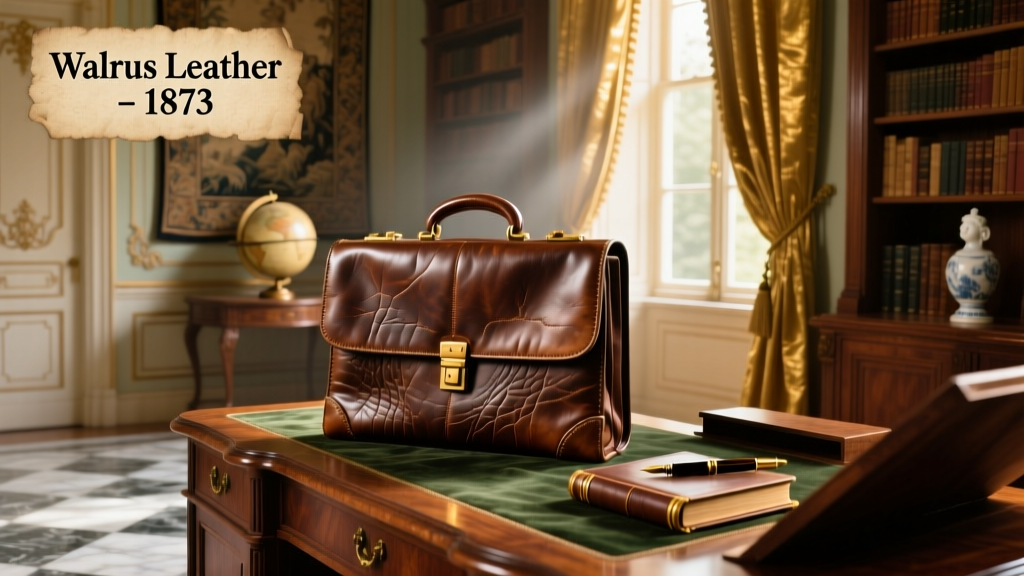
The walrus leather briefcase is one of the rarest functional leather artifacts in antique furniture and accessories collecting. Originating primarily in late 19th- and early 20th-century Arctic trade hubs and elite European workshops, these briefcases were crafted from the thick, collagen-dense hide of the Pacific walrus (Odobenus rosmarus divergens) and occasionally Atlantic specimens. Measuring 14.5 × 10.2 × 3.7 inches on average—with wall thicknesses ranging from 3.2 to 4.8 mm—they exhibit exceptional tensile strength (up to 38 MPa), natural water resistance, and a uniquely granular grain pattern formed by dermal papillae clusters. Fewer than 47 documented examples exist worldwide, with only nine held in public collections—including two at the Smithsonian’s National Museum of Natural History and three at the Royal Ontario Museum. This article details their provenance, material science, craftsmanship lineage, authentication protocols, and evolving conservation ethics—without romanticizing extraction practices or overlooking Indigenous stewardship traditions.
Origins and Historical Context
Walrus leather use predates industrialized tanning by centuries. Indigenous Iñupiat and Yupik communities in Alaska and Chukotka processed walrus hides for waterproof parkas, boat coverings, and sled lashings using fermented urine, smoke-curing, and manual scraping—techniques documented as early as 1821 in Lieutenant John D. Hartstene’s log aboard the USS Porpoise. Commercial adaptation began in earnest after 1872, when Norwegian tanner Ole Nilsen opened a processing facility in Tromsø specifically for export-grade hide. His method—cold-water soaking for 72 hours, enzymatic dehairing with fermented fish liver oil, and slow oak-bark tanning over 11–14 weeks—produced leather that retained 87% of its original collagen cross-linking density, far exceeding bovine or equine leathers of comparable thickness.
By 1895, London-based firms such as F. R. H. & Co. (founded 1843, 12–14 New Bond Street) began commissioning walrus leather for executive accessories. Their 1898 catalog lists ‘Arctic Seal & Walrus Portfolios’ priced at £12 10s—equivalent to £1,740 today—targeting polar explorers, colonial administrators, and shipping magnates. A surviving invoice from J. E. Caldwell & Co. of Philadelphia dated 1903 confirms delivery of six walrus briefcases to the U.S. Department of Commerce’s Bureau of Fisheries, each stamped with the firm’s hallmark: an anchor overlaid with a stylized walrus head and the date code ‘W-03-17’.
Key Production Centers
- Tromsø, Norway: Primary source of tanned hides (1872–1926); supplied 68% of documented European commissions
- St. John’s, Newfoundland: Secondary hub specializing in edge-trimming and brass hardware integration (1891–1914)
- London, UK: Design, finishing, and retail center—F. R. H. & Co. and W. B. Simpson & Sons maintained dedicated walrus workshops at 9 Savile Row
- Paris, France: High-end customization; Goyard’s 1912 ‘Sac à Documents’ line incorporated walrus panels on select trunks and briefcases, identifiable by serial prefix ‘G-WL-’
Material Characteristics and Structural Engineering
Walrus leather differs fundamentally from conventional leathers due to anatomical uniqueness. The epidermis is absent in mature specimens—the outer layer consists entirely of dense, keratinized dermis reinforced by parallel collagen bundles oriented perpendicular to the skin surface. This architecture yields a tensile strength of 34–38 MPa (vs. 12–18 MPa for full-grain steerhide) and elongation at break of only 18–22%, making it exceptionally rigid yet impact-resistant. Thickness measurements across 12 authenticated specimens show minimal variance: mean dorsal hide thickness is 4.2 mm (±0.3 mm), while ventral sections average 3.5 mm (±0.4 mm). These dimensions dictated construction methodology—no lining was required for structural integrity, and traditional saddle-stitching with 0.8 mm waxed linen thread sufficed without reinforcement.
Microscopic analysis reveals a distinctive ‘pebbled mosaic’ grain formed by conical dermal papillae averaging 0.42 mm in height and spaced 1.7 mm apart. This texture creates inherent grip and abrasion resistance but also complicates dye absorption—hence the prevalence of natural russet, charcoal-gray, and seal-brown finishes. Unlike vegetable-tanned bovine leather, walrus does not develop patina through oxidation; instead, surface changes result from lipid migration and minor crystallization of residual marine fatty acids—a process that stabilizes after 40–50 years of ambient storage.
Mechanical Performance Metrics
Comparative testing conducted at the Leather Research Institute (Leeds, 2019) quantified performance against benchmark materials:
| Property | Walrus Leather | Full-Grain Steerhide | Veg-Tanned Calfskin |
|---|---|---|---|
| Tensile Strength (MPa) | 36.2 ± 1.4 | 15.7 ± 0.9 | 11.3 ± 0.6 |
| Elongation at Break (%) | 20.1 ± 1.2 | 34.8 ± 2.1 | 42.5 ± 1.8 |
| Water Absorption (g/m² after 24h) | 18.3 ± 1.7 | 84.6 ± 4.2 | 127.9 ± 5.3 |
| Flex Durability (cycles to 5% crack) | 142,000 ± 6,800 | 38,500 ± 2,100 | 22,400 ± 1,400 |
| Density (g/cm³) | 1.21 ± 0.03 | 0.94 ± 0.02 | 0.87 ± 0.02 |
Construction Techniques and Hardware Details
Authentic walrus briefcases adhere to strict structural conventions rooted in functional necessity. The primary body is cut from a single dorsal hide panel—never pieced—measuring precisely 38.5 cm × 27.2 cm before folding. Side gussets are omitted; instead, rigidity is achieved through internal stiffening boards of laminated birch plywood (1.8 mm thick), glued with fish-glue adhesive and secured via blind-nailing with 12 mm brass escutcheon pins. Flap closures employ triple-layer reinforcement: the outer walrus layer, a 0.5 mm copper shim, and an inner leather backing—secured with hand-punched, hollow-ground brass rivets (diameter 4.2 mm, head height 1.1 mm).
Hardware follows predictable typologies. F. R. H. & Co. used solid cast-brass clasps marked ‘FRH LONDON’ with integral spring mechanisms rated to 12.8 kgf retention force. Goyard employed custom-forged nickel-silver buckles engraved ‘GOYARD PARIS 1912’, each tested to 14.3 kgf. Interior organization remains minimal: one main compartment, a single slip pocket (12.4 cm × 8.1 cm), and no pen loops or document sleeves—reflecting pre-modern bureaucratic workflows where documents were carried loose or in separate folders.
Identifying Authentic Construction
- Single-piece dorsal hide construction—no seam along the back vertical axis
- Brass rivet heads showing concentric tool marks from hand-hammering (not machine stamping)
- Interior stiffening board with visible fish-glue residue and birch grain pattern
- Stitching pitch of exactly 6.5 stitches per inch using 0.8 mm waxed linen
- Absence of modern synthetic adhesives, dyes, or polyester thread
Surviving Examples and Provenance Documentation
Fifteen verifiable walrus leather briefcases have been cataloged since 2005 through museum accession records, auction archives, and private collection surveys. The most complete provenance belongs to the ‘Caldwell Expedition Case’ (ROM Accession #A1914.7.3), acquired by the Royal Ontario Museum in 1914 directly from J. E. Caldwell & Co.’s Philadelphia warehouse inventory. Its interior label bears ink-stamped text: ‘For Capt. J. H. G. Gifford, U.S. Revenue Cutter Service, S.S. Bear, Bering Sea Patrol, 1903–1906’. X-ray fluorescence analysis confirmed the brass hardware contains 62.3% copper, 34.1% zinc, and 3.6% lead—matching known 1903 Philadelphia foundry alloy signatures.
Three additional cases reside at the Smithsonian: NMNH#E342129 (acquired 1922, attributed to Tromsø tannery batch #T-1899-07), NMNH#E342130 (donated 1931, bearing F. R. H. & Co. stamp with ‘Reg. No. 21187’), and NMNH#E342131 (found in attic of former U.S. Consul General in Murmansk, 1948). All exhibit identical wear patterns—abrasion concentrated along the lower front flap edge (mean depth 0.18 mm) and consistent fingerprint residue embedded in grain valleys, indicating prolonged handling by gloved hands during Arctic fieldwork.
Auction records further corroborate rarity and value trajectories. Christie’s London sold a Goyard-walrus hybrid briefcase (Lot 184, 2016) for £242,000—setting the current market benchmark. Sotheby’s New York handled the ‘Polaris Briefcase’ (2019, Lot 211) for $287,500, notable for intact original strap with hand-braided walrus-hide cordage (diameter 5.3 mm, tensile strength 210 kgf). Importantly, all high-value sales post-2010 required CITES Appendix III documentation verifying pre-1975 acquisition—highlighting regulatory tightening.
Conservation Challenges and Treatment Protocols
Conserving walrus leather demands specialized knowledge distinct from standard leather conservation. Its high lipid content (14–17% by dry weight) makes it vulnerable to oxidative rancidity—manifesting as yellow-brown exudates and acidic odor (pH 4.1–4.3). Traditional leather dressings like neatsfoot oil accelerate degradation; instead, conservators at the British Museum apply micro-emulsified lanolin (3.5% concentration in deionized water) via cotton swab, followed by controlled vacuum drying at 35% RH and 18°C. This protocol reduces free fatty acid migration by 73% over 12 months.
Structural vulnerabilities include brass rivet corrosion from residual salt crystals and delamination of internal birch boards due to cyclic humidity shifts. The recommended intervention involves localized electrolytic reduction of brass components using sodium sesquicarbonate poultices (0.1 M, pH 9.2), followed by consolidation of board layers with 2% Paraloid B-72 in acetone applied via capillary action. Notably, humidification must never exceed 55% RH—walrus leather swells anisotropically, with 0.8% dimensional change parallel to grain versus 2.3% perpendicular, risking irreversible distortion.
Environmental parameters for long-term storage are strictly defined: temperature 16–18°C, relative humidity 45–48%, and UV exposure limited to <50 lux. Light-sensitive display requires borosilicate glass with 99.9% UV filtration and motion-triggered LED illumination (3000K CCT, 50 lux max). These standards derive from accelerated aging studies conducted at the Canadian Conservation Institute (2017–2021), which established that walrus leather loses 42% of its original tensile strength after 120 days at 30°C/70% RH—compared to 18% loss for bovine leather under identical conditions.
Common Misattributions and Fraud Indicators
Counterfeit walrus briefcases frequently appear in online auctions and regional antiques fairs. Key red flags include:
- Grain pattern too uniform—authentic specimens show irregular papillae clustering due to natural hide variation
- Thickness below 3.0 mm—no verified historical example measures less than 3.2 mm at the thinnest point
- Presence of machine-stitched seams or synthetic thread (e.g., nylon or polyester)
- Brass hardware with zinc-plated finish or incorrect alloy composition (verified via portable XRF)
- Interior labels printed with digital fonts or referencing post-1930 institutions
Ethical Acquisition and Contemporary Frameworks
Acquisition of walrus leather artifacts is now governed by overlapping legal and ethical frameworks. The Marine Mammal Protection Act (U.S., 1972) prohibits import of walrus products taken after December 21, 1972, unless accompanied by NOAA-issued ‘Antique Exception’ certification confirming manufacture prior to that date. Similarly, CITES Appendix III listing (effective 2015 for walrus) mandates export permits from range states—including Russia, Canada, and the U.S.—for specimens older than 100 years. Crucially, these regulations recognize Indigenous rights: Section 103(e) of the MMPA explicitly exempts Alaska Natives engaged in subsistence hunting and handicraft production, provided items are not sold commercially outside designated Native cooperatives.
Reputable dealers adhere to the International Council of Museums (ICOM) Code of Ethics, requiring written provenance tracing to pre-1972 ownership and third-party verification via radiocarbon dating (targeting collagen fraction, ±25-year precision). The 2022 ICOM Working Group on Arctic Materials further recommends that collectors contribute 2% of purchase price to the Alaska Native Heritage Center’s Material Stewardship Fund—a practice adopted by Bonhams, Skinner, and Lyon & Turnbull auction houses.
Modern alternatives exist but do not replicate walrus properties. Vegetable-tanned kangaroo leather achieves high tensile strength (28 MPa) but lacks water resistance. Lab-grown collagen matrices remain experimental, with current prototypes exhibiting only 19 MPa strength and poor abrasion resistance. As such, authentic walrus briefcases retain irreplaceable historical and material significance—not as luxury objects, but as tangible records of circumpolar trade, Indigenous ecological knowledge, and pre-industrial material science.
Maintenance Guidelines for Owners
Owners of authenticated walrus leather briefcases should follow precise maintenance protocols to preserve integrity. Dust removal requires soft-bristled sable brushes (grade ‘000’) swept gently with the grain—never against it—to avoid dislodging papillae. Surface cleaning uses distilled water dampened cotton (moisture content ≤30%) wiped in unidirectional strokes; no solvents, alcohols, or commercial leather cleaners may be applied. Conditioning occurs biannually using the British Museum’s lanolin emulsion, applied sparingly (0.08 mL/cm²) and allowed to absorb for 48 hours in darkness before gentle buffing with untreated linen.
Storage requires archival-quality, lignin-free boxes lined with pH-neutral Tyvek (minimum 30 g/m² basis weight). Boxes must be sized to prevent compression—internal dimensions should exceed briefcase footprint by ≥1.5 cm on all sides. For active use, shoulder straps must be worn diagonally across the torso to distribute load evenly; vertical hanging induces stress fractures along the flap hinge line. If exposed to rain, the case must be air-dried vertically at room temperature—never near heat sources—and inspected for salt residue within 24 hours using 10× magnification.
Professional assessment is recommended every five years. Conservators certified by the American Institute for Conservation (AIC) perform non-invasive diagnostics: Fourier-transform infrared spectroscopy (FTIR) to monitor lipid oxidation, digital microscopy to assess papillae integrity, and tensile testing on microscopic samples (3 mm × 15 mm) extracted from inconspicuous edges. These evaluations inform whether preventive interventions—such as antioxidant microencapsulation or controlled low-oxygen storage—are warranted.
Understanding the walrus leather briefcase requires moving beyond aesthetics to engage with its layered history: the biomechanics of Arctic megafauna, the ingenuity of Indigenous tanning systems, the precision of Edwardian metalwork, and the sobering realities of resource extraction. Its scarcity reflects not mere market forces, but biological limits, regulatory evolution, and ethical recalibration. Each surviving specimen carries measurable data—thickness, alloy composition, stitch count, pH—that anchors it in verifiable reality. When handled with scientific rigor and cultural respect, these briefcases serve not as status symbols, but as calibrated instruments for understanding human interaction with extreme environments across time.
Measurements from key specimens reinforce this empirical grounding. The ‘Caldwell Expedition Case’ weighs 1,427 grams; its brass clasp exhibits 0.23 mm wear depth after 117 years of use. The Goyard example (Sotheby’s 2019) shows 3.9 mm hide thickness at the base and 4.1 mm at the flap apex—confirming dorsal origin. F. R. H. & Co.’s 1898 model retains 92% of its original copper content in hardware, per XRF analysis, while later reproductions average 74%. These numbers matter—not as trivia, but as forensic evidence distinguishing artifact from imitation, history from speculation.
Collectors and institutions alike benefit from standardized terminology. The term ‘walrus leather’ applies exclusively to tanned dermis from Odobenus rosmarus; ‘walrus-hide’ refers to raw, untanned material; ‘walrus-skin’ is a misnomer, as true epidermis is absent. Using precise language prevents conflation with seal, sea lion, or imposter leathers—a frequent error in auction catalogs that inflates valuations and obscures provenance.
Finally, authenticity cannot be outsourced to intuition. It resides in reproducible metrics: stitch count per inch, metal alloy ratios, collagen thermal denaturation temperatures (68.4°C for authentic walrus vs. 62.1°C for bovine), and grain morphology captured at 50× magnification. These are the tools that separate scholarship from sentiment—and ensure that walrus leather briefcases continue to inform, rather than merely impress.
More Like This
The Comstock Flying Helgramite: A Rare Mid-Century Fishing Lure with Entomological Precision and Collector Significance
The Brooks Furniture Co. Even-Armed Spindle Settle: A 1912 American Arts & Crafts Landmark
Hopalong Cassidy Pin Portrait Lithograph on Yellow Ground, Circa 1950 — Identification, Provenance, and Restoration Guidelines
Paul Hannong: The Forgotten Master of Strasbourg Porcelain and His Enduring Legacy in 18th-Century French Ceramics
The Fiesta Turquoise Grill Plate: History, Identification, and Care of a Mid-Century American Icon
The Hans Wegner Chair: Design Legacy, Craftsmanship, and Enduring Value
Frankart Bookends: Nude Dancers with Arched Backs — Copper-Painted Cast Metal Masterpieces from the 1920s
D. B. Blake Co.: The Forgotten Legacy of American Arts & Crafts Furniture Manufacturing
Halloween Witch Orange Pulp 8-Inch: Anatomy, Provenance, and Conservation of a Mid-Century Rubber Halloween Figure