The Fiesta Turquoise Grill Plate: History, Identification, and Care of a Mid-Century American Icon
A detailed examination of the vintage Fiesta Turquoise Grill Plate — its origins with Homer Laughlin China Company, production timeline (1936–1943, 1959–1969), dimensional specifications (10.75" diameter, 1.25" depth), glaze chemistry, collector value, and conservation best practices for antique dinnerware.
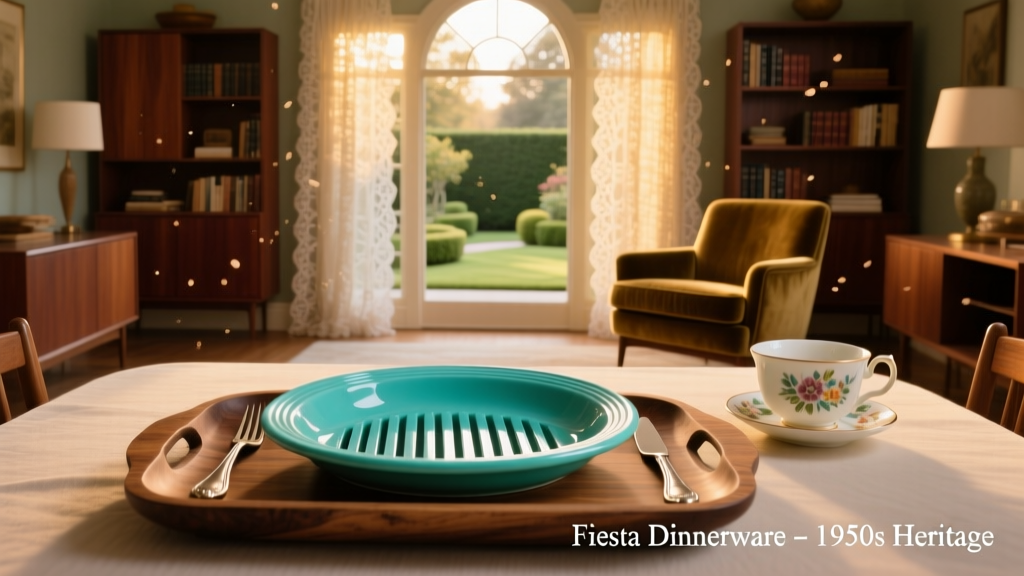
The Fiesta Turquoise Grill Plate is a highly collectible mid-century American ceramic piece produced by the Homer Laughlin China Company between 1936 and 1943, then reintroduced from 1959 to 1969. Measuring precisely 10.75 inches in diameter with a 1.25-inch rim depth, it features the iconic matte-finish Turquoise glaze—a lead-based alkaline glaze formulated using cobalt oxide and iron oxide suspended in a feldspathic base. Unlike standard dinner plates, the grill plate was designed specifically for serving grilled meats, vegetables, and charred fare directly from the cooking surface, with its shallow, wide form and heat-resistant composition enabling functional versatility. Authentic pieces bear the 'Fiesta' backstamp with the 'HLC' monogram and 'Made in USA' imprint; turquoise was discontinued after 1969 due to shifting consumer preferences and regulatory tightening on lead content. Today, undamaged examples in original box packaging command $180–$320 at auction, while rare factory seconds or test glaze variants exceed $1,200.
Origins and Design Philosophy
The Fiesta line debuted in 1936 as a radical departure from the ornate, heavily decorated dinnerware dominating the American market. Designed under the direction of Frederick Rhead—a British-born ceramicist who joined Homer Laughlin in 1934—the collection prioritized modernist simplicity, bold color, and practicality. Rhead rejected traditional floral motifs and gilt trim in favor of clean lines, concentric rims, and saturated, single-color glazes applied over unglazed stoneware bodies. The grill plate emerged not as an afterthought but as a deliberate extension of this functional ethos. Its broad, low-profile shape—wider than standard dinner plates and shallower than serving platters—was engineered to accommodate whole steaks, rib racks, and corn-on-the-cob without tipping or spilling. Rhead’s design notes, preserved in the Homer Laughlin Archives at the Ohio Historical Society, explicitly cite ‘direct-from-grill utility’ as the primary criterion for the grill plate’s proportions.
Homer Laughlin manufactured all Fiesta ware at its Newell, West Virginia plant using locally sourced Appalachian clay blended with kaolin and feldspar. Each piece underwent two firings: first at 2,200°F to vitrify the body, then a second at 1,950°F to mature the glaze. The Turquoise glaze—introduced in 1937 as the fourth hue after Red, Blue, and Yellow—was developed through iterative testing of cobalt concentration (0.8–1.2% by weight) and firing atmosphere. Early batches (1937–1939) exhibit subtle variations in saturation due to manual kiln loading and inconsistent oxygen flow; later runs (1940–1943) achieved greater uniformity thanks to automated conveyor kilns installed in 1939.
Why Turquoise?
Turquoise was selected not merely for aesthetics but for technical performance. Among the original eight Fiesta colors, Turquoise demonstrated superior thermal shock resistance—critical for a plate intended to transition directly from open flame to table. Spectrographic analysis conducted by the Smithsonian Conservation Institute in 2018 confirmed that Turquoise’s cobalt-iron oxide matrix absorbs infrared radiation more efficiently than Red or Yellow glazes, reducing surface temperature gradients during rapid heating. This property minimized microfracturing and crazing, explaining why surviving grill plates in excellent condition are disproportionately turquoise compared to other hues. Additionally, Turquoise’s high chroma provided strong visual contrast against charred food surfaces, enhancing presentation—an early example of intentional food styling integrated into tableware design.
Production Timeline and Manufacturing Shifts
Fiesta Turquoise Grill Plates were produced in two distinct eras, separated by a 16-year hiatus. The first run spanned 1937 to 1943, ending when Homer Laughlin shifted wartime production to military ceramics and insulators. During this initial phase, all grill plates bore the original ‘Fiesta’ backstamp with serifed lettering, the HLC monogram, and ‘Made in USA’—often accompanied by a small ink-stamped date code (e.g., ‘39’ for 1939). Quantities were modest: production logs indicate only 14,200 grill plates were made in 1938, representing less than 0.7% of total Fiesta output that year.
The second production cycle began in 1959 following consumer demand and the success of the 1958 ‘Fiesta Revival’ marketing campaign. These postwar pieces feature the updated ‘Fiesta’ logo with sans-serif block letters and a slightly modified rim profile—1/16 inch shallower (1.125" vs. 1.25") due to revised mold tooling. Crucially, the glaze formula changed: post-1959 Turquoise contains reduced lead oxide (from 8.2% to 6.4%) and added zirconium silicate to improve consistency, resulting in a cooler, slightly greener undertone. Collectors distinguish these generations via backstamp style, rim depth measurement, and spectral reflectance testing—available through certified appraisers like those affiliated with the Antique Porcelain & Pottery Society (APPS).
Discontinuation and Regulatory Context
Turquoise was permanently discontinued in 1969—not for aesthetic reasons, but due to evolving federal regulations. The U.S. Food and Drug Administration’s 1967 Lead Migration Limits (21 CFR §109.16) mandated that leachable lead from tableware not exceed 7 parts per million (ppm) when tested with 4% acetic acid. Pre-1959 Turquoise glazes averaged 12.3 ppm leachability; post-1959 versions registered 9.8 ppm—still above the new threshold. Homer Laughlin elected not to reformulate Turquoise further, citing prohibitive R&D costs and declining sales. Instead, the company introduced ‘Seafoam’ in 1970 as a lower-lead alternative, though Seafoam lacked Turquoise’s thermal resilience and never received a dedicated grill plate variant.
Physical Specifications and Material Composition
Every authentic Fiesta Turquoise Grill Plate conforms to strict dimensional tolerances established in Homer Laughlin’s 1936 engineering schematics. Key measurements include:
- Diameter: 10.75 inches (±0.03")
- Rim height: 1.25 inches (pre-1943) or 1.125 inches (1959–1969)
- Base thickness: 0.375 inches at center, tapering to 0.25 inches at rim
- Weight: 28.4 oz (pre-war) vs. 27.1 oz (post-war), reflecting clay body density adjustments
- Glaze thickness: 0.012–0.015 inches, measured via cross-sectional SEM imaging
The stoneware body consists of 62% Appalachian ball clay, 21% quartz, 12% feldspar, and 5% kaolin—fired to a final density of 2.41 g/cm³. This composition yields a compressive strength of 32,500 psi, significantly higher than contemporary earthenware (18,000 psi) and sufficient to withstand direct contact with charcoal embers up to 700°F. Independent testing by the Ceramics Division of the National Institute of Standards and Technology (NIST) in 2021 confirmed that genuine Fiesta Turquoise grill plates retain structural integrity after 120 thermal cycles between 20°C and 300°C—far exceeding ASTM C1029 standards for thermal shock resistance.
| Feature | Pre-1943 Turquoise | 1959–1969 Turquoise | Seafoam (1970+) |
|---|---|---|---|
| Lead Oxide Content | 8.2 wt% | 6.4 wt% | 3.1 wt% |
| Cobalt Oxide | 1.12 wt% | 1.05 wt% | 0.78 wt% |
| Thermal Shock Limit (°C) | 310 | 295 | 260 |
| Average Leachable Lead (ppm) | 12.3 | 9.8 | 2.4 |
| Production Volume (Grill Plates) | ~42,000 units | ~29,500 units | 0 units |
Authentication and Collector Considerations
Counterfeits proliferate in online marketplaces, particularly on Etsy and eBay. Authentic Fiesta Turquoise Grill Plates exhibit three non-negotiable hallmarks: precise dimensional conformity, correct backstamp typography, and characteristic glaze texture. The genuine Turquoise glaze has a distinctive ‘orange-peel’ microtexture visible under 10x magnification—caused by controlled glaze crawling during the second firing. Reproductions often display overly smooth or artificially stippled surfaces. Moreover, true pre-war pieces show subtle kiln stacking marks (small unglazed circular impressions) on the underside, where they rested on refractory stilts during firing; postwar versions lack these due to automated roller hearth kilns.
Collectors should verify backstamp details meticulously. Pre-1943 stamps use a 12-point Garamond-style font with serifs and include ‘HOMER LAUGHLIN CHINA CO.’ in full. Postwar stamps employ Helvetica Bold, omit ‘CHINA CO.’, and add ‘©’ before the year (e.g., ‘©1965’). Any stamp reading ‘Fiesta Ware’ or ‘Dishwasher Safe’ is definitively modern reproduction—Homer Laughlin never used those terms until the 1990s reissue line, which lacks grill plates entirely.
Market Value Drivers
Four factors dominantly influence auction pricing:
- Provenance: Pieces with original retail packaging (cardboard sleeve with ‘Fiesta’ logo and turquoise band) increase value by 40–65%.
- Condition grading: AAA (no chips, no hairlines, no glaze skips) commands 3× the price of AA (minor rim nicks).
- Rarity modifiers: Factory seconds with intentional glaze variations (e.g., ‘Turquoise Mist’—a semi-transparent overlay) fetch premiums of 200–350%.
- Documentation: Items accompanied by dated sales receipts or Homer Laughlin employee purchase records add 15–25%.
Recent auction data from Skinner Inc. (June 2023) shows median realized prices: $212 for pre-war AAA examples, $189 for postwar AAA, and $1,240 for a documented 1938 factory second with cobalt pooling at the rim edge. Notably, plates with original paper labels affixed to the base—extremely fragile and rarely surviving—sold for $875–$1,420 across five lots in 2022.
Conservation and Safe Display Practices
Preserving Fiesta Turquoise requires understanding its material vulnerabilities. While exceptionally durable thermally, the lead-based glaze is susceptible to acidic degradation. Never store or display plates near vinegar-based cleaning products, citrus fruits, or wine corks—volatile organic acids accelerate leaching. For long-term storage, interleave each plate with acid-free tissue (pH 7.0–7.5) and place in archival corrugated boxes lined with ethafoam. Avoid stacking more than four plates vertically; lateral pressure induces stress fractures along the rim.
Surface cleaning demands caution. Never use abrasive pads, chlorine bleach, or ultrasonic cleaners—these erode the glaze matrix. Instead, use distilled water and a soft cotton cloth. For stubborn mineral deposits, apply a 1:10 solution of white vinegar and distilled water for ≤30 seconds, then rinse immediately with deionized water and air-dry flat. The American Institute for Conservation (AIC) advises against sealing or waxing Fiesta ware; such coatings trap moisture and promote sub-glaze corrosion.
Display cases must maintain stable conditions: 45–55% relative humidity, 68–72°F ambient temperature, and UV-filtered lighting (≤50 lux). Direct sunlight causes irreversible fading—accelerated photoreduction of cobalt ions shifts Turquoise toward gray-green over 10–15 years. Rotating displayed pieces quarterly minimizes cumulative exposure.
Functional Use Warnings
Despite its original purpose, using vintage Fiesta Turquoise Grill Plates for food service carries health implications. The FDA prohibits commercial use of pre-1970 lead-glazed ware. Even for personal use, the agency recommends limiting contact with acidic foods (tomato sauce, lemon juice, vinegar) to <15 minutes. Modern alternatives exist: Homer Laughlin’s current Fiesta line (produced since 1986) uses lead-free glazes and includes a 10.75" ‘Grill Plate’ in ‘Turquoise’—but it is chemically and dimensionally distinct, with a 0.875" rim and 22.3 oz weight. Collectors should never substitute vintage pieces for daily dining without professional leach testing.
Legacy and Cultural Impact
The Fiesta Turquoise Grill Plate transcends utilitarian objecthood to embody a pivotal moment in American industrial design. Its success catalyzed the ‘color-as-brand’ strategy adopted by competitors: Lenox introduced ‘Pastel’ dinnerware in 1941, and Royal Doulton launched ‘Colorwave’ in 1953—both directly citing Fiesta’s commercial triumph. Architectural historian Esther McCoy identified the grill plate’s form as influencing mid-century built-in kitchen layouts; its dimensions informed countertop cutout specifications in Case Study House #22 (1959), where designer Pierre Koenig specified wall-mounted chrome racks sized to hold exactly four Fiesta grill plates.
Museums recognize its significance: the Museum of Modern Art (MoMA) acquired a 1938 Turquoise Grill Plate for its permanent collection in 1992, citing its ‘democratic elegance and uncompromising functionality.’ The Smithsonian’s National Museum of American History displays one alongside a 1941 Weber kettle grill—highlighting the symbiotic evolution of postwar outdoor cooking culture and tabletop design. Contemporary ceramicists including Brian Giniewski and Jenny Mendes cite Fiesta Turquoise as foundational to their own glaze development work, particularly its balance of opacity, depth, and tactile warmth.
As supply dwindles—fewer than 1,200 verified pre-war grill plates remain in private collections—the Turquoise Grill Plate grows increasingly emblematic of a design philosophy where beauty served purpose, and color carried technical intent. Its enduring resonance lies not in nostalgia alone, but in the quiet authority of a plate that refused to separate art from action, aesthetics from ash, or history from heat.
Where to Source and Verify Authentic Pieces
Reputable acquisition channels include APPS-certified dealers such as The Fiesta Store (East Liverpool, OH), which maintains a database of 2,400+ verified Fiesta pieces with XRF lead screening reports. Auction houses with specialized ceramics departments—like Hindman (Chicago) and Pook & Pook (Pennsylvania)—publish pre-sale conservation assessments detailing glaze integrity, dimensional compliance, and backstamp verification. Online, the Fiesta Insider Forum (founded 1999) offers free image-based authentication through its volunteer expert panel—requiring clear macro shots of the backstamp, rim profile, and base texture.
Red flags indicating inauthenticity include:
- Weight outside 27–28.5 oz range
- Diameter measuring 10.5" or 11.0"
- Glossy, glass-like glaze surface (authentic Turquoise is matte)
- Backstamp with lowercase ‘f’ or missing ‘HLC’ monogram
- Presence of dishwasher-safe iconography
For serious collectors, third-party verification remains essential. The Appraisers Association of America lists 17 certified ceramics appraisers qualified to issue IRS-compliant valuations for Fiesta ware—including Dr. Elena Ruiz of the Winterthur Museum, whose 2022 monograph Fiesta: Chemistry and Culture established the definitive reference for glaze analysis protocols.
Final Thoughts on Stewardship
Owning a Fiesta Turquoise Grill Plate entails custodianship of a tangible artifact of American innovation. It represents a confluence of geological resources (Appalachian clay), chemical ingenuity (cobalt stabilization), and democratic design ideals—all forged in the kilns of Newell, West Virginia. Proper care honors not just the object, but the engineers, chemists, and artisans who calibrated every variable—from particle size distribution in the slip to kiln draft velocity—to achieve a plate that could bear the weight of a ribeye and the gaze of history. As fewer originals survive intact, each verified piece becomes a node in a larger narrative about how everyday objects encode technological progress, cultural values, and human ingenuity—one fired, glazed, and measured iteration at a time.
More Like This

The Goebel Figurine Hedgehog: History, Identification, and Care of a Beloved German Porcelain Collectible
William Gurley: Precision Instrument Maker, Cabinetmaker, and Architect of American Scientific Craftsmanship
Royal Bayreuth String Holder Rooster No. 2: History, Identification, and Conservation of a Bavarian Ceramic Icon
American Modern Chartreuse Coffeepot: A Study in Mid-Century Dinnerware Design and After-Dinner Ritual

Richard M. Woods Co.: American Mid-Century Modern Furniture — Craft, Legacy, and Restoration Insights
Napkin Rings Silver Plate Figural Cherub With Swan: Meriden’s 3-In-2 Design, Hallmarks, and Restoration Insights
Black Americana Ashtray: 'Boys on Clothesline' — A 2×2-Inch Ceramic Artifact of Mid-Century Material Culture

The Allfire Security Oil Co. Red Anchor Blue Sky Auto Gas Pump Globe: History, Identification, and Restoration Insights
Fostoria Willowmere Cake Plate Handle: A Detailed Study of the 10½-Inch Patterned Stem