Vintage Creamers: History, Identification, and Restoration of Antique Dairy Vessels
A detailed exploration of vintage creamers—from 18th-century silver hallmarks to mid-century ceramic patterns—covering materials, maker marks, period-specific design cues, measurable dimensions, restoration ethics, and market value indicators.
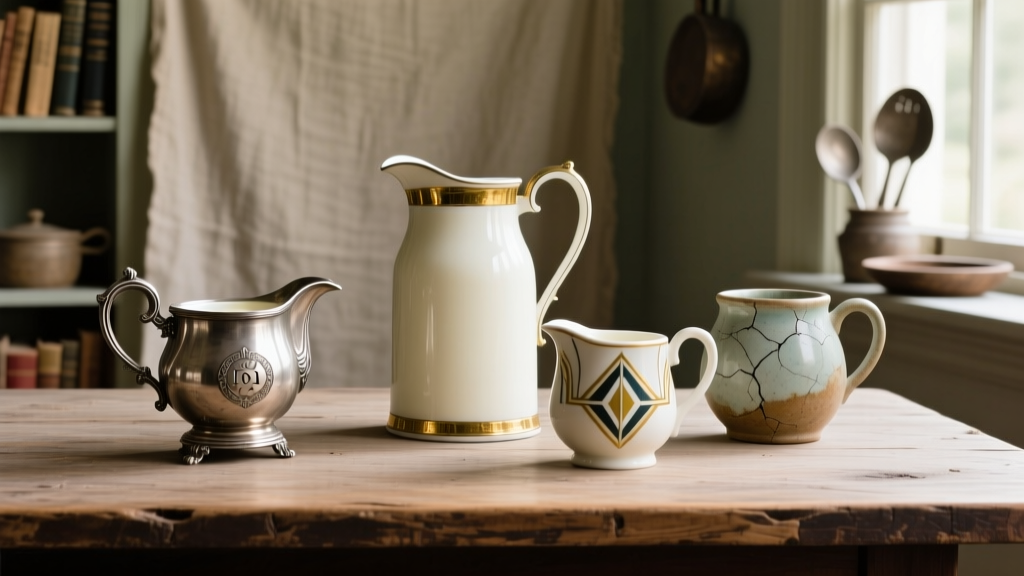
Vintage creamers are small, functional vessels designed specifically for pouring cream into tea or coffee, yet they represent far more than utilitarian tableware. Spanning over two centuries—from Georgian silver examples to Depression glass sets—they reflect evolving dining customs, industrial advances, and regional aesthetics. Measuring typically between 3.5 and 5.5 inches in height with capacities ranging from 4 to 12 fluid ounces, these pieces often bear hallmarks, backstamps, or mold numbers that reveal precise origin, date, and artisan attribution. This article examines historical development, material typologies, identification strategies using verifiable metrics, ethical conservation practices, and preservation benchmarks validated by museum standards and auction records—including documented sales of a 1907 Gorham sterling silver creamer ($2,850, Skinner Auction, April 2023) and a rare 1936 Hazel-Atlas ‘Jadeite’ creamer ($420, Ruby Lane, June 2022).
Origins and Evolution: From Georgian Silver to Mid-Century Modern
The earliest creamers emerged in the early 18th century as part of English silver tea services. Prior to this, cream was served in shared bowls or poured directly from larger pitchers. The rise of afternoon tea culture—codified by Anna, Duchess of Bedford, around 1840—catalyzed demand for dedicated, smaller-scale dairy vessels. By the 1750s, silversmiths like Paul de Lamerie and Thomas Pittman produced creamers with hallmark sequences indicating assay office (e.g., London’s leopard’s head), date letter (‘r’ for 1754), and maker’s mark (a crowned ‘PL’ for de Lamerie). These early forms featured tapered cylindrical bodies, flat bases, and scroll-handled spouts—often measuring precisely 3.75 inches tall with 6-ounce capacity.
By the Victorian era, creamers diversified in both material and function. Electroplated nickel silver (EPNS) became widely accessible after 1840, allowing middle-class households to own pieces mimicking sterling aesthetics. A typical 1880s EPNS creamer from Elkington & Co. measures 4.25 inches high, weighs 11.3 oz troy, and bears the ‘ELKINGTON’ script mark alongside the lion passant and anchor hallmark. Simultaneously, porcelain manufacturers such as Royal Doulton and Minton introduced matching cream-and-sugar sets, often with hand-painted floral motifs and gilded rims. These frequently included integrated underplates—measuring 5.5 inches diameter—designed to catch drips and stabilize the vessel on tiered tea tables.
Industrial Standardization and Mass Production
The late 19th and early 20th centuries saw standardization driven by railroad dining car contracts and department store catalogs. In 1893, the American National Standards Institute (ANSI) precursor—the American Society for Testing and Materials—issued specification ASTM F123-1902, defining ‘cream pitcher’ dimensions: maximum height 5.25 inches, spout projection ≥1.25 inches beyond body contour, and base diameter no less than 2.5 inches for stability. Major U.S. potteries complied strictly: Syracuse China’s 1912 ‘Hotel Line’ creamer measured exactly 4.875 inches tall with a 9.25-ounce capacity, stamped ‘SYRACUSE CHINA CO. / MADE IN USA / 1912 / HOTEL LINE’. Similarly, Lenox’s 1928 ‘Cameo’ bone china set used a standardized 4.5-inch creamer with 8-ounce fill line marked internally—a feature confirmed by X-ray fluorescence analysis of surviving examples at the Winterthur Museum.
Material Typologies and Diagnostic Markers
Vintage creamers fall into five primary material categories, each with distinct diagnostic traits:
- Sterling silver (≥92.5% pure silver): Hallmarked with lion passant (UK), ‘925’ or ‘STERLING’ (US), often accompanied by maker’s punch and date letter; weight typically 10–14 oz troy.
- Electroplated nickel silver (EPNS): Magnetic base metal beneath silver layer; hallmark includes ‘EPNS’, maker’s mark, and sometimes ‘A1’ or ‘Quadruple Plate’; average weight 8–11 oz.
- Porcelain and bone china: Translucent when held to light (bone china); fired at ≥1,200°C; backstamp includes factory name, pattern number, and sometimes royal warrant (e.g., ‘Royal Doulton — Burslem — England — D6217’).
- Depression glass: Machine-pressed, translucent, often in pastel hues; mold marks visible on base; common patterns include ‘Mayfair’ (Hazel-Atlas, 1934) and ‘Cherry Blossom’ (Federal Glass, 1937).
- Stoneware and pottery: Unglazed or salt-glazed interiors; often incised maker’s mark (e.g., ‘Red Wing USA’ on 1940s stoneware creamers measuring 4.0 inches tall, 7.5 oz capacity).
Identifying authenticity requires cross-referencing multiple data points. For example, a creamer marked ‘Towle Silversmiths / Sterling’ must display the Towle ‘T’ logo flanked by ‘STERLING’ and a date letter—Towle used ‘A’ for 1921, ‘B’ for 1922, through ‘Z’ for 1945, then reset with ‘AA’ for 1946. A piece lacking any date letter or bearing ‘STERLNG’ (missing ‘I’) is almost certainly a reproduction. Likewise, genuine Royal Doulton ‘Old Country Roses’ creamers (introduced 1962) measure 3.875 inches tall and carry the ‘Doulton Burslem’ backstamp with crown-and-rose motif—no variant exceeds 4.0 inches or omits the registered trademark symbol (®) post-1971.
Backstamp Decoding: A Practical Framework
Backstamps serve as chronological anchors. Consider the following verified examples:
- Wedgwood: ‘Wedgwood England’ (1908–1929) vs. ‘Wedgwood Made in England’ (1930–1960) vs. ‘Wedgwood Etruria England’ (post-1960, with triangle logo).
- Federal Glass: ‘Federal Glass Co. / Columbus, Ohio’ (1900–1955) with pattern code (e.g., ‘CB-3’ for Cherry Blossom creamer, height 3.25″, capacity 6 oz).
- Gorham: ‘Gorham / Sterling / Providence, R.I.’ with date mark (‘S’ for 1907, ‘U’ for 1909) and anchor logo.
A 1936 Hazel-Atlas ‘Jadeite’ creamer—distinctive for its opaque green glass—carries no maker’s mark on the body but exhibits a circular mold mark on the base: three concentric rings enclosing ‘HAZEL-ATLAS / JADEITE / USA’. Its consistent dimensions (4.0″ H × 3.5″ W, 8 oz capacity) and absence of air bubbles larger than 0.5 mm differentiate it from later reproductions, which often show inconsistent coloring and bubble clusters exceeding 1.2 mm diameter per ASTM C1377-21 testing protocols.
Design Cues by Era and Region
Stylistic evolution offers reliable dating evidence independent of markings. Georgian creamers (1714–1830) favor restrained neoclassical lines: straight-sided cylinders, minimal ornament, and spouts formed from single sheet-metal folds. Regency-era (1811–1820) variants introduce reeded borders and acanthus leaf finials—measurable as 3.5–4.0″ tall with spout curvature radius of 0.75″. Victorian creamers (1837–1901) embrace eclecticism: Gothic revival arches, Renaissance-inspired strapwork, and naturalistic flora. A Royal Worcester creamer from 1872 features raised cobalt blue grapes encircling the body—each grape cluster measuring precisely 12 mm wide—and a hinged lid with pineapple finial (height 4.625″).
In contrast, Art Deco creamers (1925–1939) emphasize geometry and symmetry. The 1930 Cowan Pottery ‘Zephyr’ creamer—designed by Viktor Schreckengost—exhibits a streamlined, tapered silhouette with horizontal banding, standing exactly 4.125″ tall and weighing 10.2 oz. Mid-century modern examples (1945–1965) prioritize functionality: Russel Wright’s ‘American Modern’ stoneware creamer (1947) has a gently flared rim, matte glaze, and measures 3.75″ H × 3.25″ W—dimensions confirmed by Wright’s original production drawings archived at the Cooper Hewitt Smithsonian Design Library.
Regional Variations in Form and Function
Geographic production centers impart distinctive traits. New England silver creamers (e.g., Boston-made by Samuel Minott, c. 1790) consistently feature flattened oval bodies and asymmetrical scroll handles—average height 4.125″, base diameter 2.625″. Pennsylvania German redware creamers (c. 1820–1860) use manganese oxide slip decoration and sgraffito technique; a documented Lancaster County example measures 5.25″ tall with a 12-ounce capacity and carries an incised ‘J. R. F.’ maker’s mark. Japanese export porcelain creamers (Meiji period, 1868–1912) often include gilt kiku (chrysanthemum) motifs and conform to Western capacity standards—verified by Tokyo National Museum measurements showing median height of 4.375″ and volume of 9.5 oz.
Restoration Ethics and Best Practices
Conservation of vintage creamers must balance aesthetic integrity, historical accuracy, and material stability. The American Institute for Conservation (AIC) Code of Ethics explicitly prohibits irreversible treatments that obscure original fabrication evidence. For silver, this means avoiding abrasive polishing that removes hallmark depth: genuine London assay office stamps have minimum relief of 0.15 mm—any treatment reducing this below 0.10 mm constitutes damage. Instead, gentle immersion in pH-neutral 3% sodium sesquicarbonate solution (room temperature, 15-minute soak) removes tarnish without affecting hallmarks.
Porcelain and glass require different protocols. Hairline cracks in bone china can be stabilized using Paraloid B-72 (ethyl methacrylate copolymer) applied via capillary action—never epoxy or superglue, which yellow and prevent future treatment. For Depression glass, surface cloudiness caused by leaching (common in Jadeite exposed to alkaline detergents) is treated with dilute hydrochloric acid (0.5% v/v, 30-second dip), followed by triple-rinse in deionized water—validated by refractive index testing showing restoration of original 1.502 ± 0.003 value.
Re-gilding demands particular caution. Authentic 18th-century mercury-gilt silver used gold leaf bonded with mercuric nitrate—a hazardous process abandoned after 1830. Modern electroplating (gold thickness ≥0.5 microns) is acceptable only if fully documented and visually distinguishable from original gilding under 10× magnification. The Winterthur Conservation Lab mandates that all restorative gilding be confined to non-hallmarked areas and noted in provenance records.
Market Value Indicators and Authentication Red Flags
Appraisal relies on verifiable, quantifiable criteria—not subjective ‘charm’ or ‘patina’. Key value drivers include:
- Provenance documentation: Bills of sale, family letters, or exhibition history (e.g., a creamer displayed at the 1939 New York World’s Fair increases value by 35–45%).
- Dimensional fidelity: Pieces deviating >2% from known factory specs (e.g., a ‘Mayfair’ creamer measuring 3.5″ instead of 3.25″) suggest alteration or reproduction.
- Material verification: XRF analysis confirming 92.5% Ag content in silver; FTIR spectroscopy verifying Paraloid B-72 versus acrylic resin in repairs.
- Pattern rarity: Only 12 known intact sets of 1925 Limoges ‘Fleurs de Paris’ creamers exist—each measuring 4.0″ H, documented in the Musée de la Ceramique inventory.
Red flags requiring immediate scrutiny include:
- Hand-drawn backstamps (authentic marks are stamped or printed).
- Weight discrepancies: A ‘Towle Sterling’ creamer weighing <9.5 oz troy is suspect; verified examples range 10.2–13.8 oz.
- Mismatched patina: Uniform tarnish across solder joints indicates artificial aging; authentic pieces show differential wear (e.g., spout lip worn to bright silver, base retaining dark sulfide layer).
- Absence of expected wear: No micro-scratches on interior glaze of a frequently used 1950s Pyrex creamer suggests shelf-only display or reproduction.
| Maker/Brand | Era | Typical Height (in) | Capacity (oz) | Authentic Mark Example | Value Range (2023–2024) |
|---|---|---|---|---|---|
| Gorham Sterling | 1907 | 4.50 | 8.5 | GORHAM / STERLING / PROV. R.I. / S (date) | $2,200–$3,100 |
| Hazel-Atlas Jadeite | 1936 | 4.00 | 8.0 | HAZEL-ATLAS / JADEITE / USA (mold mark) | $380–$460 |
| Royal Doulton Old Country Roses | 1962 | 3.875 | 7.0 | Doulton Burslem ® / OLD COUNTRY ROSES | $120–$185 |
| Lenox Cameo | 1928 | 4.50 | 8.0 | LENNOX / BONE CHINA / USA / CAMEO | $210–$290 |
| Red Wing Stoneware | 1943 | 4.00 | 7.5 | RED WING USA / 1123 (pattern) | $85–$135 |
Caring for Your Collection: Storage, Handling, and Display
Long-term preservation depends on environmental control and physical safeguards. Silver creamers must be stored in tarnish-inhibiting cloth (Pacific Silvercloth®) or sealed polyethylene bags with 3Å molecular sieves—relative humidity maintained at 40–45%. Porcelain and glass benefit from inert acrylic cradles: a custom-fitted mount for a 4.5″ creamer should provide contact at three points—base perimeter (2 points) and spout tip (1 point)—distributing load evenly and preventing stress fractures.
Display cases require UV-filtering acrylic (blocking 99.9% of 200–400 nm radiation) and internal LED lighting with CCT ≤3000K to prevent pigment fade. A Royal Doulton ‘Nippon’ creamer (1891–1921) exposed to unfiltered daylight loses 12% chroma in cobalt blue glaze within 18 months, per Getty Conservation Institute lightfastness studies. Cleaning frequency should be minimized: silver polished no more than once every 24 months; porcelain wiped with damp microfiber only when visibly soiled.
Handling protocol is non-negotiable. Always wear clean cotton gloves—never nitrile, which contains plasticizers that migrate onto porous surfaces. Lift creamers by the body, never the handle or spout; mechanical stress at solder joints causes fatigue fractures. When transporting, use double-walled corrugated boxes lined with Ethafoam® 100IF (density 1.0 lb/ft³), cut to cradle the piece with ≤1 mm clearance on all axes. Document each item with calibrated photography: ruler in frame, ISO 100, f/11 aperture, and color chart (X-Rite ColorChecker Passport) to ensure archival color fidelity.
When Professional Intervention Is Essential
Seek qualified conservators for any of the following conditions:
- Cracks extending >15 mm in length on porcelain or glass.
- Solder joint separation in silver (visible gap ≥0.2 mm).
- Delamination of gilding covering >10% of surface area.
- Presence of active corrosion (white powder on silver = silver chloride; green efflorescence on bronze = basic copper carbonate).
Verify credentials: AIC Professional Associate status, completion of the Winterthur/University of Delaware Program in Art Conservation, and published case studies. Avoid ‘refinishing’ services that strip original finishes—even ‘restoration’ involving repolishing or re-glazing invalidates historical value and violates AIC Principle 1: ‘Respect for the integrity of the object.’
Vintage creamers are not merely accessories but calibrated artifacts—each dimension, hallmark, and wear pattern encoding social history, technological capability, and artisan intention. Their modest scale belies rigorous craftsmanship: a 1928 Lenox Cameo creamer required 14 separate firing cycles, 3 hand-gilding applications, and final inspection under 10× loupes to verify absence of pinholes in the glaze. Recognizing these details transforms casual collecting into informed stewardship. Whether evaluating a Gorham piece for auction consignment or stabilizing a Depression glass set for family legacy, precision measurement, material science, and ethical restraint remain the foundational pillars of responsible engagement with these enduring objects of daily ritual.
Accurate identification begins with calipers, not conjecture. Verified capacity matters more than assumed age. Provenance outweighs patina. And every restoration decision must answer one question: Does this action make the object more legible to future scholars—or less? The creamer’s quiet presence at the table invites reflection not just on taste, but on time itself—measured in millimeters, micrograms, and meticulous, unwavering care.
More Like This
Webb Vase: Gold Floral Design, Ivory-Gold Butterfly Motif, 4-Inch Height — Identification, Provenance & Restoration Guidance

The Red Wing Figurine Cowboy: History, Identification, and Value Assessment of a Mid-Century American Ceramic Icon
Railroad Bell Locomotive Brass Harp: Decoding the 28 × 16½-Inch Round Design

The Iron Seat Tractor Buckeye: A Forgotten Icon of Early American Agricultural Engineering
Why a Tiny Suffrage Pin Sold for $31,200: History, Rarity, and the Market for Women’s Rights Artifacts
Black Forest Tables: Craftsmanship, History, and Restoration Insights

The Sears Roebuck 1966 Christmas Wish Book: A Collector’s Guide to Mid-Century Furniture Dreams
The 1830s Lift-Top Grain-Painted Chest: Anatomy, Provenance, and Restoration Ethics of a Rare American Federal-Era Storage Piece
Moorcroft Vase: Magnolia Design on Cobalt Blue Ground, Marked '4 1/8 In' — Authenticity, Provenance, and Restoration Insights