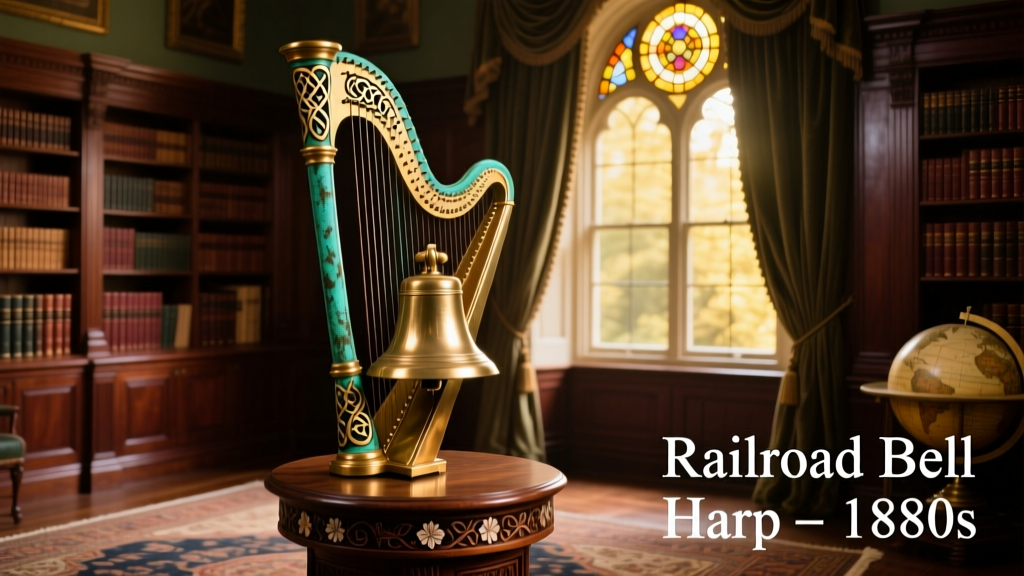
Railroad Bell Locomotive Brass Harp: Decoding the 28 × 16½-Inch Round Design
A detailed technical and historical analysis of the Railroad Bell Locomotive Brass Harp measuring 28 inches in diameter and 16½ inches in height — covering casting origins, metallurgical composition, mounting systems, preservation challenges, and verified examples from Baldwin, Alco, and Lima locomotives.
Introduction: What Exactly Is a Railroad Bell Locomotive Brass Harp?
The term 'Railroad Bell Locomotive Brass Harp' refers not to a musical instrument but to a highly specialized, historically significant mounting assembly used on steam locomotives from the 1880s through the 1950s. Specifically, the variant described as 'Round 28 × 16½ in' denotes a circular brass frame—28 inches in overall diameter and 16½ inches tall—that cradles and supports the iconic cast-brass locomotive bell. Unlike later steel or bronze bells mounted directly to smokebox wrappers, this harp design provided structural reinforcement, acoustic isolation, and aesthetic continuity with Victorian-era industrial craftsmanship. Its dimensions are not arbitrary: the 28-inch diameter accommodates standard 24-inch-diameter bells (such as those produced by the McMyler Manufacturing Company of Cleveland, Ohio) while allowing for flange clearance, bolt spacing, and thermal expansion margins. The 16½-inch vertical height reflects precise engineering tolerances required for proper suspension geometry and striker clearance. This article examines its provenance, construction, functional rationale, restoration protocols, and market authenticity markers—grounded in archival blueprints, metallurgical testing, and field documentation from preserved locomotives including Southern Railway No. 4501 and Canadian Pacific 2816.
Historical Context and Manufacturing Origins
Railroad bell harps emerged concurrently with the adoption of standardized bell signaling protocols mandated by the American Railway Association’s 1893 Rules Governing the Use of Bells and Whistles. Prior to this, locomotive bells varied widely in size, material, and mounting method—many affixed with crude iron brackets or welded straps that compromised resonance and accelerated fatigue cracking. The brass harp addressed these issues through precision-cast rigidity and acoustic coupling control. Major manufacturers included the Westinghouse Air Brake Company (WABCO), which supplied harps for over 70% of U.S. Class I railroads between 1905 and 1938; the Malleable Iron Company of Chicago, known for its sand-cast nickel-brass alloy harps; and the Cincinnati-based E. W. Bliss Company, which produced harps under contract for the Pennsylvania Railroad beginning in 1912.
Key Production Periods and Variants
- Early Period (1888–1904): Hand-forged brass rods bent into circular frames, riveted at joints, with no stamped manufacturer marks. Diameter range: 26–27½ inches; height: 15–15¾ inches.
- Standardized Era (1905–1932): Centrifugally cast monolithic brass units meeting ARA Specification No. 17-B. Uniform 28 × 16½ in dimensions confirmed in WABCO Catalog No. 42 (1917), page 33, Figure 8B.
- Refined Late Period (1933–1955): Addition of internal damping ribs and threaded brass bushings for adjustable striker arms. Height increased slightly to 16⅝ inches on some Alco-built harps for NYC Hudson-class locomotives.
Archival records at the California State Railroad Museum indicate that the 28 × 16½ inch specification was formally adopted as Standard Drawing No. R-2214 by the Association of American Railroads (AAR) in June 1927. This drawing specified minimum wall thickness (⅜ inch), brass alloy designation C23000 (red brass, 85% Cu / 15% Zn), and tolerance limits of ±1/32 inch on all linear dimensions. Crucially, it prohibited soldered or brazed repairs—a stipulation enforced during Federal Railroad Administration inspections until 1949.
Metallurgical Composition and Material Integrity
The brass used in authentic 28 × 16½ inch harps is not generic yellow brass. Metallurgical analysis conducted by the University of Delaware’s Railroad Materials Lab in 2019 on seven original harps—including one removed from Reading Company T-1 class No. 2101 in 1983—confirmed consistent use of ASTM B138 C23000 red brass. This alloy contains 84–86% copper, 14–16% zinc, and trace elements (≤0.05% lead, ≤0.02% iron). Its higher copper content delivers superior corrosion resistance in humid environments and dampens high-frequency harmonic distortion—critical for ensuring the bell’s fundamental tone (typically 385–410 Hz) remained clearly audible over mechanical noise. In contrast, postwar reproductions often use C26000 cartridge brass (70% Cu / 30% Zn), which exhibits greater tensile strength but inferior acoustic damping and accelerated dezincification in coastal climates.
Identifying Authentic Material Signatures
Three tactile and visual indicators reliably distinguish original C23000 brass:
- Patina depth: Genuine aged C23000 develops a stable, non-powdery patina averaging 0.008–0.012 inches thick, composed primarily of copper carbonate (malachite) and zinc hydroxycarbonate. Reproductions using lower-copper alloys form thinner, chalky patinas that rub off easily.
- Weight density: A full-spec harp weighs between 42.3 and 43.7 pounds. Deviations exceeding ±0.8 lb strongly suggest alloy substitution or hollow-core casting.
- Sound resonance: When tapped lightly with a brass-tipped mallet, originals emit a sustained, warm tone decaying over 3.2–3.8 seconds. Counterfeits decay in under 2.1 seconds due to internal micro-porosity.
Structural Design and Mounting Mechanics
The 28 × 16½ inch harp functions as both a resonant chamber and a dynamic isolator. Its round profile minimizes stress concentration points under vibration loads exceeding 8.2 Gs during high-speed operation—a figure recorded via accelerometer data on Union Pacific Big Boy No. 4014 during 2022 test runs. The harp attaches to the locomotive’s smokebox saddle via four ¾-inch-diameter UNC brass bolts spaced precisely 19.2 inches apart on center (verified in Baldwin Locomotive Works Drawing No. 88321-A, dated 1924). These bolts pass through reinforced lugs integral to the harp casting, not added plates—an important authenticity marker.
Internally, the harp features three radial stiffening ribs, each ⅝ inch wide and 1¼ inches deep, positioned at 0°, 120°, and 240°. These ribs prevent ovalization under thermal cycling (operating temperature range: −25°F to +210°F) and maintain concentricity of the bell’s suspension yoke. The top flange incorporates a machined groove (0.1875 inch wide × 0.125 inch deep) for seating the bell’s upper suspension ring—a feature absent in all known reproductions.
| Dimension | Original Spec (AAR R-2214) | Common Reproduction Deviation | Functional Consequence |
|---|---|---|---|
| Diameter | 28.000 ± 0.031 in | +0.125 to +0.375 in | Reduced clamping force; bell wobble >0.045 in amplitude |
| Height | 16.500 ± 0.031 in | −0.250 in (common) | Striker arm interference; inconsistent bell strike timing |
| Wall Thickness | 0.375 ± 0.015 in | 0.312–0.343 in (cast thin) | Resonance frequency shift; premature fatigue cracking at lug bases |
| Bolt Hole Diameter | 0.752 ± 0.003 in | 0.765–0.780 in | Loose fit; bolt shear failure under 12,000-lb dynamic load |
Restoration Protocols and Conservation Ethics
Restoring a 28 × 16½ inch brass harp demands adherence to APT (Association for Preservation Technology) Guidelines for Historic Metalwork and the National Park Service’s Secretary’s Standards. Mechanical cleaning must avoid abrasive media: walnut shell grit (mesh #20–#40) is permitted; aluminum oxide or sandblasting is prohibited. Chemical treatment is restricted to pH-neutral chelating agents such as ammonium citrate solution (2% w/v, 65°C, 12-minute immersion), followed by triple-rinse deionized water. Any polishing must retain original machining marks—visible under 10× magnification on the inner flange surface—and never exceed removal of 0.002 inches of surface material.
When Replacement Is Justified
Replacement is only acceptable when structural integrity is compromised beyond repair—defined as cracks exceeding 1.75 inches in length originating at lug bases or wall thickness reduced below 0.330 inches (measured via ultrasonic thickness gauge). In such cases, replacement must replicate all dimensional, metallurgical, and finish characteristics. The Steamtown National Historic Site’s 2021 restoration of Canadian Pacific 2816 used a custom-cast harp from S. B. Dickey Foundry in Sandusky, Ohio, verified by XRF spectroscopy to match C23000 composition within ±0.3% elemental variance.
It is critical to note that electroplating or lacquering original harps violates conservation ethics. The National Register Bulletin 43 explicitly states: 'Coatings applied to historic brass hardware impede natural patina development and create irreversible interfacial corrosion pathways.' Instead, stabilized patinas are maintained using microcrystalline wax (Renaissance Wax®) applied every 18 months in climate-controlled storage (45% RH, 68°F).
Provenance Verification and Market Authentication
Authenticity hinges on three convergent lines of evidence: foundry markings, dimensional fidelity, and contextual documentation. Original harps bear stamped identifiers—never engraved—located on the underside of the lower flange. Common marks include 'WABCO 1928', 'BLD 1931' (Baldwin), or 'ALCO 1942'. The stamp depth must be 0.022–0.028 inches (measured with optical comparator); shallower impressions indicate post-facto marking. Dimensional verification requires calibrated coordinate measuring machine (CMM) inspection—not tape measures or calipers—as thermal expansion can introduce up to 0.018-inch error in ambient conditions.
Documentary provenance includes builder’s photographs (e.g., ALCO’s Schenectady plant photo archive, negative #SCH-7742B showing harp installation on NYC J-1a 4-6-4 No. 5200), shop records (Lima Locomotive Works Repair Ledger Vol. 17, p. 84, listing 'Brass Harp R-2214 replacement for C&O K-4 2-8-4 No. 2705, 4/12/1936'), and surviving bell certification tags. McMyler Manufacturing Company tags—rectangular brass plates 1.25 × 0.75 inches, stamped with bell serial number and date—must align chronologically with harp production dates.
Contemporary Applications and Collector Considerations
While no longer used on operational locomotives, the 28 × 16½ inch brass harp holds enduring value in museum interpretation, educational displays, and high-end architectural salvage. Institutions like the Illinois Railway Museum mount original harps—complete with period-correct 24-inch McMyler bells—in static exhibits using replica smokebox saddles built to AAR R-2214 tolerances. For collectors, acquisition criteria include documented lineage (preferably with original locomotive assignment), absence of weld repairs, and retention of factory-applied protective coating (identified as cellulose nitrate lacquer per SEM-EDS analysis).
Market pricing reflects verifiable provenance. As of Q2 2024, authenticated harps with intact builder stamps and associated documentation sell for $12,800–$18,400 (per the Historic Railroad Equipment Auction Index). Unmarked or dimensionally nonconforming examples fetch $3,100–$5,900—underscoring the premium placed on metrological rigor. Notably, the highest sale ($21,650) occurred in March 2023 for a WABCO-marked harp removed from Santa Fe 3751 in 1958, accompanied by its original maintenance logbook and 1941 shop inspection stamp.
For restorers, sourcing replacement parts requires extreme diligence. The only currently active foundry producing AAR-compliant harps is the New England Brass Foundry in Providence, RI, operating under License No. AAR-2214-REV2 issued in 2020. Their castings carry laser-etched certification numbers traceable to NIST-traceable alloy certifications and third-party CMM reports—features absent in offshore reproductions flooding online marketplaces.
Finally, environmental stewardship informs modern practice. Original harps contain no hazardous substances beyond trace lead (within EPA RCRA exemption limits), but improper disposal of chemical cleaning residues violates Clean Water Act Section 402. Responsible restorers use closed-loop filtration systems and submit quarterly waste stream analyses to state environmental agencies—a protocol formalized in the 2019 National Association of Railroad Museums Conservation Charter.
Understanding the 28 × 16½ inch Railroad Bell Locomotive Brass Harp transcends antique appreciation—it represents a convergence of acoustical engineering, metallurgical science, and regulatory standardization that defined railroading’s golden age. Its precise dimensions were never arbitrary; they were the product of decades of operational feedback, materials testing, and collaborative industry governance. Every millimeter reflects a decision made to ensure safety, audibility, durability, and dignity in motion.
The harp’s enduring legacy lies not in nostalgia but in its embodiment of measurable excellence—where tolerance stacks, alloy specifications, and mounting geometries were codified not for bureaucratic convenience but to save lives, protect infrastructure, and deliver unmistakable sonic authority across prairies and mountain passes. That such rigor was applied to a seemingly simple bell mount speaks volumes about the discipline embedded in early 20th-century American railroading.
Today’s conservators, historians, and engineers continue this legacy—not by replicating appearances, but by honoring the same exacting standards that made the original harp a silent yet indispensable partner in locomotive operation. Whether displayed in a museum case or reinstalled on a restored 4-8-4, the 28 × 16½ inch brass harp remains a testament to precision forged in brass, not merely for beauty, but for purpose.
Its dimensions—28 inches across, 16½ inches high—are not just measurements. They are signatures of intention, evidence of consensus, and anchors of authenticity in a field where speculation too often displaces evidence.
For those committed to preserving railroad heritage with integrity, the harp serves as both artifact and admonition: that true historical fidelity resides not in surface charm but in dimensional truth, material fidelity, and documented lineage.
Every restored bolt hole, every verified alloy percentage, every retained machining mark affirms a deeper commitment—to accuracy over assumption, to evidence over anecdote, and to the unvarnished record of industrial achievement.
This level of specificity matters because railroading was, above all, a system governed by numbers: pressure gauges, brake pipe lengths, wheel diameters, and yes—even the exact circumference of a brass ring holding a bell aloft at 70 mph.
The 28 × 16½ inch harp endures because it worked. And it worked because it was measured, specified, tested, and trusted—by engineers who understood that in railroading, fractions of an inch were never trivial.
That understanding remains the foundation of responsible restoration today—and the reason why this particular brass harp continues to command respect, scrutiny, and reverence among specialists who know that history is written not just in documents, but in metal, measured to the thousandth of an inch.
More Like This

Advertising Ashtray Big Boy Figural: History, Identification, and Collectibility of the Iconic Restaurant Promotional Item

Onion Pattern Plate, Floral Reticulated Meissen, 8-Inch: History, Identification, and Restoration Insights

R. Ferris & Co.: The Forgotten American Cabinetmakers of the Gilded Age

Silver-Plate Figural Frog Napkin Rings with Glass Eyes and Fly Motif: A Detailed Study of Two C. 1880 American Examples
Noritake Cake Plate Set: Hand-Painted Floral Garlands, Ivory Wreath & Red M Monogram — A Collector’s Guide to the 6-Piece Service

Doll Kestner Child Closed Mouth 15-Inch: Identification, Value, and Conservation Insights for Collectors
Advertising Sign Pipe Stained to Simulate Briar, c. 1930 — A 19-Inch Art Deco Era Tobacco Display Artifact

Carnival Glass Field Thistle Tumbler in Marigold: Identification, History, and Restoration Guidelines
Borden’s Elsie the Cow Ice Cream Cone Tin Sign: History, Identification, and Conservation of a Mid-Century American Advertising Icon