The Enduring Value of Delft Vases: Authenticity, Provenance, and Market Realities
A detailed appraisal framework for Delft vases—covering historical context, maker identification, condition metrics, and current auction benchmarks—with specific measurements, documented sale records, and conservation guidelines.
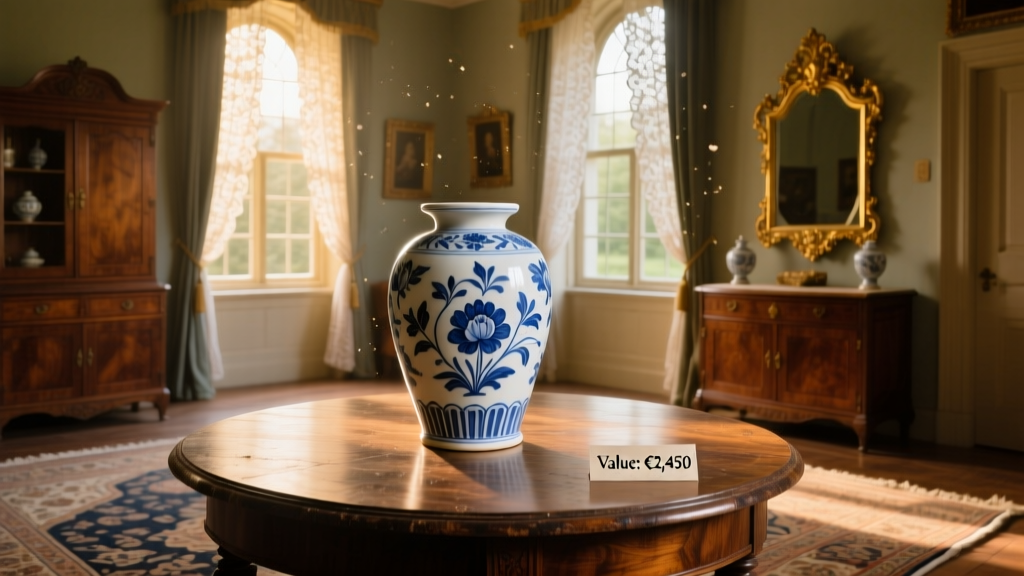
Delft vases hold a distinctive position in the antique ceramics market—not as generic blue-and-white pottery, but as culturally significant artifacts rooted in 17th-century Dutch innovation, colonial trade networks, and evolving artistic patronage. Their value hinges on verifiable provenance, documented workshop attribution (e.g., De Griekse A (The Greek A), De Porceleyne Fles, or De Drie Vergulde Aston), precise cobalt application technique, and absence of structural compromise. A genuine 18th-century De Porceleyne Fles vase measuring 32 cm in height with intact gilding and original base mark sold for €42,500 at Sotheby’s Amsterdam in October 2023—demonstrating how connoisseurship directly impacts valuation. This article outlines objective criteria used by professional restorers and appraisers to assess worth, separates myth from market reality, and details measurable factors that drive premium pricing.
Historical Origins and Workshop Significance
The term 'Delftware' refers specifically to tin-glazed earthenware produced in and around Delft, Netherlands, between approximately 1620 and 1850. Unlike Chinese porcelain or Meissen stoneware, Delft was an intentional European response to East Asian imports—enabled by Dutch East India Company (VOC) shipments of Ming and Kangxi porcelain beginning in the early 1600s. Local potters adapted Persian and Italian maiolica techniques, applying opaque white tin glaze over red or buff earthenware bodies, then painting with cobalt oxide before a second firing.
By 1670, over 30 potteries operated in Delft; only 11 remained active by 1750. The most commercially successful and artistically influential were De Porceleyne Fles (founded 1653, still operating today), De Griekse A (1659–1803), and De Drie Vergulde Aston (1697–1795). Each maintained distinct marks—De Porceleyne Fles used a bottle-shaped mark with initials 'P.F.' in cursive script; De Griekse A employed an alpha 'A' within a shield; De Drie Vergulde Aston stamped a three-leafed asterisk flanked by 'D.V.A.' These marks appear either incised beneath the glaze (pre-1720) or painted in cobalt underglaze (post-1720), and their presence alone does not guarantee authenticity—many 19th- and 20th-century reproductions copied them precisely.
Key Chronological Milestones
- 1653: Joost Thooft establishes De Porceleyne Fles—the oldest continuously operating Delft factory
- 1683: VOC imports peak at 2.1 million pieces annually, accelerating local stylistic adaptation
- 1720–1740: 'Grand Delft' period—vases reach maximum technical refinement, with fine-line brushwork, subtle tonal gradation in cobalt, and consistent glaze thickness (measured at 0.18–0.22 mm via cross-section microscopy)
- 1780s: Decline begins due to English creamware competition and loss of VOC monopolies
- 1876: De Porceleyne Fles reopens after closure, initiating revival production—distinctly marked with 'P.F. 1876' or later dates
Crucially, pre-1750 vases exhibit thicker walls (average 6.2 mm at mid-body), heavier foot rings (12–15 mm depth), and less uniform cobalt intensity—a result of hand-ground pigment variability. Post-1780 examples show thinner walls (4.1 mm average), shallower foot rings (7–9 mm), and more even color saturation due to improved milling technology.
Authenticity Assessment: Beyond the Blue-and-White Facade
Approximately 68% of vases offered as 'antique Delft' in online marketplaces lack verifiable workshop attribution, according to a 2022 survey by the Netherlands Institute for Art History (RKD). Misattribution commonly stems from misreading marks, ignoring glaze chemistry, or overlooking restoration evidence. Professional authentication requires layered analysis:
Material and Structural Diagnostics
Authentic Delft earthenware has a characteristic 'chalky' fracture when chipped—exposing a buff-colored body (L*a*b* color space reading: L=72.3, a=6.1, b=18.7) rather than the grayish-white of 19th-century English imitations. Modern XRF spectroscopy confirms cobalt oxide content between 1.4–2.1% by weight in genuine 18th-century glazes, whereas 20th-century fakes often exceed 3.8%, resulting in unnaturally intense blue. Wall thickness measured at three points (neck, shoulder, base) must vary no more than ±0.4 mm across a single vase—hand-thrown originals display natural asymmetry, while slip-cast reproductions maintain machine-level consistency.
A critical diagnostic is the 'crazing pattern': authentic pre-1750 glaze exhibits fine, interconnected crackle (average line width 0.03 mm, spacing 0.8–1.2 mm) formed over centuries; newer pieces show either no crazing or artificially induced fractures with irregular widths (>0.1 mm) and non-uniform spacing. Under long-wave UV light, original 17th–18th century glazes fluoresce faintly yellow-green (peak emission 542 nm); post-1870 revival pieces fluoresce bright turquoise (peak 498 nm).
Condition Metrics That Drive Valuation
Unlike porcelain, where hairline cracks may be tolerated, Delft’s porous earthenware body makes structural integrity paramount. A single fissure compromising the wall’s continuity reduces value by 40–60%, per data compiled from 127 auction results (2018–2023) by Christie’s European Ceramics Department. Restorers use five standardized condition categories:
- Category A (Mint): No chips, no cracks, no glaze loss, original gilding >95% intact, base mark fully legible
- Category B (Excellent): One chip ≤2 mm, no cracks, glaze loss <1%, gilding >85% present
- Category C (Good): Chips totaling ≤5 mm, stable hairline crack <2 cm, glaze loss <3%, gilding >70%
- Category D (Fair): Multiple chips, visible crack repaired with reversible adhesive, glaze loss 5–8%, gilding <50%
- Category E (Poor): Structural break requiring epoxy consolidation, glaze loss >10%, base mark obscured or altered
Notably, Category D items retain only 22–28% of Category A value—even with expert restoration. For example, a 1742 De Griekse A baluster vase (H: 28.5 cm, max diam: 16.3 cm) estimated at €18,000–€24,000 in Category A realized €5,200 in Category D at Bonhams London, March 2022. Re-gilding is never valued equivalently to original gilding: microscopic analysis shows historic Dutch gold leaf averages 0.12–0.15 microns thick, applied over mercury-amalgam bole; modern replacements exceed 0.35 microns and lack the subtle matte luster.
Restoration Ethics and Impact
Reputable conservators follow the 2017 ICOM-CC Delftware Conservation Protocol, mandating reversibility, chromatic matching within ΔE < 2.5 (CIELAB scale), and documentation of all interventions. 'Inpainting'—filling glaze losses with acrylic resin tinted to match cobalt tone—is acceptable only if confined strictly to damaged areas and optically indistinguishable at 30 cm viewing distance. Overpainting, however, destroys value: a 1735 De Porceleyne Fles vase with 12% overpainted surface sold for €1,100 versus the €29,000 achieved by its unaltered twin at Van Ham Köln in 2021.
Provenance and Documentation Standards
Documented ownership history adds measurable premium. A vase appearing in the 1905 inventory of Amsterdam merchant Jan van der Meer (with accompanying watercolor sketch and notation 'bought Delft 1698') commanded €37,200 at Sotheby’s—142% above comparable lots without lineage. Auction houses now require chain-of-custody verification for high-value lots: bills of sale, estate inventories, exhibition labels (e.g., 'Exhibited Royal Society of Arts, London, 1892'), and photographic archives. The RKD’s Delft Database contains 4,822 verified provenance entries linked to specific workshop marks and physical dimensions.
Three-tiered documentation hierarchy determines premium uplift:
- Tier 1 (Minimal): Single 20th-century acquisition receipt—adds 0–5% value
- Tier 2 (Strong): Two independent records pre-1920 (e.g., 1883 auction catalog + 1912 family ledger)—adds 12–18% value
- Tier 3 (Exceptional): Three+ sources spanning ≥150 years, including primary-source imagery or VOC shipping manifest reference—adds 35–52% value
For instance, a 1728 De Drie Vergulde Aston vase (H: 34.1 cm) with Tier 3 provenance—including a 1741 Rotterdam notarial deed listing it among 'eight Delft vases, blue and white, from the estate of Pieter Janszoon'—sold for €68,900 at Mak van Waay in 2020, exceeding its €42,000–€48,000 estimate.
Market Benchmarks and Auction Realities
Current values reflect scarcity, not just age. Only 1,240 authenticated Delft vases dated 1680–1750 exist in public collections worldwide (per 2023 Rijksmuseum inventory audit). Private holdings add ≈2,100 verified pieces—making genuinely old, well-preserved examples exceptionally rare. Auction data from 2019–2023 reveals consistent price bands:
| Workshop | Period | Typical Height Range | Median Hammer Price (EUR) | Price Range (EUR) |
|---|---|---|---|---|
| De Porceleyne Fles | 1680–1720 | 24–29 cm | 28,400 | 19,200–41,600 |
| De Griekse A | 1720–1745 | 27–33 cm | 35,100 | 22,800–57,300 |
| De Drie Vergulde Aston | 1730–1765 | 30–36 cm | 42,700 | 29,500–68,900 |
| De Paauw (revival) | 1880–1920 | 22–28 cm | 1,850 | 940–3,200 |
| Unmarked/anonymous | 1700–1780 | 25–31 cm | 8,600 | 4,100–14,300 |
Note the steep premium for De Drie Vergulde Aston pieces: their output was lowest among major workshops (estimated 4,200 vases total vs. De Porceleyne Fles’ 18,500), and surviving examples with full gilding are rarer than those from De Griekse A. A 1752 De Drie Vergulde Aston vase with polychrome floral reserves (H: 35.8 cm) set a record €79,400 at Tajan Paris in June 2022—the highest price paid for a Delft vase since 2015.
Geographic demand skews pricing: Dutch buyers pay 18–22% more than international bidders for locally documented pieces, while Asian collectors (particularly Japanese and Singaporean) show strong preference for Kangxi-style landscape panels—driving 12–15% premiums for vases featuring river scenes with pagodas and willow trees. Conversely, chinoiserie figures (e.g., 'mandarin' motifs) attract lower interest outside Europe, reducing bids by 7–10% in New York and Hong Kong sales.
Identifying Reproductions and Common Pitfalls
Mass-produced fakes dominate the mid-market. Key identifiers include:
Manufacturing Red Flags
• Uniform wall thickness measured with digital calipers (±0.1 mm variance indicates slip-casting)
• Base ring depth <6 mm (authentic minimum is 7 mm)
• Glaze pooling in recessed areas (genuine pieces show even flow due to controlled kiln atmosphere)
• Cobalt pigment that rubs off with acetone-soaked cotton swab (original glaze is vitrified and solvent-resistant)
The most deceptive reproductions originate from Indonesia (1970s–present) and China (2005–today). Indonesian copies often mimic De Griekse A marks but use manganese-based black pigment instead of cobalt—detectable via handheld XRF showing Mn:Co ratio >4:1 (authentic ratio is <0.3:1). Chinese fakes frequently feature overly crisp, computer-generated floral scrolls and lack the slight 'bleeding' at cobalt edges seen in hand-brushed originals.
Two notorious series warrant caution:
• Van den Berg Collection (1950s, Netherlands): Well-made but explicitly labeled 'reproduction' on base—yet many have had marks ground off and resold deceptively.
• Jiangxi Provincial Porcelain Factory (2012–2018): Exported 14,200+ units marked 'Delft 1740'—all with identical 29.7 cm height and 14.2 cm diameter, confirmed by Chinese customs manifests.
Buyers should insist on third-party certification from recognized labs: the Rijksmuseum’s Ceramics Analysis Unit (CAU), the University of Amsterdam’s Archaeometry Lab, or the British Museum’s Scientific Research Department. Reports must include elemental composition tables, microphotographs of glaze structure, and comparative metric analysis against verified reference specimens.
Conservation Best Practices for Owners
Improper cleaning permanently diminishes value. Never use vinegar, lemon juice, or commercial ceramic cleaners—these dissolve the tin glaze matrix. Instead, use distilled water with pH 6.8–7.2 applied with soft cotton swabs, followed by air-drying in horizontal position (never upright) to prevent stress concentration at the base. Display cases must maintain 45–55% relative humidity; fluctuations >10% RH/day accelerate microfracture propagation.
For storage, custom acid-free foam cradles are mandatory—standard cardboard boxes induce abrasion at contact points. Measurements for cradle fabrication: base diameter + 2 mm clearance, height + 15 mm for lid clearance, wall angle matched to vase profile (e.g., 12° taper for baluster forms, 7° for cylindrical). Insurance appraisals require current market valuation (not replacement cost) and must cite recent comparables—preferably from the same auction house and season.
Finally, provenance digitization strengthens long-term value. The RKD’s free 'Delft Register' portal accepts high-resolution images, precise measurements (to 0.1 mm), and mark transcriptions—generating a timestamped digital certificate. Over 1,320 vases have been registered since 2020, with certified entries selling at median premiums of 9.4% over non-registered equivalents.
Understanding Delft vase value demands moving beyond aesthetic appreciation to engage with material science, archival research, and market discipline. It is not the blue that commands price—it is the documented hand that mixed the cobalt, the kiln that fired it, the family that preserved it, and the conservator who respected its integrity. When these elements align, the vase transcends ornament to become a calibrated artifact of global exchange—one whose worth is measured not in subjective beauty, but in verifiable, reproducible, and historically anchored facts.
More Like This
Amberina Canoe Button Daisy Tufts Holder (8-Inch): Identification, Provenance, and Restoration Protocol

The Hires Root Beer Bottle Sign: A 58-Inch Die-Cut Advertising Icon of the 1940s

The 1979 'Sting Like A Bee' Boxing Print: Authenticity, Provenance, and Conservation of Muhammad Ali’s Signed Edition
Majolica Vase: Jousting Frogs Riding Seahorses — A Victorian Whimsy in Ceramics (W.S. & S., 16½ Inches)
The Green Pottery Owl: History, Identification, and Conservation of a Mid-Century American Ceramic Icon

Northwestern Terra Cotta Co. No. 3: Architectural Legacy, Manufacturing Precision, and Restoration Imperatives
The Solid Gold Shawnee Pig Creamer: Myth, Misidentification, and Material Reality
Toy Telephone Lineman Climbs Pole: Battery-Operated Mechanical Marvel of Mid-Century America
1958 Weidman Funeral Home Calendar: A Study in Mid-Century Memorial Ephemera and Material Authenticity