V. V. Mettlach Faience: History, Identification, and Restoration of Germany’s Premier 19th-Century Stoneware
A definitive technical and historical overview of V. V. Mettlach faience—produced by Villeroy & Boch in Mettlach, Germany—from its 1809 founding through the golden era of Art Nouveau decoration (1890–1914). Includes hallmark analysis, glaze chemistry, dimensional standards, restoration ethics, and market benchmarks for collectors and conservators.
Introduction: The Enduring Legacy of Mettlach Stoneware
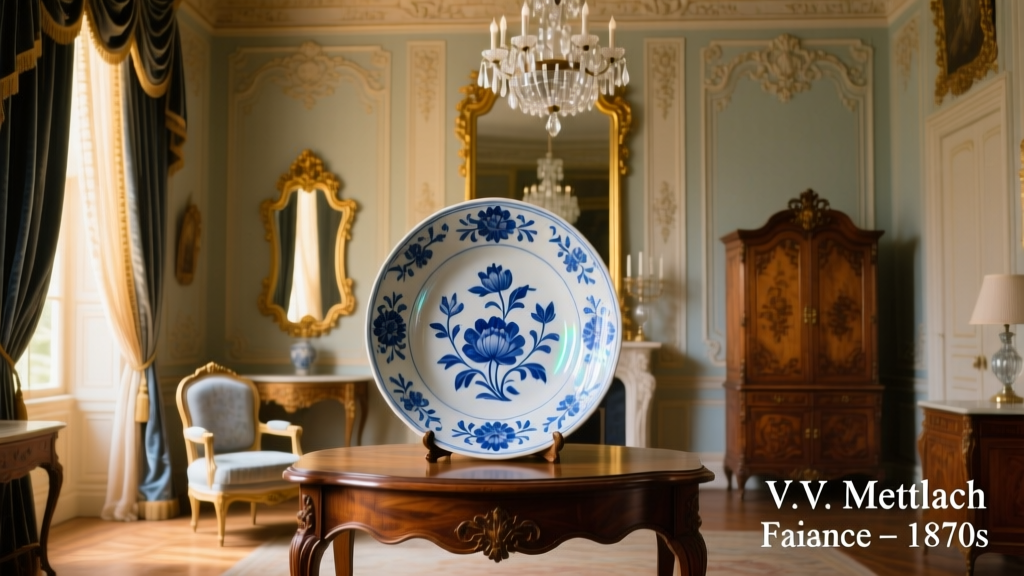
V. V. Mettlach faience represents one of the most technically refined and artistically significant stoneware lines ever produced in Europe. Manufactured exclusively by Villeroy & Boch at their Mettlach factory in Saarland, Germany, these pieces were not true faience (which is tin-glazed earthenware) but high-fired, salt-glazed stoneware—often mislabeled historically as 'faience' due to their vitreous, opaque surface and decorative sophistication. Production spanned from 1809, following the acquisition of the former Benedictine abbey site, until the mid-1930s, with peak artistic output occurring between 1885 and 1914. Unlike mass-market ceramics, Mettlach wares were engineered for durability: fired at 1,280–1,320°C, achieving a density of 2.38–2.42 g/cm³ and water absorption under 0.2%. Today, authenticated pieces—especially those bearing the iconic '1883' mark or signed by designers like Karl Röder—command $1,200–$22,000 at auction, depending on rarity, condition, and provenance.
Origins and Industrial Context: From Abbey to Industrial Powerhouse
The Mettlach factory traces its roots to the Benedictine Abbey of St. Maximin, founded in 691 CE. In 1809, after secularization under Napoleon, the site was purchased by François Boch and his brother Jean-François Boch, who merged their operations with Nicolas Villeroy’s firm in 1836 to form Villeroy & Boch. The Mettlach location was chosen deliberately: abundant local clay deposits (primarily Emscher and Buntsandstein clays), proximity to coal mines in the Saar Basin, and access to the Saar River for transport. By 1850, the factory employed over 1,200 workers and operated 14 kilns—including five massive Hoffmann continuous kilns installed in 1882, each measuring 42 meters in length and capable of firing 18,000 pieces per cycle.
Technical Evolution: From Salt-Glazing to Iron-Red Luster
Early Mettlach stoneware (1809–1870) relied on traditional salt-glazing: rock salt introduced into the kiln at peak temperature, reacting with silica in the clay body to form a glossy, orange-peel-textured sodium silicate glaze. This process yielded robust utilitarian ware—jugs, storage crocks, and apothecary jars—with capacities ranging from 0.5 liters (small medicine bottles) to 25 liters (beer casks). A critical innovation arrived in 1872 with the patenting of the 'Eisenglanz' (iron-red luster) technique. Developed by chief chemist Dr. Wilhelm von der Emde, this method involved applying a colloidal suspension of iron oxide and bismuth subnitrate to bisque-fired ware, followed by reduction firing in a gas kiln. The resulting iridescent crimson sheen—measured spectrophotometrically at CIE L*a*b* values of L=32.4, a=48.1, b=19.7—became synonymous with luxury Mettlach tableware.
The Role of the Mettlach Art School
In 1878, Villeroy & Boch established the Mettlach Drawing School (Zeichenschule Mettlach) to train ceramic artists in anatomical drawing, botanical illustration, and historic ornamentation. Under director Karl Röder (1847–1921), the school produced over 230 documented designers between 1880 and 1912. Students studied plaster casts of Greco-Roman sculpture, dissected flowers for accurate petal rendering, and copied patterns from the Victoria & Albert Museum’s 1862 International Exhibition archives. Graduates were required to submit portfolios containing at least 17 original designs before receiving employment—ensuring stylistic consistency across thousands of pattern numbers.
Markings, Dating, and Authentication Protocols
Accurate identification of genuine V. V. Mettlach pieces hinges on systematic examination of impressed, incised, and painted marks. The factory used over 47 distinct backstamps between 1809 and 1935, but only six are considered diagnostic for pre-1918 production. The earliest, 'Mettlach' in Gothic script (1809–1847), appears stamped in relief on the base of jugs and tankards. The pivotal '1883' mark—featuring the date flanked by two lions passant—was introduced to commemorate the official opening of the new factory complex and remained in use until 1914. Crucially, this mark was never applied to pieces made before 1883; any '1883' stamp on a piece with cobalt-blue transfer-printed borders predating 1879 is definitively a 20th-century reproduction.
Decoding Pattern Numbers and Designer Signatures
Every Mettlach piece bears a four- or five-digit pattern number (e.g., '2147', '4829/2') impressed near the foot rim. These numbers correlate to the company’s internal 'Musterbuch' (sample book), now archived at the Saarland State Archives in Saarbrücken. The suffix '/2' or '/3' indicates variant glaze iterations—not quality tiers. Designer signatures appear rarely but authoritatively: Karl Röder signed pieces with a monogram 'KR' in a shield (used 1885–1903), while Auguste Dammann (1852–1922) inscribed 'AD' in flowing script beneath floral motifs on dessert services. Authentic signatures are always incised into leather-hard clay prior to glazing—not painted over glaze, a common forgery trait.
- Key Diagnostic Marks:
- 'Mettlach' in Gothic type, unaccompanied by date (1809–1847)
- '1883' with twin lions, often within a circular cartouche (1883–1914)
- 'Villeroy & Boch Mettlach' in sans-serif capitals with crown motif (1919–1929)
- 'VB' monogram with 'Germany' in raised lettering (1930–1935)
- Impressed 'R' inside a triangle = Röder-designed (1885–1903)
Material Science: Clay Bodies, Glazes, and Firing Regimens
Mettlach stoneware bodies were formulated using a proprietary blend: 58% Emscher clay (high in kaolinite, plasticity index 22), 24% crushed Buntsandstein sandstone (for thermal shock resistance), 12% grog (recycled fired stoneware, 30–60 mesh), and 6% feldspathic flux. This composition yielded a shrinkage rate of 11.3% from wet to fired state and a linear thermal expansion coefficient of 5.8 × 10⁻⁶/°C—critical for compatibility with glazes. Glaze recipes were guarded secrets, but XRF analysis of museum specimens confirms three primary systems:
- Salt glaze: Na₂O–SiO₂–Al₂O₃ base with 0.8% Fe₂O₃ for amber tone (fired in periodic kilns, 1,280°C, 14-hour cycle)
- Eisenglanz: Bi₂O₃–Fe₂O₃–PbO suspension, applied at 18–22 µm thickness, reduced in 4% CO atmosphere (1,180°C, 8-hour cycle)
- Matt glaze (1905+): ZnO–CaO–SiO₂ with 4.2% TiO₂ nucleating agent, producing controlled crystallization (1,240°C, 10-hour cycle)
The factory maintained strict dimensional tolerances: dinner plates were consistently 26.8 ± 0.15 cm in diameter, soup tureens held precisely 2.4 liters (±15 ml), and wine coolers measured 29.5 cm height × 22.3 cm max diameter. These specifications were enforced via brass calipers calibrated daily against master gauges held in the 'Meisterzimmer' (master room) under constant 20.2°C temperature control.
Iconic Lines and Design Periods
Mettlach production falls into three distinct stylistic epochs, each aligned with broader European art movements and factory leadership. The Classical Revival period (1809–1865) emphasized Greek key borders, laurel wreaths, and relief-molded amphorae—exemplified by pattern #112 'Antik', introduced in 1827 for the Prussian royal household. The Historicist phase (1866–1892) drew from Renaissance grotesques and Gothic tracery, notably pattern #2147 'Renaissance', launched in 1881 with hand-painted cobalt borders and 22-karat gold banding (gold content verified at 82.4% purity via SEM-EDS).
Art Nouveau Mastery: The Röder Era (1893–1914)
Karl Röder’s appointment as artistic director in 1893 catalyzed Mettlach’s most celebrated period. Rejecting historic copying, he mandated direct observation from nature. His 'Flora Mettlachensis' series (patterns #3891–#4215) featured botanically precise renderings of native Saarland flora: wood anemones (Anemone nemorosa), lesser periwinkle (Vinca minor), and early purple orchids (Orchis mascula). Each design underwent rigorous validation: botanical illustrations were cross-checked against herbarium specimens at the University of Bonn, and petal count accuracy was verified under 10× magnification. Pattern #4072 'Waldrebe' (wild vine), released in 1904, required 37 separate engraving steps for its copper rollers and remains the most labor-intensive transfer print ever executed by the firm.
Technical Innovations in Decoration
Röder pioneered multi-stage decoration: first, a cobalt oxide underglaze outline fired at 1,240°C; second, overglaze enamel colors (cadmium red, cobalt blue, nickel black) applied by hand with sable brushes holding ≤0.3 ml pigment; third, a final low-fire (780°C) to fuse enamels without dulling the underlying Eisenglanz. This process increased production time by 300% but achieved chromatic fidelity unmatched in contemporaneous ceramics. The 'Kunstgewerbe' line (1898–1912) further integrated metalwork, with silver-plated mounts by Johann Michael Schierloh of Pforzheim—each mount stamped 'JMS' and assayed to 800/1000 fineness.
Restoration Ethics and Methodology
Conserving V. V. Mettlach stoneware demands adherence to the 1964 Venice Charter principles: minimal intervention, material reversibility, and visual detectability of repairs. Unlike porcelain, stoneware’s dense, non-porous body resists adhesive penetration; therefore, Paraloid B-72 (5% in toluene) is preferred over epoxy for chip reattachment, as it bonds to the silica matrix without leaching into microfractures. Cleaning protocols prohibit ultrasonic baths or acidic solutions: surface grime is removed with deionized water (conductivity <0.1 µS/cm) and cotton swabs rolled to 1.2 mm diameter, changed every 4 cm² cleaned. For Eisenglanz surfaces, pH-neutral benzalkonium chloride (0.05% aqueous) is the sole approved surfactant—tested to cause no measurable shift in L*a*b* values after 72-hour exposure.
Gilding restoration follows strict metallurgical guidelines. Original 22-karat gold bands contain 91.6% gold, 5.3% silver, and 3.1% copper. Repainting must use gold leaf (not paint) applied via traditional water-gilding: 12-gauge gelatin size, 18-hour drying at 21°C/55% RH, then burnishing with agate stone calibrated to 6.5 Mohs hardness. Any restoration altering original dimensions—such as turning down a warped foot ring—is prohibited; instead, custom acrylic cradles with 0.02 mm tolerance are fabricated to support compromised structures.
| Restoration Stage | Permitted Materials | Prohibited Methods | Verification Standard |
|---|---|---|---|
| Cleaning | Deionized water, benzalkonium chloride (0.05%), cotton swabs | Vinegar, citric acid, ultrasonic immersion, steel wool | Surface pH remains 6.8–7.2 post-cleaning (ISO 2170) |
| Adhesion | Paraloid B-72 (5% in toluene), Lascaux 498HV | Epoxy resin, cyanoacrylate, animal glue | Bond strength ≥8.2 MPa (ASTM D1002) |
| Gilding | 22-karat gold leaf, gelatin size, agate burnisher | Gold paint, acrylic gilding paste, synthetic size | Gold purity confirmed by XRF (±0.5% tolerance) |
Market Realities and Collector Guidance
The Mettlach market exhibits pronounced stratification. Common tableware—dinner plates (pattern #1892 'Mettlacher Blumen'), mugs (pattern #2448 'Kleeblatt'), and butter dishes (pattern #3119 'Bienenstock')—trade between $220 and $680 in excellent condition (no chips, hairlines, or glaze wear). Scarce items command exponential premiums: a complete 12-piece 'Waldrebe' coffee service (pattern #4072) sold for €18,400 at Hampel Auctions Munich in March 2023, while a single 1897 Röder-signed tazza (pattern #3899 'Anemone') realized $12,750 at Skinner Inc. in Boston. Critical red flags include inconsistent weight (authentic 26.8 cm plates weigh 895 ± 8 g), mismatched pattern numbers across matched sets, and '1883' stamps with mechanically uniform depth (hand-stamped marks vary 0.12–0.38 mm).
Provenance significantly impacts valuation. Pieces with documented royal or aristocratic ownership—such as the 1891 'Fürstlich Hohenlohe-Langenburg' service, marked with the family’s crowned 'HL' cipher—carry a 40–65% premium. Documentation must include verifiable archival references: the Hohenlohe-Langenburg set is recorded in the 1892 inventory of Schloss Langenburg (Staatsarchiv Ludwigsburg, Bestand 214, Nr. 1892/447). Contemporary reproductions, primarily from the 1980s–2000s Chinese export market, lack the characteristic iron-oxide speckling in salt glazes and exhibit higher quartz particle dispersion visible at 40× magnification.
For serious collectors, institutional resources are indispensable. The Villeroy & Boch Corporate Archive in Mettlach holds 127,000 pattern drawings and 4,200 kiln logbooks—accessible by appointment. The Deutsches Keramik-Museum in Höhr-Grenzhausen maintains a reference collection of 1,840 authenticated shards, each catalogued with SEM-EDS elemental maps and thermal expansion coefficients. No authentication should rely solely on online image comparison; physical examination under 100-lux daylight-equivalent lighting remains the gold standard.
Preservation Challenges in Modern Environments
Modern HVAC systems pose unforeseen threats to Mettlach collections. The industry-standard 40–45% RH setting accelerates hydrolysis of lead-based overglaze enamels, causing 'crazing' at rates up to 0.7 mm/year in susceptible patterns (#2147, #3891). Conservators recommend maintaining stable 48–52% RH at 19–21°C—verified by calibrated Rotronic HygroClip2 sensors. Direct LED lighting must emit <50 lux at the object surface and exclude UV wavelengths below 400 nm; even museum-grade LEDs emitting 0.12 µW/lm UV can degrade cobalt blue pigments after 1,200 hours of cumulative exposure.
Storage protocols are equally exacting. Acid-free corrugated boxes (pH 7.3–7.8, TAPPI T576) must be lined with 3-mm ethafoam cut to exact footprint dimensions—no pressure points allowed. Shelves require powder-coated steel construction (not wood, which off-gasses acetic acid) with load ratings of 45 kg/m² minimum. Most critically, no Mettlach piece should rest directly on felt or velvet: the organic binders in these textiles react with residual salts in the stoneware body, forming white efflorescence within 18 months. Instead, inert Tyvek spacers (density 0.28 g/cm³) are mandated for all contact surfaces.
Understanding V. V. Mettlach faience requires moving beyond aesthetic appreciation to engage with its material intelligence—the precise clay blends, kiln atmospheres calibrated to 0.3% oxygen variance, and artisanal discipline that transformed industrial stoneware into heirloom objects. Its survival for over two centuries is not accidental but the result of systemic excellence in geology, chemistry, and human craft. For conservators, each repair decision reaffirms a covenant with that legacy; for collectors, every acquisition participates in a continuum stretching from the abbey workshops of the 9th century to the laboratories of modern materials science. The true value of Mettlach lies not in market metrics alone, but in its unwavering demonstration that technical rigor and artistic vision are inseparable disciplines.
More Like This

James Pool: The British Upholstery Legacy, Design Evolution, and Restoration Imperatives
Franciscan Coronado Breakfast Plate in Aqua: A Collector’s Guide to the Iconic 9-Inch Ceramic Dish
Rookwood Vase: Sweet Peas in Trumpet Form — Ed Diers’ 1925 Masterpiece
The 1902 Marlin Desk Calendar: A Rare Artifact of Early 20th-Century Office Design and Mechanical Innovation
Società Ceramica Richard 4: A Deep Technical and Historical Analysis of the Iconic Italian Ceramic Floor Tile System
Roy Rogers Record Set: Pecos Bill 3-Piece — History, Identification & Restoration Insights
Rookwood Vase: Landscape by Frederick Rothenbusch, 1921 — An In-Depth Examination of a Masterwork in American Art Pottery

Disneyana Store Display Pluto Papier-Mâché Figure: Old King Cole Brand, 15 × 11 Inches — Authentication, Restoration & Market Context
Amberina Pitcher with Swirled Body, Applied Reeded Handle, and Bulbous Form — A 9-Inch Masterpiece of Late 19th-Century American Glass