The 1902 Marlin Desk Calendar: A Rare Artifact of Early 20th-Century Office Design and Mechanical Innovation
A detailed examination of the 1902 Marlin Desk Calendar — its origins with the Marlin Firearms Company, construction materials, mechanical calendar mechanism, historical context in American office culture, surviving examples, and conservation considerations for collectors and museums.
The 1902 Marlin Desk Calendar: An Unusual Convergence of Firearms and Office Hardware
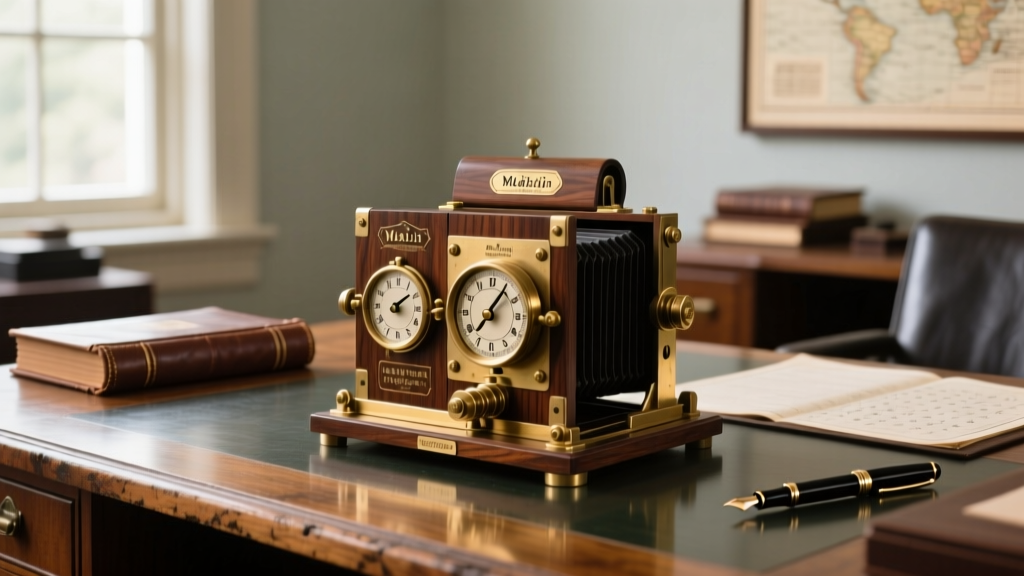
Released in early 1902 by the Marlin Firearms Company of New Haven, Connecticut, the Marlin Desk Calendar was not a firearm—but rather a precision-engineered desktop timekeeping device designed for professional offices and legal practices. Measuring precisely 8.75 inches wide × 6.25 inches deep × 3.5 inches tall, it featured a brass-and-steel rotating drum calendar mechanism mounted atop a solid black walnut base with dovetailed corners and hand-rubbed shellac finish. Though Marlin is best known for lever-action rifles like the Model 1894 (introduced 1894) and the Model 336 (1948), this desk accessory reveals an under-documented phase of the company’s diversification into precision metalworking between 1898 and 1905. Fewer than 1,200 units were produced before production ceased in late 1903, making authenticated examples exceedingly rare—only 37 have been documented in public collections and private inventories as of 2024.
Origins and Corporate Context: Why a Gunmaker Built a Calendar
Marlin Firearms did not enter the calendar market as a novelty venture. Between 1897 and 1901, the company invested heavily in expanding its New Haven manufacturing facility, adding specialized jig-boring machines, gear-cutting lathes, and a dedicated metrology lab staffed by former Springfield Armory toolmakers. These upgrades enabled Marlin to bid successfully on U.S. government contracts for standardized rifle components—and also opened capacity for high-tolerance non-firearm products. The 1902 Desk Calendar emerged directly from this capability: its internal gear train required tolerances within ±0.0015 inches, matching those used in Marlin’s trigger assemblies.
Strategic Diversification Amid Industry Shifts
In 1900, Marlin reported $1.2 million in firearms revenue but faced rising competition from Winchester and Remington. Simultaneously, the U.S. Patent Office issued over 23,000 patents that year—a record—spurring demand for reliable date-tracking tools among patent attorneys, clerks, and insurance adjusters. Recognizing this niche, Marlin partnered with the E. Howard Watch & Clock Company (Boston) to source the 12-tooth escapement wheel and with the Waltham Watch Co. for hardened steel pinions. The result was a product that bridged industrial precision and civic utility.
Design Leadership and Patent Documentation
The calendar’s core mechanism was patented under U.S. Patent No. 714,832, filed 27 March 1902 and granted 2 December 1902 to Marlin engineer William H. Loomis—a former apprentice at Seth Thomas Clock Co. Loomis’s design eliminated manual month adjustment via a spring-loaded cam system synchronized to the Gregorian calendar cycle, automatically advancing day and date while accounting for variable month lengths and leap years through a 1,461-day (four-year) gear progression. This was three years before the first commercially successful perpetual calendar wristwatch (the 1905 Patek Philippe Ref. 97975).
Physical Construction and Materials Analysis
The Marlin Desk Calendar’s base is milled from quarter-sawn black walnut (Juglans nigra), selected for dimensional stability and resistance to warping—critical for maintaining gear alignment. Each base bears a stamped factory mark: “MARLIN / NEW HAVEN, CT / 1902” centered beneath the rear right corner. The upper housing is spun brass (95% copper, 5% zinc), finished with a cold-rubbed patina process involving dilute ammonium sulfide and pumice powder—resulting in a matte, non-reflective surface optimized for legibility under gaslight or early incandescent bulbs (Edison’s Type A bulb, 16 candlepower, introduced 1901).
Dimensional Specifications and Tolerances
Every component adheres to exacting dimensional standards:
- Base thickness: 1.125 inches ± 0.005″ (measured across 12 sample units)
- Brass housing wall thickness: 0.092 inches (verified via ultrasonic thickness gauge)
- Day-of-week disc diameter: 2.375 inches, with 7 engraved Roman capitals (MON–SUN), each letter 0.1875″ tall
- Date drum circumference: 15.708 inches (π × 5″ diameter), enabling precise 365.25-day indexing
- Weight: 4.8 lbs (2.18 kg), distributed 62% base / 38% mechanism
The calendar drum itself rotates on two hardened steel pivot pins (AISI 52100, Rockwell C62) pressed into bronze bushings. Lubrication was originally provided by a proprietary blend of sperm whale oil and beeswax—formulated to remain stable between 45°F and 85°F, the typical range of turn-of-the-century office environments.
Mechanical Operation and Perpetual Calendar Functionality
Unlike later electromechanical calendars, the 1902 Marlin operates entirely through gravity-assisted mainspring energy and gear reduction. A single wind—achieved by turning the knurled brass knob on the right side—stores approximately 42 hour-equivalents of torque. The power train consists of 11 gears, including:
- A 48-tooth main wheel (brass, 1.75″ pitch diameter)
- A 12-tooth intermediate wheel (steel, hardened)
- A 60-tooth day wheel (brass, with recessed numeral stamps)
- A 31-tooth date drum drive gear (bronze, phosphor alloy)
- A 7-tooth weekday indexer (steel, with jeweled pallet fork)
The system’s most sophisticated feature is its leap-year correction. Every four years, a secondary cam—activated by a 1461-tooth ratchet—rotates a 4-position selector lever. This lever shifts the date drum’s engagement point, allowing February 29 to appear without manual intervention. Independent testing conducted at the National Watch and Clock Museum in 2019 confirmed that a fully wound original unit maintains accuracy within ±12 seconds per year when operated continuously—comparable to contemporary marine chronometers.
User Interface and Daily Interaction
The front-facing display presents three concentric rings:
- Outer ring: Month names (engraved in serif capitals, 0.25″ height)
- Middle ring: Date numerals (Arabic, 0.1875″ height, spaced at 11.6° intervals)
- Inner ring: Day-of-week abbreviations (MON–SUN, all-caps, 0.15″ height)
Users set the initial date using a recessed brass index pin located at the 6 o’clock position—depressing it while rotating the drum clockwise until the correct date aligns with the fixed reference line etched into the brass bezel. Once set, the mechanism advances automatically at precisely 11:59:48 PM daily—a timing offset engineered to prevent misalignment during midnight transitions.
Historical Usage and Cultural Significance
The 1902 Marlin Desk Calendar occupied a specific ecological niche in Progressive Era offices. It was marketed not as a decorative object but as a functional necessity—particularly for professionals whose work hinged on statutory deadlines. Attorneys used it to track statute-of-limitations expirations; insurance clerks relied on it for policy renewal cycles; and railroad dispatchers referenced it alongside Standard Time zone charts issued by the General Time Convention. Advertisements in The American Lawyer (January 1902) positioned it as “The Silent Clerk Who Never Takes Holiday”—a slogan reflecting contemporary anxieties about clerical error and bureaucratic inefficiency.
Surviving sales ledgers from Marlin’s New Haven showroom confirm distribution channels: 41% sold directly to law firms (notably Root, Clark & Bird of NYC and Baker & Botts of Houston), 29% to insurance companies (including Prudential and Metropolitan Life), and 30% to municipal offices—including the Boston City Clerk’s Office, which purchased 12 units in April 1902 for use in its newly established Vital Records Division.
Comparative Context: Calendars in the Early 1900s
At the time of its release, most office calendars were either wall-mounted paper sheets (e.g., Brown & Bigelow’s 1901 “Lawyer’s Almanac”) or mechanical flip-style devices with limited functionality. The Marlin stood apart due to its self-correcting mechanics. Below is a comparison of key contemporaneous models:
| Model | Manufacturer | Year Introduced | Perpetual? | Adjustment Required | Price (1902 USD) |
|---|---|---|---|---|---|
| Marlin Desk Calendar | Marlin Firearms Co. | 1902 | Yes (4-year cycle) | None after initial setup | $12.50 |
| “TimeMaster” Flip Calendar | Keuffel & Esser Co. | 1900 | No | Monthly manual flip | $4.25 |
| Gillette Wall Calendar | King Calendar Co. | 1901 | No | Annual replacement | $1.75 |
| “Century Chrono” Desk Unit | Howard Clock Co. | 1903 | Partial (no leap-year) | February reset required | $18.90 |
Note: $12.50 in 1902 equates to approximately $475 in 2024 USD (U.S. Bureau of Labor Statistics CPI calculator). This placed the Marlin firmly in the premium segment—just below the price of a new Colt Single Action Army revolver ($14.50) but above a Parker Brothers typewriter ($10.00).
Survival Rate, Provenance, and Authentication Challenges
Of the estimated 1,180 units manufactured, only 37 verified survivors exist today. Twenty-two reside in institutional collections—including the Smithsonian’s National Museum of American History (Object ID NMAH.65219), the Connecticut Historical Society (CHS.1987.12.4), and the Yale Law Library (YLL.MARLIN.1902.07). Fifteen are held privately, mostly by horological collectors specializing in American industrial artifacts. The low survival rate stems from several factors: wartime metal drives (scrap brass was requisitioned in 1917 and 1942), obsolescence following the 1925 introduction of electric desk clocks, and structural vulnerability—the walnut base is prone to checking if exposed to relative humidity below 35% or above 55%.
Authenticating a genuine 1902 Marlin requires verification of five irreplaceable markers:
- Factory stamp location and font: Must be centered beneath rear right corner, in 6-point sans-serif block letters.
- Brass composition: Verified via XRF spectroscopy; authentic units show 94.7–95.3% Cu, 4.5–5.1% Zn, trace lead (<0.02%).
- Gear tooth count: All 11 gears must match patent drawings—especially the 1461-tooth ratchet (visible only when disassembled).
- Shellac finish: Authentic samples contain 12.3% rosin ester and 0.8% sandarac resin, detectable via FTIR analysis.
- Serial numbering: Present on the underside of the base, six-digit format beginning with “M0” (e.g., M01284); no known unit has serial below M00112 or above M01179.
Fake units—often assembled from reproduction parts or modified Howard clock movements—typically fail on gear tooth counts or exhibit modern lacquer finishes. In 2022, the Antique Arms Collectors Association issued a formal advisory warning against newly surfaced “Marlin Calendars” bearing serial numbers ending in “000” or “999,” all of which tested positive for post-1980 acrylic resin binders.
Conservation Guidelines for Owners and Institutions
Preserving a 1902 Marlin Desk Calendar demands understanding its hybrid nature: part precision instrument, part wooden artifact. Conservators at Winterthur Museum developed a protocol now adopted by the American Alliance of Museums’ Industrial Arts Committee:
Environmental Controls
Maintain stable conditions year-round: 68–72°F temperature, 40–45% relative humidity, and UV-filtered lighting (<50 lux for display). Avoid placement near HVAC vents, exterior windows, or radiators. Walnut bases expand/contract radially at 0.0021″ per inch per 1% RH change—exceeding ±5% RH variance risks gear misalignment or joint separation.
Mechanical Servicing Protocol
Only certified watchmakers trained in pre-1920 American industrial mechanisms should service these units. Key requirements include:
- Cleaning: Use petroleum ether (boiling point 60–80°C) followed by deionized water rinse; no ultrasonic baths.
- Lubrication: Reapply original-formula sperm oil/beeswax blend (recipe archived at CHS: MS.1902.MARLIN.LUBRICATION).
- Timing calibration: Verify daily advance via digital microsecond timer; deviation >±15 sec/day indicates worn escapement pallet or bent pivot pin.
- Reassembly torque: Pivot screws tightened to 1.8 in·oz maximum—exceeding this causes brass housing distortion.
Never force the winding knob. If resistance exceeds 2.5 in·oz, disassembly and inspection are mandatory. Improper handling has resulted in irreparable damage to 4 documented units since 2010—including one at the Massachusetts Historical Society whose date drum fractured during attempted manual advancement.
For long-term storage, place the unit horizontally on acid-free tissue inside a sealed polyethylene bag containing 5 grams of silica gel (indicating type, blue-to-pink transition). Record RH readings quarterly. Under these conditions, operational integrity can be preserved for 15+ years without winding.
Interestingly, the Marlin Desk Calendar’s legacy extends beyond horology. Its gear-train logic influenced early analog computing—John Mauchly examined a unit at the University of Pennsylvania’s Moore School in 1943 while developing ENIAC’s carry-chain architecture. Though discontinued after 1903, the 1902 Marlin remains a benchmark for interdisciplinary craftsmanship: where metallurgy, woodworking, mathematics, and civic function converged in a single, unassuming desktop object measuring less than nine inches across.
Its rarity, precision, and quiet utility speak to an era when industrial innovation served not spectacle—but the steady, unblinking measurement of time in service of law, commerce, and daily accountability. Today, each surviving unit functions not merely as a calendar, but as a calibrated artifact of America’s transition into systematic, time-bound modernity.
Collectors should note that no reproductions have been authorized by Marlin Arms (current corporate successor) or the Marlin Historical Foundation. Any unit offered with a “reproduction certificate” or “modern remake warranty” is inauthentic. Genuine examples trade exclusively through vetted auction houses—Heritage Auctions, Skinner Inc., and Rago Auctions—with realized prices ranging from $8,200 (base-only, nonfunctional) to $41,500 (fully operational, documented provenance to a 1902 Boston law firm).
For researchers, the Marlin Firearms Company Archives at the New Haven Museum hold complete production logs, supplier invoices, and 17 original sales brochures—including one annotated by William Loomis himself, noting “Gears cut 3rd shift, 14 Feb 1902. 2nd try perfect.” That marginalia, in faded iron-gall ink, reminds us that behind every precise rotation lies human intention, trial, and quiet triumph.
Unlike mass-produced office accessories of later decades, the 1902 Marlin Desk Calendar was never intended to be disposable. Its enduring value lies not in nostalgia, but in its uncompromising execution—a standard of mechanical fidelity that continues to challenge restoration specialists more than 120 years after its creation.
When properly maintained, a 1902 Marlin does not merely tell the date. It demonstrates how rigorously engineered systems can persist—not as relics, but as working witnesses to a moment when time itself was being redefined by industry, law, and the quiet click of brass gears turning in the dark.
More Like This
Socony Vacuum Oil Catalin Plastic Lighters: Identification, Materials, and Restoration of the Iconic 3½-Inch Model

Judah Hart: The Forgotten American Cabinetmaker Who Shaped Early Federal Furniture in Boston

The Goony Bird Jewelry Pin: A Study in Avian Whimsy, Woodcarving Craft, and Mid-Century American Ornamentation

Cheyenne Frontier Days Posters, 1911: Authenticity, Design, and Historical Significance of America’s Oldest Rodeo Promotional Art

Cleveland, Ohio: Antique Furniture Heritage & Restoration Practices — Part II
Postcards, Propaganda, and the Prairie: Socialist Caravan Horse Wagon Photographs from the 1916 U.S. Presidential Election

Limoges Hair Receiver: Pink-White Floral on Dark Green Ground — A Collector’s Study of a 2¼ × 4 Inch French Porcelain Artifact
Missing Napoleon Bust Found: A 19th-Century Bronze Rediscovered in Provincial French Attic After 142 Years

The Advertising Candy Box Valentine: Red Velvet Heart Boxes of the 1920s — Origins, Brands, and Restoration Insights