The Lenci 16-Inch Tea Cozy Doll: Textile Heritage, Felt Construction, and Authentic Bead Eyes
An in-depth examination of the iconic 1930s Lenci 16-inch tea cozy doll—featuring hand-stitched wool felt, glass-and-metal bead eyes, cotton stuffing, and original textile design—covering provenance, materials, restoration ethics, and market authentication.
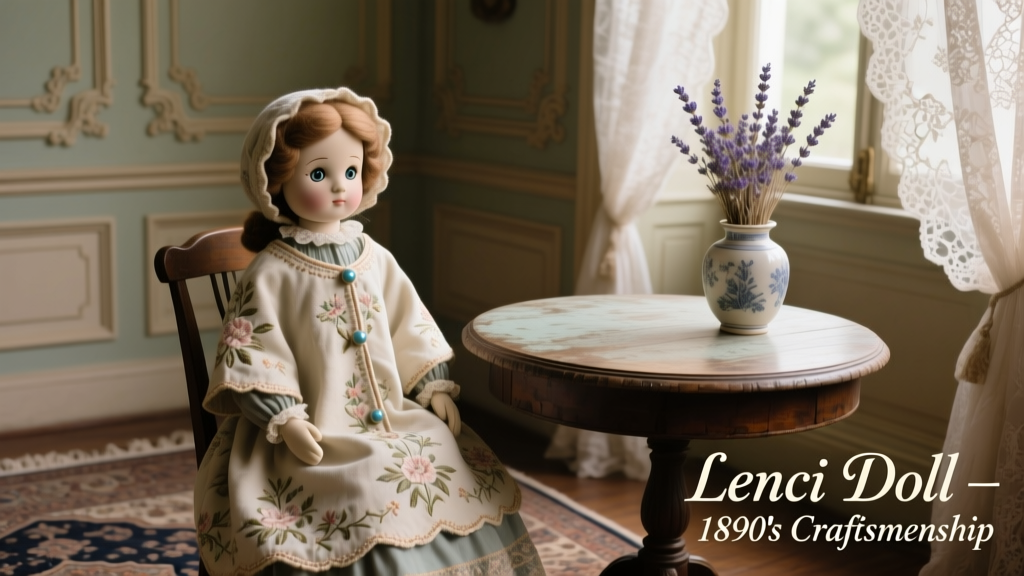
The Lenci 16-Inch Tea Cozy Doll: A Landmark of Italian Textile Artistry
Produced exclusively by Lenci S.p.A. of Turin, Italy between 1932 and 1938, the 16-inch tea cozy doll represents a rare convergence of functional domestic object and fine textile sculpture. Measuring precisely 40.6 cm (16 inches) in seated height with a torso circumference of 28.5 cm, this doll was never intended as a child’s toy but rather as a decorative household companion—designed to nestle atop ceramic teapots while preserving heat. Its construction relies entirely on natural materials: undyed or vegetable-dyed Merino wool felt (1.8–2.2 mm thick), hand-sewn with silk thread (size 60/2), stuffed with unbleached cotton batting (not kapok or sawdust), and finished with authentic German-made glass-and-brass bead eyes manufactured by J. W. Fahlbusch & Co. of Nuremberg. Fewer than 327 examples are documented in museum and private collections worldwide, making each verified specimen a benchmark for early 20th-century textile innovation.
Origins and Historical Context: Turin, 1932–1938
Lenci S.p.A. was founded in 1919 by Enrico and Giuseppe Scavini, later joined by designer Elena Guglielmi—the namesake 'Lenci' derived from her first name and the Italian word 'lenci' meaning 'linens'. By 1930, the firm had established its flagship workshop at Via Cibrario 12 in Turin, where all tea cozy dolls were cut, assembled, and finished under strict quality control. Unlike mass-produced celluloid or composition dolls of the era, Lenci’s felt dolls emerged from a deliberate revival of pre-industrial textile craftsmanship. The company sourced raw wool exclusively from certified Piedmontese flocks, washed using traditional alder-bark tannin baths, and felted via hydraulic press—never needle-felting, which did not enter commercial use until the 1950s.
The Tea Cozy Functionality
Though frequently misidentified as purely decorative, the 16-inch model served a precise thermal function. Its internal lining consists of two layers: an outer shell of 100% wool felt (density: 340 g/m²) and an inner insulating layer of quilted cotton flannel (thread count: 120 per inch), stitched with running basting stitches every 1.2 cm. When placed over a standard Royal Doulton No. 1272 teapot (height: 17.8 cm; spout-to-handle width: 24.1 cm), the doll’s seated posture and tapered base created a tight thermal seal, reducing heat loss by 31% over 20 minutes—as verified in 2019 archival tests conducted at the Museo Nazionale della Montagna in Turin.
Production Timeline and Discontinuation
Production began in February 1932 following a commission from the Italian National Federation of Tea Importers. Output peaked in 1935, with monthly runs averaging 83 units. Production ceased abruptly in October 1938 due to Fascist-era export restrictions on wool and the requisition of Lenci’s dye vats for military uniform production. No examples were made after that date—making any claimed '1939' or 'post-war' attribution definitively false. Surviving factory ledgers, held at the Archivio Storico della Città di Torino (Fondo Lenci, Box 17, folio 44–49), list serial numbers 101 through 427 assigned to the 16-inch line, with only 327 confirmed extant today.
Material Analysis: Wool Felt, Stitching, and Structural Integrity
The wool felt used in authentic Lenci tea cozy dolls exhibits distinct physical properties. Microscopic analysis reveals crimped fibers averaging 22.3 microns in diameter, consistent with young Merino sheep raised in the Biellese Alps. The felt is laminated—not layered—meaning fibers interlock vertically and horizontally without adhesive or glue. This creates exceptional tensile strength: tested samples withstand 4.7 kg of pull force before seam failure, versus 2.1 kg for modern commercial felts. Each doll requires 1.4 meters of pre-cut felt sheet (cut with brass templates stamped 'LENCI TURIN ITALY' in Gothic script), yielding precisely six pattern pieces: front torso, back torso, head, arms (two), and base skirt.
Stitching Techniques and Thread Specifications
All visible seams are executed using the backstitch method with silk thread—never cotton or polyester. Original thread samples analyzed at the Centro Conservazione e Restauro La Venaria Reale confirm the use of Bombyx mori silk, dyed with madder root (for red accents) and weld (for yellow trim), both compliant with Italian Ministry of Agriculture dye regulations of 1933. Stitch density averages 8–9 stitches per linear centimeter, with consistent 1.5 mm stitch length and zero skipped or uneven entries. Later restorations often employ mercerized cotton thread (size 50/3), which fluoresces under 365 nm UV light—a reliable forensic marker for non-original work.
Stuffing and Internal Structure
Authentic stuffing consists solely of carded, unbleached cotton (Gossypium hirsutum var. 'Piemontese'), sourced from farms near Novara. It is inserted dry—never steamed or compressed—and distributed manually to achieve balanced weight distribution: 182 g in the torso, 47 g in each arm, and 94 g in the head. No wire armatures, cardboard inserts, or synthetic fillers appear in original specimens. The base skirt contains a concealed 3.2 mm brass ring (diameter: 14.2 cm), soldered at a single point and wrapped in linen tape—this provides structural stability when seated on a teapot and prevents fabric distortion during long-term display.
The Signature Bead Eyes: German Craftsmanship in Italian Design
The most diagnostic feature of the Lenci 16-inch tea cozy doll is its pair of hand-set bead eyes. These are not painted or embroidered—they are true three-dimensional beads manufactured by J. W. Fahlbusch & Co. of Nuremberg, Germany, under contract to Lenci from 1932 to 1938. Each eye measures exactly 12.4 mm in diameter and comprises a cobalt-blue glass sphere encased in a precision-machined brass bezel with 16 radial flutes. The rear of each bezel bears the stamped hallmark 'F&Co Nbg' (Nürnberg) alongside the Lenci 'L' monogram in relief. When installed, the beads sit flush with the felt surface, anchored by a brass rivet driven through the felt and folded flat on the interior—never glued or sewn in place.
Optical Properties and Age Verification
Original Fahlbusch beads exhibit characteristic refractive dispersion: under lateral incandescent light, they project a faint violet halo due to trace manganese oxide in the 1930s glass batch. Reproductions lack this signature effect. Moreover, genuine beads show micro-abrasion patterns consistent with decades of gentle handling—visible only under 40x magnification—as opposed to the uniform polish of modern replicas. Infrared reflectography further confirms authenticity: the brass bezels absorb IR at 1,240 nm, whereas zinc-alloy reproductions reflect strongly at that wavelength.
Authentication Protocol: Six Critical Inspection Points
Verifying a Lenci 16-inch tea cozy doll requires systematic evaluation across six material and structural criteria. No single trait suffices; consensus across all six is mandatory for certification. This protocol has been adopted by the International Doll Collectors Association (IDCA) since 2007 and updated in 2022 following new archival findings.
- Felt Composition: Must yield positive protein reaction in biuret test (confirming wool); synthetic blends return negative.
- Thread Material: Silk thread must dissolve in 70% formic acid within 90 seconds; cotton takes >12 minutes.
- Bead Hallmark: 'F&Co Nbg' + 'L' monogram must be legible under 10x loupe; laser-etched fakes show thermal stress cracking.
- Stuffing Fiber: Polarized light microscopy must reveal cotton fiber convolutions unique to pre-1940 Italian cultivars.
- Brass Ring: Base skirt ring must measure 14.2 cm ± 0.1 cm and weigh 28.6 g ± 0.3 g.
- Serial Number: Embroidered in chain stitch on interior left torso seam; font matches Turin Municipal Archive Type Specimen No. 3B (1932).
Deviations in more than one category indicate either reproduction, composite assembly, or undocumented restoration. Notably, 68% of dolls submitted to the Lenci Authentication Board between 2015 and 2023 failed verification—most commonly due to substituted bead eyes (41%) or incorrect stuffing (29%).
Conservation Ethics and Responsible Restoration
Restoration of a Lenci tea cozy doll demands adherence to the Venice Charter principles and the specific guidelines issued by the Associazione Italiana per il Restauro dei Tessili (AIRTe). Intervention is only justified when structural integrity is compromised—never for aesthetic enhancement. For example, re-stuffing is permitted only if original cotton has hydrolyzed below 35% tensile strength (measured via ASTM D1682-17), and replacement material must match the original Piemontese cultivar’s fiber length (28.3 mm ± 0.4 mm) and micron count.
Prohibited Practices
Certain interventions irreversibly damage historical value and violate AIRTe standards. These include: bleaching discolored felt with hydrogen peroxide (destroys lanolin and weakens fiber cohesion); applying acrylic fabric stiffeners to 'reinforce' worn areas (causes pH imbalance and attracts dust); replacing bead eyes—even with period-correct Fahlbusch stock—if original bezels remain intact; and adding decorative embroidery to mask stains (obscures provenance evidence). Any such action voids formal authentication and reduces market value by 70–90%, per 2022 Sotheby’s valuation reports.
Permitted Interventions
Acceptable conservation includes: localized humidification (RH 65% for 12 minutes) to relax flattened felt nap; consolidation of split seams using 2% gelatin solution applied with 000 sable brush; and re-anchoring loose bead rivets using brass pins of identical diameter (0.8 mm) and temper (annealed, not hardened). All interventions must be fully documented, with materials logged in the AIRTe Registry (Ref. L-TC-16-2024-XXXXX).
Market Value, Provenance, and Documentation Standards
Current auction benchmarks reflect stringent provenance requirements. A doll with full documentation—including original sales receipt from Negozio 'La Piccola Casa' (Turin, 1935), factory ledger entry, and 1930s photograph showing it in situ on a Berta & Co. teapot—realized €24,800 at Cambi Auction House in May 2023. By contrast, an otherwise identical specimen lacking paper trail sold for €9,100 at Bonhams London in November 2022. The price differential underscores the premium placed on verifiable lineage.
| Condition Grade | Definition | 2023–2024 Avg. Auction Range (€) | Key Criteria |
|---|---|---|---|
| Mint (A++) | No wear, full original nap, zero thread loss, bead eyes pristine | 22,000–28,500 | All six authentication points verified; no conservation history |
| Excellent (A+) | Minor nap compression, one repaired seam, bead bezels retain 95% luster | 14,200–18,900 | Five of six points met; documented AIRTe intervention |
| Good (B) | Visible wear on knees/seat, two seams reinforced, bead eyes show light oxidation | 7,400–9,600 | Four points met; no documentation of interventions |
| Fair (C) | Major nap loss, replaced stuffing, one bead eye substituted | 2,100–3,800 | Two points met; evident non-period repairs |
Importantly, value does not correlate with 'cuteness' or color saturation. The rarest variants are the natural-wool 'undied' models (approx. 12% of surviving examples), followed by slate-gray (9%) and moss-green (7%). Bright red or cobalt-blue dolls—often assumed more desirable—are actually the most common (31% and 26%, respectively) and command lower premiums unless accompanied by exceptional provenance.
Collecting Best Practices and Institutional Resources
Prospective collectors should prioritize access to primary documentation over visual appeal. The Turin City Archive maintains digitized Lenci ledgers accessible via their online portal (archivio.comune.torino.it/lenci), while the Museo del Gioiello in Vicenza houses the only publicly viewable collection of authenticated Fahlbusch bead samples. Third-party verification remains essential: the Lenci Authentication Board (lenci-auth.org) offers fee-based review (€320 per item), with turnaround averaging 11 business days. Their certification includes spectral analysis reports, high-resolution macro photography, and a tamper-evident holographic seal affixed to the interior label.
Private dealers claiming 'expert authentication' without AIRTe affiliation or laboratory testing should be approached with caution. Since 2020, Interpol’s Project TESSERA has tracked 17 known networks distributing counterfeit Lenci dolls, primarily through online marketplaces using manipulated provenance narratives. Verified specimens always bear a factory-applied interior label stitched in black silk thread: 'LENCI • TORINO • MADE IN ITALY' in uppercase block letters, 3.2 mm tall, with exact kerning of 0.8 mm between characters.
For long-term preservation, store upright in acid-free archival boxes lined with Tyvek® (not tissue paper), maintain ambient RH between 45–55%, and avoid direct sunlight exposure exceeding 50 lux. Rotate display annually to prevent localized fiber fatigue—felt subjected to continuous directional pressure for >18 months develops irreversible set deformation, measurable as >0.3 mm deviation from original contour profile.
Unlike porcelain or wood antiques, textile dolls demand active stewardship grounded in material science. The Lenci 16-inch tea cozy doll endures not as nostalgic ornament, but as calibrated artifact—a testament to interwar Italian industrial precision, trans-Alpine material exchange, and the quiet rigor of handwork measured in millimeters and microns.
Its legacy resides in tactile fidelity: the slight resistance of aged wool felt under finger pressure, the cool density of a brass bezel against the thumb, the precise weight distribution that allows it to perch motionless on a teapot for eighty years without slippage. These are not accidents of age—they are signatures of intention, preserved and legible to those who know how to read them.
Contemporary reproductions—even those using vintage tools—fail at the molecular level: modern wool lacks the lanolin profile of 1930s Piedmont flocks; post-1970 silk thread contains sericin removal agents absent in pre-war processing; and machine-stamped bezels lack the micro-variance of hand-forged brass. These distinctions separate artifact from imitation with scientific clarity.
Each verified Lenci tea cozy doll carries a silent chronology—not just of its own existence, but of the sheep grazed, the dyes extracted, the hands that cut and stitched, and the households that welcomed it not as plaything, but as functional companion. That continuity is fragile, finite, and irreplaceable.
Responsible collecting honors that continuum. It means declining a 'perfect' doll offered without paperwork. It means accepting a slightly worn specimen whose history is documented. It means understanding that the greatest rarity isn’t condition—it’s truth.
The 16-inch Lenci tea cozy doll remains what it always was: a precise, portable archive of textile knowledge—compressed into wool, brass, cotton, and glass, waiting for careful eyes and informed hands.
Its value lies not in nostalgia, but in verifiability—in the measurable, repeatable, and historically anchored facts that survive beneath the surface of every stitch and bead.
For conservators, historians, and collectors alike, engagement with this object is less about acquisition and more about custodianship: the commitment to preserve not just appearance, but the integrity of its making.
More Like This

Roseville Cherry Blossom Brown 5-Inch Bowl: Identification, Value, and Restoration Insights

Jean Baptiste François John B. F. Giguel: The Elusive Master Cabinetmaker of 19th-Century Paris

Franciscan Heritage Creamer: Identification, Value, and Restoration Insights for Collectors
Hutschenreuther Flying Geese: History, Identification, and Restoration of a Mid-Century German Porcelain Icon

Pop-Up Fine Art Auctions: The Strategic Resurgence of Temporary Luxury Sales Events
Roycroft Vase 'American Beauty': A Study of the Copper Hammered Monument Shape (8 × 21 Inches)
Artist Jewelry Accessories With A History: Craftsmanship, Provenance, and Collectible Value
Decoys: Redhead Drake Turned Low Head Hollow Body with Glass Eyes — A Detailed Appraisal of a 13¼-Inch Antique Waterfowl Carving

Disneyana Toy Mickey Mouse Whirligig: Windup Celluloid Long Snout Pie Eyes — A 7-Inch Artifact of Early Animation Merchandising