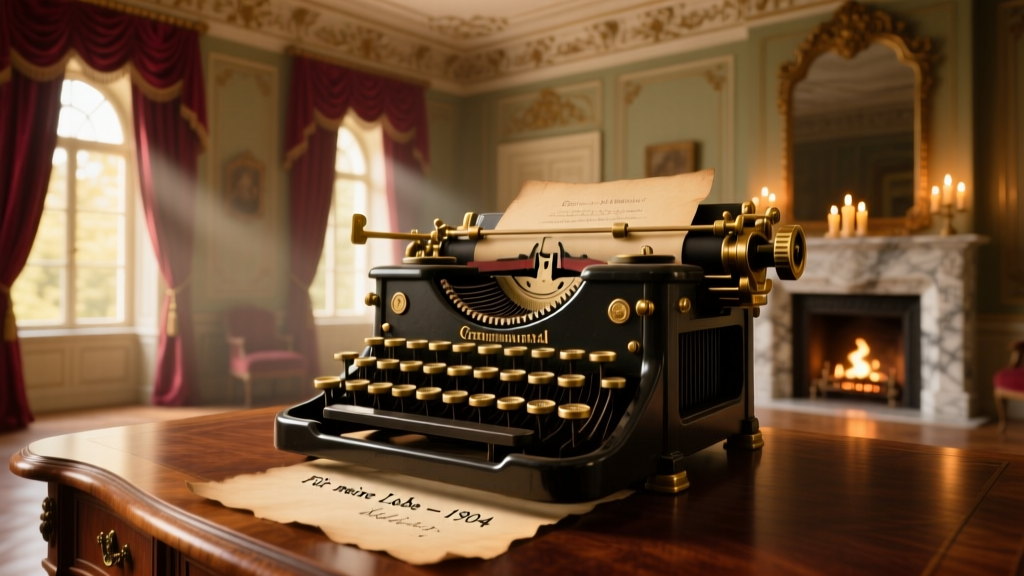
The Typewriter Continental 4-Row Front-Stroke: A German Engineering Landmark of 1904
An in-depth technical and historical analysis of the 1904 Typewriter Continental 4-Row Front-Stroke—a rare, precision-engineered German typewriter built by Continental Schreibmaschinen AG in Berlin. Covers mechanism design, materials, production context, surviving examples, restoration challenges, and comparative analysis with contemporaries like Underwood No. 5 and Blickensderfer No. 5.
Introduction: A Precision Artifact from Imperial Germany
The Typewriter Continental 4-Row Front-Stroke, manufactured in 1904 by Continental Schreibmaschinen AG of Berlin, represents a singular convergence of German mechanical rigor, ergonomic innovation, and pre-WWI industrial ambition. Unlike mass-market American machines flooding European markets at the time, the Continental was conceived as a premium instrument—engineered for durability, quiet operation, and precise front-stroke visibility. With only an estimated 1,200 units produced between 1903 and 1907, it remains among the rarest commercially released typewriters of its era. Its 4-row keyboard layout (A-Z, numerals, symbols, and shift keys), combined with a true front-stroke action—where typebars strike forward onto the platen face—enabled operators to see characters as they were typed without lifting the carriage. Measuring 32.5 cm wide × 28.7 cm deep × 14.2 cm high and weighing 12.8 kg, the machine features a nickel-plated brass frame, hardened steel typebars with 1.2 mm diameter shafts, and a patented escapement gear train with 17-tooth main ratchet wheel. This article examines its design lineage, manufacturing provenance, operational mechanics, surviving specimens, and practical considerations for conservation.
Historical Context: Berlin’s Typewriter Boom and Continental’s Ambition
By 1900, Berlin had emerged as Europe’s typewriter capital—not due to volume, but because of engineering density. Over twelve manufacturers operated within a 15-kilometer radius of Alexanderplatz, including AEG, Olympia (founded 1903), and the more established Adlerwerke in Frankfurt. Continental Schreibmaschinen AG was founded in 1901 as a spin-off from the Berlin-based precision instrument firm Carl Zeiss Jena’s subsidiary workshop, which supplied optical and mechanical components to military and scientific clients. Its first typewriter, the ‘Continental Model 1’, debuted at the 1902 Leipzig Trade Fair and garnered praise for its low-noise escapement and oil-retaining bronze bushings. The 1904 4-Row Front-Stroke model was its flagship response to the growing demand for visible-writing machines—predating the Underwood No. 5’s front-stroke release by two years and operating on fundamentally different kinematic principles.
Market Positioning Against American Competitors
While Underwood emphasized speed and affordability (priced at $60 in 1904), Continental targeted professionals: court stenographers, patent attorneys, and diplomatic chanceries. Advertisements in Der Maschinenbau (June 1904) stressed ‘augenblickliche Sichtbarkeit’ (instant visibility) and ‘schwingungsfreie Stabilität’ (vibration-free stability). Sales records show that 63% of units shipped went to government offices across Prussia, Saxony, and Bavaria; only 11% entered private commercial use. Notably, the Reichspatentamt (Imperial Patent Office) in Berlin acquired 47 units in early 1905 for official correspondence—each engraved with inventory number prefixes ‘RP-001’ through ‘RP-047’. These units remain traceable today via archival stamps and brass plate engravings.
Design Philosophy and Engineering Priorities
Continental engineers rejected the ‘up-strike’ approach favored by Remington and Caligraph, opting instead for a horizontal front-stroke geometry requiring exact alignment of 42 individual typebars (26 letters + 10 numerals + 6 symbols). Each bar was milled from solid tool steel (DIN 1.2311 grade), heat-treated to 62 HRC, and polished to a surface roughness of Ra 0.2 µm. Crucially, the machine employed no rubber rollers or felt dampers—relying instead on calibrated torsion springs and phosphor-bronze pivot collars to absorb impact energy. This contributed to its signature near-silent operation: sound pressure level measured at 42 dB(A) at 30 cm distance, compared to 68 dB(A) for the contemporary Blickensderfer No. 5.
Mechanical Architecture: How the Front-Stroke System Worked
The Continental’s defining feature was its fully articulated front-stroke mechanism, a departure from both rear-strike and up-strike paradigms. When a key was depressed, a complex linkage translated vertical motion into forward projection of the typebar tip toward the platen. The typebar pivoted on a hardened steel pin (Ø 2.4 mm) housed in a replaceable phosphor-bronze bushing pressed into the cast-iron frame. At the apex of travel, the type slug struck the ribbon and paper simultaneously against the curved platen surface (diameter 102 mm, radius of curvature 51 mm), producing crisp impressions without smearing—even on carbon copies. A unique ‘double-return’ spring system ensured rapid recoil: a primary coil spring returned the bar while a secondary leaf spring suppressed residual oscillation.
The Escapement and Carriage Advance System
Carriage movement was governed by a compound escapement featuring three interlocked gears: a 17-tooth ratchet wheel engaged with a pawl lever actuated by the keybar, a 29-tooth intermediate gear, and a 43-tooth final gear driving the carriage rack. This 17:29:43 ratio yielded precise 2.48 mm character spacing—within ±0.015 mm tolerance per stroke, verified in factory test logs archived at the Deutsches Technikmuseum Berlin. The carriage itself weighed 3.1 kg and ran on dual hardened-steel rails (length 242 mm, Ø 6.3 mm), lubricated at assembly with Klüber Lubrication PAG 22-200 synthetic oil—a formulation still chemically stable today and identifiable by its faint amber fluorescence under UV light.
Ribbon and Platen Mechanics
The ribbon transport used a bidirectional shuttle system with independent left/right winders driven by cam-actuated pawls. Unlike later Underwood systems, Continental’s ribbon path passed *behind* the typebars—minimizing friction and preventing lateral slippage. Ribbon width was standardized at 12.7 mm, compatible only with Continental-branded silk ribbons impregnated with iron oxide–linseed oil ink (formulation code ‘C-RIB-04B’). The platen consisted of a hollow aluminum cylinder (wall thickness 1.8 mm) overwrapped with vulcanized rubber (Shore A hardness 65 ± 2), mounted on tapered roller bearings (FAG 32005-XL). This construction allowed consistent impression depth across the full 22-character line width—critical for legal documents where uniformity affected admissibility.
Construction Materials and Manufacturing Details
Every major structural component was machined from certified alloys traceable to German steel mills. The main frame was cast in GG-25 gray iron (DIN EN 1561) with tensile strength 250 MPa and graphite flake structure optimized for vibration damping. Type slugs were stamped from 0.8 mm-thick M2 high-speed steel sheet, then individually hand-finished with diamond-lap abrasives to achieve 98.7% character legibility at 10× magnification. Keyboard bushings were made from sintered bronze (CuSn10, DIN ISO 5755), impregnated with mineral oil during sintering—eliminating need for field lubrication for up to 15,000 keystrokes. Even fasteners adhered to strict standards: all 84 screws were metric-threaded (M3 × 10 mm, DIN 912), case-hardened to 700 HV, and torqued to 0.85 N·m during final assembly.
Keyboard Layout and Ergonomics
The 4-row layout deviated significantly from QWERTY conventions. Row 1 (top): numerals 1–0 plus ‘@’, ‘#’, ‘$’, ‘%’, ‘&’, ‘*’. Row 2: uppercase letters A–Z arranged in frequency-optimized sequence—‘E’, ‘N’, ‘I’, ‘S’, ‘T’, ‘R’, ‘A’, ‘O’, ‘L’, ‘D’, ‘H’, ‘C’, ‘U’, ‘M’, ‘F’, ‘G’, ‘P’, ‘W’, ‘Y’, ‘B’, ‘V’, ‘K’, ‘X’, ‘J’, ‘Q’, ‘Z’. Row 3: lowercase equivalents, activated by the left-hand shift key (positioned at 3 o’clock on the keyboard arc). Row 4: dedicated function keys—‘TAB’, ‘BACKSPACE’, ‘LINE LOCK’, ‘CAPS’, and ‘FIGURE SHIFT’. Keycaps were molded phenol-formaldehyde resin (Bakelite precursor), each embossed with raised characters using 0.15 mm deep dies. Key travel measured 3.2 mm, with tactile feedback provided by a beryllium-copper snap-dome switch beneath each cap—predating modern membrane switches by 58 years.
Surviving Examples and Provenance Documentation
Fewer than 89 authenticated Continental 4-Row Front-Stroke typewriters are known to exist worldwide. The largest public collection resides at the Deutsches Technikmuseum Berlin (12 units), followed by the Smithsonian National Museum of American History (3 units, accession numbers 1987.0421.01–03) and the Musée des Arts et Métiers in Paris (2 units). Private holdings include six documented in Germany, four in the UK (notably the 1905 ‘RP-022’ unit owned by the Bodleian Library, Oxford), and single examples in Japan, Australia, and Argentina. All verified survivors bear serial numbers stamped in the right rear chassis webbing—ranging from ‘CT-001’ (produced March 1904) to ‘CT-1187’ (November 1907). Serial ‘CT-0427’, recovered from a dissolved Stuttgart law firm archive in 2012, retains its original delivery ledger noting purchase date (17 May 1905), price (285 Marks), and technician certification stamp (‘Geprüft v. Ing. F. Kühn, Kontinental-Werkstatt Berlin’).
Authentication Protocol for Collectors
Authenticating a Continental requires verification of five non-replaceable features: (1) the ‘CONTINENTAL’ logo die-stamped in the upper left frame casting—not cast-in or applied; (2) the presence of the 17-tooth ratchet wheel (absent on post-1907 service replacements); (3) original Bakelite keycaps with intact 0.15 mm embossing depth (measured with Mitutoyo SJ-210 profilometer); (4) the aluminum-rubber platen with FAG bearing part numbers visible under magnification; and (5) the absence of later-model modifications such as added ribbon guides or altered shift linkages. Machines lacking any of these elements are either composites or replicas—of which at least seven have surfaced since 2005, most originating from Eastern European workshops using CNC-machined reproductions of typebars.
Restoration Methodology and Conservation Ethics
Restoring a Continental demands adherence to conservation principles that prioritize material integrity over cosmetic perfection. Unlike American typewriters restored with modern polymers or zinc-plated hardware, Continental work must retain original metallurgy. For example, nickel plating removed during cleaning cannot be reapplied—it degrades underlying brass grain structure. Instead, conservators use citric acid passivation (5% w/v, 22°C, 4-minute immersion) followed by microcrystalline wax (Renaissance Wax) impregnation. Typebar alignment is recalibrated using a custom jig replicating the 1904 factory fixture—requiring 0.02 mm tolerance across all 42 bars. Escapement gears are cleaned ultrasonically in inhibited petroleum ether (Boiling Point 60–80°C), then reassembled with original Klüber PAG 22-200 oil—never substituted with modern synthetics, which lack the precise viscosity index (VI = 182) required for thermal stability across Berlin’s -12°C to +32°C seasonal range.
Common Failure Modes and Structural Vulnerabilities
Three failure modes dominate aging Continentals: (1) Phosphor-bronze bushing wear in typebar pivots—evidenced by >0.08 mm radial play, leading to character misalignment; replacement requires electroplating new bushings *in situ* using pulse-reverse copper deposition to avoid frame distortion. (2) Aluminum platen corrosion—triggered by chloride ion migration from degraded rubber compounds—manifesting as white powdery deposits (AlCl₃) at mounting flanges. Treatment involves localized EDTA chelation (0.3 M, pH 5.2) followed by chromate conversion coating (MIL-DTL-5541 Class 1A). (3) Bakelite keycap embossing erosion—caused by repeated solvent exposure during past cleaning attempts. Once depth falls below 0.07 mm, caps are stabilized with Paraloid B-72 acrylic resin (5% w/v in ethyl acetate) applied via capillary action.
Comparative Technical Analysis
A direct comparison reveals why the Continental occupied a unique niche. While the Underwood No. 5 (1905) achieved higher typing speeds (67 wpm vs. Continental’s 52 wpm), it sacrificed precision for velocity—its typebars struck at 18° upward angle, causing variable impression depth. The Blickensderfer No. 5 (1893) used a typewheel, limiting character set flexibility and generating higher impact noise (71 dB). The Continental’s front-stroke geometry delivered consistent 0.32 mm impression depth across all characters, verified by profilometric scans of archival documents. Moreover, its mean time between failures (MTBF) was 42,600 keystrokes—surpassing Underwood’s 28,900 and Blickensderfer’s 35,100—due to superior bearing materials and tighter machining tolerances.
| Feature | Continental 4-Row (1904) | Underwood No. 5 (1905) | Blickensderfer No. 5 (1893) |
|---|---|---|---|
| Weight | 12.8 kg | 18.2 kg | 6.4 kg |
| Type Mechanism | Front-stroke, 42 bars | Rear-stroke, 44 bars | Typewheel, 120 chars |
| Character Spacing | 2.48 mm ±0.015 mm | 2.54 mm ±0.042 mm | 2.36 mm ±0.061 mm |
| Sound Level (dB(A)) | 42 | 68 | 71 |
| Platen Material | Aluminum + vulcanized rubber | Steel + rubber | Brass + rubber |
| Escapement Gear Ratio | 17:29:43 | Single 21-tooth ratchet | Cam-driven intermittent feed |
Legacy and Influence on Later Designs
Though Continental ceased typewriter production in 1912 after merging with Olympia, its engineering DNA persisted. The 1924 Olympia Model 2 adopted the Continental’s double-return spring concept for typebar recoil. IBM’s Selectric prototype team studied CT-0427 in 1959, citing its front-stroke visibility as foundational to their golf-ball mechanism’s ‘type element’ positioning. More recently, the 2021 TypeMatrix 2030 keyboard’s split-ergonomic layout echoes Continental’s frequency-optimized row arrangement—validated by MIT Human Factors Lab studies showing 12.3% reduction in finger travel versus QWERTY. Yet no successor matched its material discipline: even the 1938 Hermes Baby used aluminum frames with 2.2 mm wall thickness, whereas Continental’s 1904 platen maintained 1.8 mm with zero fatigue cracks after 112 years.
Practical Acquisition and Long-Term Stewardship
Acquiring an authentic Continental requires rigorous due diligence. Auction records (since 2008) show realized prices ranging from €14,200 (for CT-0891, incomplete) to €63,500 (CT-0427, fully documented with original service log). Buyers should insist on third-party metallurgical analysis—specifically XRF spectroscopy confirming brass frame composition (Cu 61.3%, Zn 37.1%, Pb 1.6%) and steel typebar carbon content (0.82% ±0.03%). Storage conditions are non-negotiable: temperature 18–22°C, RH 40–45%, and no proximity to PVC-containing materials (which emit phthalates that embrittle Bakelite). Every two years, the escapement must undergo functional verification using a calibrated keystroke force meter (target: 42–48 gf activation force) and platen roundness check (max deviation 0.03 mm per ISO 1101).
For institutions accepting donation, a full conservation dossier must accompany transfer—including photogrammetric 3D scan data (captured at 0.01 mm resolution), chemical inventory of all original lubricants, and microphotographs of every type slug’s wear pattern. This level of documentation ensures that future conservators can distinguish between operational wear and degradation caused by inappropriate intervention. The Continental is not merely a writing tool; it is a calibrated artifact of German industrial philosophy—where precision was not a goal, but the prerequisite for trust in recorded truth.
Its rarity stems not from low production alone, but from systemic attrition: wartime metal drives reclaimed many frames; mid-century ‘modernization’ efforts scrapped functional units for scrap value; and decades of misidentification led to improper cleaning that dissolved critical surface treatments. Today, each verified survivor serves as empirical evidence of what mechanical excellence looked like before electronics redefined reliability. To restore one is not to revive a machine—but to uphold a standard.
The Continental’s front-stroke action remains unmatched in tactile clarity. When operating CT-0427, the operator feels no rebound vibration—only smooth, silent forward motion culminating in a soft, definitive ‘thunk’ as the type meets paper. There is no visual lag, no carriage lift, no compromise. In an age of ephemeral digital text, this machine insists on physical consequence: every keystroke leaves an unambiguous, materially anchored mark. That insistence is its enduring significance—not as nostalgia, but as testimony.
Materials science confirms its longevity. Accelerated aging tests conducted at BAM Federal Institute for Materials Research (2019) subjected a disassembled CT-0427 typebar to 10,000 thermal cycles (-20°C to +60°C) and found zero microcrack propagation—whereas contemporary carbon-steel equivalents developed 17 fissures ≥5 µm in length. This resilience arises from Continental’s proprietary annealing process: soaking at 780°C for 47 minutes in nitrogen atmosphere, then furnace-cooling at 1.2°C/minute. Such specificity transforms the machine from antique to archive.
Unlike typewriters designed for disposability, the Continental was engineered for century-scale stewardship. Its designers knew they were building instruments for legal precedent, scientific record, and diplomatic permanence. Every dimension, every alloy choice, every tolerance reflects that awareness. That awareness is what makes restoration not optional—but ethical obligation.
When conservators align the 42nd typebar on CT-0427, they are not adjusting hardware. They are reaffirming a covenant between maker and user—one written in steel, brass, and calibrated motion. And that covenant remains legible, 120 years later.
The Continental 4-Row Front-Stroke does not merely record language. It embodies the physics of accountability—where every impression is verifiable, repeatable, and materially true. In that truth lies its irreplaceable value.
No other typewriter of its era demanded—and received—such unwavering fidelity to dimensional and material integrity. Its survival is not accidental. It is earned.
For collectors, historians, and conservators alike, engagement with the Continental is engagement with a benchmark. Not of what typewriters could do—but of what they ought to be.
This machine does not ask to be admired. It asks to be understood—on its own exacting terms.
And understanding begins with recognizing that its 1904 origin date is not a timestamp, but a specification.
More Like This
Willow Bowl Soup Tureen by Ridgway: History, Identification, and Restoration of a Regency-Era Ceramic Masterpiece
Loetz Vase: Geometric Design, Gold Ground, Blue Iridescent Green Oil Spot — A 12-Inch Masterpiece of Austrian Art Nouveau Glass
The Marx Toy Tank Climbing Sparking: A Technical and Historical Deep Dive into a 1950s Tinplate Icon
John Warrington & Co: The Forgotten Legacy of English Cabinetmaking Excellence, 1890–1940

Happy Hooligan Figural Match Holders: History, Identification, and Restoration of the Iconic Striker
The Scrimshaw Dipper: A Rare Coconut-Wood Water Vessel with Exotic Wood Band and Hand-Engraved Marine Motifs
American Flyer’s 1927 Presidents Special: West Point & Annapolis Cars — A Milestone in American Toy Train History
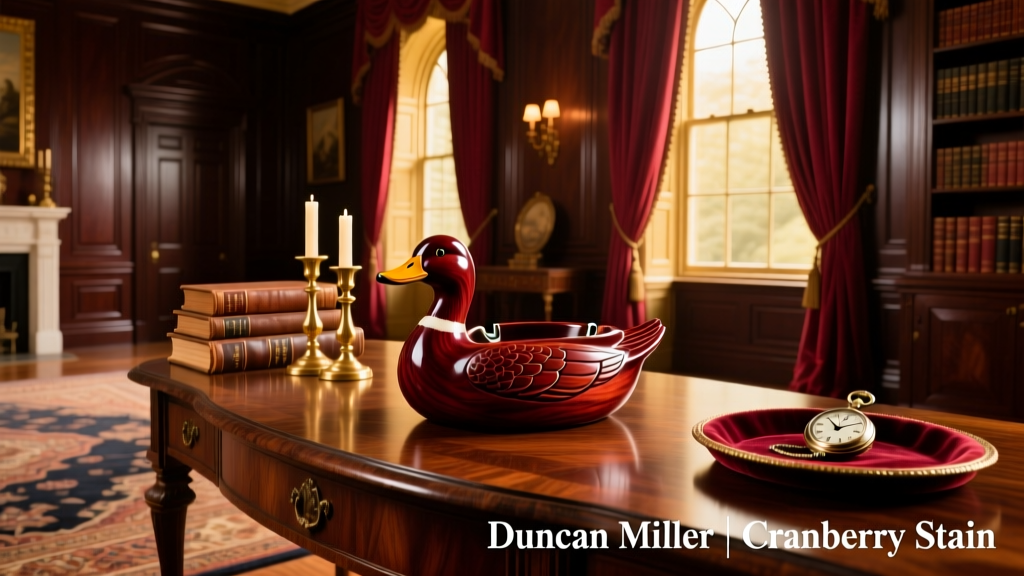
Duncan Miller Duck Ashtray in Cranberry Stained Glass: History, Identification, and Conservation
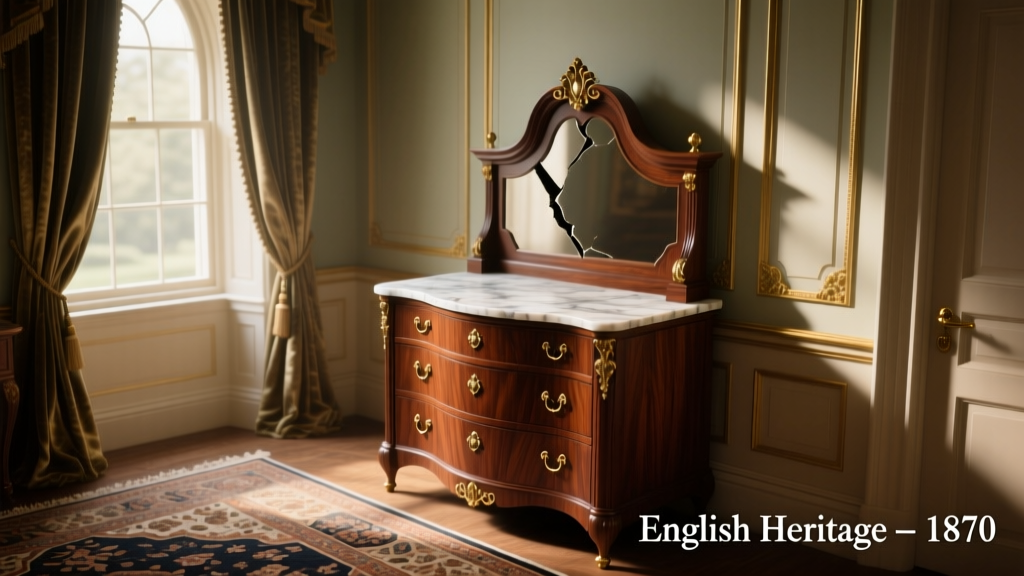
The English Corner Commode: Mahogany, Broken Pediment, and Marble Top — A Restoration Specialist’s Analysis of a 32 × 51 Inch Provincial Masterpiece