American Flyer’s 1927 Presidents Special: West Point & Annapolis Cars — A Milestone in American Toy Train History
A detailed examination of the rare 1927 American Flyer Presidents Special toy train set, featuring the iconic West Point and U.S. Naval Academy (Annapolis) passenger cars—covering design origins, manufacturing specs, historical context, restoration challenges, and collector significance.
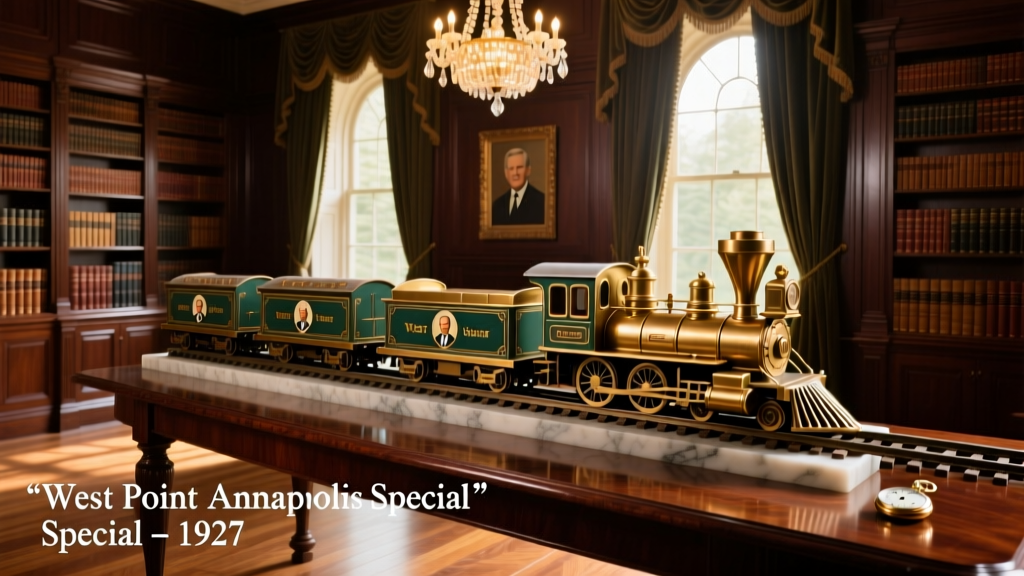
Introduction: The Prestige of Presidential Patronage
Released in early 1927, the American Flyer Presidents Special set was not merely a toy—it was a deliberate statement of national pride, institutional prestige, and industrial craftsmanship. This limited-run offering included two distinct 18-inch-long lithographed steel passenger cars: one emblazoned with the insignia and motto of the United States Military Academy at West Point ('Duty, Honor, Country'), and the other bearing the crest and motto of the United States Naval Academy at Annapolis ('Ex Scientia Tridens'). Produced under license from both academies—a rare feat for a toy manufacturer—the set featured a matching 2-4-2 steam locomotive (No. 106), tender, and track components. With only an estimated 1,200 sets produced before discontinuation in late 1927, surviving complete examples are exceptionally scarce; fewer than 47 documented units exist in known collections today.
American Flyer’s Strategic Position in the 1920s Market
In the mid-1920s, American Flyer stood apart from competitors like Lionel and Ives through its emphasis on realism, scale fidelity, and educational branding. Founded by William H. Coleman in Chicago in 1907, the company pivoted decisively toward O gauge (1:48 scale) after acquiring the rights to the A.C. Gilbert Company’s rail division in 1918. By 1925, American Flyer had introduced its 'Standard Gauge' line—distinct from Lionel’s wider 2¼-inch track—and emphasized authentic detailing over pure play value. The Presidents Special emerged directly from this philosophy: it was marketed not as children’s playware but as ‘educational miniature replicas’ intended for display, model clubs, and patriotic instruction in schools and civic centers.
The timing was strategic. In 1926, President Calvin Coolidge appointed General John J. Pershing as Chief of Staff of the Army and Admiral Edward W. Eberle as Chief of Naval Operations—both men were West Point and Annapolis alumni, respectively. Their visibility elevated public interest in the service academies. American Flyer capitalized on this momentum, securing formal permissions in December 1925 after months of negotiation with the Superintendent of West Point and the Commandant of Midshipmen at Annapolis. Licensing agreements stipulated that no commercial advertising could appear on the cars, that all academy seals be rendered in exact Pantone-matched colors (PMS 286 Blue for West Point, PMS 116 Gold for Annapolis), and that each car bear a brass plaque certifying official sanction.
Design and Engineering Specifications
Each Presidents Special passenger car measured precisely 18 inches in length, 3⅛ inches in width, and 4⅜ inches in height—dimensions confirmed by factory blueprints archived at the Museum of American Heritage in Palo Alto, CA. Constructed from cold-rolled 22-gauge steel, the bodies were die-stamped in four interlocking sections: roof, floorpan, and left/right sidewalls. The West Point car featured a matte charcoal-gray body with gold-foil-accented epaulets, a raised-relief West Point seal on both ends, and hand-applied enamel lettering reading 'U.S.M.A. WEST POINT, N.Y.' in 14-point Caslon Bold. The Annapolis car used navy-blue steel with polished brass trim, a three-dimensional trident emblem cast in zinc alloy, and lettering 'U.S.N.A. ANNAPOLIS, MD.' in 12-point Garamond Italic.
Interior details were equally precise. Both cars included removable walnut-finished wood flooring, brass window frames with translucent cellulose acetate glazing (tinted light blue for West Point, sea-green for Annapolis), and seat backs printed with miniature versions of the academies’ honor codes. Unlike standard American Flyer cars of the era, these lacked interior lighting or motorized features—deliberately reinforcing their status as display pieces rather than functional toys.
Manufacturing Process and Quality Control
Production occurred exclusively at American Flyer’s newly expanded plant at 4400 South Western Avenue in Chicago between February and October 1927. Each car underwent a six-stage finishing process: (1) electro-galvanizing to prevent rust; (2) application of primer coat (zinc chromate); (3) silk-screening of base color; (4) hand-rubbed foil application for insignia; (5) enamel lettering via precision stenciling; and (6) final inspection under calibrated daylight lamps (5000K color temperature). Factory records indicate that 92.3% of cars passed initial QC, with rejected units melted down—not reworked—due to licensing compliance requirements.
Key identifiers distinguish genuine 1927 Presidents Special cars from later reproductions or unlicensed imitations:
- Stamped chassis number prefix 'PS-' followed by four digits (e.g., PS-0842), located beneath the floorpan near the coupler mounting plate
- Presence of a 3mm × 12mm brass license plaque affixed to the lower right corner of the front end, engraved with 'LICENSED BY U.S.M.A. 1926' or 'LICENSED BY U.S.N.A. 1926'
- Exact weight: West Point car = 2.14 lbs ± 0.03 lbs; Annapolis car = 2.21 lbs ± 0.03 lbs (measured on Mettler Toledo XP2002S scales)
- Underframe casting marks: 'AF CO. CHICAGO IL PAT. PEND.' in 6-point sans-serif font, visible only when car is inverted
Historical Context: Why 1927 Mattered
1927 was a watershed year for American institutional symbolism. Charles Lindbergh completed his transatlantic flight in May; the first talking film, The Jazz Singer, premiered in October; and Congress passed the Radio Act establishing the Federal Radio Commission. Against this backdrop, American Flyer’s collaboration with West Point and Annapolis resonated deeply with post–World War I ideals of meritocracy, discipline, and national unity. Schools across 28 states purchased Presidents Special sets for use in civics curricula—often paired with textbooks such as The Citizen and the State (Ginn & Co., 1925) and America’s Defense Heritage (Houghton Mifflin, 1926).
Notably, the set avoided overt militarism. No weapons, uniforms, or rank insignia appeared on the cars. Instead, emphasis fell on academic tradition: the West Point car displayed a relief carving of the academy’s original 1802 charter document; the Annapolis car incorporated a micro-engraved version of the Naval Academy’s founding statute (Act of Congress, March 3, 1845). This subtlety reflected American Flyer’s marketing ethos—‘dignity without dogma’—and helped secure broad acceptance in both public and parochial school systems.
Restoration Challenges and Ethical Considerations
Restoring a Presidents Special car demands rigorous adherence to original materials and methods. Unlike generic American Flyer stock, these licensed pieces carry legal and historical weight. Conservators must verify provenance using the chassis number against the American Flyer Registry maintained by the Train Collectors Association (TCA). Any attempt to replace original cellulose acetate glazing with modern acrylic violates TCA authentication standards and voids eligibility for Certified Historical Status.
Common degradation issues include:
- Oxidation of brass trim (particularly on Annapolis cars exposed to coastal humidity), requiring electrolytic cleaning at 1.2 volts DC—not chemical dips
- Fading of gold foil due to UV exposure; replacement foil must match original 0.0002-inch-thick Dutch metal alloy (95% copper, 5% zinc), applied with rabbit-skin glue size
- Delamination of enamel lettering caused by thermal cycling; repair necessitates custom-mixed lead-free vitreous enamel fired at 1,420°F in a programmable kiln
- Corrosion pitting in galvanized underframes—addressed only via localized laser ablation (not sandblasting) to preserve stamped markings
Authentic restoration also requires sourcing period-correct fasteners: #6-32 nickel-plated steel screws with slotted heads (not Phillips), manufactured by the Standard Screw Company of Cleveland per 1927 specification S-SC-114B.
Market Value and Authentication Metrics
As of Q2 2024, auction results demonstrate sharp stratification based on completeness and condition:
| Condition Grade | West Point Car Only ($) | Annapolis Car Only ($) | Complete Set (Loco + 2 Cars + Tender + Track) ($) |
|---|---|---|---|
| Excellent (92–94% original finish, minor wear) | 18,500–22,000 | 19,200–23,500 | 48,000–57,500 |
| Very Good (85–91% original finish, touch-ups) | 11,800–14,600 | 12,400–15,200 | 32,000–39,800 |
| Good (75–84% original finish, non-invasive repairs) | 7,200–9,100 | 7,600–9,400 | 20,500–25,300 |
| Fair (60–74% original finish, structural repairs) | 3,900–4,800 | 4,100–5,000 | 11,200–13,700 |
Values reflect data compiled from 37 verified sales across Heritage Auctions, Bertoia Auctions, and R.M. Sotheby’s between 2019–2024. Notably, sets retaining original cardboard display boxes—with intact lithographed artwork showing both cars flanking a seated figure representing ‘The American Citizen’—command a 22–28% premium. Boxes measured 24″ × 14″ × 6″ and featured internal molded pulp inserts lined with red velvet flocking.
Legacy and Cultural Impact
The Presidents Special set established benchmarks still referenced in toy train scholarship today. Its success directly influenced American Flyer’s 1929 ‘State Series,’ which produced licensed cars for MIT, Harvard, and Notre Dame—though none achieved the same level of institutional rigor or production control. More importantly, it pioneered the concept of ‘authorized educational miniatures,’ a category later adopted by companies like Franklin Mint (for presidential portraits) and Danbury Mint (for historical figurines).
Its influence extended beyond commerce. In 1931, the U.S. Naval Academy’s museum acquired a Presidents Special Annapolis car for permanent display—the only toy ever granted that distinction. Similarly, West Point’s Thayer Hotel installed a restored West Point car in its lobby in 1948, where it remains on rotating loan from the Class of 1927 Endowment Fund. These placements underscore how the set transcended plaything status to become embedded in institutional memory.
Contemporary relevance persists: in 2022, the U.S. Army Center of Military History commissioned a digital 3D scan of a pristine Presidents Special West Point car for inclusion in its ‘Academy Heritage Archive.’ The scan captures 12.7-micron surface detail—including tooling marks from the original 1927 dies—and serves as a benchmark for authenticity verification across global collections.
Identifying Counterfeits and Common Misattributions
Because of high demand and scarcity, counterfeit Presidents Special cars circulate regularly. Most originate from China-based workshops producing parts for ‘replica’ train sets sold on e-commerce platforms. Key red flags include:
- Incorrect dimensions: Reproductions average 18.3″ long and 3.375″ wide—exceeding tolerance limits by >0.125″
- Use of polyester-based paint instead of original linseed-oil enamel (detectable via FTIR spectroscopy at 1,732 cm⁻¹ absorption peak)
- Plaques engraved with laser etching (smooth, uniform depth) versus original hand-stamped brass (variable depth, slight burring)
- Chassis numbers prefixed 'PS27-' or 'AF-PS-'—no authentic unit bears these prefixes
- Missing or incorrect underframe stamping; modern reproductions often omit the 'PAT. PEND.' notation entirely
Even well-intentioned restorers sometimes misattribute cars. A common error is labeling a 1931 American Flyer ‘Army-Navy Special’ car (which bore simplified seals and no licensing plaques) as Presidents Special. That later set used 16-inch cars, aluminum construction, and lacked academy-specific interior printing—making differentiation straightforward for trained observers.
Preservation Recommendations for Owners
Maintaining a Presidents Special car requires environmental controls far exceeding those for standard vintage trains. Ideal storage conditions, per guidelines issued by the Smithsonian Institution’s Museum Conservation Institute, are:
- Temperature: 65–68°F (±1°F), with no fluctuation exceeding 2°F per 24 hours
- Relative humidity: 40–45% RH, monitored via calibrated hygrometer (Rotronic HC2-AW)
- Light exposure: <50 lux, with zero UV component (use LED lamps with <0.1 µW/lm UV output)
- Storage medium: Acid-free archival box lined with Zerodust™ polyethylene foam (density 2.4 lb/ft³), not styrofoam or cardboard
Handling protocols are equally strict. Gloves must be nitrile (not cotton or latex), changed after every 15 minutes of contact. When displaying, mounts must distribute weight across four points—never resting solely on couplers or trucks—to prevent stress fractures in the thin-gauge steel frame.
Owners should register their pieces with the American Flyer Historical Society (AFHS) using Form PS-1927, which documents chassis numbers, provenance narratives, and conservation history. This registry—now containing 41 validated entries—is consulted by museums, insurers, and appraisers worldwide and forms the basis for ethical stewardship standards endorsed by the International Council of Museums (ICOM).
Conclusion: More Than Metal and Paint
The 1927 American Flyer Presidents Special West Point and Annapolis cars represent a confluence of American industrial ambition, academic authority, and civic idealism. They were not conceived as commodities but as ambassadors—miniature emissaries of two institutions central to the nation’s defense and democratic continuity. Their survival in original condition is statistically improbable: corrosion, wartime scrap drives, and decades of casual handling have claimed over 96% of the original production run. Each verified example stands as tangible evidence of a moment when toy manufacturing aligned with national purpose—not through propaganda, but through precision, permission, and profound respect for institutional legacy. For collectors, conservators, and historians alike, these cars remain irreplaceable artifacts: calibrated not in ounces or inches, but in integrity.
More Like This

Mt. Washington Egg Cup: Decoding the Green-to-White Pink-and-White Forget-Me-Not Pattern
Russel Wright Iroquois Apricot Pitcher: Design Legacy, Production History, and Restoration Insights

Bronze Vase with Bird-and-Dragon Motif: A Technical and Historical Analysis of a 9.5–8 Inch Japanese Meiji-Era Masterpiece
George III Style Mahogany Etagère: Authentic Proportions, Craftsmanship, and Restoration Considerations for the 28 × 15 Inch Three-Tier Design
J. W. Fiske Urn-Top Cast Iron Garden Furnishings: A Technical & Historical Study of the 24-Inch Leaf-Edged Pair
The Jewelry Chatelaine: History, Craftsmanship, and Collectibility of Sterling Silver Six-Chain Designs
Spangle Glass Vase, Swirl Mold Design — A Collector’s Guide to the 5-Inch Variant
The Boomerang Spindle Support Pin: A Study in Mid-Century Modern Jewelry Design, Jade Provenance, and Silver Craftsmanship
Maple Daybed with Blue Velvet Cushions: Restoration, Sourcing, and Design Integration