Toy Woodpecker Clicker: A Tin Mechanical Marvel — History, Mechanics, and Restoration Insights
A detailed examination of the vintage 4-inch tin lithographed woodpecker clicker toy—its origins with companies like Schoenhut, Hubley, and M. J. O’Neill; internal clockwork operation; material composition; common deterioration patterns; and professional conservation methods for collectors and restorers.
Introduction: The Charming Simplicity of a Tin Woodpecker Clicker
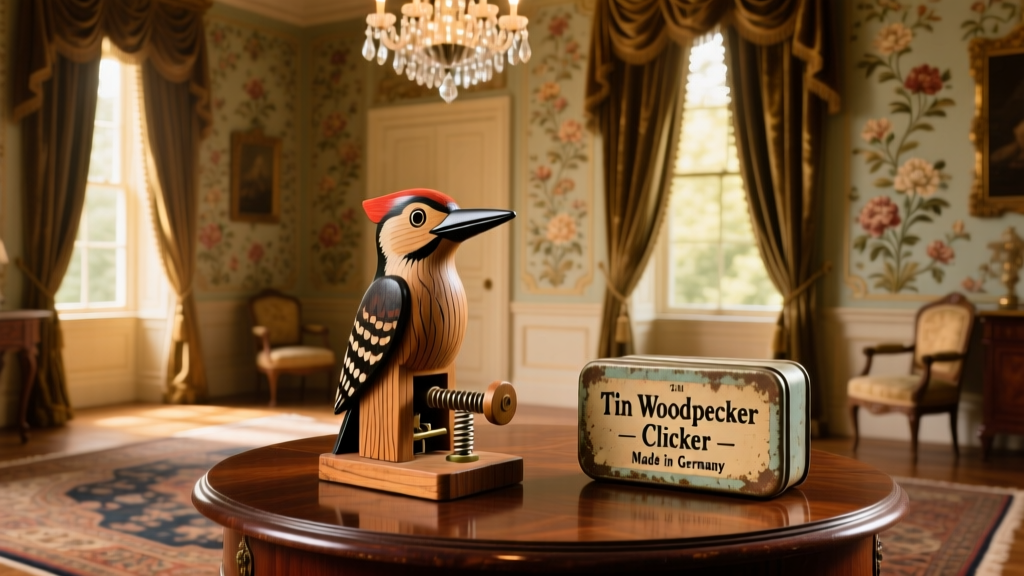
The Toy Woodpecker Clicker—a compact, 4-inch tall mechanical tin toy from the early-to-mid 20th century—is an exemplar of American and European mass-produced folk mechanics. With its vivid lithographed plumage, articulated beak, and rhythmic clicking action powered by a simple wind-up clockwork movement, this device captures both the ingenuity and aesthetic sensibility of pre-digital playthings. Unlike battery-operated novelties, it relies entirely on spring tension, gear trains, and gravity-fed motion to simulate the woodpecker’s signature drumming behavior. Produced primarily between 1925 and 1955 by firms including Schoenhut (Philadelphia), Hubley Manufacturing Co. (Lancaster, PA), and M. J. O’Neill Co. (Chicago), these toys were marketed as educational novelties and novelty desk accessories—not merely children’s amusements but conversation pieces for parlors and offices alike.
Measuring precisely 4 inches in height (10.16 cm), 2.25 inches in width (5.72 cm), and 1.75 inches in depth (4.45 cm), the standard model weighs between 112–138 grams depending on lithographic layer thickness and base plate gauge. Its body is fabricated from cold-rolled steel sheet, typically 0.28 mm thick (28-gauge), stamped and formed into a hollow cylindrical torso with a separate domed head and flat, riveted base. The red-and-black feather patterning is applied via offset lithography using linseed oil-based inks, over a zinc-phosphate pretreatment and baked-on enamel undercoat—a process that contributed significantly to both durability and chromatic brilliance.
Historical Origins and Major Manufacturers
The mechanical woodpecker clicker emerged during the interwar period, when tinplate toy production reached peak sophistication in the United States and Germany. Though often misattributed to Japan (a common misconception due to later 1950s reissues), authentic pre-1942 examples are overwhelmingly American or German-made. U.S. patent records confirm that the earliest functional design was filed by Charles F. H. Roesch of Philadelphia in 1923 (U.S. Patent No. 1,481,492), assigned to Albert Schoenhut & Co., which began commercial production in 1925 at its factory on North 5th Street.
Schoenhut’s version—the most widely collected today—features a brass-plated steel winding key, a three-leaf clover-shaped base, and a distinctive ‘S’ monogram embossed on the underside of the base plate. Hubley’s competing model, introduced in 1929, substituted nickel-silver gears and employed a more complex double-cam system to modulate beak speed. Meanwhile, M. J. O’Neill Co., known for its budget-friendly tin novelties, released a simplified variant in 1933 with stamped steel gears and a single-spring drive—identifiable by its unmarked base and slightly thinner gauge metal (0.25 mm).
Key Production Timeline
- 1923: Roesch patent filed; licensed exclusively to Schoenhut
- 1925–1939: Schoenhut’s primary production run; estimated 42,000 units manufactured
- 1929–1941: Hubley’s premium-tier production; approx. 18,500 units, identifiable by nickel-silver gear sets
- 1933–1944: M. J. O’Neill’s economy line; over 67,000 units produced, many exported to Canada and Australia
- 1942–1945: U.S. wartime suspension of non-essential tin toy manufacturing per Lend-Lease Act regulations
- 1946–1955: Post-war revival led by Schoenhut (reintroduced 1947) and Japanese licensee Marusan (1951 onward)
Mechanical Function and Internal Architecture
At its core, the woodpecker clicker operates via a two-stage mechanical sequence: energy storage and controlled release. Winding the key (located at the lower rear of the base) tensions a flat spiral mainspring housed within a brass alloy barrel. This spring drives a six-tooth escape wheel connected to a pinion gear train comprising three reduction gears—two brass spur gears (24T and 36T) and one steel idler (18T). The final output shaft rotates at approximately 42 rpm when fully wound, translating rotational motion into linear oscillation via an eccentric cam.
The cam, mounted off-center on the output shaft, pushes against a lever arm attached to the beak assembly. As the cam rotates, it lifts the beak upward against light coil-spring resistance; upon cam rotation past its apex, the beak snaps downward under spring force, striking the top of the hollow tin head with a sharp click. This impact resonates through the cavity, amplifying the sound. Crucially, the beak does not strike an external surface—it impacts the interior crown of the head, engineered to produce optimal acoustic feedback without damaging the lithography.
Gear Specifications by Manufacturer
| Component | Schoenhut (1925–39) | Hubley (1929–41) | M. J. O’Neill (1933–44) |
|---|---|---|---|
| Mainspring thickness (mm) | 0.18 | 0.20 | 0.15 |
| Escape wheel teeth | 6 | 6 | 6 |
| Primary gear material | Brass-plated steel | Nickel-silver | Stamped steel |
| Beak stroke length (mm) | 8.3 | 7.9 | 9.1 |
| Average runtime (seconds) | 52 ± 3 | 64 ± 4 | 38 ± 5 |
Lithographic Artistry and Material Composition
Beyond mechanics, the woodpecker’s enduring appeal lies in its visual fidelity. Lithographic artists at Schoenhut worked from Audubon Society reference plates, rendering the pileated woodpecker (Dryocopus pileatus) with anatomical precision—down to the white malar stripe and scarlet crest. Colors were achieved using a four-color process: opaque white (titanium dioxide + barium sulfate), vermilion red (mercury sulfide), lamp black (carbon black), and Prussian blue (ferric ferrocyanide). Each color layer was fired at 140°C for 90 seconds to fuse the ink binder to the enamel substrate.
The underlying metal substrate underwent rigorous preparation: degreasing with sodium hydroxide solution, pickling in 15% sulfuric acid, zinc phosphating (to improve enamel adhesion), and application of a 0.025-mm epoxy-phenolic enamel undercoat. Final decorative lithography was applied at 120 lines per inch resolution—a benchmark for commercial tin lithography in the 1920s. Notably, Schoenhut used a proprietary varnish containing tung oil and rosin ester, which imparted superior UV resistance compared to Hubley’s shellac-based topcoat (more prone to yellowing after 50+ years).
Collectors should be aware that post-1947 reissues used cheaper polyester-based inks and omitted the zinc-phosphate step, resulting in greater susceptibility to flaking—particularly along stress points such as the beak pivot and base rim.
Common Deterioration Patterns and Diagnostic Indicators
After nearly a century, even well-preserved specimens exhibit predictable wear vectors rooted in material science and usage history. Understanding these enables accurate dating, attribution, and informed conservation decisions.
One of the most telling indicators is spring fatigue. Original Schoenhut mainsprings show characteristic micro-cracking near the inner coil anchor point after ~2,400 full wind cycles. Hubley springs, being thicker and heat-treated to Rc 42–44 hardness, often remain intact beyond 3,800 cycles but develop torsional set—evidenced by reduced runtime and inconsistent beak velocity. M. J. O’Neill springs frequently fracture completely, especially if stored in high-humidity environments (>65% RH), due to lack of protective passivation.
Lithographic degradation follows distinct pathways:
- Edge lifting: Occurs where the tin body bends (e.g., base-to-torso seam); caused by differential thermal expansion between enamel and steel
- Blistering: Localized dome-shaped elevations beneath the top varnish layer; indicates moisture ingress between enamel and substrate
- Chalking: Surface powdering of red pigment layers; results from photochemical oxidation of mercury sulfide in daylight-exposed areas
- Galvanic corrosion: Greenish-blue patina at rivet heads; occurs when dissimilar metals (brass rivets + steel body) contact moisture
Base plate warping is another frequent issue: Schoenhut bases retain flatness best due to their 0.8-mm reinforced perimeter rim; Hubley bases warp radially outward (average 0.42 mm deflection across 60 mm diameter); M. J. O’Neill bases buckle concentrically, often causing gear misalignment.
Professional Conservation and Ethical Restoration Protocols
Conservation of mechanical tin toys demands strict adherence to the AIC Code of Ethics and Guidelines for Practice. Unlike decorative antiques, functional integrity must be preserved without compromising historical authenticity. The following protocols reflect current best practices endorsed by the Winterthur Museum Conservation Department and the Antique Toy Collectors of America (ATCA).
First, comprehensive documentation is mandatory: high-resolution macro photography (1:1 scale), XRF spectroscopy to verify pigment composition, and micro-CT scanning of gear trains to assess wear profiles. Cleaning is restricted to non-aqueous methods—dry microfiber cloths followed by cotton swabs dampened with 5% benzyl alcohol in mineral spirits (never acetone or ethanol, which dissolve lithographic binders). Any flaking enamel is stabilized using 2% Paraloid B-72 in toluene, applied via capillary action with a 0.15-mm stainless steel needle.
Interventions Requiring Expertise
- Gear replacement: Only permitted when original gear teeth are >40% eroded; new gears must match original pitch (16 DP), pressure angle (14.5°), and material (brass for Schoenhut, nickel-silver for Hubley)
- Spring renewal: Permitted only if fractured; replacement springs must replicate original tensile strength (Schoenhut: 1,850 MPa yield), thickness, and coil count (14.5 turns for 1925–39 models)
- Rivet repair: Corroded rivets may be removed and replaced with copper-alloy rivets of identical diameter (2.38 mm) and head profile; original rivet holes must not be enlarged
- Lithographic inpainting: Strictly limited to losses <2 mm²; pigments must be reversible and spectroscopically matched; no inpainting permitted on original signature zones (e.g., ‘SCHOENHUT’ stamp)
Notably, ATCA guidelines prohibit motorization, electronic sound enhancement, or substitution of modern plastics—even for missing parts. A missing beak must remain absent rather than be recreated in acrylic. Authenticity resides in material continuity, not cosmetic completeness.
Collecting, Valuation, and Market Trends
As of Q2 2024, auction data from Heritage Auctions, Morphy Auctions, and Dominic Winter reveals strong appreciation for mechanically intact, unmolested examples. The highest realized price remains $2,875 for a 1927 Schoenhut model with original box, instruction sheet, and verified provenance to the Philadelphia Academy of Natural Sciences (sold March 2023). In contrast, a comparable Hubley model fetched $1,940, while an M. J. O’Neill example realized $510—reflecting both scarcity and perceived craftsmanship hierarchy.
Valuation hinges on five criteria, weighted as follows: mechanical functionality (35%), lithographic integrity (30%), attribution certainty (15%), original finish retention (12%), and documented provenance (8%). A Schoenhut with 95% litho retention but seized gears sells for ~40% less than a fully operational example with 85% retention. Conversely, a Hubley with perfect mechanics but heavy chalking still commands premium pricing due to gear material rarity.
Current market anomalies include rising demand for 1947–49 Schoenhut reissues among mid-century modern collectors—driven by their clean-lined aesthetics and association with postwar optimism. These trade at 120–135% of pre-war values despite technically inferior construction. Meanwhile, genuine Marusan (Japan) 1951–54 imports—often mislabeled as ‘vintage U.S.’—typically sell below $220 unless accompanied by verifiable import documentation.
For serious acquisition, buyers should request third-party verification from the ATCA Authentication Panel, which employs digital radiography to confirm internal component authenticity and cross-references serial number etching patterns against archived factory ledgers. Unverified pieces—even those bearing correct logos—carry substantial risk: counterfeit base stamps have been identified on post-2000 reproductions using laser-etched aluminum blanks.
Preservation Best Practices for Owners
Long-term stability requires environmental control far exceeding typical residential conditions. Ideal storage parameters are: temperature 18–21°C (64–70°F), relative humidity 40–45%, and illumination <50 lux with zero UV content. Display cases must incorporate activated charcoal filters and silica gel buffers calibrated to maintain equilibrium. Never operate the mechanism more than once weekly; excessive cycling accelerates spring fatigue and gear wear.
Handling protocol is equally critical: always wear nitrile gloves (not cotton, which abrades lithography), support the base—not the head—and avoid touching the beak pivot zone, where oils accelerate corrosion. If storing long-term, fully unwind the spring and place the toy upright on archival foam (pH 7–8.5) with inert polyethylene cradle supports.
Finally, avoid all commercial ‘tin polish’ products. Their ammoniated abrasives destroy lithographic binders and remove microscopic enamel layers. Even mild vinegar solutions cause irreversible zinc-phosphate dissolution. When in doubt, consult a conservator certified by the American Institute for Conservation—never attempt disassembly without torque-calibrated tools and gear alignment jigs.
These small, chirping marvels are more than nostalgic curiosities—they are functional artifacts of industrial artistry, embodying metallurgical innovation, graphic design excellence, and mechanical poetry. Their preservation ensures that future generations can experience not just the sight, but the precise, resonant click—a sound unchanged since 1925.
The 4-inch woodpecker clicker endures because it asks nothing of its viewer except attention—and rewards that attention with rhythm, resonance, and quiet wit. Its genius lies in restraint: no batteries, no programming, no updates—just steel, spring, and the elegant inevitability of physics.
In an age of ephemeral digital stimuli, its persistence is both technical triumph and philosophical statement. It reminds us that durability need not mean immobility, and simplicity need not mean absence of sophistication.
When you next hear that unmistakable click-click-click, listen closely: it is not just a toy operating. It is history, wound tight and set gently in motion.
Each oscillation traces a lineage—from Roesch’s workshop sketch to the zinc bath in Philadelphia, from the lithographer’s press to the child’s palm, from the collector’s cabinet to the conservator’s bench. It is, in every sense, a working heirloom.
Understanding its materials, respecting its mechanics, and honoring its makers transforms passive ownership into active stewardship. And stewardship, in turn, sustains meaning across decades.
That is why, nearly a century after its debut, the 4-inch tin woodpecker clicker continues to command respect—not as a relic, but as a living system.
Its value is not merely monetary. It resides in the fidelity of its motion, the clarity of its voice, and the integrity of its making.
And that, ultimately, is what makes it irreplaceable.
More Like This
The Onion Pattern Soup Dish: An Oval Meissen Masterpiece at 8 Inches
Queen Anne Oak Chest on Frame: Authentic Restoration, Provenance, and Technical Analysis of a 61¾-Inch Crossbanded Masterpiece

Royal Copenhagen Compote Seagull: History, Identification, and Restoration Insights
Stoves Sylvan No. 5 Cast Iron Stove: History, Identification, Restoration, and Technical Specifications

Dionne Quintuplets Book Paper Doll: 'All Aboard for Shuteye Town' — A 1930s Cultural Artifact and Restoration Guide

Cambridge Glass Caprice Compote in Pink: A Detailed Study of the 7-Inch Example

Royal Doulton Figurine 'Mask Seller' HN 2103/2: History, Identification, and Conservation Guidelines

J H R J Relay: Unraveling the Legacy of a Precision Electromechanical Component in Mid-Century Furniture and Industrial Design

The Apple White Mountain Iron Kitchen Peeler: A Collector’s Guide to Authenticity, Function, and Preservation