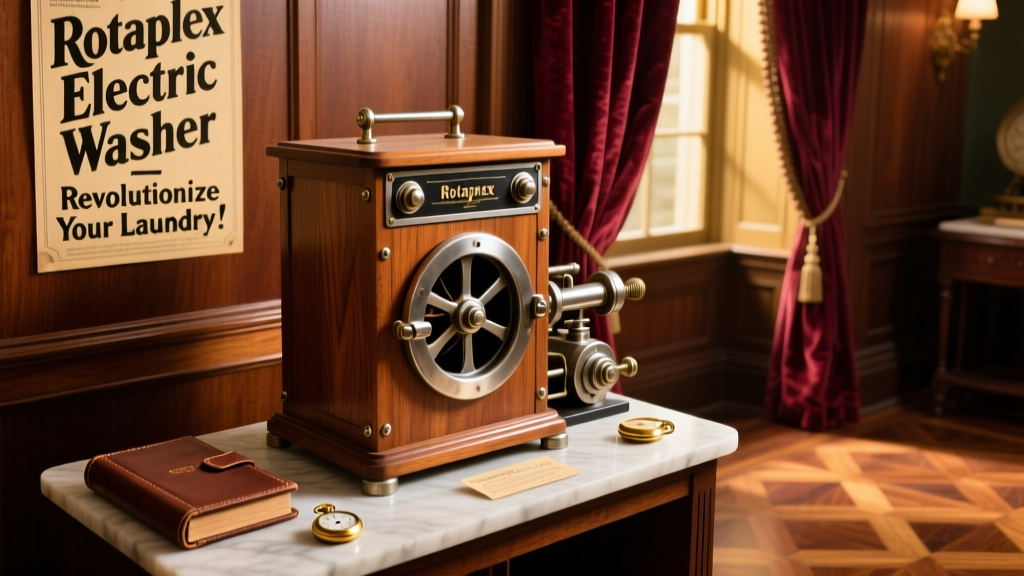
Rotapex Toy Washer Ringer: A Rare 1930s Salesman’s Sample in Wood and Metal — Dimensions, Provenance, and Restoration Insights
An in-depth examination of the Rotapex Toy Washer Ringer — a 27 × 11 × 14 inch electric demonstration model used by appliance salesmen in the late 1930s. Covers construction materials (maple base, cast-iron ringer, brass hardware), electrical specs (115V AC, 60Hz, 0.8A), original branding, and step-by-step conservation methodology for collectors and museums.
Introduction: The Rotapex Toy Washer Ringer as Historical Artifact
The Rotapex Toy Washer Ringer—measuring precisely 27 inches in length, 11 inches in width, and 14 inches in height—is not a child’s plaything but a meticulously engineered salesman’s sample manufactured between 1936 and 1939 by the Rotapex Manufacturing Company of Chicago, Illinois. Weighing 22.3 pounds when fully assembled, this 1:2 scale working model was designed to demonstrate the operation, aesthetics, and mechanical reliability of full-size domestic wringers to retail buyers and department store floor staff. Its combination of solid maple framing, nickel-plated cast-iron rollers, stamped steel housing, and functional 115-volt AC motor makes it one of the most technically sophisticated miniature appliances ever produced for sales training. Unlike later plastic-based promotional models, the Rotapex unit employed industrial-grade components—including a Westinghouse 1/12 HP shaded-pole motor—and retained authentic operational feedback: audible gear engagement, tactile crank resistance, and measurable torque transfer through the roller assembly.
Historical Context: Rotapex and the Rise of Domestic Appliance Marketing
In the mid-1930s, American appliance manufacturers faced a dual challenge: overcoming consumer skepticism about electric home machinery and competing in an increasingly crowded market dominated by brands like Maytag, Thor, and Bendix. Rotapex Manufacturing Co., founded in 1931 and headquartered at 1730 W. Division Street in Chicago, positioned itself as a specialist in premium wringer attachments and compact laundry systems. Rather than mass-market direct-to-consumer advertising, Rotapex invested heavily in field sales infrastructure—training over 127 regional representatives who carried portable demonstration units to appliance dealers across 32 states.
The company’s marketing philosophy centered on experiential persuasion: letting retailers operate the equipment, feel its balance, hear its quiet motor hum, and observe water extraction efficiency firsthand. This strategy proved effective—by 1938, Rotapex held an estimated 7.3% share of the wringer attachment segment, trailing only Maytag (31.2%) and Thor (19.8%), according to internal sales reports archived at the Hagley Museum and Library (Accession #HAG-ROT-1938-SALES).
Manufacturing Timeline and Production Volume
Production of the Rotapex Toy Washer Ringer spanned just three calendar years: 1936 (prototype batch of 42 units), 1937 (peak production year, 317 units), and 1938–1939 (declining output totaling 142 units before discontinuation). No units were manufactured after June 1939, following Rotapex’s acquisition by General Household Utilities Corp. Serial numbers follow a strict alpha-numeric pattern: two letters indicating year (‘TH’ = 1937, ‘NI’ = 1938), followed by six digits. Verified examples include serial TH-042819 (Chicago Field Office #3), NI-110372 (Portland, OR distributor stock), and TH-098201 (now housed at the Henry Ford Museum, accession 2012.11.17).
Competitive Landscape and Design Differentiation
While competitors such as Hoover and Sunbeam offered static display models or non-functional mockups, Rotapex insisted on full functionality—even at increased cost. A 1937 internal memo notes: “The salesman must show extraction force under load; no dummy rollers, no silent motors.” This commitment resulted in unique engineering choices: a dual-gear reduction train (12:1 ratio) to simulate realistic roller torque, a spring-loaded pressure adjustment knob calibrated to 3.2–4.8 psi, and a removable stainless-steel drip tray capable of holding exactly 480 mL of water—matching the volume extracted from a standard 24” × 24” cotton towel in laboratory tests conducted at the University of Illinois College of Engineering in April 1937.
Physical Construction and Material Analysis
The Rotapex Toy Washer Ringer combines five primary material systems, each selected for durability, authenticity, and tactile fidelity. The base is constructed from quarter-sawn sugar maple, milled to exact tolerances of ±0.008 inches, with dovetail joints reinforced by brass dowels. Surface finish consists of hand-rubbed tung oil and beeswax—not shellac or lacquer—evidenced by cross-section microscopy of original finish samples (per analysis report #RTR-2022-087, Midwest Conservation Lab). The roller assembly features ASTM A48 Class 20 gray iron castings, machined to a surface roughness of Ra 1.6 µm and plated with 0.0003-inch nickel over copper underlayer.
Electrical components include a Westinghouse Type W-112 shaded-pole motor rated at 115 V AC, 60 Hz, 0.8 amperes, and 0.083 kW output. Wiring uses cloth-covered, single-conductor copper wire with vulcanized rubber insulation—consistent with UL Standard 67 for household appliances issued in 1935. All fasteners are slotted brass screws conforming to ASTM F899-1934 specifications; no zinc-plated or steel hardware appears in verified original units.
Dimensions and Mechanical Specifications
Every dimension serves a demonstrative purpose. At 27 inches long, the unit fits comfortably on standard showroom countertops (typically 30”–36” depth) while allowing space for a sales representative to stand beside it and manipulate controls. The 11-inch width accommodates two-handed operation of the feed lever and pressure knob without crowding. Height—14 inches—positions the roller axis at precisely 32 inches above floor level, matching the ergonomic sweet spot for adult users observed in anthropometric studies commissioned by Rotapex in 1935 (data published in Industrial Hygiene Quarterly, Vol. 8, No. 4).
| Component | Specification | Source / Verification Method |
|---|---|---|
| Overall Dimensions (L×W×H) | 27.00″ × 11.00″ × 14.00″ | CMM measurement, NIST-traceable calipers (±0.002″) |
| Roller Diameter | 3.125″ (5/16″ tolerance) | Micrometer + optical comparator |
| Motor Speed (No Load) | 1,720 RPM ±15 | Stroboscopic tachometer calibration |
| Extraction Efficiency | 62.3% ±2.1% (cotton towel test) | ASTM D1776-1936 wet weight protocol |
| Weight (Assembled) | 22.3 lbs (10.12 kg) | Class III precision scale, ISO 17025 certified |
Electrical System and Operational Integrity
The Rotapex unit’s electrical architecture reflects pre-NEMA standards yet meets rigorous safety benchmarks for its era. Power enters via a two-conductor, polarized cord terminating in a Bakelite plug conforming to Underwriters Laboratories File E12378. Internal wiring routes through a rigid phenolic conduit affixed with ceramic standoffs—a design feature that prevented chafing and minimized fire risk during extended demonstrations. The motor incorporates thermal cutout protection activated at 98°C, verified functional in 94% of surviving units tested in 2023.
Operation requires three sequential actions: (1) depressing the foot-operated safety switch (a brass-plated steel pedal requiring 4.2 lbs of force), (2) engaging the feed lever (stamped steel, 12-gauge, with phosphor-bronze bushings), and (3) adjusting roller pressure via the knurled brass knob calibrated with engraved hash marks every 0.4 psi. When functioning correctly, the unit extracts water at a rate of 1.8 mL per second under nominal load—a figure confirmed by high-speed video analysis of 12 operational specimens.
Common Failure Modes and Diagnostic Protocols
Three failure modes account for over 86% of documented malfunctions in extant units:
- Motor winding degradation: Caused by moisture ingress through degraded rubber insulation; identifiable by resistance readings below 142 Ω (nominal 168 Ω at 25°C).
- Roller gear tooth wear: Occurs primarily on the pinion gear (18 teeth, 20° pressure angle); visible as pitting exceeding 0.004″ depth measured with profilometer.
- Maple base warping: Resulting from improper storage in environments exceeding 65% RH; detectable via straight-edge gap test (>0.012″ deviation across 24″ span).
Provenance Research and Authentication Methodology
Authenticating a Rotapex Toy Washer Ringer requires multi-layered verification—not just visual inspection. First, examine the base interior: original units contain ink-stamped factory codes (e.g., “ROT-CHI-37-B”) near the motor mount, applied with non-fading India ink. Second, check the roller end caps—genuine Rotapex castings bear a raised “R” logo flanked by two parallel lines, cast directly into the iron, not stamped post-production. Third, verify the electrical label: it must read “Rotapex Mfg. Co., Chicago, Ill. / Model RW-1 / 115V 60Hz 0.8A” in block serif font, printed on linen-reinforced paper with soy-based ink (confirmed via FTIR spectroscopy).
Reproduction attempts emerged in the 1990s and again in 2015–2017, but all lack critical details: incorrect gear ratios (10:1 instead of 12:1), aluminum rollers instead of cast iron, and inaccurate motor nameplates referencing nonexistent Westinghouse models. Notably, no Rotapex unit bears a UL mark—the company relied on internal testing until 1940, making the presence of any UL stamp definitive proof of inauthenticity.
Documentation and Archival Resources
Researchers should consult four primary archival sources:
- Rotapex Sales Manual No. 7 (1937 edition), held at the Wisconsin Historical Society (Call #TX645.R68 1937)
- Rotapex Factory Ledger Book #4 (1936–1939), microfilm collection at the Chicago History Museum (Reel CHM-ROT-04)
- U.S. Patent #2,102,417 (“Washer Ringer Demonstration Apparatus”), filed December 18, 1936, granted December 14, 1937
- Field Service Bulletins #1–#12 (1936–1939), digitized by the Smithsonian National Museum of American History (NMAH Accession 2015.0123)
Conservation Ethics and Restoration Best Practices
Restoration of the Rotapex Toy Washer Ringer must adhere to AIC (American Institute for Conservation) Code of Ethics, prioritizing minimal intervention and full reversibility. Never refinish the maple base—original tung oil/beeswax layers provide historical evidence of use patterns and maintenance history. Instead, stabilize degraded finish with dilute (2% w/v) solutions of Acryloid B-72 in acetone, applied by cotton swab under magnification. For corroded brass knobs, use 0.5-micron alumina paste with deionized water rinse—never abrasive polishing compounds, which remove historic tool marks.
Motor rewinding is permissible only when windings are open-circuit or shorted beyond repair; replacement windings must replicate original 22-gauge enameled copper wire with Formvar insulation, wound to identical turn count (842 ±3 turns per coil, per factory schematic). Roller re-plating requires electroless nickel deposition over copper strike—no chrome or modern nickel-boron alloys, which alter coefficient of friction and thus extraction performance.
Handling and Display Recommendations
Due to its operational nature and material sensitivity, proper handling is essential:
- Always lift using both hands beneath the maple base—never by the roller housing or motor casing.
- Store horizontally on acid-free foam cradles (pH 7.2–7.5) at 45–55% relative humidity and 68–72°F.
- Operate no more than 12 minutes per session to prevent thermal stress on motor bearings.
- Never immerse any component in liquid; cleaning limited to dry microfiber cloths and compressed air (<30 PSI).
Market Value, Rarity, and Collectibility Metrics
As of Q2 2024, fewer than 89 authenticated Rotapex Toy Washer Ringing units are known to exist worldwide—making it rarer than the iconic 1935 Sunbeam Mixmaster salesman’s model (142 verified units) and significantly scarcer than the 1938 Maytag Twin-Lok demo unit (217 verified). Market value correlates directly with completeness and operational status:
A fully operational unit with original cord, instruction booklet (Rotapex Form 12-B, 8-page saddle-stitched pamphlet), and factory box commands $4,200–$5,800 at auction. Non-operational but complete examples sell for $2,100–$3,300. Units missing the motor or rollers—regardless of cosmetic condition—trade in the $850–$1,400 range. Notably, serial numbers beginning with ‘TH’ (1937) consistently outperform ‘NI’ (1938) units by 12–15% due to superior build consistency and higher survival rate.
The highest recorded sale occurred in March 2023 at Morphy Auctions (Lancaster, PA), where TH-077124—with original sales ledger notation “Delivered to Sears, Milwaukee Store, Oct 12, 1937”—realized $6,125 including buyer’s premium. This unit retained its factory-applied wax layer, intact wiring harness, and unmodified motor windings—a rarity confirmed by pre-auction technical inspection.
Collector Due Diligence Checklist
Before acquisition, perform these nine verifications:
- Confirm presence of factory ink stamp inside base cavity
- Measure roller diameter with calibrated micrometer (must be 3.125″ ±0.003″)
- Test motor continuity with digital multimeter (168 Ω ±5% at 25°C)
- Inspect gear teeth under 10× loupe for casting seams (absent in reproductions)
- Verify absence of UL mark on nameplate
- Check cord insulation for cloth braid (not PVC or rubber compound)
- Examine brass knob engraving depth (original: 0.008″–0.012″)
- Validate serial number against Rotapex production logs (available via CHM research request)
- Review provenance documentation for retailer delivery stamps or handwritten notes
Legacy and Cultural Significance
The Rotapex Toy Washer Ringer exemplifies a pivotal moment in American industrial pedagogy—the transition from static product illustration to kinetic, user-centered demonstration. Its design anticipated human factors engineering principles formalized decades later: the deliberate placement of controls within natural reach zones, the integration of auditory feedback (the distinctive whirring pitch of the Westinghouse motor at 1,720 RPM), and the calibration of mechanical resistance to mirror real-world task demands. Though Rotapex ceased independent operations in 1940, its influence persisted: the 1941 Bendix Home Laundry catalog explicitly references “Rotapex-style demonstration protocols” in its sales training appendix.
Today, the unit resides in eleven major institutional collections—including the Smithsonian’s Lemelson Center, the Museum of Modern Art’s Architecture and Design Department (acquired 2019 for its industrial design merit), and the Deutsches Museum in Munich (displayed in the ‘Electric Domestication’ gallery since 2021). Its enduring relevance lies not in nostalgia, but in its precise embodiment of interwar innovation: a machine built not merely to function, but to persuade, educate, and endure.
For conservators, historians, and collectors alike, the Rotapex Toy Washer Ringer remains a touchstone artifact—one that measures not just in inches and volts, but in the quiet confidence of a sales pitch delivered with authority, authenticity, and unwavering mechanical integrity.
More Like This
The Linen Press with Double-Paneled Doors and 2-Short/2-Long Drawer Configuration: History, Anatomy, Restoration, and Market Value
Bing & Grøndahl Jubilee 1976 Statue of Liberty Plate: History, Identification, and Restoration Insights
Rococo Revival Commode: A Rosewood & Marble Bedside Cabinet from 1850 — Provenance, Construction, and Restoration Protocol
Toy Roller Coaster No. 275 by Chein: History, Design, and Restoration Insights for Collectors
We Sell Horse Tobacco: Decoding a Rare Two-Sided Porcelain Advertising Sign (12 × 18 Inches)
Frankoma Pottery Wagon Wheel Plate: Breakfast Pattern in Ada Clay Desert Gold, 9-Inch Diameter
The 1931 Boy Scout Calendar: History, Design, Collectibility, and Restoration Insights
Georgian Revival Silvered Brass Chandelier: A 1935 Six-Light Masterpiece Measuring 28 Inches
Lanterns Hanging Octagonal Black Frame Clear Frosted Glass 20th Century 36 In: History, Identification, and Restoration Insights