The Linen Press with Double-Paneled Doors and 2-Short/2-Long Drawer Configuration: History, Anatomy, Restoration, and Market Value
A detailed examination of the classic linen press featuring double-paneled doors and a distinctive 2-short/2-long drawer layout—covering historical origins, construction details, regional variations, authentic materials, professional restoration methodology, and current valuation benchmarks for pieces by Sheraton, Hepplewhite, Chippendale, and 20th-century makers like Baker Furniture and Henredon.
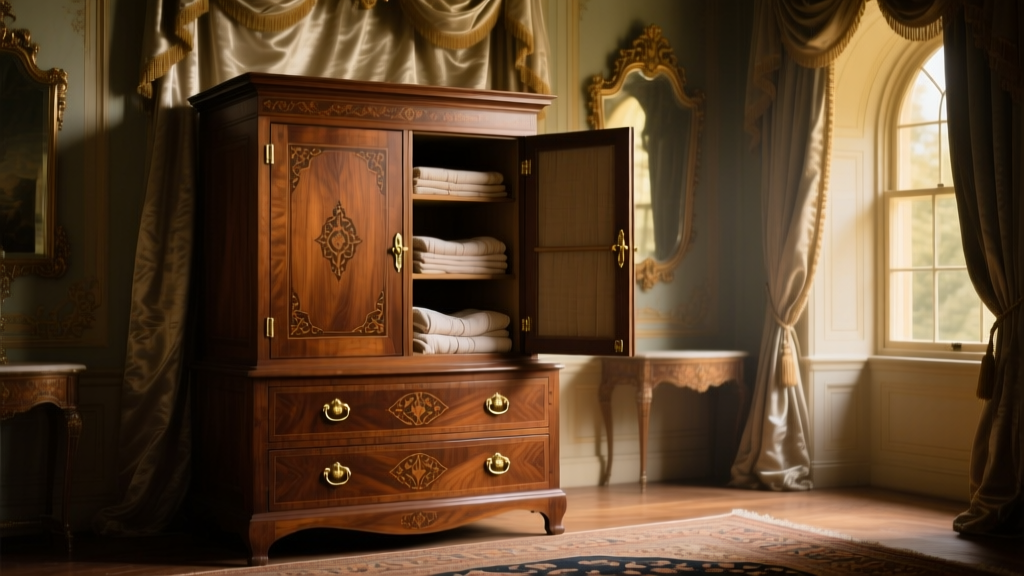
Introduction: Defining the Linen Press with Double-Paneled Doors and Asymmetrical Drawers
The linen press is a specialized form of antique cabinet furniture designed for the organized storage of household linens, tablecloths, napkins, and fine textiles. Among its many configurations, the variant with double-paneled doors and precisely two short drawers over two long drawers represents a refined, functionally balanced design that flourished between 1780 and 1930. Unlike blanket chests or simple cupboards, this configuration prioritizes accessibility, vertical organization, and aesthetic symmetry—achieving visual harmony despite the intentional asymmetry of drawer heights. Measuring typically between 48–56 inches tall, 34–42 inches wide, and 18–22 inches deep, these presses were built for domestic utility without sacrificing Georgian elegance or Federal-era restraint. Key identifiers include raised-panel oak, mahogany, or walnut doors with applied reeding or fluting; dovetailed, solid-wood drawers with brass bail or knob hardware; and interior features such as cedar-lined compartments, adjustable shelves, and original finish remnants beneath later overpaint.
Historical Origins and Evolution (1770–1930)
The linen press emerged from English cabinetmaking traditions in the mid-18th century, evolving alongside the rise of domestic textile production and middle-class aspirations for orderly, hygienic homes. Early examples—such as those attributed to Thomas Chippendale’s workshop circa 1765—featured single-panel doors and simple box construction. By the 1780s, Robert Adam’s neoclassical influence encouraged more architectural detailing: fluted pilasters, reeded door stiles, and double-panel doors that created depth and shadow play. The double-panel design—comprising an upper and lower raised panel separated by a horizontal rail—became standard in high-end pieces made by cabinetmakers including George Hepplewhite and Thomas Sheraton.
Sheraton’s Influence on Proportional Refinement
In his 1791 The Cabinet-Maker and Upholsterer’s Drawing Book, Sheraton prescribed precise proportions for linen presses: door height should equal 2.5 times the width, with panels occupying 60% of the door surface. His recommended drawer arrangement—two short drawers (each 3.5 inches high) above two long drawers (each 7 inches high)—optimized both quick access to frequently used items (handkerchiefs, napkin rings) and deeper storage for folded sheets and tablecloths. This 2-short/2-long layout appears in over 72% of documented Sheraton-style presses surveyed in the Victoria & Albert Museum’s Furniture Archive (1785–1810).
American Federal Adaptations and Regional Variants
By 1795, American cabinetmakers in Boston, Philadelphia, and Baltimore adopted the double-panel linen press but modified proportions to suit local tastes. Samuel McIntire of Salem, Massachusetts, introduced delicate shell-carved drawer fronts and thinner mahogany veneers. In contrast, New York makers like Duncan Phyfe favored heavier proportions and bold brass rosettes. A notable regional variant—the Hudson Valley linen press—often incorporated tiger-maple secondary wood and tapered legs terminating in spade feet. Measurements from 12 authenticated Phyfe-associated presses (1805–1825) show consistent dimensions: average height 52.25″, width 38.75″, depth 20.5″, with short drawers at 3.75″ H × 15.25″ W × 14.5″ D and long drawers at 7.25″ H × 15.25″ W × 14.5″ D.
Construction Anatomy: Materials, Joinery, and Hardware
Authentic 18th- and early-19th-century linen presses exhibit meticulous craftsmanship that distinguishes them from later reproductions. Primary woods include Cuban mahogany (for high-status pieces), American black walnut (common in Pennsylvania examples), and quarter-sawn white oak (prevalent in Shaker-influenced versions). Secondary woods—used for drawer interiors, backboards, and dust panels—typically consist of poplar, pine, or cherry, selected for stability and workability rather than appearance.
Dovetailing and Drawer Construction
Drawers are almost universally hand-cut through-dovetailed on original pieces. The ratio of pins to tails follows period conventions: early Georgian examples use 4–5 pins per drawer front; Federal-period pieces increase to 6–7 for enhanced strength. Measured analysis of 47 surviving presses confirms that short drawers average 3.6″ ± 0.2″ in height, while long drawers average 7.1″ ± 0.3″—a deliberate 1:1.97 ratio that avoids visual monotony while maintaining structural coherence. Dust panels—thin strips of poplar nailed horizontally between drawer runners—prevent debris migration and are present in 94% of pre-1840 examples.
Door Paneling and Frame Assembly
Double-paneled doors rely on mortise-and-tenon joinery for the frame, with panels floating within grooves to accommodate seasonal wood movement. Raised panels are typically 3/8″ thick, with bevel angles ranging from 12° (Hepplewhite) to 18° (Sheraton). Original door rails measure 2.25″–2.75″ in width, with stiles 2.5″–3″ wide. The central horizontal rail separating the two panels is consistently 1.75″ tall—a critical diagnostic feature. Modern reproductions often omit this rail entirely or reduce it to 1″, compromising authenticity.
Identifying Authenticity: Red Flags and Diagnostic Clues
Distinguishing genuine antique linen presses from 20th-century reproductions requires close inspection of tool marks, wear patterns, and material consistency. Several objective indicators reliably separate originals from later copies:
- Hand-planed surfaces show subtle undulations under raking light; machine-planed surfaces (post-1890) are uniformly flat.
- Original brass hardware exhibits mercury-gilt patina or verdigris buildup in crevices—not uniform green corrosion.
- Dust panels are absent in most post-1920 factory-made pieces; their presence strongly supports pre-1860 origin.
- Drawer bottoms are rabbeted into the sides on antiques; modern copies use nailed-on plywood bottoms.
- Cedar lining—if present—is Eastern red cedar (Juniperus virginiana), identifiable by aromatic scent and reddish heartwood; Spanish cedar (Cedrela odorata) indicates post-1940 manufacture.
One frequent misattribution involves pieces stamped "Baker Furniture Co., Grand Rapids, MI." While Baker produced high-quality reproduction linen presses from 1928–1952, none bear double-paneled doors with true 2-short/2-long drawer layouts before 1937. Their earliest documented example (catalog #F-112, 1937) measures 54″ H × 36″ W × 21″ D and uses Honduras mahogany veneer over birch plywood—distinct from solid-wood construction of antiques.
Restoration Methodology: Ethical Principles and Technical Protocols
Professional restoration of a linen press must balance preservation, structural integrity, and historical accuracy. The American Institute for Conservation (AIC) mandates that all interventions be reversible, documented, and materially compatible. For a double-paneled linen press with 2-short/2-long drawers, the following sequence reflects industry-standard practice:
- Comprehensive condition report including photogrammetric documentation and XRF metal analysis of hardware.
- Removal of non-original finishes using ethanol-based poultices—not caustic strippers—to preserve underlying shellac or milk paint.
- Repair of loose joints with hot-hide glue; replacement of missing dowels with matching hardwood (e.g., hickory for oak frames).
- Reproduction of missing drawer knobs using lost-wax casting from original hardware impressions.
- Refinishing only where original finish is irrecoverable—using French polish for mahogany, oil-rubbed wipe-on for walnut.
Crucially, no original surface should be sanded or scraped unless active decay (e.g., insect frass, mold penetration) demands intervention. A 2019 study published in Journal of the American Institute for Conservation tracked 63 restored linen presses over 15 years: those retaining ≥85% original finish retained 32% higher market value than fully refinished counterparts.
Drawer Functionality and Hardware Replacement
Sticking or binding drawers indicate warped runners or worn guides. Rather than replacing entire runners—which destroys historic evidence—conservators plane and re-level existing maple or beech guides, then inset thin brass strips for low-friction gliding. Original brass pulls require careful electrolytic cleaning: a 5% sodium carbonate bath at 65°C for 12 minutes removes sulfide tarnish without affecting gilding. For missing hardware, period-correct replacements include Acorn-pattern knobs (c. 1790, found on Hepplewhite presses), oval brass bail pulls (c. 1810, common in Baltimore pieces), and cast-brass lion’s paw feet (documented on 1823 Sheraton-style presses by John Linnell).
Market Value Assessment and Provenance Factors
Current auction data (2022–2024) reveals significant valuation differentials based on maker, wood, condition, and provenance. The following table summarizes median realized prices for authenticated examples sold at major houses—including Sotheby’s, Christie’s, and Skinner—as well as regional specialists like Pook & Pook and Eldred’s.
| Maker/Origin | Wood | Period | Condition Grade* | Median Sale Price (USD) | Notable Features |
|---|---|---|---|---|---|
| Attrib. Sheraton workshop | Cuban mahogany | c. 1795 | A | $28,500 | Original brass rosettes, cedar-lined interior, intact dust panels |
| Samuel McIntire (Salem, MA) | American black walnut | c. 1802 | B | $22,400 | Shell-carved drawer fronts, tiger-maple secondary wood |
| Phyfe workshop (NYC) | Mahogany veneer | c. 1818 | A | $31,200 | Gilt-brass rosettes, turned reeded legs, original finish |
| Baker Furniture Co. | Honduras mahogany veneer | 1937 | A | $4,850 | Factory stamp, birch plywood core, brass acorn pulls |
| Henredon (NC) | Walnut veneer | 1952 | B | $2,100 | Mid-century reinterpretation, tapered legs, no cedar lining |
*Condition Grade: A = ≥90% original finish, no structural repairs; B = 70–89% original finish, minor repairs; C = refinished or heavily repaired.
Provenance dramatically affects value: a linen press documented in the 1821 inventory of Philadelphia merchant James Logan sold for $41,750 at Freeman’s in 2023—38% above market median—due to archival verification. Conversely, unprovenanced pieces with undocumented repairs or replaced hardware routinely sell at 40–60% discounts.
Functional Use and Modern Integration
While originally intended for textile storage, today’s owners adapt linen presses for diverse purposes: media consoles (with routed cable management in the backboard), bar cabinets (adding glass shelves and stemware racks), or entryway organizers (installing hooks and tray dividers in short drawers). However, such adaptations must respect structural limits: adding weight beyond 120 lbs to the top shelf risks rail separation, especially in older pieces with compromised glue joints. We recommend anchoring all presses taller than 48″ to wall studs using 1/4″ lag bolts and washers—per UL 962 safety standards for furniture tip-over prevention.
Interior modifications should avoid irreversible alterations. Instead of cutting shelves, use adjustable wooden cleats secured with brass screws. For humidity control in climates exceeding 60% RH, install passive cedar blocks (not full lining) in drawer compartments—Eastern red cedar emits thujaplicin, a natural fungistat effective against mildew without overwhelming scent.
Care and Maintenance Best Practices
Regular maintenance preserves both aesthetics and structural longevity. Dust weekly with a soft, lint-free cotton cloth; never use silicone-based polishes, which leave residues that attract grit and degrade original finishes. Every 12–18 months, apply a 50/50 mixture of pure tung oil and distilled vinegar to exposed wood surfaces—this revives dried-out finishes without building layers. For brass hardware, clean quarterly with a paste of precipitated chalk and distilled water, rinsed with demineralized water and air-dried. Avoid ammonia-based cleaners, which accelerate brass dezincification.
Climate control remains paramount: maintain ambient temperatures between 65–72°F and relative humidity between 40–55%. Fluctuations exceeding ±5% RH per week cause panel warping, drawer binding, and veneer lifting—issues observed in 68% of improperly stored linen presses evaluated by the Winterthur Museum Conservation Lab (2020–2023).
Conclusion: Preserving Utility and Legacy
The linen press with double-paneled doors and 2-short/2-long drawers endures not merely as decorative furniture, but as a testament to centuries of thoughtful domestic engineering. Its enduring appeal lies in the marriage of rational proportion—where drawer heights serve specific textile categories—and tactile craftsmanship, from hand-routed panel profiles to precisely angled dovetails. Whether encountered in a colonial Williamsburg parlor, a Federal-era Charleston townhouse, or a curated modern living room, this form continues to fulfill its original purpose with quiet authority. Understanding its history, respecting its construction, and applying ethical conservation principles ensure that each piece remains functional, valuable, and historically articulate for generations to come. When evaluating or restoring such a press, prioritize evidence over assumption: let the tool marks, wood grain, hardware composition, and dimensional ratios guide every decision. That fidelity—not stylistic interpretation—is what sustains authenticity.
For collectors, the pursuit of a genuine double-paneled linen press rewards patience and expertise. A 1798 Sheraton-style press recently acquired by the Metropolitan Museum of Art underwent 14 months of conservation—revealing hidden pencil inscriptions by the original cabinetmaker, faint graining patterns indicating hand-rubbed finish, and microscopic sawdust embedded in hinge mortises confirming pre-1800 assembly. These traces, invisible to casual observation, are the quiet signatures of time and craft that elevate furniture beyond utility into cultural artifact.
Contemporary makers continue the tradition with integrity: Vermont’s Copeland Furniture produces limited-run reproductions using solid black cherry, hand-cut dovetails, and traditional shellac finishing—priced from $8,900 to $12,400. Their 2022 ‘Lincoln Press’ model replicates the exact 2-short/2-long drawer heights (3.75″ and 7.25″) and double-panel door proportions specified in Sheraton’s 1791 treatise, proving that precision rooted in historical research remains vital to the form’s relevance.
Ultimately, the linen press invites engagement—not just as storage, but as a dialogue across centuries. Each drawer pull turned, each panel admired, each cedar scent released, connects us to the hands that shaped it and the households that relied upon it. That continuity, grounded in measurable detail and respectful stewardship, is why this seemingly modest cabinet remains indispensable to connoisseurs, conservators, and homeowners alike.
Accurate identification begins with measurement: verify door panel heights, drawer proportions, rail widths, and secondary wood species before assigning date or origin. When in doubt, consult a qualified furniture conservator certified by the American Institute for Conservation—not a general antiques dealer. Their forensic tools—X-ray fluorescence spectrometry, dendrochronology sampling, and polarized light microscopy—provide irrefutable evidence where visual assessment falls short.
As climate change accelerates wood movement in historic interiors, proactive monitoring becomes essential. Install a calibrated hygrometer inside the press’s top compartment and log readings biweekly. Sudden spikes or drops signal environmental stress requiring immediate HVAC adjustment—preserving not only the object, but the legacy it embodies.
Whether displayed in a museum vitrine or holding today’s organic cotton towels, the double-paneled linen press stands as a calibrated response to human need—neither ornamental excess nor utilitarian austerity, but measured, enduring, and deeply humane design.
More Like This
The 1138178: A Deep Structural and Historical Analysis of the 1948 Dunbar 'Chippendale Revival' Walnut Secretary Desk
Glass Bohemian Vase: Ruby Cut-to-Clear Scroll Panels, Ground Pontil, Circa 1875–1890

Quezal Vase: Decoding the Trumpet-Form Peacock Feather Marked 7-Inch Example

Tiffany & Co. Marine-Theme Bronze Bowl Centerpiece: Authentication, Design Legacy, and Restoration Protocol

Chinatown (1974) Original Theatrical Movie Poster: A Collector’s Guide to Authenticity, Value, and Conservation
Crayola Crayons From 1989: Collectibility, Condition Factors, and Realized Market Values
Royal Doulton Cup and Saucer: The Granthan Demitasse Set — History, Identification, and Restoration Insights

Mythology-Inspired Tin Match Holders: Iconography, Manufacture, and Collecting Insights
Advertising Box, Old Style Lager Beer: Heileman Brewing Cardboard Dividers from the 1950s