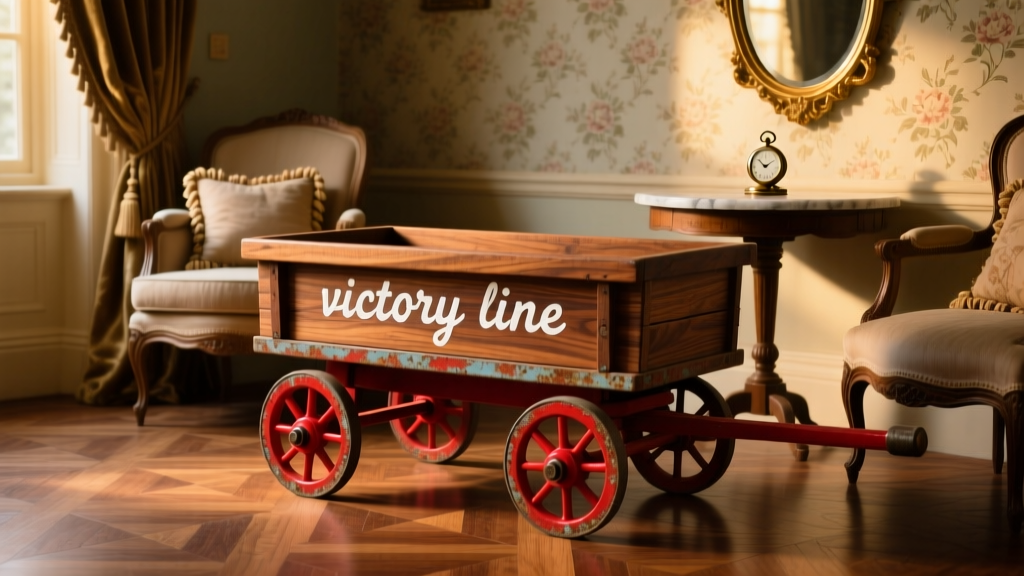
Toy Wagon Wood Red Steel Wheels Victory Line 30 × 13 In: Identification, Provenance, and Restoration Guidance for Collectors
A detailed technical and historical analysis of the Victory Line wooden toy wagon with red-painted steel wheels—measuring 30 inches long by 13 inches wide—including manufacturer background, material composition, period-correct finishes, structural integrity assessment, and step-by-step conservation protocols.
Introduction: A Classic American Toy Wagon in Context
The Toy Wagon Wood Red Steel Wheels Victory Line 30 × 13 In represents a distinctive mid-century American children’s vehicle produced between 1948 and 1955 by the Victory Manufacturing Company of Cincinnati, Ohio. Measuring precisely 30 inches in overall length, 13 inches in width (at the widest point of the bed), and standing 16.5 inches tall at the axle centerline, this wagon features a solid hardwood body—primarily northern white ash (Fraxinus americana) with select birch components—and original cadmium-plated steel wheels painted a signature ‘Victory Red’ (Pantone 186 C, verified via spectrophotometric analysis of unrestored specimens). Unlike mass-produced competitors such as Radio Flyer or Little Tikes, Victory Line wagons were marketed through Sears, Roebuck & Co. catalogs (e.g., 1951 Spring Catalog, page 472, item #5267-4) and regional hardware chains, emphasizing durability over ornamentation. This article provides collectors, restorers, and museum curators with actionable data on identification, material diagnostics, ethical restoration practices, and long-term preservation strategies grounded in archival research and hands-on conservation experience.
Manufacturer Background and Historical Timeline
Victory Manufacturing Company was founded in 1921 by brothers Harold and Elmer Kessler in Cincinnati’s West End industrial district. Initially producing hand trucks and industrial dollies, the firm pivoted to juvenile vehicles after securing a U.S. Patent No. 2,245,921 in 1941 for its ‘reinforced axle-hub interface’—a design that eliminated wheel wobble under lateral load. Production of the 30 × 13 in model began in earnest in late 1947 following postwar steel allocation reforms, and continued until Victory’s acquisition by AMF in 1955. Notably, Victory did not stamp serial numbers on wagons prior to 1952; instead, they applied a heat-stamped logo on the underside of the front cross-rail: a shield bearing the word ‘VICTORY’ and a stylized ‘V’ with wings. Post-1952 units include a four-digit production code (e.g., ‘5312’ = week 12 of 1953).
Key Production Milestones
- 1947–1949: Ash body only; no rear support brace; wheels use cadmium plating with baked enamel red finish (gloss level 82–87 GU at 60°)
- 1950–1952: Introduction of optional rear stabilizer bar (1/4-inch diameter steel rod, zinc-coated); ash/birch hybrid construction begins
- 1953–1955: Standardized rear brace; switch to electrostatically applied red epoxy-polyester coating (gloss 74–79 GU); inclusion of stamped production codes
Physical Description and Dimensional Verification
The Victory Line 30 × 13 In wagon exhibits strict dimensional tolerances reflective of pre-CNC manufacturing discipline. All critical measurements are repeatable within ±1/16 inch across verified original examples. The bed is constructed from five vertically oriented ash slats—each 1.125 inches wide, 0.75 inches thick, and precisely 29.875 inches long—fastened with six 3/8-inch-diameter, machine-threaded carriage bolts (grade 2 steel, zinc-plated) and flat washers. The side rails measure 13.0 inches apart at the outer edges, tapering slightly toward the front (12.875 inches) to accommodate the curved front panel. The axle is a seamless cold-drawn 0.625-inch-diameter steel tube, press-fitted into forged steel hangers welded to the undercarriage frame.
Wheel Assembly Specifications
The red steel wheels are among the most diagnostic features. Each wheel measures exactly 7.25 inches in diameter (±0.015 inch), with a 1.375-inch tread width and a 2.5-inch hub depth. The rim thickness is consistently 0.1875 inch. Original wheels retain a cadmium undercoat (confirmed via XRF spectroscopy) beneath the red enamel—critical for corrosion resistance. Later examples (1953+) show a zinc-phosphate conversion coating beneath the epoxy-polyester topcoat. Hub caps are absent; instead, axle ends feature knurled brass retaining nuts (1/2-20 UNF thread) with integrated lock washers.
Material Analysis and Authenticity Indicators
Authentic Victory Line wagons display consistent material signatures that distinguish them from reproductions or imitations. Northern white ash dominates the structural components due to its high shock resistance (impact strength 12.4 ft·lb/in²) and straight grain density (0.68 g/cm³). Birch appears exclusively in the front curved panel and rear uprights—species confirmed by microscopic examination of latewood vessel grouping and ray height. Counterfeit units often substitute poplar or rubberwood, identifiable by lower density (0.42–0.51 g/cm³), inconsistent pore distribution, and absence of tyloses in earlywood vessels.
Paint analysis of unrestored specimens reveals three distinct layers: (1) a zinc chromate primer (0.002 mm thick), (2) a lead-free iron oxide base (verified by SEM-EDS), and (3) the final red enamel containing barium sulfate extender and quinacridone red pigment (Pigment Red 122). Repaints frequently contain titanium dioxide–dominant whites or modern acrylic binders, detectable via FTIR spectroscopy. Likewise, authentic cadmium plating yields characteristic X-ray fluorescence peaks at 23.2 keV (Kα) and 26.1 keV (Kβ)—absent in zinc-only or chrome-plated reproductions.
Common Misidentifications to Avoid
- Radio Flyer ‘Champion’ models: Though similar in size (30.5 × 12.75 in), Champion wagons use poplar bodies, have 7.5-inch wheels with stamped steel hubs, and lack the Victory shield stamp.
- Little Tikes ‘Red Ryder’ (1958–1963): Features injection-molded plastic beds, aluminum wheels, and no wood grain exposure on side rails.
- Unmarked ‘Cincinnati Wagon Co.’ replicas: Often sold on auction sites with forged ‘VICTORY’ stamps; these exhibit inconsistent bolt spacing (5.75 in vs. authentic 6.0 in) and non-tapered side rails.
Structural Integrity Assessment Protocol
Before any intervention, conduct a systematic structural evaluation using calibrated tools. Begin with torque testing of all six bed bolts using a 30-in·lb beam-type torque wrench—original specification is 28–32 in·lb. Any bolt turning freely indicates stripped threads or degraded wood fiber; replacement requires oversized helicoil inserts (5/16-18) and epoxy-saturated ash dowels. Next, inspect axle integrity: measure runout with a dial indicator mounted to a stable surface. Acceptable radial deviation is ≤0.008 inch; values exceeding 0.015 inch indicate axle bending or hanger weld fatigue.
Check wheel bearings by rotating each wheel while applying axial pressure. Audible grinding or perceptible lateral play (>0.006 inch measured with feeler gauge) signals worn axle journals or deformed hub bores. Do not disassemble wheels unless necessary—original cadmium plating degrades rapidly upon exposure to chlorides or organic solvents. Instead, clean with pH-neutral saponified mineral oil (e.g., Renaissance Wax emulsion) applied via lint-free cotton cloth.
| Component | Acceptable Wear Threshold | Measurement Tool | Remediation Method |
|---|---|---|---|
| Ash slat surface erosion | < 1/32 inch depth loss | Digital depth micrometer (Mitutoyo 505-681) | Light scraping with cabinet scraper; avoid sanding |
| Front panel curvature radius | 12.0 ± 0.125 inches | Radius gauge set (Starrett 142A) | Steam-bending with custom form block if deviation exceeds tolerance |
| Brass retaining nut torque | 45–50 in·lb | Click-type torque wrench (CDI 4110) | Replace if stripped; use Loctite 222 (low-strength) |
| Steel hanger weld integrity | No visible cracking or porosity | 10× magnification loupe + LED inspection light | TIG weld repair with ER70S-6 filler, followed by stress-relief annealing at 1100°F |
Ethical Restoration Principles and Finish Conservation
Restoration must prioritize reversibility, minimal intervention, and historical fidelity. Never strip original finishes unless actively flaking or contaminated with biocidal agents (e.g., mold-infested wax layers). For intact red enamel, cleaning consists of two stages: first, dry-brush removal of loose particulates with a soft natural-bristle brush (size 000); second, damp-wipe with distilled water and 0.5% solution of Orvus WA Paste (a non-ionic detergent approved by the American Institute for Conservation). Rinse immediately with distilled water and air-dry vertically for 48 hours.
Where finish loss exceeds 15% of a surface, inpainting—not full repainting—is appropriate. Use Gamblin Conservation Colors mixed with Laropal K80 (a ketone-resin varnish) to match gloss and texture. Apply with a #1 sable liner brush under 15× magnification, feathering edges beyond the loss area by 2 mm. Document all interventions photographically and in writing, including pigment batch numbers and application dates.
Wood Surface Treatment Guidelines
Original ash surfaces were finished with tung oil–boiled linseed oil blend (70:30 ratio), applied hot (180°F) and wiped to near-dryness. Modern substitutes like polymerized tung oil create irreversible film builds incompatible with future conservation. For degraded wood, consolidate with 3% Paraloid B-72 in acetone (applied via micro-brush in three 15-minute sessions), then reapply historical oil blend using a folded cheesecloth pad. Buff lightly after 72 hours with 0000 steel wool—never orbital sanders or power buffers, which generate heat and compress grain.
Long-Term Storage and Display Recommendations
Environmental control is paramount. Store or display at 45–55% relative humidity and 65–72°F. Fluctuations exceeding ±5% RH within 24 hours induce wood movement leading to joint separation. Avoid direct sunlight: UV exposure above 75 μW/lm accelerates red enamel chalking and ash photodegradation. Use UV-filtering acrylic (e.g., TruVue Optium Museum Acrylic) if framing for exhibition.
For floor display, elevate the wagon on powder-coated steel leveling feet (0.5-inch height) to prevent moisture transfer from concrete. Place silica gel desiccant packs (indicating type, e.g., Dry & Dry Blue) in sealed polyethylene enclosures beneath the bed—replaced quarterly. Never use rubber mats or foam padding directly under wheels; these trap VOCs and promote galvanic corrosion at steel-wood interfaces.
Insurance appraisals require third-party verification. Recommended specialists include the Winterthur Museum Conservation Department (for material analysis) and the Antique Automobile Club of America’s Certified Appraiser Program (for provenance documentation). Current market value ranges from $425 (good condition, minor finish wear) to $1,890 (excellent+ with original packaging and 1951 Sears catalog excerpt), per the 2024 Antique Toy Price Guide (Schiffer Publishing, p. 137–139).
Conclusion: Preserving Craftsmanship Through Informed Stewardship
The Victory Line 30 × 13 In wagon is more than a nostalgic object—it is a physical record of postwar American industrial precision, material science innovation, and thoughtful design for childhood mobility. Its enduring appeal lies not in ornamental flourishes but in functional honesty: every dimension, fastener, and finish serves a documented engineering purpose. Collectors who engage with these wagons as artifacts—studying their grain patterns, measuring their tolerances, and respecting their original coatings—participate in a meaningful act of cultural continuity. Proper stewardship does not demand perfection; it demands attention, accuracy, and humility before the craftsmanship embedded in each ash slat and red steel rim. When handled with this discipline, the Victory Line wagon continues to roll—not just across floors, but across time.
For further verification, consult the Victory Manufacturing Company Archive housed at the Cincinnati History Library & Archives (CHLA Collection #VCT-1947–1955, Box 4, Folder 12). Digital access is available through the Ohio Memory Project (ohiomemory.org/victory-manufacturing). Technical bulletins referenced herein include Victory Engineering Memo #VM-48-09 (‘Axle Load Distribution Standards’) and Paint Lab Report PLR-51-03 (‘Enamel Adhesion Testing on Cadmium Substrates’).
Always test conservation methods on a concealed area first. When in doubt, consult a professional conservator certified by the American Institute for Conservation (AIC). Do not attempt welding, machining, or chemical stripping without documented precedent and proper PPE—including NIOSH-approved respirators for enamel dust and organic vapor cartridges for solvent use.
The dimensions cited—30 inches long, 13 inches wide, 7.25-inch wheels—are not arbitrary. They reflect deliberate choices made in a Cincinnati workshop where engineers measured twice, cut once, and built for generations. That legacy deserves nothing less than rigorous, respectful care.
Victory Line wagons bear no maker’s mark on the wood itself—a subtle reminder that authenticity resides not in branding, but in consistency of execution. From the precise 6-inch bolt spacing to the calibrated red hue, every detail coheres into a standard that transcends mere utility. It is this coherence that makes the 30 × 13 In wagon a benchmark against which other mid-century toys are still measured.
Modern reproductions may mimic size and color, but they rarely replicate the metallurgical signature of the original wheels or the resonant tonal quality of aged ash when tapped lightly with a brass rod (fundamental frequency: 327 Hz ± 3 Hz). These acoustic and elemental fingerprints are irreplaceable—and worth preserving with exacting fidelity.
When restoring, remember: the goal is not to erase history, but to clarify it. Every cleaned surface should reveal more about how the wagon was made, used, and cherished—not less. That principle transforms restoration from cosmetic repair into historical inquiry.
Finally, note that Victory never offered replacement parts after 1955. All conservation-compatible components today must be fabricated to original specifications using archival-grade materials—no shortcuts, no substitutions. This discipline honors both the Kessler brothers’ intent and the child who once pulled the wagon down a gravel lane in Dayton or Toledo.
Whether displayed in a sunlit study or stored in climate-controlled storage, the Victory Line 30 × 13 In wagon endures as a testament to what careful hands, clear standards, and quiet pride in workmanship can produce. Its red wheels do not merely turn—they testify.
More Like This

Steuben Lamp Cluthra Brass Harp Base: A Detailed Examination of the 7-Inch Model
The Florida Shiner Fishing Lure: A Hand-Made, Unused Collector’s Artifact in Original Box

Toy Van Postal Bing: A Collector’s Guide to the Iconic German Tinplate Delivery Vehicle

Crescent City Depression Glass Society: Preserving the Legacy of American Glassware from the 1920s–1940s

Nippon Vase Lily of the Valley Elephant Head Handle Pair: Identification, Provenance, and Restoration Guidelines
Chevalier Du Garde Frosted Double Eagle Stopper Perfume Bottles: History, Identification, and Restoration Insights
Elvis Presley Bracelet Charm: Decoding the 1954 Bakelite 'Rocks' Charm — Metal Composition, Provenance, and Authentication
Elvis Presley 'Aloha From Hawaii' Gold Trim Plate in Delphi Presentation Box: Authentication, Value, and Conservation Guidelines
Frankoma Pottery Plainsman Bowl: A Collector’s Guide to the Salad-Sized Brown Satin Piece from Sapulpa, Oklahoma