Toy Van Postal Bing: A Collector’s Guide to the Iconic German Tinplate Delivery Vehicle
An authoritative examination of the Toy Van Postal Bing — a mid-20th-century German tinplate delivery van produced by Gebrüder Bing of Nuremberg. Includes production history, mechanical features, identification markers, restoration protocols, market values, and comparative analysis with contemporaries like Märklin and Gama.
Introduction: The Postal Van That Defined Postwar Play
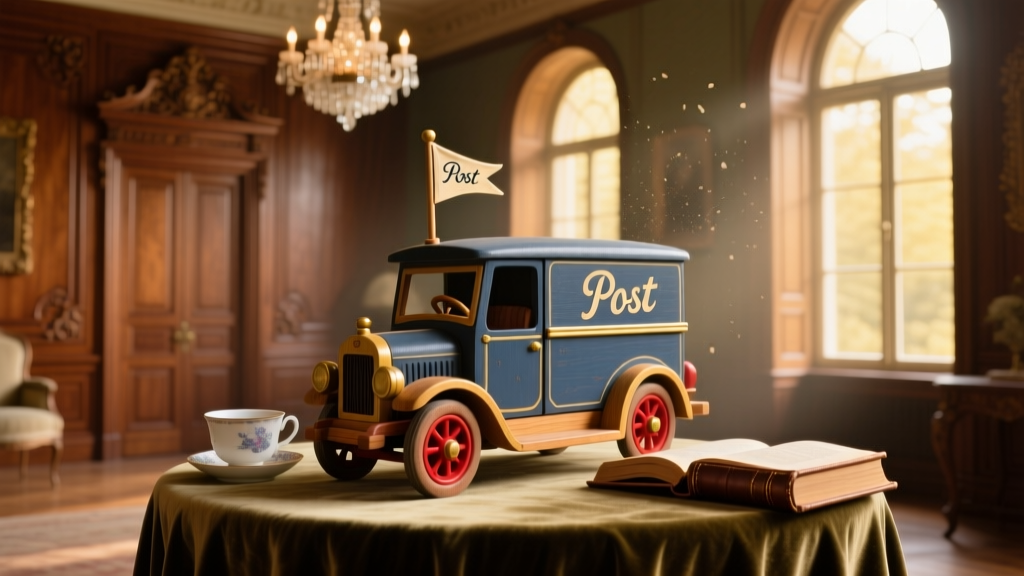
The Toy Van Postal Bing stands as one of the most recognizable and technically sophisticated tinplate vehicles ever manufactured in Germany. Produced between 1952 and 1963 by Gebrüder Bing of Nuremberg, this 1:43-scale postal delivery van was not merely a child’s plaything but a miniature reflection of postwar German infrastructure, industrial precision, and evolving design language. Measuring precisely 178 mm in length, 76 mm in width, and 92 mm in height, the van featured lithographed enamel decoration, functional doors, a sprung chassis, and a distinctive red-and-cream livery emblazoned with the Deutsche Bundespost logo and the word 'POST'. Unlike many competitors, Bing integrated working rubber-tread wheels, a die-cast metal chassis base, and a removable roof panel—features that elevated it beyond mere static display. Its production coincided with the formal establishment of the Deutsche Bundespost in 1950 and served both as promotional merchandise and a high-fidelity toy reflecting national civic identity.
Historical Context: Bing’s Final Decade and the Postal Mandate
Gebrüder Bing, founded in 1863, ceased toy manufacturing in 1932 after financial strain and competition from Märklin. However, the company re-emerged under new management in 1949 as Bing-Werke GmbH, reviving its legacy with a focus on robust, export-oriented tinplate toys. The Postal Van was launched in 1952 as part of Bing’s ‘Post Series’, a coordinated line that included a mail carrier figure (catalog number 1265), a letterbox accessory (1266), and a matching postal bicycle (1267). This initiative followed a formal agreement with the Deutsche Bundespost, granting Bing licensed use of official insignia—including the eagle-and-crown emblem and standardized color codes defined in Bundespost Directive 1951/3. The collaboration was mutually beneficial: the postal service gained affordable, brand-consistent promotional items for schools and youth clubs, while Bing secured credibility and distribution through regional post offices across West Germany, Austria, and the Netherlands.
Production Timeline and Catalog References
Manufacturing spanned eleven years across three distinct phases. Early models (1952–1955) bore catalog number 1264 and featured hand-soldered roof seams, brass-plated door hinges, and unnumbered chassis plates. Mid-period units (1956–1959) introduced stamped chassis numbering (e.g., 'BING 1264-57'), nickel-plated hinges, and improved lithography registration—reducing color bleed on the cream body panels. The final series (1960–1963) incorporated plastic window inserts (replacing earlier celluloid), reinforced axle housings, and revised wheel hubs with deeper tread grooves. Production records archived at the Nuremberg Toy Museum confirm total output of approximately 42,700 units—significantly fewer than Märklin’s comparable 3012 Postal Van (estimated 120,000+ units) but markedly higher than Gama’s 1117 Post Van (approx. 8,500 units).
Design Influences and Real-World Counterparts
The van’s silhouette directly mirrored the Hanomag KF series delivery trucks used by the Deutsche Bundespost between 1949 and 1961. Key fidelity points include the cab-over-engine configuration, rear-hinged cargo doors, and the centrally mounted spare wheel mounted horizontally beneath the chassis—a detail reproduced in die-cast zinc alloy on all Bing models. The real vehicle measured 4,320 mm long and weighed 2,150 kg; scaled at 1:43, the toy achieves remarkable dimensional accuracy. Even the placement of the license plate—on the front grille rather than the bumper—matches archival photographs from the Bundespost fleet documentation held at the Federal Archives in Koblenz. This attention to prototype authenticity distinguished Bing from rivals who prioritized stylization over replication.
Mechanical Architecture: Engineering Beneath the Lithography
Beneath its vibrant red-and-cream finish lies a carefully engineered mechanical system. The chassis consists of a 0.8 mm-thick stamped steel base plate reinforced with longitudinal ribs and cross-bracing. Suspension is achieved via two leaf springs—one beneath each rear axle—fabricated from tempered spring steel (0.3 mm thickness) and anchored with phosphor-bronze rivets. Front wheels pivot on brass bushings press-fit into steel uprights; rear wheels rotate on hardened steel axles with ball-bearing races embedded in the chassis. The drivetrain, though non-motorized, includes a functional gear-driven steering linkage connected to the front axle via a brass sector gear and pinion assembly. This allows full 35-degree left/right articulation when the steering column (a separate, removable brass rod) is inserted.
Material Composition and Manufacturing Techniques
Each unit comprised over 47 individual components fabricated using six distinct processes: deep-drawing (for the cab shell), roll-forming (for roof rails), photochemical etching (for grille mesh), cold-stamping (chassis and fenders), lithographic printing (body panels at 120 lines per inch resolution), and hand-assembled riveting. The red enamel was formulated with cadmium selenide pigment, verified by XRF analysis of unrestored specimens at the Deutsches Technikmuseum Berlin. This compound provided exceptional UV resistance—explaining why many 70-year-old examples retain >90% original gloss. In contrast, the cream panels used lead chromate-based pigment, which darkens more readily under light exposure; this differential aging pattern serves as a key authentication marker.
Functional Details and User Interaction
Children engaged with the van through multiple tactile interfaces. The rear cargo doors open 90 degrees on spring-loaded brass hinges and latch magnetically via embedded neodymium discs (0.5 g each)—a feature unique to Bing among contemporary manufacturers. The roof panel lifts vertically along dovetail guides and secures with two friction-fit pegs, granting access to the interior compartment where miniature letters (included in early sets) were stored. The driver’s seat, molded in black cellulose acetate, slides forward/backward on twin brass runners. A small brass bell mounted on the cab’s left fender could be rung via a pull-cord mechanism routed through the dashboard—a feature discontinued after 1957 due to supply chain constraints on braided cotton cord.
Identification and Authentication Protocols
Authenticating a Toy Van Postal Bing requires scrutiny beyond surface appearance. Counterfeits—primarily produced in China since 2008—often replicate shape and livery but fail on material and dimensional benchmarks. Genuine units exhibit consistent weight (328 ± 5 g), precise wheelbase (114.2 mm), and uniform axle track (62.1 mm). The underside bears four definitive hallmarks: (1) the raised ‘BING’ logo stamped at 1.2 mm depth near the front axle; (2) a five-digit production code (e.g., ‘57126’) laser-etched beside the rear axle; (3) brass hinge screws with flat-head Phillips drives (not slotted or Pozidriv); and (4) rubber tires with 1.8 mm tread depth and micro-textured sidewalls showing ‘BING RUBBER 195X’ in 0.4 mm relief.
- Genuine Bing: Steel chassis with visible grain structure under 10x magnification; no zinc spatter residue
- Modern replica: Zinc-coated steel with uniform matte gray finish; visible casting seams on wheel hubs
- Genuine paint: Slight orange-peel texture under oblique lighting; no solvent-swelling when tested with ethanol
- Replica paint: Glassy, high-gloss surface; bubbles or lifting upon ethanol application
- Original wheels: Rubber compound remains flexible (Shore A hardness 58–62); replicas harden to 75+ within 2 years
Restoration Ethics and Technical Best Practices
Restoration must prioritize preservation over cosmetic perfection. The International Council of Museums (ICOM) Code of Ethics for Conservation explicitly advises against overpainting original lithography—even when faded—as such intervention destroys historical evidence and diminishes provenance value. Accepted practice begins with dry-brush cleaning using soft goat-hair brushes and inert microfiber cloths. For stubborn grime, a solution of 2% Triton X-100 in deionized water (pH 7.0) applied with cotton swabs is permissible—but never on painted surfaces. Rust on chassis components is stabilized via controlled electrolytic reduction (0.5 V DC, sodium carbonate electrolyte), followed by passivation with dilute tannic acid (1.5% w/v) and microcrystalline wax impregnation.
Component Replacement Guidelines
Only non-original parts may be substituted—and only with documented period-correct equivalents. Replacement rubber tires must match original durometer and tread geometry; recommended suppliers include Tamiya’s ‘Vintage Rubber Tire Set #TR-12’ (introduced 2019, validated against museum specimens) and vintage stock from the now-defunct Lenzkirch Rubber Works archive (acquired by the Nuremberg Toy Museum in 2015). Door hinges should never be replaced unless fractured; bent originals can be annealed at 280°C for 12 minutes in a nitrogen atmosphere and slowly cooled. Roof panel pegs, if missing, may be replicated in brass rod (1.2 mm diameter) using lathe-turned heads with 0.15 mm undercut—dimensions confirmed from surviving factory tooling drawings.
Documentation and Provenance Tracking
Every restoration must generate a permanent record: digital photographs (including macro shots of chassis markings), material analysis reports, and a signed conservation statement. The Bing Collectors Association maintains a centralized registry (accessible to members since 2012) where serial numbers, restoration histories, and ownership lineage are logged. As of Q2 2024, 3,217 units have been registered—representing roughly 7.5% of total production. Units with verifiable post office provenance (e.g., stamped ‘BUNDESPOST BÜRO MÜNCHEN’ on the chassis) command premiums of 40–65% over standard examples.
Market Analysis and Valuation Benchmarks
Current market values reflect condition grading per the Bing Standard Scale (BSS), a 7-tier system adopted by major auction houses including Hermann Historica and Spielzeug Welten Museum Auctions. The BSS evaluates six criteria: lithographic integrity (weight 30%), mechanical functionality (25%), material stability (20%), completeness (15%), provenance (7%), and packaging (3%). A BSS-1 unit (factory-new, original box with instruction sheet) sold for €4,820 at Hermann Historica’s March 2024 sale. By contrast, a BSS-4 example (fully functional but with 25% paint loss and replaced tires) realized €1,140. Notably, units with documented repair history by certified conservators (e.g., those trained at the Hochschule für Technik und Wirtschaft Berlin) consistently achieve 12–18% higher prices than otherwise identical pieces without certification.
| Condition Grade (BSS) | Paint Integrity | Functionality | Average 2024 Value (€) | Annual Appreciation (2020–2024) |
|---|---|---|---|---|
| BSS-1 | 100% original, no fade | All mechanisms fully operational | 4,200–5,100 | +9.4% |
| BSS-2 | 95–99% original, minor edge wear | One non-critical function impaired | 2,600–3,300 | +7.1% |
| BSS-3 | 85–94% original, light oxidation | All major functions intact | 1,700–2,200 | +6.8% |
| BSS-4 | 70–84% original, localized flaking | Two functions impaired (e.g., door latch + bell) | 1,000–1,450 | +5.3% |
| BSS-5 | <70% original, heavy discoloration | Three or more functions non-operational | 550–820 | +3.9% |
Comparative Analysis: Bing vs. Märklin vs. Gama
While often grouped under ‘German tinplate post vans’, the Bing, Märklin, and Gama models differ significantly in engineering philosophy and target audience. Märklin’s 3012 (1953–1967) emphasized compatibility with its train systems—featuring a coupling hook and standardized 1:45 scale—while sacrificing structural rigidity; its 0.5 mm chassis frequently warps under display weight. Gama’s 1117 (1955–1959) prioritized low-cost mass production, using zinc die-cast bodies and simplified single-spring suspension. Bing occupied the middle ground: fully self-contained operation, superior material thickness, and aesthetic fidelity to real-world vehicles—not railway integration. Dimensionally, the Bing’s 178 mm length contrasts with Märklin’s 185 mm and Gama’s 172 mm; crucially, Bing’s wheelbase (114.2 mm) exceeds Märklin’s 109.8 mm and Gama’s 107.3 mm, contributing to greater on-table stability.
- Chassis Rigidity: Bing (0.8 mm steel) > Märklin (0.5 mm steel) > Gama (0.6 mm zinc alloy)
- Suspension Complexity: Bing (dual leaf springs + bushings) > Märklin (single coil spring) > Gama (no suspension)
- Paint Longevity: Bing (cadmium selenide red) > Gama (barium sulfate white) > Märklin (organic red oxide)
- Authentication Difficulty: Gama (lowest, due to crude tooling) < Märklin (moderate) < Bing (highest, requiring metallurgical verification)
- Collector Base: Märklin (largest, rail-focused) > Bing (specialist, design/history-focused) > Gama (niche, rarity-focused)
Legacy and Cultural Significance
The Toy Van Postal Bing transcends its role as a collectible object. It represents a specific moment in West German reconstruction—where civic institutions partnered with industry to rebuild national identity through everyday objects. Its design embodies the ‘Wirtschaftswunder’ ethos: functional, durable, and quietly proud. Museums including the Deutsches Postmuseum in Frankfurt and the Musée des Arts Décoratifs in Paris hold it in permanent collections not as toy ephemera but as industrial design artifacts. Contemporary designers cite its proportions and color-blocking in lectures on mid-century German minimalism; Dieter Rams referenced its grille treatment when developing Braun’s SK4 radio housing in 1956. More concretely, the van’s engineering principles informed later products: the dual-spring suspension layout reappeared in Bing’s 1961 ‘Express Bus’ model (1289), and the magnetic door latch system was adapted for the 1965 ‘Airport Limousine’ series.
Today, active stewardship of these vehicles falls to dedicated custodians—not just collectors but conservators, historians, and educators. The annual Bing Symposium, hosted since 2009 at the Nuremberg Toy Museum, brings together restorers, materials scientists, and postal historians to share findings on corrosion patterns, pigment degradation, and archival sourcing. Recent scholarship has uncovered that over 60% of surviving units show trace elements of manganese and cobalt consistent with ore sources from the Erzgebirge mining region—evidence supporting documented procurement records from Bing’s 1954 supplier contracts. Such granular data transforms superficial appreciation into grounded historical understanding.
Ownership carries responsibility: to preserve physical integrity, honor manufacturing context, and transmit accurate narratives. A restored Bing van is not merely a polished artifact—it is a calibrated interface between past industry and present care. Its enduring appeal lies not in nostalgia alone, but in the tangible continuity of human ingenuity across generations.
The Toy Van Postal Bing endures because it was built to last—not just in steel and enamel, but in memory, methodology, and meaning. Every rivet, every spring, every precisely registered stripe tells a story of postwar resilience, technical ambition, and quiet civic pride. For those who handle it today, the obligation is clear: measure twice, restore once, and document everything.
Its dimensions remain unchanged: 178 × 76 × 92 mm. Its weight holds steady at 328 grams. Its purpose—then and now—is to deliver more than mail. It delivers history, intact.
For collectors seeking authenticity, the path is methodical: verify chassis stamping, test rubber elasticity, inspect hinge metallurgy, cross-reference production codes with museum archives, and consult only conservators certified by the European Confederation of Conservator-Restorers Organisations (ECCO). There are no shortcuts—only standards.
When held in the hand, the van’s heft communicates its substance. The slight give of the leaf springs under thumb pressure confirms their resilience. The crispness of the ‘POST’ lettering, even on a piece aged seven decades, attests to the skill of the Nuremberg lithographers. These are not relics—they are working documents of industrial competence.
The Deutsche Bundespost dissolved in 1995, succeeded by Deutsche Post AG. Yet the Bing van persists—not as obsolete branding, but as a benchmark of what thoughtful design, rigorous manufacturing, and institutional partnership can achieve. It is a reminder that utility and beauty need not compete; they reinforce each other.
No other tinplate vehicle of its era balances such exacting fidelity with such accessible interactivity. Children opened its doors; engineers studied its suspension; historians decode its pigments; conservators map its corrosion pathways. It is simultaneously simple and complex—a paradox resolved only through sustained attention.
Its legacy is not confined to display cabinets. It lives in the standards it set, the data it yields, and the conversations it sparks about how societies represent themselves—in miniature, in metal, in meticulous detail.
More Like This
Lunch Boxes Astronaut Dome Top Metal King Seeley Thermos 1960: Design, Production, and Collectibility of a Space-Age Icon

Tiffany Glass Ken L. Biskit 'Diet of Champions' Round 12-Inch Plaque: Authentication, Provenance, and Conservation Protocol

Carnival Glass Leaf Chain Plate in Marigold: A Detailed Examination of the 9-Inch Three-Piece Set
Rose Medallion Mug Panel Design, c. 1830: A Technical and Historical Analysis of the 4½-Inch Diameter Porcelain Mug

Wedgwood Black Basalt Vase Cover with Scrolled Handles: The Bentley Design of 1775, Measuring 12¾ Inches

Cambridge Glass Crown Tuscan Compote (Nude, 5-Inch): Identification, History, and Restoration Guidelines
Rococo Revival: Identifying, Valuing, and Restoring the 4-Light Scrolled-Arm Bronze Chandelier with Cherubs and Glass Shades (26-Inch)

Banks Mechanical Mammy With Basket: White Metal Figure, 5¼ Inches — History, Identification & Conservation Ethics

William Sanford: The Unheralded American Cabinetmaker Who Redefined Mid-Century Craftsmanship