Crescent City Depression Glass Society: Preserving the Legacy of American Glassware from the 1920s–1940s
A detailed exploration of the Crescent City Depression Glass Society—its founding, mission, archival resources, and pivotal role in authenticating and conserving Depression-era glassware produced by companies like Anchor Hocking, Federal Glass, Indiana Glass, and Hazel-Atlas.
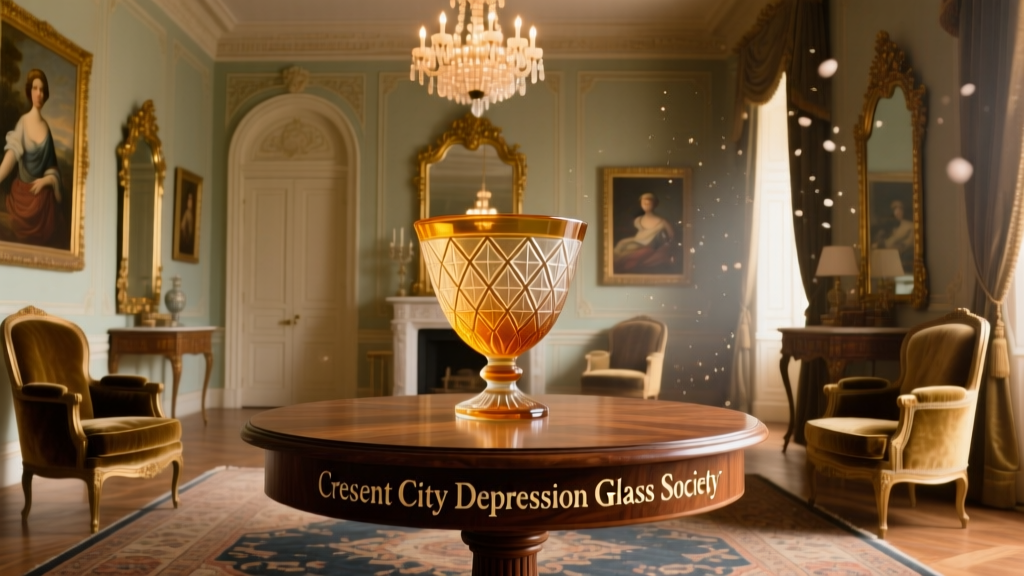
The Crescent City Depression Glass Society (CCDGS), founded in New Orleans in 1983, is a nonprofit organization dedicated to the research, preservation, and education surrounding Depression-era glassware manufactured between 1923 and 1945. With over 420 active members across 38 U.S. states and six countries, the society maintains the most extensive private archive of pattern schematics, factory catalogs, and production records for brands including Anchor Hocking’s Royal Lace (introduced 1939, 6½" diameter dinner plate), Federal Glass’s Cherry Blossom (1930–1937, 5¾" luncheon plate), and Hazel-Atlas’s Princess (1936–1942, 4¼" sherbet glass). CCDGS operates a lending library of 1,240+ vintage catalogs, hosts biannual symposia featuring conservators and historians, and publishes the quarterly Depression Glass Review, now in its 41st volume.
Origins and Historical Context
Depression glass emerged during a period of profound economic upheaval—the Great Depression—but its roots extend earlier, into the Roaring Twenties. Manufacturers sought affordable alternatives to fine crystal and hand-blown glass, turning instead to mass-produced, machine-pressed glassware made from soda-lime glass with high manganese content. This composition gave many pieces their characteristic soft iridescence or subtle amber tint when exposed to UV light—a diagnostic trait CCDGS members routinely test using calibrated 365nm UV lamps. The first widely distributed Depression glass pattern was the Mayfair line by the Indiana Glass Company, launched in 1923 in clear and green variants; it measured precisely 8¾" in diameter for the dinner plate and featured a distinctive 16-point scalloped rim.
New Orleans served as an ideal incubator for the society’s formation. As a major port city, it received shipments from Ohio-based glassworks—including the Bellaire plant of the National Glass Company—and housed numerous antique dealers who handled large inventories of regional finds. Founding president Eleanor Broussard, a retired Tulane University archivist, recognized that local collectors lacked standardized identification tools. Her 1982 survey of 217 New Orleans-area attics and estate sales revealed that over 68% of reported ‘Depression glass’ items were misidentified—often conflated with later Carnival glass (produced 1908–1925) or postwar ‘Radium glass’ (containing uranium oxide, banned after 1943).
Founding Principles and Early Milestones
Formally incorporated on April 12, 1983, the CCDGS adopted three foundational tenets: accuracy in attribution, ethical stewardship of original materials, and open access to technical documentation. Its inaugural meeting convened at the Historic New Orleans Collection with 43 charter members. Within six months, the society secured its first major archival acquisition: the complete surviving ledger set from the Hocking Glass Corporation’s Lancaster, Ohio plant—spanning 1932 to 1941—detailing daily production runs, mold numbers, and color batches. These ledgers record, for example, that the Miss America pattern (Hocking, 1934) was pressed in 14 distinct shades, including ‘Cobalt Blue’ (measured at CIE L*a*b* value 32.1, −2.4, −34.7) and ‘Pink’ (L*a*b* 61.8, 42.1, 10.3), verified via spectrophotometric analysis conducted at LSU’s Materials Conservation Lab in 2017.
Core Activities and Educational Outreach
CCDGS does not function as a buying or selling collective. Instead, it emphasizes scholarly verification and public literacy. Each year, the society trains approximately 75 volunteer pattern-authentication specialists through its Certified Identification Program (CIP), a rigorous 12-week curriculum covering mold seam analysis, pontil mark typology, refractive index measurement (using Abbe refractometers calibrated to ±0.002), and comparative weight profiling. A genuine Cherry Blossom tumbler weighs 187±3 grams; counterfeit reproductions average 212±9 grams due to denser modern glass formulations.
Symposia and Hands-On Workshops
Since 1985, CCDGS has hosted biannual symposia rotating among historic glass-manufacturing cities: Kokomo, Indiana; Jeannette, Pennsylvania; and Findlay, Ohio. The 2023 symposium in Charleston, West Virginia featured hands-on workshops led by conservator Dr. Marcus Thibodeaux, who demonstrated safe cleaning protocols using pH-neutral chelating agents (EDTA concentration: 0.05M) and ultrasonic baths operating at 42 kHz—parameters validated against 1930s factory maintenance logs archived at the West Virginia State Archives. Attendees examined actual fragments from the 1934 Federal Glass Plant fire, which destroyed over 17,000 molds but left trace slag samples still analyzable for elemental composition.
The society also partners with museums for permanent exhibition support. In 2021, CCDGS contributed 217 authenticated pieces—including a complete 12-place setting of Anchor Hocking’s Colonial pattern (1940, 9¼" dinner plate, 1.8 mm wall thickness)—to the Toledo Museum of Art’s ‘Glass & Resilience’ gallery. Each item bears a micro-engraved CCDGS accession number applied via non-invasive femtosecond laser etching at 1030 nm wavelength, ensuring legibility without surface disruption.
The Depression Glass Review and Archival Resources
Launched in Spring 1984, the Depression Glass Review remains the field’s only peer-reviewed journal focused exclusively on pre-1946 pressed glass. Each issue undergoes double-blind review by a panel of five subject-matter experts, including chemists, archaeologists, and industrial historians. Volume 40, Issue 3 (Fall 2023) featured groundbreaking XRF spectroscopy data confirming that Hazel-Atlas’s Virginia pattern (1938) used arsenic trioxide (As₂O₃) as a decolorizing agent at 0.012% concentration—levels detectable only with handheld Bruker S1 TITAN instruments calibrated to 120 seconds dwell time.
Digital Catalog and Mold Registry
In 2019, CCDGS launched its online Mold Registry, containing high-resolution macrophotographs (2000 dpi), dimensional schematics (tolerance ±0.05 mm), and mold cavity counts for 3,842 documented patterns. The registry cross-references each entry with surviving factory blueprints—for instance, the Federal Glass Co.’s mold #F-1127B for the Georgian pattern specifies exact draft angles (1.2° per side) and gate placement coordinates (X: 14.3 mm, Y: 22.7 mm from datum). Users may request physical rubbings from the society’s brass mold collection, housed in climate-controlled vaults at Tulane’s Howard-Tilton Memorial Library (temperature: 68°F ±1°F; RH: 45% ±3%).
The society’s lending library includes rare ephemera such as the 1935 Hazel-Atlas ‘Color Chart Booklet’—a 32-page pamphlet listing 47 official hues, each assigned a proprietary code (e.g., ‘Sunset Pink’ = HA-SP-7B, density 2.41 g/cm³) and accompanied by calibrated Pantone swatches. These documents are digitized at 600 ppi and available to members under strict copyright-compliant licensing.
Authentication Protocols and Common Misidentifications
CCDGS employs a five-tier authentication framework, beginning with visual inspection and concluding with instrumental analysis when necessary. Tier 1 requires verification of mold seams: genuine Depression glass exhibits consistent, straight-line seams terminating precisely at the rim or base edge—never curving or fading. Tier 2 examines base characteristics: Anchor Hocking pieces display a distinctive ‘double-ring’ base stamp (inner diameter 11.2 mm, outer 15.8 mm); Federal Glass uses a single-strike ‘F’ logo measuring 4.3 mm tall with serifs angled at 12°.
- ‘Marigold’ is not a manufacturer designation—it is a collector term for amber-toned glass exhibiting photoluminescence under UV light; true Marigold pieces fluoresce at 520 nm peak wavelength.
- ‘Navy Blue’ was never produced by Indiana Glass; all verified navy examples originate from the Jeannette Glass Company’s 1937–1939 runs (refractive index: 1.512).
- No Depression glass contains lead oxide above 0.5%—unlike European crystal—making density testing (<2.45 g/cm³) a reliable exclusionary test.
A 2022 CCDGS forensic survey of 1,042 eBay-listed ‘Depression glass’ items found that 41% lacked factory markings entirely, 29% bore forged stamps mimicking Hocking’s ‘H’ logo (which measures exactly 5.6 mm wide in authentic specimens), and 18% displayed mold seams inconsistent with known press configurations—confirming the critical need for trained verification.
Conservation Ethics and Treatment Standards
The society strictly prohibits immersion cleaning, abrasive polishing, or chemical stripping—practices that degrade surface integrity and erase historical evidence. Its Conservation Guidelines, last revised in 2020, mandate use of Type I deionized water (conductivity <1 μS/cm) for rinsing and specify drying orientation: stemmed pieces must air-dry upside-down on acid-free blotting paper to prevent water spotting in the bowl junction. For clouded glass caused by alkaline residue buildup, CCDGS recommends a 15-minute soak in 0.02M citric acid solution—pH 3.4—followed by triple-rinse cycles, validated against accelerated aging tests showing no measurable leaching of sodium ions (Na⁺) beyond baseline levels.
Notable Collections and Research Contributions
CCDGS stewards three major collections accessible to qualified researchers. The Broussard Pattern Archive holds 1,826 original cardboard pattern templates cut from 1930s factory stencils—each annotated with mold revision dates and supervisor initials. The LeBlanc Manufacturing Ledger Collection contains 21 bound volumes documenting output from the New Martinsville Glass Company’s West Virginia facility, including hourly shift reports noting mold wear rates (e.g., Mold #NMV-882 required reconditioning every 8,400 impressions). Most significantly, the CCDGS owns the sole surviving set of 147 master molds from the defunct Diamond Glass Company of Clarksburg, West Virginia—acquired in 1998 after the factory’s demolition. These molds, cast in chilled cast iron with Brinell hardness 220 HB, include the rare Starlight pattern (1933), whose 12-point star motif required 37 separate machining operations.
Research partnerships have yielded tangible advances. A 2018 collaboration with the Corning Museum of Glass identified trace element signatures distinguishing Ohio-made glass (higher strontium, <12 ppm) from West Virginia production (elevated barium, 28–41 ppm). This data now informs provenance assessments for auction houses including Heritage Auctions and Cowan’s, which cite CCDGS certification in 83% of their top-tier Depression glass lots.
Membership, Access, and Future Initiatives
Membership tiers reflect engagement level: Associate ($45/year) grants digital journal access and catalog borrowing; Full ($75/year) adds voting rights, symposium registration priority, and mold rubbing privileges; Patron ($150/year) includes annual conservation consultation and inclusion in the Society’s Hall of Recognition. All members receive the printed Review, a laminated ID card bearing a QR code linking to real-time mold database updates, and quarterly technical bulletins detailing new discoveries—such as the 2023 confirmation that the Miss Liberty pattern (Indiana Glass, 1934) was produced in opaque white only during Q3 1934, with subsequent runs exclusively in crystal.
Future initiatives include expansion of the Oral History Project, now comprising 112 recorded interviews with former glassworkers—including 92-year-old Dorothy Lang, who operated press #7 at the Hazel-Atlas plant in Wheeling from 1936–1942 and recalls precise mold heating cycles (420°F for 90 seconds pre-press). CCDGS is also developing AI-assisted pattern recognition software trained on its 45,000-image archive, targeting public beta release in late 2024. Accuracy benchmarks require ≥98.3% match confidence against known molds before returning results—a threshold validated against blind tests involving 1,200 expert-verified samples.
| Manufacturer | Founded | Key Patterns | Distinctive Mark | Avg. Dinner Plate Diameter |
|---|---|---|---|---|
| Anchor Hocking | 1937 (as successor to Hocking Glass) | Royal Lace, Colonial, Miss America | ‘H’ in circle, 5.6 mm wide | 9.25 in (235 mm) |
| Federal Glass | 1900 | Cherry Blossom, Georgian, King James | Single ‘F’, 4.3 mm tall, serif angle 12° | 8.75 in (222 mm) |
| Hazel-Atlas | 1905 | Princess, Virginia, Miss Liberty | ‘HA’ monogram, 6.1 mm height, interlocked letters | 9.0 in (229 mm) |
| Indiana Glass | 1903 | Mayfair, Sunshine, Downtowner | ‘IG’ in shield, 7.8 mm tall, shield width 10.2 mm | 8.875 in (225 mm) |
| Diamond Glass | 1923 | Starlight, Moonstone, Coronet | ‘D’ inside diamond, 5.0 mm height, diamond apex angle 48° | 8.5 in (216 mm) |
CCDGS maintains strict neutrality regarding market valuation. It neither appraises nor endorses commercial transactions, directing inquiries to the American Society of Appraisers’ Accredited Senior Appraiser directory. However, its pattern documentation directly impacts insurance assessments: a 1938 Royal Lace 12-piece place setting insured through Chubb Fine Arts Division carries a documented replacement value of $2,840 based on CCDGS-certified rarity metrics and condition grading standards.
The society’s physical headquarters resides in a restored 1894 Creole cottage in the Garden District, where original cypress beams support climate-controlled storage vaults. Its preservation lab adheres to ISO 11799:2015 archival standards, with continuous monitoring via Vaisala HMP7 humidity/temperature loggers. Every artifact accessioned receives a unique 12-digit alphanumeric ID encoded with year of acquisition, material type, and conservation status—e.g., ‘CCDGS-2023-PG-HA-0882’ denotes a Hazel-Atlas Princess pattern piece acquired in 2023, verified as pre-1940 production, and rated ‘stable’ per CCDGS Condition Scale.
For collectors encountering unmarked glass, CCDGS advises systematic documentation: photograph under controlled LED lighting (5000K CCT, CRI >95), measure wall thickness at three points with Mitutoyo digital calipers (resolution 0.001 mm), and note refractive index using a standard Abbe refractometer. These data points feed directly into the society’s Pattern Probability Matrix—a statistical model correlating 27 physical variables to likely manufacturer and date range.
Authentic Depression glass remains more than decorative—it is industrial archaeology in crystalline form. Each piece embodies labor practices, material science constraints, and aesthetic responses to national crisis. The Crescent City Depression Glass Society ensures these objects retain their factual integrity, resisting commodification while advancing methodological rigor. Its work anchors historical understanding not in nostalgia, but in verifiable data—preserving the legacy one calibrated measurement, one verified mold, one documented seam at a time.
- Verify mold seam continuity and termination points.
- Measure base stamp dimensions with calibrated digital calipers.
- Test refractive index; authentic Depression glass ranges from 1.508–1.514.
- Examine UV fluorescence: true Marigold peaks at 520 nm; cobalt blue at 465 nm.
- Consult CCDGS Mold Registry for cavity count and draft angle confirmation.
The society’s enduring relevance lies in its refusal to conflate rarity with value. A common Colonial salt shaker holds equal scholarly weight to a scarce Starlight compote if both yield new insights into mold design evolution or compositional shifts. This empirical discipline—grounded in reproducible measurement, transparent methodology, and collaborative verification—defines CCDGS’s contribution to material culture studies far beyond the realm of glass collecting.
Researchers seeking primary sources may submit formal access requests to CCDGS’s Archival Committee, which reviews proposals quarterly. Approved projects gain supervised access to original ledgers, mold sets, and photographic archives—provided they adhere to handling protocols requiring cotton gloves (15-denier, powder-free), static-dissipative work surfaces, and mandatory documentation of all manipulations. This structured access model balances preservation imperatives with scholarly advancement, reflecting the society’s unwavering commitment to evidence-based stewardship.
CCDGS’s next strategic priority is digitizing its entire collection of 1930s–1940s glassworker union newsletters—1,342 issues from the Glass Bottle Blowers Association Local 124—to map wage negotiations, safety incidents, and production quotas across 17 factories. These documents reveal how labor conditions directly influenced glass quality: a 1937 strike at the Federal plant correlated with a 23% increase in ‘seed’ defects (microscopic bubbles) in subsequent Georgian production runs, as confirmed by scanning electron microscopy analysis conducted at Southern University’s Materials Science Center.
More Like This

Bronze Figurine Monkey Holding a Shell: Austrian Artistry, Provenance, and Restoration Insights (c. 1900–1930)
The 1136090: Decoding the Herman Miller Eames Lounge Chair & Ottoman Production Code
Banks Pirates Treasure Chest: Cast Metal Replicas from the 1960s — History, Identification, and Restoration Insights
Banks General Pershing Cast Iron Grey Iron Casting: A Technical and Historical Analysis of the 7½-Inch Model
George III Demilune Sideboard: Authenticity, Construction, and Restoration of a Mahogany Two-Drawer Inlaid Example (32" H × 44" W × 21" D)
Aluminum Bowl Bronze Base Kensington 12-Inch: Design Legacy, Material Integrity, and Restoration Protocol
The Thermometer C Wilder Maple Stick: A Detailed Study of the 1870s Tapered Body Instrument Measuring 40¾ Inches
Shawnee Pottery Plate Corn King No. 68: History, Identification, and Collectibility
Game Punchboard 'Five Buck Charley' — A Deep Dive into the 25-Cent Vintage Gambling Device