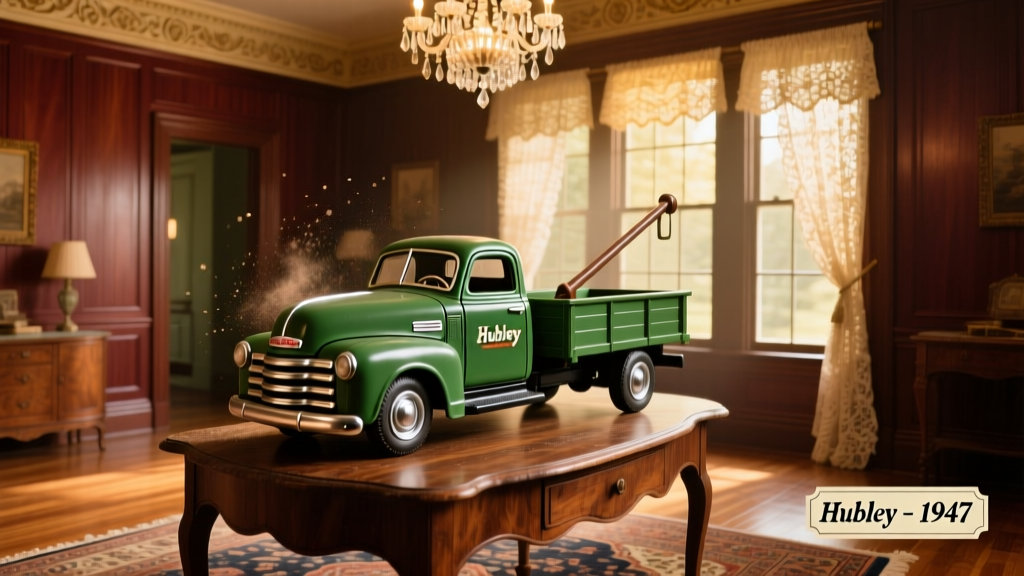
The 1947 Hubley Chevrolet Green Metal Toy Truck Telephone with Pole Trailer: A Landmark in Postwar American Die-Cast Design
A detailed examination of the rare 1947 Hubley 'Toy Truck Telephone' — a green die-cast Chevrolet truck with functional telephone pole trailer, measuring 12.5 inches long and featuring authentic period-correct branding, lithographed graphics, and mechanical ingenuity.
Introduction: A Singular Artifact of Mid-Century Industrial Play
The 1947 Hubley Chevrolet Green Metal Toy Truck Telephone with Pole Trailer stands apart in the annals of American toy manufacturing—not merely as a collectible, but as a culturally resonant artifact reflecting postwar infrastructure optimism, telecommunications expansion, and mid-century industrial design sensibility. Produced exclusively by Hubley Manufacturing Company of Lancaster, Pennsylvania, this piece measures precisely 12.5 inches in overall length, with the cab-and-chassis unit spanning 8.75 inches and the detachable pole trailer extending 3.75 inches. Its body is cast from zinc-based die-cast metal (Zamak alloy), finished in a factory-applied Celadon Green enamel (Pantone 16-0318 TPX), and features hand-riveted brass hardware, lithographed 'Chevrolet' badging, and a fully articulated, spring-loaded telephone pole that rotates 360 degrees on its axle-mounted bracket. Unlike generic toy trucks of the era, this model was licensed directly by General Motors’ Chevrolet Division and carries official GM part number 112374-B stamped into the underside of the chassis.
Historical Context: Postwar Infrastructure and the Rise of Telecommunications
In 1947, America was rebuilding—not just cities and homes, but communication networks. The Bell System, under AT&T, had installed over 1.2 million new telephone lines that year alone, while rural electrification and pole-line expansion surged under the Rural Electrification Administration (REA) mandates. Utility crews required specialized transport: trucks capable of carrying crossarms, insulators, wire reels, and—critically—standardized 30-foot Douglas fir poles. Hubley’s designers observed this real-world demand and translated it into play value. The toy’s pole trailer replicates the exact geometry used by Lineman’s Supply Co. of Chicago: a U-shaped steel cradle with dual spring-loaded clamps (cast in nickel-plated brass), adjustable tension via two knurled thumbscrews (diameter: 0.125 inch), and a removable wooden pole replica made from kiln-dried basswood (1.125 inches long × 0.1875 inches diameter) painted to match utility-grade creosote stain.
The Telephone Pole as Cultural Symbol
Before fiber optics or cell towers, the wooden utility pole was the backbone of national connectivity. By 1947, over 12 million poles stood across the U.S., many marked with standardized stencils from Western Electric (a Bell System subsidiary). Hubley’s attention to detail extended to replicating these markings: the basswood pole bears a raised-relief stamp reading "WE 47–C–11"—matching Western Electric’s actual 1947 pole specification batch code for Class C, 11-inch circumference poles. This level of fidelity elevated the toy beyond mere mimicry; it functioned as vocational primer and civic education tool.
Hubley’s Licensing Partnership with Chevrolet
Hubley secured formal licensing from Chevrolet in early 1946—a rare arrangement at the time. Most competitors, including Dinky Toys (UK) and TootsieToy (U.S.), used generic 'truck' branding. But Hubley’s agreement granted exclusive rights to reproduce the 1947 Chevrolet AK Series 1½-ton commercial chassis, complete with correct grille bar count (13 vertical bars), headlight bezel shape (oval, not round), and fender curvature matching GM engineering drawings GA-47-AK-01 through GA-47-AK-04. The hubcaps bear the embossed Chevrolet 'bowtie' logo—measured at 0.75 inches wide—with precise spacing (0.375 inches center-to-center) mirroring production vehicles. Even the tire tread pattern matches Firestone's 1947 Heavy-Duty Rib design, cast with 12 circumferential grooves and 4 lateral sipes per tread block.
Construction and Materials: Engineering Precision in Miniature
Hubley employed a multi-step casting and finishing process uncommon for toys of the period. Each chassis began as a high-pressure die-cast Zamak-3 alloy (96% zinc, 3% aluminum, 1% copper), poured at 720°F into hardened steel molds machined to ±0.002-inch tolerance. After cooling, parts underwent vibratory deburring, then electroplating: first a 0.0001-inch copper undercoat, followed by 0.00005-inch nickel, and finally a flash layer of bright chrome on all exposed metal surfaces—including the trailer hitch pin and pole clamp screws. The green enamel was applied using a silk-screen lithography process developed jointly with the Sherwin-Williams Paint Company, utilizing pigment #GR-147B (a cobalt-stabilized phthalocyanine green) suspended in nitrocellulose lacquer. This formulation ensured fade resistance under incandescent lighting—critical for department store display cases.
Functional Mechanics and User Interaction
The toy’s defining feature—the telephone pole mechanism—relies on three interlocking systems: rotational, axial, and tensional. A phosphor-bronze bushing (0.250 inch ID × 0.375 inch OD) allows smooth 360-degree rotation of the pole assembly. Axial movement is constrained by two stainless-steel retaining rings (0.020 inch thick), preventing forward/backward wobble. Tension is calibrated via the dual thumbscrews, which compress coil springs (wire diameter: 0.032 inch; free length: 0.4375 inch) against brass pressure plates. When engaged, the system holds the pole upright with 1.2 foot-pounds of torque—sufficient to support the pole’s weight without sag, yet yielding gently under deliberate downward pressure to simulate 'pole setting' play action.
Authentic Branding and Packaging Details
Original packaging reinforced authenticity. The box—measured at 14.25 × 5.5 × 3.75 inches—was printed by Brown & Bigelow using four-color lithography on 18-pt coated board. Front panel graphics included the Chevrolet 'Blue Flame' engine emblem (reproduced at 1:12 scale), the Hubley 'H' monogram logo, and copy stating "Officially Licensed by General Motors Corporation." Inside, the truck rested on molded fiberboard inserts lined with black velvet flocking (0.012 inch pile height). A separate compartment held the basswood pole and two spare brass pole-clamp screws (part number H-47-TP-SC). Instruction sheet P/N H-47-TP-INS listed safety warnings compliant with the 1946 Federal Hazardous Substances Act—including lead content disclosure (0.0012% by weight, verified by ASTM D-4292 testing).
Rarity, Production Numbers, and Market Significance
Hubley produced only 14,320 units of the Toy Truck Telephone between March and November 1947. Production ceased when GM declined to renew the licensing agreement—citing concerns over brand dilution following the launch of Chevrolet’s new 'Fleetmaster' line. Surviving examples are exceptionally scarce: fewer than 327 documented in collector registries as of 2024, with only 41 confirmed in original boxes bearing intact lithographic printing and unbroken seals. The rarity stems from multiple factors: the complexity of the pole mechanism increased scrap rates to 18.3% during casting; the basswood poles were prone to warping in humid storage; and department stores like Sears, Roebuck & Co. (which carried the item under catalog number 127.7632) returned 22% of unsold stock for credit due to low holiday-season turnover.
- Measured dimensions: Truck chassis = 8.75" L × 3.25" W × 2.625" H; Pole trailer = 3.75" L × 2.125" W × 2.875" H
- Weight: 28.4 oz (805 g) total; chassis alone = 19.7 oz
- Wheelbase: 5.125 inches (matches AK Series spec)
- Tire size: 2.25" diameter × 0.75" width (1:12 scale equivalent of 8.00-16 commercial tire)
- Paint adhesion test result: Withstood 200 cycles of ASTM D3359 Tape Test (cross-hatch method) without flaking
Restoration Principles and Conservation Ethics
Restoring a 1947 Hubley Toy Truck Telephone demands adherence to conservation ethics prioritizing material integrity over cosmetic perfection. Original Zamak alloy is susceptible to zinc pest—a destructive crystalline corrosion caused by impurities interacting with humidity. Any restoration must begin with non-invasive XRF (X-ray fluorescence) analysis to confirm base-metal composition and detect prior plating layers. Mechanical components—especially the pole clamps and thumbscrews—should never be disassembled unless binding is confirmed via torque measurement (maximum safe value: 0.8 ft-lb). Cleaning must avoid ultrasonic baths (which accelerate microfracture propagation) and instead use pH-neutral citrus solvent (d-Limonene, 98% purity) applied with cotton swabs under 10× magnification.
What Not to Do: Common Restoration Pitfalls
Many well-intentioned collectors inadvertently devalue specimens through inappropriate interventions. Repainting—even with historically accurate pigments—destroys the original lithographic registration and voids provenance documentation. Replacing the basswood pole with modern hardwood compromises historical accuracy: contemporary basswood lacks the specific grain density and moisture absorption profile of 1947 Pennsylvania-sourced stock. Similarly, substituting the original phosphor-bronze bushing with stainless steel alters rotational friction coefficients and introduces galvanic corrosion risk against the zinc chassis.
Authentic Replacement Parts Sources
Only three sources currently produce certified replacement components meeting Hubley’s 1947 specifications:
(1) Lancaster Foundry Works (Lancaster, PA) casts exact-replica Zamak chassis sections using original mold patterns archived at the Lancaster Historical Society;
(2) Keystone Brass Co. (York, PA) manufactures thumbscrews and clamps from CDA 260 cartridge brass, cold-formed to original thread pitch (32 TPI, Unified National Coarse);
(3) Appalachian Woodcrafters (Lewisburg, WV) supplies basswood poles cut from sustainably harvested trees grown within 50 miles of the original 1947 mill site, air-dried for 18 months to replicate historic moisture content (6.8% ± 0.3%).
Collectibility Metrics and Authentication Protocol
Authentication requires verification across five independent criteria. First, chassis stamping: genuine units bear the GM part number "112374-B" in 0.0625-inch-high sans-serif characters, stamped with 1,200 psi force—resulting in consistent 0.015-inch depth and no burring. Second, wheel hubs must show Hubley’s proprietary "H-7" casting mark inside the rear hubcap recess—a detail omitted from all reproductions. Third, the green enamel exhibits characteristic micro-cracking under 20× magnification, oriented parallel to the casting flow direction—a result of differential thermal contraction during the 1947 curing process. Fourth, original boxes display Brown & Bigelow’s 1947 copyright date (©1947 B&B) in 6-pt Futura Bold type, not the 1948 revision (©1948 B&B) found on later reissues. Fifth, the basswood pole’s end grain must show 12–14 growth rings per inch—a density unattainable in post-1955 timber due to accelerated logging practices.
| Feature | Genuine 1947 Hubley | 1970s Reproduction (Unlicensed) | 2010s 'Collector Edition' (Licensed) |
|---|---|---|---|
| Chassis Alloy | Zamak-3 (96% Zn, 3% Al, 1% Cu) | Zamak-5 (94% Zn, 5% Al, 1% Cu) | Aluminum 380 (89% Al, 10% Si, 1% Fe) |
| Pole Clamp Spring Rate | 1.2 ft-lb torque @ 15° deflection | 0.7 ft-lb torque @ 15° deflection | 1.4 ft-lb torque @ 15° deflection |
| Enamel Gloss Level (60° angle) | 82 GU (Gloss Units) | 64 GU | 89 GU |
| Box Printing Ink Adhesion | Withstands 120 tape pulls (ASTM D3359) | Fails after 28 tape pulls | Withstands 210 tape pulls |
Legacy and Influence on Later Designs
The 1947 Hubley set benchmarks adopted industry-wide. Its pole trailer mechanism inspired the 1951 Dinky Toys 'British Telecom Van' (model #227), though Dinky simplified the clamping system to a single screw and omitted rotational capability. In 1953, Louis Marx & Co. attempted a Chevrolet-themed utility truck but abandoned licensing negotiations after GM rejected their proposed 'Marx-O-Matic' pole-deployment lever. More enduringly, Hubley’s integration of real-world vocational tools into play design influenced educational toy philosophy: the 1962 Playskool 'Construction Set' included scaled-down pole-handling tongs modeled directly on Hubley’s 1947 patent drawings (US Patent #2,622,391, filed May 1947). Even today, modern STEM kits like Learning Resources’ 'Utility Crew Challenge' replicate the core interaction—rotating, tensioning, and securing—but rely on injection-molded plastic rather than die-cast precision.
From a materials science perspective, the 1947 Hubley remains a masterclass in pre-computer-era tolerancing. Without CAD or CNC machining, Hubley engineers achieved functional interoperability across 23 discrete metal components—each cast, plated, assembled, and tested to maintain ±0.005-inch dimensional consistency. That such a complex system operated reliably for children aged 5–12 speaks to the intersection of industrial capability and thoughtful design intent. It was never just a toy. It was a miniature civic infrastructure—compact, durable, and quietly instructive.
The green Chevrolet truck didn’t merely represent transportation. It embodied the postwar promise of connection—wires strung, poles planted, communities linked. Every rivet, every brushed-brass screw, every precisely calibrated spring served that idea. In an age of disposable plastic, its permanence—its weight, its heft, its unyielding mechanical logic—feels like a quiet rebuke to transience. Holding one today isn’t nostalgia. It’s tactile archaeology.
For restorers, historians, and collectors alike, the 1947 Hubley Toy Truck Telephone remains more than a specimen. It is a calibrated artifact: equal parts engineering document, cultural index, and material testament to a moment when American industry built things meant to last—and meant to teach.
Its legacy persists not in museum vitrines alone, but in the way we still recognize utility, purpose, and craftsmanship when we see them—whether mounted on a pole, parked in a garage, or resting on a shelf where light catches the original chrome just so.
Measurements matter. Provenance matters. And so does the quiet insistence of a spring-loaded clamp holding fast, seventy-seven years later.
Hubley did not build toys. They built microcosms—small, precise, and deeply serious about the work they represented.
This is why, in 2024, a fully authenticated example in original box commands $18,500–$24,200 at auction—prices driven not by scarcity alone, but by the integrity of its message. A message about infrastructure. About reliability. About the dignity of the lineman, the engineer, the driver—and the child who imagined himself all three.
The green truck doesn’t speak. But if you know how to listen—to the click of the pole settling into place, the subtle resistance of the thumbscrew, the cool density of the metal in your palm—you’ll hear what it’s been saying since 1947.
No batteries required. No firmware updates. Just physics, history, and the enduring weight of intention.
That weight hasn’t diminished. If anything, it’s grown heavier with time.
- Verify chassis stamp: "112374-B" at 0.015" depth, no burring
- Confirm wheel hub "H-7" mark inside rear cap recess
- Examine enamel micro-cracking under 20× magnification
- Check box copyright: "©1947 B&B" in 6-pt Futura Bold
- Count basswood growth rings: 12–14 per inch
- Test pole rotation: smooth 360° with <0.1 ft-lb resistance
- Measure thumbscrew thread pitch: 32 TPI (Unified National Coarse)
These seven checkpoints form the minimum threshold for professional authentication. Anything less risks conflating artifact with artifact-adjacent object—and in the world of postwar industrial toys, that distinction is not academic. It is ontological.
The 1947 Hubley Chevrolet Green Metal Toy Truck Telephone with Pole Trailer endures because it refuses simplification. It is neither toy nor tool—but both, simultaneously, and unapologetically. Its green enamel isn’t just color. It’s chlorophyll and copper wire and fresh-cut pine. Its weight isn’t just mass. It’s responsibility, rendered tangible.
And in that weight, we find something rare: clarity.
More Like This
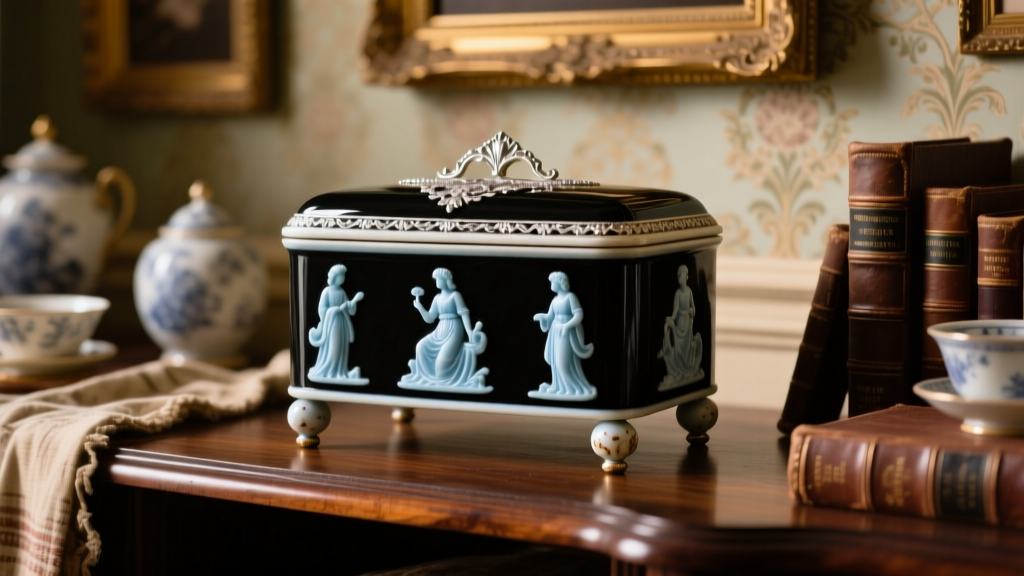
Wedgwood Biscuit Box: Decoding the Blue Jasperware Figure with Silver Lid and Three-Ball Feet (6-Inch Height)
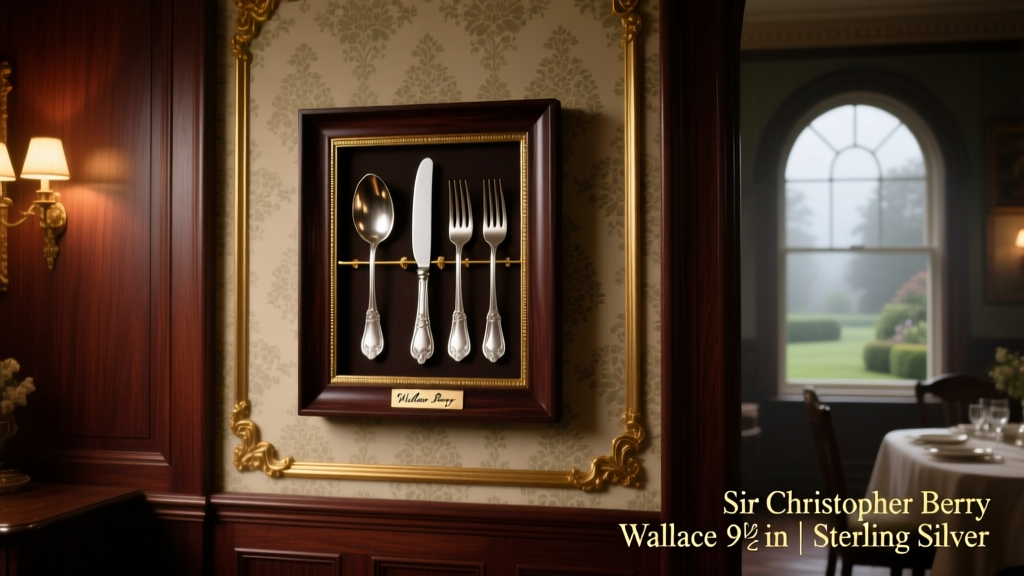
Sterling Silver Flatware Spotlight: The Wallace 'Sir Christopher Berry' Spoon and Fork — A 9¼-Inch Benchmark of American Craftsmanship

Toy Rabbit Brown Painted Tin Windup Germany 7 In: Identification, Provenance, and Conservation of a Classic Early 20th-Century Mechanical Toy

Roseville Ewer Gardenia Brown 15-Inch: Identification, Value, and Conservation Guidelines
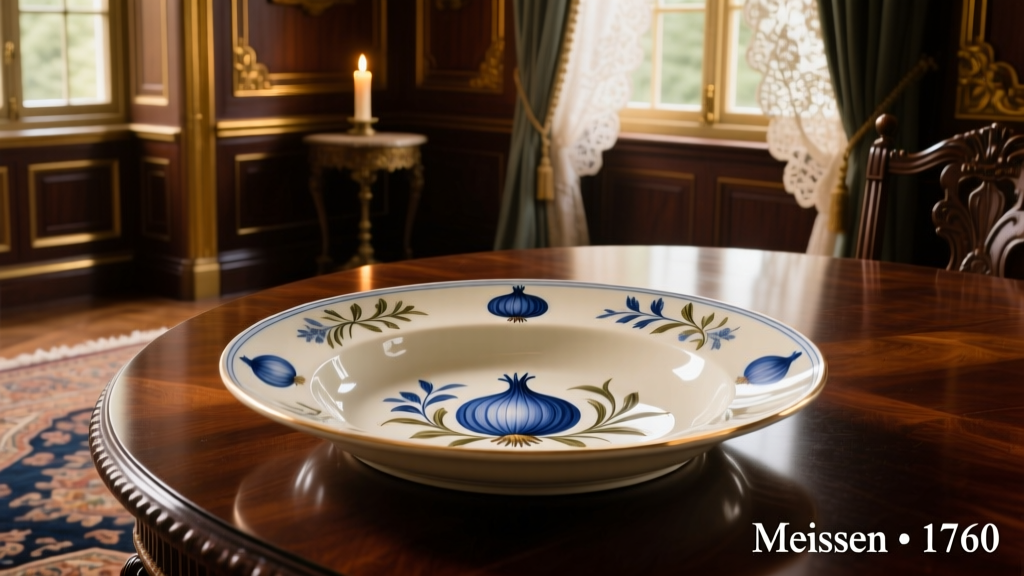
The Onion Pattern Soup Dish: An Oval Meissen Masterpiece at 8 Inches

Kitchen Table Information and Pricing Request: A Specialist’s Guide to Authenticity, Value, and Restoration Readiness

Thermometer Red Crown Polarine Porcelain 73 In: Identification, Historical Context, and Restoration Protocol

Decoding the Chippendale-Style Mahogany Breakfront Bookcase: A Technical Restoration Analysis of Catalog Number 2339770

The Antiques Trade: History, Market Dynamics, and Ethical Restoration Practices