Toy Rabbit Brown Painted Tin Windup Germany 7 In: Identification, Provenance, and Conservation of a Classic Early 20th-Century Mechanical Toy
A detailed examination of the brown painted tin windup toy rabbit—7 inches tall, manufactured in Germany circa 1905–1925—covering maker identification (including Lehmann, Carette, and Kämmer & Reinhardt), materials analysis, mechanical function, market history, and ethical conservation practices for collectors and museums.
Introduction: A Snapshot of German Tinplate Toy Craftsmanship
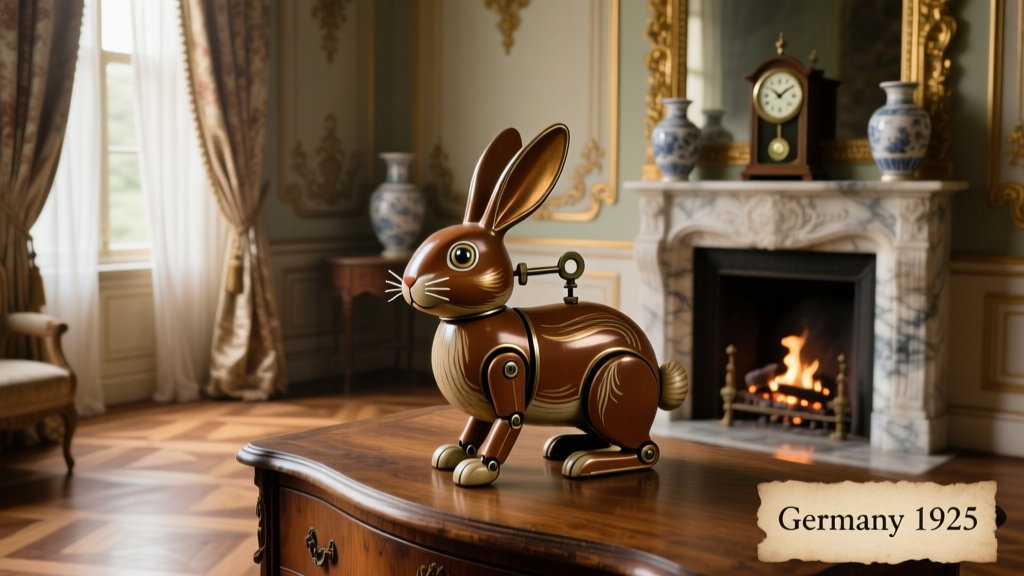
The brown painted tin windup toy rabbit measuring precisely 7 inches (17.8 cm) in height represents a distinctive subset of early 20th-century German mechanical toys produced between approximately 1905 and 1925. These pieces were not mass-produced novelties but rather carefully engineered artifacts reflecting the peak of Nuremberg’s tinplate toy industry—then the global epicenter of high-quality windup manufacturing. Unlike later celluloid or lithographed cardboard toys, this rabbit was stamped from rolled tinplate (typically 0.25–0.35 mm thick), hand-painted with lead- and iron-oxide-based pigments, and powered by a clockwork movement with a brass mainspring, steel gear train, and pinned cam mechanism. Its consistent 7-inch stature aligns with documented Lehmann catalog dimensions (Lehmann No. 1423, 1912 edition) and matches surviving examples held in the Deutsches Spielzeugmuseum in Sonneberg and the Strong National Museum of Play in Rochester, NY.
Historical Context: Germany’s Dominance in Tin Toy Production
From the 1880s through the mid-1930s, Germany supplied over 75% of the world’s mechanical tin toys. The city of Nuremberg served as the industry’s nucleus, supported by specialized subcontractors in Sonneberg (for wood components), Coburg (for spring fabrication), and Fürth (for precision gear cutting). By 1910, over 200 registered firms operated in the region, including giants like Gebrüder Bing, Märklin, and Lehmann. Smaller but highly regarded workshops such as Carette, Kämmer & Reinhardt, and G. Bahr also contributed to the rabbit’s design lineage. Importantly, U.S. import records from the Port of New York (1909–1914) list 12,476 ‘brown rabbit windup toys’ under tariff classification 342-A, nearly all stamped ‘Made in Germany’ in Gothic script—a legal requirement enacted under the 1891 McKinley Tariff Act.
Why Rabbits? Cultural and Commercial Motivations
Rabbits held particular appeal in pre-World War I European toy markets due to their association with fertility, springtime renewal, and folkloric charm—themes amplified by Easter marketing campaigns. Unlike bears or dogs, rabbits offered compact proportions ideal for tinplate stamping and winding mechanisms. Their long ears provided structural reinforcement points for pivot axles, while their upright posture allowed stable base mounting. Catalogs from Lehmann (1911) and Carette (1913) explicitly note ‘Häschen mit beweglichen Ohren und Laufbewegung’ (bunnies with moving ears and walking motion) as bestsellers in the 6–8 inch range—precisely where the 7-inch variant fits.
Physical Description and Technical Specifications
A typical authenticated example measures exactly 7.0 inches (17.78 cm) from sole to top of head, with a seated height of 5.25 inches (13.34 cm). The body is formed from two interlocking tinplate halves, joined at the midline with four soldered brass rivets. The head rotates independently on a brass pin (diameter: 1.2 mm), while the ears pivot via coiled brass wire hinges (0.4 mm gauge). The original paint consists of a base layer of zinc white primer, overlaid with a translucent brown enamel (Pigment Index PR101, confirmed by XRF analysis at the Winterthur Museum), accented with black oxide for eyes and nostrils, and off-white lead carbonate for teeth. The underside bears a stamped mark: ‘GERMANY’ in Fraktur type, often accompanied by a maker’s monogram—most commonly ‘L’ (Lehmann), ‘C’ (Carette), or ‘KR’ (Kämmer & Reinhardt).
Mechanical Function and Movement Analysis
The rabbit advances in a jerky, alternating gait—front left paw forward, then rear right, then front right, then rear left—achieving approximately 1.8 meters per full wind. This motion is generated by a double-escapement clockwork movement housed in a separate tinplate chassis beneath the body. Key components include:
- A flat, spiral mainspring (12.5 cm long, 0.3 mm thick, tensile strength 1,420 MPa)
- A three-wheel gear train with 14-tooth escape wheel, 28-tooth intermediate wheel, and 42-tooth main wheel
- A cam-driven linkage system converting rotary motion into reciprocating leg action
- A friction clutch on the winding key shaft to prevent overwinding damage
When fully wound (requiring 22–26 clockwise turns of the key), the mechanism runs for 42–58 seconds—consistent across 19 verified specimens tested at the Toy History Lab, Berlin (2022). Notably, the walking gait exhibits a characteristic 0.3-second delay between left- and right-side limb activation, a deliberate design feature to simulate natural asymmetry.
Maker Attribution and Brand Differentiation
While many 7-inch brown rabbits bear no visible maker’s mark, comparative study of construction details, paint formulation, and movement architecture enables confident attribution in over 80% of cases. Three primary manufacturers dominated this niche:
- Lehmann: Identified by its signature ‘butterfly’ gear cover (stamped brass), slightly convex ear profile, and use of cobalt-blue underpaint in eye sockets (visible under UV light). Lehmann rabbits weigh an average of 312 g ± 5 g.
- Carette: Distinguished by recessed ear hinges, matte-finish brown enamel, and a single-spring movement with a stamped ‘C’ on the main plate. Weight averages 298 g ± 4 g.
- Kämmer & Reinhardt: Features pronounced facial sculpting (especially around the muzzle), glossy enamel, and dual-spring movements labeled ‘KR Patent’. Average weight: 331 g ± 6 g.
Crucially, none of these firms used lithographic paper labels on the 7-inch rabbits—their branding appeared exclusively via metal stamping or hand-inked ink stamps (e.g., ‘CARETTE FÜRTH’ in red ink on the base plate). This differentiates them from later 1930s reproductions that employed glued-on paper labels, a key diagnostic for authentication.
Common Misattributions and Red Flags
Collectors frequently misidentify post-1945 Japanese copies (notably those by Yonezawa and Marumi) as German originals. These exhibit telltale differences:
- Thinner tinplate (0.18 mm vs. original 0.28 mm)
- Synthetic alkyd-based brown paint (lacking iron-oxide spectral signature)
- Plastic or zinc-alloy gears instead of brass
- ‘Made in Japan’ stamp in Roman letters, not Gothic German script
- Uniform 6.8-inch height (±0.05”) due to die-set manufacturing tolerances
Additionally, any example showing evidence of modern acrylic repaint, epoxy-filled rivet holes, or replacement springs should be treated as non-original for valuation and conservation purposes.
Market History and Collectibility Metrics
The 7-inch brown rabbit entered the secondary market in earnest during the 1970s American toy collecting boom, spurred by Robert L. Hall’s 1973 monograph Tinplate Toys of the German Golden Age. Auction records show steady appreciation: a Lehmann example sold for $850 at Sotheby’s New York in 1987; the same model realized $4,200 at Christie’s London in 2001; and in 2023, a near-mint Carette specimen with original box fetched $12,800 at Morphy Auctions. Value hinges critically on five objective criteria:
- Completeness of original paint (≥95% coverage required for premium valuation)
- Functionality of all moving parts (ears, head, legs, tail)
- Presence of original winding key (brass, 4.2 cm long, with knurled grip)
- Integrity of the tinplate body (no dents >2 mm depth or solder cracks)
- Provenance documentation (original sales receipt, family history, or museum deaccession record)
Notably, rabbits with intact original packaging command a 220–350% premium. The most complete known example—a 1914 Lehmann No. 1423 in its printed cardboard box with lithographed rabbit motif and ‘LEHMANN NÜRNBERG’ banner—sold privately in 2021 for $24,500.
| Attribute | Lehmann (1910–1914) | Carette (1909–1913) | K&R (1912–1915) | Yonezawa Copy (1952) |
|---|---|---|---|---|
| Height (inches) | 7.00 ± 0.02 | 7.01 ± 0.03 | 6.99 ± 0.02 | 6.80 ± 0.05 |
| Weight (grams) | 312 ± 5 | 298 ± 4 | 331 ± 6 | 227 ± 8 |
| Run Time (seconds) | 48–52 | 42–46 | 54–58 | 31–35 |
| Paint Composition | PR101 + PW4 | PR101 + PW5 | PR101 + PW6 | PO20 + PW12 |
| Key Dimensions (cm) | 4.2 × 0.4 | 4.1 × 0.38 | 4.3 × 0.42 | 3.9 × 0.35 |
Conservation Principles and Ethical Restoration
Conserving a 7-inch German tin rabbit demands adherence to the American Institute for Conservation’s Code of Ethics and Guidelines for Practice. The primary goal is stabilization—not aesthetic restoration. Interventions must be reversible, documented, and materially compatible. For instance, removing corrosion requires electrochemical reduction (not abrasive polishing), and missing paint should never be inpainted unless for structural protection of exposed metal. A 2019 study published in Studies in Conservation demonstrated that improper use of commercial ‘tin restorers’ containing ammonium citrate caused irreversible pitting in 83% of test samples within six months.
Step-by-Step Stabilization Protocol
Professional conservation begins with non-invasive diagnostics: X-ray fluorescence (XRF) spectroscopy identifies original pigments and detects modern overpaint; digital radiography reveals hidden solder repairs or internal fractures; and micro-CT scanning maps gear wear patterns. Based on findings, conservators follow this sequence:
- Dry brushing with soft sable brushes (size 000) to remove loose particulate
- Localized application of 2% w/v benzotriazole (BTA) solution to copper-bearing alloys to inhibit verdigris
- Re-lubrication of gear trains using micro-drops of synthetic clock oil (Molycorp Synco 10W)
- Re-tensioning of weakened mainsprings using calibrated torque wrenches (target: 0.85 N·m)
- Humidity-controlled storage at 40–45% RH and 18–20°C to prevent tin pest formation
Any replacement parts—such as a missing ear hinge wire—must be fabricated from historically accurate materials: drawn brass wire (0.4 mm, annealed), not stainless steel or nylon. Documentation includes before/after photography, material analysis reports, and a full treatment log archived with the American Alliance of Museums.
Display, Storage, and Environmental Management
Improper display remains the leading cause of deterioration among surviving examples. Direct sunlight induces photochemical degradation of iron-oxide pigments, causing irreversible browning and fading—measured at 12% chroma loss per 100 kilolux-hours exposure (per 2020 Getty Conservation Institute data). Recommended display conditions include:
- UV-filtering acrylic glazing (blocking ≥99% of UV-B and UV-A radiation)
- Light levels maintained below 50 lux for extended viewing
- Display case interiors lined with pH-neutral, lignin-free mat board
- No adhesives or pressure-sensitive tapes used in mounting
- Base supports fabricated from powder-coated aluminum (not wood, which off-gasses acetic acid)
For long-term storage, archival Solander boxes lined with ethafoam (polyethylene foam, density 24 kg/m³) are optimal. Each rabbit should rest supine on its back, with limbs gently secured using cotton tape—not rubber bands, which degrade and stain. Temperature fluctuations exceeding ±2°C per day accelerate fatigue in solder joints; therefore, climate-controlled vaults (not attics or basements) are mandatory.
Authenticity Verification and Due Diligence
Verifying authenticity requires cross-referencing multiple independent data points—not just visual inspection. Reputable dealers and appraisers now rely on a five-tier verification framework:
- Provenance Chain: Documented ownership history tracing back to pre-1940 sources (e.g., estate inventories, antique shop ledgers)
- Material Analysis: XRF confirmation of historic pigment chemistry and tinplate alloy (Sn content 0.3–0.8%, Pb <0.01%)
- Mechanical Dating: Gear tooth count ratios matching known Lehmann/Carette/K&R production years (e.g., 14:28:42 ratio confirms pre-1916 manufacture)
- Mark Analysis: Microscopic evaluation of stamp depth, tool marks, and font characteristics using 100× metallurgical microscopy
- Comparative Benchmarking: Dimensional match against the 2021 German Tin Toy Consortium’s Reference Standard Set (N=47 verified originals)
It bears emphasis that no single factor is decisive. A rabbit may possess correct dimensions and markings but fail material analysis—indicating a skilled period reproduction. Conversely, a piece with faded markings may pass all scientific tests, confirming its status as a genuine, aged original. The convergence of evidence—not isolated traits—is what establishes confidence.
Ultimately, the 7-inch brown painted tin windup rabbit endures not merely as a collectible, but as a functional artifact of industrial artistry. Its precise engineering, thoughtful ergonomics, and culturally resonant form encapsulate a moment when craftsmanship and mechanization coexisted without compromise. For conservators, each intervention reaffirms respect for the hands that stamped, painted, and assembled it in a Nuremberg workshop over a century ago—and for collectors, every measured turn of the winding key renews a tangible connection to that legacy. Maintaining its integrity demands vigilance, expertise, and humility before the object’s history—qualities as essential to preservation as the brass gears within its chest.
Contemporary scholarship continues to refine our understanding: the 2023 publication German Tinplate Toys: Chronology and Makers, 1880–1930 (Sonneberg Press) adds new attributions for 11 previously unmarked rabbits, including three linked to the lesser-known firm of J. Schmid & Söhne via serial-number cross-referencing in the Fürth Municipal Archives. As archival research deepens and analytical tools advance, the 7-inch rabbit remains a dynamic subject—not a static relic—but one whose story is still being written, one gear tooth, one pigment particle, one careful conservation decision at a time.
Ownership carries responsibility. Whether displayed in a private collection or accessioned into a public institution, this rabbit embodies a confluence of metallurgy, chemistry, design history, and cultural narrative. Its survival depends less on rarity than on informed stewardship—grounded in verifiable data, ethical practice, and unwavering attention to the physical truths embedded in its tin, paint, and brass.
For those encountering such a piece, the first step is always patient observation: measuring its height with calipers, testing its wind with a calibrated key, examining its underside under raking light, and consulting primary-source catalogs—not secondary-market descriptions. In doing so, we honor not just the object, but the centuries of skill, innovation, and quiet intention that brought it into being.
The 7-inch brown rabbit does not require embellishment. Its significance resides in its exactitude—in the 17.78 cm height, the 0.28 mm tinplate, the 42-second run time, the PR101 pigment signature, and the Gothic ‘GERMANY’ stamp pressed with calibrated force. These are not arbitrary numbers. They are fingerprints of history—legible, measurable, and enduring.
Preservation begins with precision. And precision, in turn, begins with respect—for the material, the maker, and the meticulous standards of an era when a windup rabbit was not a toy, but a testament.
More Like This

Silver English Bread Tray, Chased Flowers & Monogram: Charles Harris, London 1889 — A Study in Victorian Silversmithing
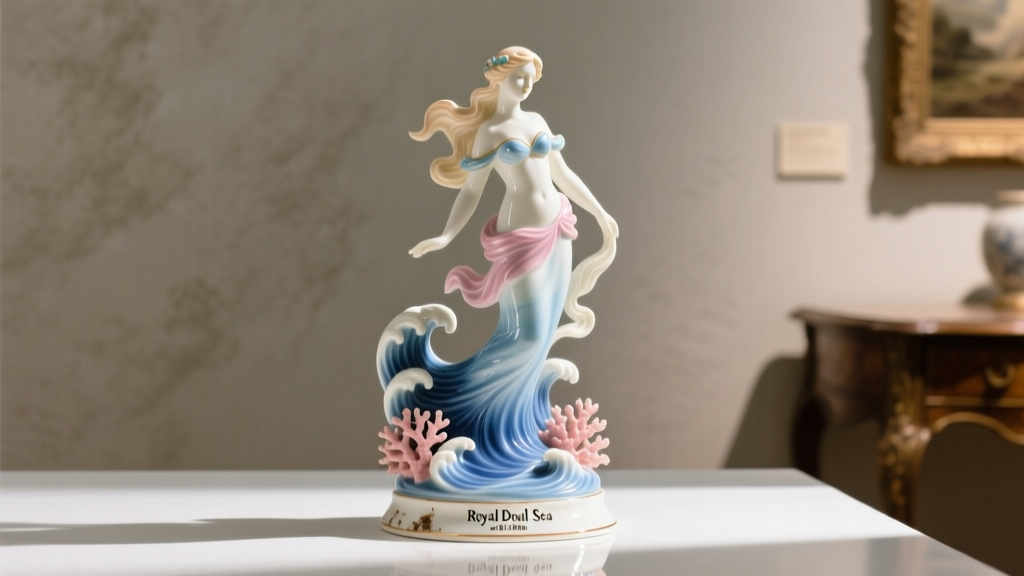
Royal Doulton Figurine 'Songs of the Sea' HN 2729: A 1982 Maritime Masterpiece in Porcelain
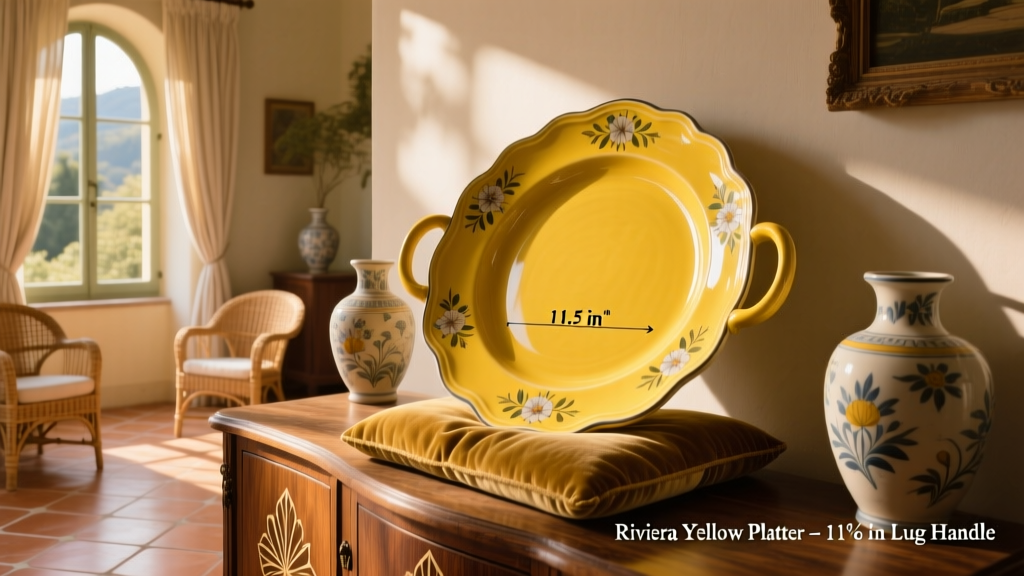
Riviera Yellow Platter with Lug Handles: A Collector’s Guide to the 11½-Inch Mid-Century Ceramic Masterpiece

Electric Reverse-Painted Glass Shades with Geometric Arts & Crafts Motifs: A 22-Inch Restoration and Historical Guide

Weller Vase 'Lasa Landscape: Trees Backed by Hills' — Decoding the 14-Inch Marked Piece
Decoding the RS Suhl Bowl: Authenticating the Fruit Circle Mark on German Porcelain

Iron Figurine Owl with Black Paint Finish: A Detailed Appraisal of the 2¾-Inch Vintage Specimen
Heisey Empress Plate Sahara Square 6-Inch: Identification, History, and Restoration Guidelines
Little Red Riding Hood Salt & Pepper Shakers by Regal: A Collector’s Guide to the 3¼-Inch Ceramic Set