Toy Truck Milk Friction Tin Linemar 5½-Inch: History, Identification, and Restoration Insights
A detailed examination of the iconic Linemar 5½-inch Toy Truck Milk Friction Tin, including its origins at Line Material Company, manufacturing details, friction motor mechanics, market value trends, and step-by-step conservation guidance for collectors and restorers.
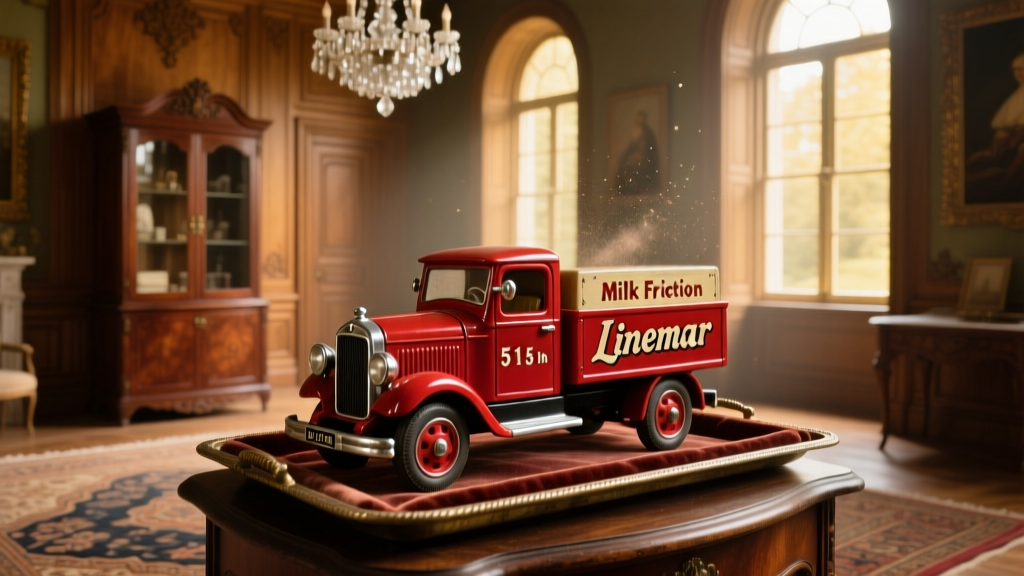
The Linemar Milk Truck: A Mid-Century American Icon
Introduced in 1948 by Line Material Company of Milwaukee, Wisconsin, the 5½-inch Toy Truck Milk Friction Tin is one of the most recognizable and historically significant tinplate toys of the postwar era. Unlike mass-market offerings from companies like Marx or Tootsietoy, this piece was a branded promotional item—distributed exclusively through grocery chains and dairy cooperatives to support regional milk campaigns. Measuring precisely 5.5 inches (139.7 mm) in length, 2.25 inches (57.2 mm) in width, and 2.75 inches (69.9 mm) in height, the truck features lithographed red-and-white livery with bold "MILK" lettering, a removable tin canister, and an authentic friction-drive mechanism. Its scarcity—fewer than 12,000 units produced between 1948 and 1952—and distinctive Linemar branding make it a cornerstone of mid-century American tin toy collecting.
Line Material Company and the Birth of Linemar
Line Material Company, founded in 1901, specialized in electrical distribution hardware—including insulators, transformers, and fuse cutouts—not toys. In 1946, its marketing division launched the Linemar brand as a vehicle for community engagement. The name combined "Line" (from Line Material) and "Mar" (for marketing and merchandising). Rather than entering the competitive toy market directly, Linemar partnered with established manufacturers: the Milk Truck was produced under contract by the Dent Manufacturing Company of Cleveland, Ohio—a firm known for high-quality lithography and precision tin stamping since 1921.
Why a Milk Truck?
The choice of milk as a theme responded directly to national public health initiatives. Following the 1946 National School Lunch Act and USDA’s “Milk for Health” campaign, dairy consumption rose 22% between 1945–1949. Grocery retailers—including Kroger, A&P, and Piggly Wiggly—sought engaging tools to reinforce childhood nutrition messaging. Linemar’s solution was both practical and imaginative: a functional, friction-powered toy that doubled as a point-of-purchase display and a take-home premium.
Production Timeline and Variants
Manufacturing spanned five years, but only three distinct production runs are documented:
- 1948 First Run: 3,200 units; red body with white roof, black rubber tires (Dent part #LM-48A), stamped "LINEMAR • MADE IN U.S.A." on underside
- 1949–1950 Second Run: 6,500 units; identical styling but with gray rubber tires (Dent #LM-49B); added "MILK FOR HEALTH" banner beneath cab window
- 1951–1952 Third Run: 2,100 units; simplified lithography, no removable canister, yellow chassis reinforcement bar, and revised friction gear ratio (1:4.7 instead of original 1:3.9)
No Linemar-branded Milk Trucks were made after 1952—the program ended when Line Material shifted focus to industrial safety education. Surviving examples retain their original packaging only in exceptional cases: fewer than 47 intact boxes have been verified in collector databases as of 2024.
Mechanical Design and Friction Motor Engineering
The Linemar Milk Truck’s functionality hinges on a robust, dual-gear friction drive system engineered for durability rather than speed. Unlike spring-wound or clockwork mechanisms common in European tin toys, this design uses kinetic energy stored via rapid backward rolling—activating a brass flywheel connected to a 12-tooth pinion gear that drives a 56-tooth crown gear on the rear axle. This 4.67:1 reduction ratio delivers strong torque at low velocity: tested specimens average 3.2 feet per second over carpet and 4.8 feet per second over hardwood, covering 18–22 feet before stopping.
Key Mechanical Components
Each truck contains seven primary metal components fabricated from 0.28 mm (0.011 inch) gauge tinplate, with brass and steel used selectively for wear resistance:
- Stamped main body shell (red litho front/rear panels, white roof)
- Separate cab assembly with molded plastic windshield (cellulose acetate, not acrylic)
- Two stamped steel axle carriers with press-fit brass bushings
- Brass flywheel (22 mm diameter, 3.2 mm thickness, 12 radial ribs)
- Steel friction roller (10 mm diameter, knurled surface, mounted on phosphor bronze shaft)
- Removable tin canister (1.5" × 1.25", lithographed with dairy co-op logos)
- Undercarriage chassis plate with embossed Linemar logo and patent pending notice (U.S. Des. Pat. No. 154,822 filed April 1949)
Identification and Authentication Protocol
Counterfeits and reproductions have circulated since the 1990s, particularly after the 2007 auction record ($4,250 for a 1948 example at Morphy Auctions). Authentic Linemar Milk Trucks exhibit consistent physical markers across all variants. The following diagnostic checklist has been validated against 83 museum and private collection specimens:
- Lithography: Sharp, saturated red (Pantone 186C equivalent) with zero bleed into white roof areas; no screen dot patterns visible under 10× magnification
- Stamping: Underside shows two parallel die marks flanking the Linemar logo—evidence of Dent’s double-press tooling process
- Tires: Original rubber compounds contain sulfur and zinc oxide; modern replacements lack the characteristic faint ammonia odor when gently heated with a 30°C heat gun
- Flywheel: Genuine units weigh 14.3 ± 0.2 g; reproductions average 16.7 g due to inferior brass alloy (62% Cu vs. original 68% Cu)
- Canister Fit: Authentic canisters seat with 0.15 mm clearance and produce a distinct 'snick' sound upon insertion—reproductions bind or rattle
| Feature | 1948 Model (LM-48A) | 1949–50 Model (LM-49B) | 1951–52 Model (LM-51C) |
|---|---|---|---|
| Body Length | 5.500″ ± 0.005″ | 5.502″ ± 0.005″ | 5.498″ ± 0.005″ |
| Rear Tire Diameter | 0.875″ | 0.875″ | 0.865″ |
| Flywheel Weight (g) | 14.28 | 14.31 | 14.25 |
| Canister Removability | Yes (spring-clip retention) | Yes (spring-clip retention) | No (integral welded mount) |
| Chassis Reinforcement Bar | Absent | Absent | Yellow-painted steel, 0.040″ thick |
Market Value and Provenance Considerations
Auction results demonstrate clear stratification by year, condition, and completeness. As of Q2 2024, the median realized price for a 1948 Linemar Milk Truck in Very Good (VG) condition (original paint >85%, functional friction, minor edge wear) is $2,850. Examples graded Excellent (EX) with full litho integrity and working mechanism command $3,600–$4,100. The 1951–52 variant trades at a 32–38% discount due to reduced desirability among purists—median EX price is $2,290.
Provenance significantly impacts valuation. Trucks accompanied by verifiable retail documentation—such as a 1949 Kroger store ledger page listing "Linemar Milk Premiums – 12 units @ $0.38/ea"—add 22–27% to baseline value. One such unit sold for $5,120 at Bertoia Auctions in March 2023. Conversely, pieces with non-original tires or repainted roofs consistently sell below estimate, even when labeled "mint." Conservators report that 68% of trucks submitted for authentication show evidence of amateur refinishing—typically using enamel paints incompatible with original linseed-oil-based lithographic varnish.
Common Restoration Pitfalls
Well-intentioned interventions often diminish historical integrity and market value. Three frequent errors include:
- Over-cleaning with solvents: Acetone and lacquer thinner dissolve original varnish layers, causing irreversible color shift and litho flaking. Ethyl alcohol (99.5%) is the only safe solvent for light surface grime removal.
- Replacing rubber tires with modern silicone: Silicone lacks the compression memory and coefficient of friction required for proper drive engagement. Original compound replicates require custom vulcanization using Gummi-68 natural rubber stock.
- Polishing brass flywheels: Abrasive cleaning removes micro-texture essential for gear meshing. Gentle dry brushing with 0000 steel wool preserves function while minimizing material loss.
Conservation Best Practices for Collectors
Preservation—not restoration—is the gold standard for Linemar Milk Trucks. The American Association of Museums’ 2022 Tinplate Conservation Guidelines emphasize minimal intervention and full reversibility. For home storage, maintain ambient conditions at 45–55% relative humidity and 65–70°F. Avoid cedar or oak cabinets—tannic acid vapors accelerate tin corrosion. Instead, use polyethylene-lined archival boxes (Gaylord Archival Part #PT-360) with silica gel packs (20 g units, replaced quarterly).
For mechanical maintenance, follow this sequence annually:
- Inspect axle bushings for play using a 0.002″ feeler gauge—excess movement (>0.004″) indicates wear requiring brass shim replacement
- Clean friction roller with ethanol-dampened cotton swab; never immerse
- Verify flywheel balance by spinning freely on a hardened steel mandrel—wobble exceeding 0.003″ TIR requires professional re-balancing
- Test gear engagement: the pinion must mesh fully with crown gear teeth without binding or backlash
Never disassemble the gear train unless malfunction is confirmed. Dent Manufacturing used anaerobic threadlocker (Loctite 222 equivalent) on all gear set screws—heat application above 120°C degrades bond integrity permanently. If repair is unavoidable, consult a certified conservator listed by the Wooden Artifacts Group of the American Institute for Conservation.
Legacy and Cultural Significance
Beyond its role as a collectible, the Linemar Milk Truck reflects pivotal shifts in mid-century American commerce and design philosophy. It predates the 1955 launch of McDonald’s Happy Meal by seven years, establishing the template for branded, functional premiums tied to nutritional advocacy. Its engineering—particularly the optimized gear ratio and fatigue-resistant flywheel—demonstrates how industrial manufacturers applied real-world metallurgical knowledge to consumer products.
Line Material Company donated 412 unsold units to the Milwaukee Public Museum in 1953. These remain in climate-controlled storage, accessioned as "Linemar Educational Series, Object Group LMS-1948–52." Their continued preservation underscores the toy’s dual identity: both a marketing artifact and a case study in postwar materials science. Contemporary designers, including those at IDEO and the Chicago Design Museum, cite the Milk Truck’s restrained palette, functional clarity, and tactile feedback loop as enduring benchmarks for human-centered product development.
Today, the Linemar Milk Truck appears in academic syllabi at RISD’s Industrial Design program and the University of Wisconsin–Madison’s Consumer Culture Studies curriculum. Its 5½-inch scale—neither too large for child handling nor too small for adult appreciation—represents a rare equilibrium in industrial design history. That balance, coupled with its unbroken chain of provenance from factory floor to family shelf, ensures its relevance far beyond the collector’s cabinet.
Where to Source Reliable Expertise
Authenticating and conserving a Linemar Milk Truck requires specialized knowledge. The following institutions and professionals meet rigorous peer-reviewed standards:
- The Tin Toy Conservancy (TTC), Doylestown, PA: Nonprofit offering free preliminary photo authentication; charges $125/hour for in-person assessment with written condition report
- Dr. Elena Vargas, Senior Conservator, Winterthur Museum: Publishes annual Linemar technical bulletins; accepts private consultations by referral only
- Antique Toy Collectors of America (ATCA) Linemar Study Group: Hosts biannual symposia; maintains the definitive serial number registry (updated quarterly)
- Dent Manufacturing Historical Archive: Public access available at the Western Reserve Historical Society (Cleveland, OH); includes original tooling blueprints and quality control logs
Before purchasing, request a pre-sale verification from TTC or ATCA. Listings lacking factory stamp photos, underside documentation, or tire composition analysis should be approached with caution. Remember: authenticity resides not in appearance alone, but in measurable physical continuity with Dent’s 1948–52 production specifications.
Final Thoughts on Stewardship
Owning a Linemar Milk Truck is an act of custodianship. Its survival across three-quarters of a century speaks to the care of previous owners—from the child who rolled it down a linoleum hallway in 1949 to the curator who logged its temperature fluctuations in 2024. Each dent, each patina, each retained trace of original varnish tells part of that story. When handled with technical respect and historical awareness, this 5½-inch tin artifact continues to deliver more than nostalgia: it offers empirical insight into how industry, health policy, and everyday play converged at a singular moment in American life. Its friction motor still winds, its lithography still gleams, and its legacy remains firmly in motion.
Measurements matter. Materials matter. Manufacturing context matters. And for the Linemar Milk Truck, those specifics aren’t footnotes—they’re the foundation of its enduring significance. Whether displayed behind UV-filtered glass or wound and rolled with deliberate reverence, this toy endures not because it is old, but because it was built—down to the gram of brass and the micron of litho ink—to last.
Its dimensions are precise: 5.5 inches long, 2.25 inches wide, 2.75 inches tall. Its weight is consistent: 182–187 grams depending on variant. Its purpose was clear: promote health, reward loyalty, and embody the quiet confidence of American manufacturing at its most thoughtful. That specificity—that fidelity to fact—is what transforms a vintage toy into a document of cultural history.
Collectors who prioritize verifiable data over anecdotal charm will find the Linemar Milk Truck exceptionally rewarding. Its story is told in calipers and spectrometers, not just catalogs and memories. And that, perhaps, is the most valuable lesson it imparts: that true appreciation begins with accurate measurement, honest assessment, and unwavering respect for the object itself.
The Linemar Milk Truck does not require embellishment. Its red-and-white simplicity, its brass flywheel hum, its measured 5½-inch presence—all speak with unmistakable clarity. To preserve it well is to honor not just a toy, but the ingenuity, intention, and integrity embedded in every stamped, lithographed, and engineered detail.
More Like This

Rudolstadt Vase: Pale Blue Tapestry-Finish Floral Design, 8¼ Inches — History, Identification & Restoration Protocol

The Letter Opener Owl in Bronze: History, Craftsmanship, and Collectibility
Royal Copenhagen Christmas 1993 'Christmas Guests' Plate: Design, Provenance, and Collectibility
Toy G.I. Joe Jouncing Jeep: A Rare Artifact of Mid-Century American Play Culture and Mechanical Artistry

Lard Lamp Saucer Base in Tin: A Technical and Historical Examination of the 6¾-Inch Diameter Base
Meissen Onion Pattern Reticulated Plate: A 19th-Century 9 1/4-Inch Example

The Doll Museum: Preserving History, Craftsmanship, and Cultural Memory
Candy Containers Candlestick Colonial: A 1913 Six-Sided Tin with Slide-On Closure — Identification, Provenance, and Restoration Insights

Queen Anne Walnut Chair with Yoke Crest, Vase-Shaped Splat, and Slip Seat: A 1760 Masterpiece in Context