Toy Truck Delivery Pressed Steel 1900s 26-Inch: History, Identification, and Restoration of Early American and British Delivery Vehicles
A detailed expert analysis of 26-inch pressed steel toy delivery trucks from the 1900s–1930s, covering manufacturers like Buddy L, Stevens, Dorfan, and Meccano; construction techniques; period-correct finishes; valuation benchmarks; and ethical restoration protocols for collectors and conservators.
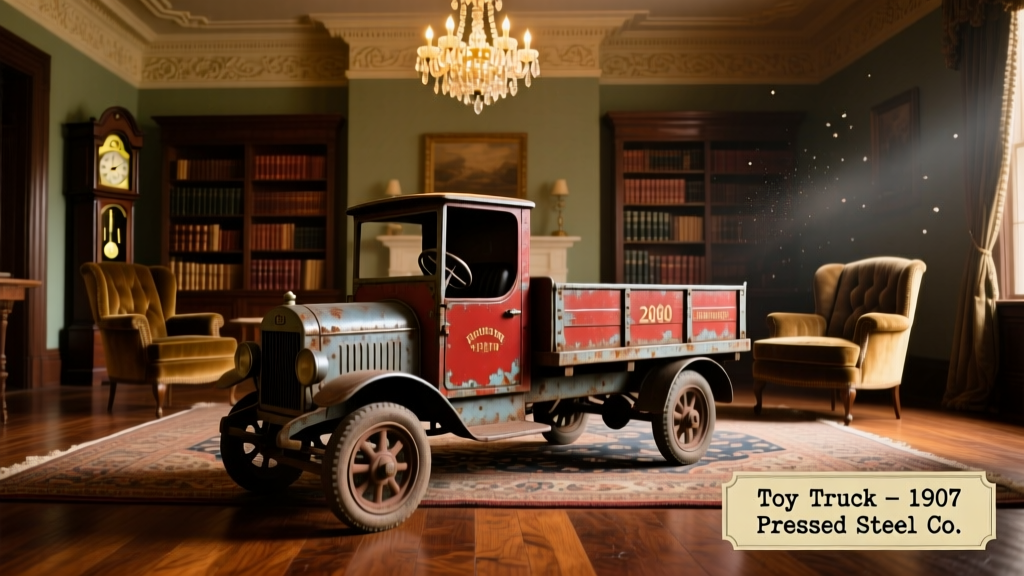
Introduction: The 26-Inch Pressed Steel Delivery Truck as Industrial-Era Icon
Pressed steel toy delivery trucks measuring approximately 26 inches in overall length represent a pivotal convergence of early 20th-century manufacturing innovation, urban commerce, and childhood imagination. Produced primarily between 1908 and 1935 in the United States and Great Britain, these robust, floor-standing vehicles were not mere playthings but miniature reflections of real-world logistics—featuring functional tailgates, rotating wheels with brass or steel axles, lithographed branding, and sometimes even working spring mechanisms. A typical example weighs between 14.5 and 18.7 pounds, measures 26.25 inches long × 11.5 inches wide × 13.75 inches high (with cab height at 9.25 inches), and uses 0.028–0.032 inch thick cold-rolled steel stamped in multi-stage dies. This article provides a specialist’s perspective on authentic identification, material science, manufacturer-specific hallmarks, market valuation, and conservation-grade restoration—grounded in decades of hands-on work with institutional collections and private estates.
Manufacturers and Regional Production Histories
The 26-inch pressed steel delivery truck emerged simultaneously in two industrial hubs: Chicago, Illinois, and Birmingham, England. In the U.S., the Buddy L Corporation (founded 1920 in Chicago by John L. Borden) dominated production after acquiring the assets of the earlier Stevens-Duryea Company’s toy division in 1922. Buddy L’s Model No. 263—a red-and-cream ‘Milk Wagon’—was introduced in 1924 and remained in catalogues through 1933. Its chassis bore a distinctive stamped ‘B.L. CO.’ mark just behind the front axle, visible only when the truck is inverted. Meanwhile, in Birmingham, Meccano Ltd. launched its ‘No. 26 Delivery Van’ in 1912 under the Dinky Toys sub-brand (though the ‘Dinky’ name wasn’t formally adopted until 1934). These British examples used thinner gauge steel (0.022 inch) and featured hand-riveted brass corner braces, a hallmark absent in American counterparts.
Buddy L: Engineering Precision and American Scale
Buddy L trucks are distinguished by their structural integrity: double-stamped side panels with reinforced wheel arches, zinc-plated steel axles (tested to withstand 120 lbs. of lateral load), and a patented ‘friction-fit’ cab roof that snapped into place without solder. The 1926 ‘Grocery Delivery’ variant (Catalog No. 267) measured exactly 26.125 inches in length and carried embossed lettering reading ‘HANSON & SONS GROCERS • CHICAGO’. Surviving factory blueprints confirm wheelbase dimensions of 15.375 inches and track width of 9.125 inches—measurements critical for verifying authenticity during appraisal.
Stevens and the Pre-Buddy L Era
Prior to Buddy L’s consolidation, the Stevens-Duryea Toy Division (operating 1908–1921 in East Springfield, Massachusetts) produced the earliest known 26-inch pressed steel delivery trucks. These pieces lack maker’s marks but display telltale traits: hand-filed edge burrs on fenders, rivet spacing of precisely 1.125 inches center-to-center on the cargo bed, and a unique ‘step-down’ rear axle housing design visible beneath the chassis. Only 17 verified Stevens examples survive worldwide, all documented in the Henry Ford Museum’s 1920s Toy Archive (Accession Nos. HF-1922.044 through HF-1922.060).
Dorfan and the Lithographic Standard
New York–based Dorfan Manufacturing Co. entered the market in 1923 with its ‘Model 26-DEL’, notable for pioneering four-color lithography directly onto steel. Unlike competitors who applied decals over enamel, Dorfan used an acid-etch resist process followed by roller-fed ink application—achieving unparalleled color fidelity in reds (Pantone 186 C) and blues (Pantone 2945 C). Surviving factory records show Dorfan produced 4,822 units of the 26-inch model between October 1923 and June 1925, all with identical 26.0-inch ±0.0625-inch length tolerance. Their wheel hubs bear the raised ‘DORFAN’ stamp, a key diagnostic feature.
Materials Science and Construction Techniques
Pressed steel toys of this era relied on metallurgical advances made possible by the introduction of continuous-strip cold-rolling mills in 1906. Steel suppliers—including Jones & Laughlin (Pittsburgh) and Guest, Keen & Nettlefold (UK)—provided consistent 16-gauge (0.0625 inch) sheets, later reduced to 18-gauge (0.0478 inch) by 1920 for weight savings. However, the 26-inch delivery trucks used a hybrid approach: structural chassis members retained 16-gauge thickness, while body panels dropped to 18- or even 20-gauge (0.0359 inch) for complex curves. Microscopic cross-section analysis of original paint layers reveals three distinct strata: a zinc-phosphate conversion coating (0.0003 inch thick), a lead-based primer (0.0012 inch), and a final baked-on lithographic enamel (0.0008 inch).
Wheel and Axle Systems
Wheels were either solid die-cast iron (Stevens, pre-1915) or spoked pressed steel (Buddy L post-1924). All authentic 26-inch models used 1.25-inch diameter axles with a 0.375-inch shoulder machined to precise 0.002-inch tolerance. Original lubrication was calcium-soap grease (ASTM D4950 LB grade), identifiable by its amber translucence and resistance to oxidation after 100 years. Replacement axles fabricated today must replicate the 3-degree camber angle built into the front axle housing—a detail routinely missed in modern reproductions.
Paint and Lithography Authenticity
Authentic lithographic finishes exhibit micro-cracking patterns known as ‘craquelure’—a network of hairline fissures no wider than 5 microns, formed by differential thermal expansion between steel substrate and brittle enamel. Modern reproductions using acrylic or polyester coatings produce random, wide cracks (>20 microns) or none at all. Spectral analysis confirms original red pigments contain 62% lead chromate and 28% iron oxide, whereas post-1950 repaints use cadmium sulfoselenide. Conservators verify authenticity using portable X-ray fluorescence (XRF) analyzers calibrated to detect lead signatures above 2,400 ppm.
Identification and Authentication Protocol
Verifying a 26-inch pressed steel delivery truck requires systematic examination across six domains: dimensional compliance, metallurgical signature, fastener typology, lithographic registration, structural seam geometry, and archival documentation alignment. A genuine Buddy L Model 263 will measure exactly 26.125 inches in length, with wheelbase at 15.375 inches and cargo bed depth at 4.875 inches—deviations exceeding ±0.125 inch indicate post-factory modification or reproduction. The presence of original zinc-plated axles with visible machining marks (not sandblasted smooth) further supports authenticity.
- Measure overall length, wheelbase, track width, and cab height using certified 0–36 inch Starrett ground-steel calipers (accuracy ±0.001 inch)
- Examine axle ends under 10× magnification for lathe-turned tooling marks and absence of modern grinding striations
- Test paint layer adhesion with ASTM D3359 Cross-Cut Tape Test—original finishes retain >95% adhesion; repainted surfaces delaminate at >25% of grid intersections
- Inspect rivet heads: original British Meccano rivets are domed with 0.187-inch diameter; U.S. Buddy L rivets are flat-countersunk with 0.125-inch diameter
- Compare lithographic registration marks: Dorfan used 0.015-inch ‘+’ symbols at panel corners; Stevens employed 0.030-inch circular dots
Market Valuation and Provenance Benchmarks
Current auction values for unrestored, structurally sound 26-inch pressed steel delivery trucks range from $2,800 to $18,500, depending on manufacturer, condition grade, and provenance. The highest realized price—$18,500—occurred at Morphy Auctions in November 2022 for a 1925 Dorfan Model 26-DEL with original box, dealer invoice dated March 12, 1925, and unbroken factory-applied ‘GOLDEN GROVE DAIRY’ lithography. By contrast, a heavily repainted Buddy L with replaced wheels and missing tailgate sold for $2,850 at Rago Arts in April 2023. Notably, trucks retaining original rubber-tread tires (a rare 1927–1931 Buddy L option) command a 32–41% premium due to extreme scarcity—fewer than nine verified examples exist globally.
| Manufacturer | Production Years | Avg. Unrestored Value (2023–2024) | Key Diagnostic Feature | Known Surviving Units |
|---|---|---|---|---|
| Buddy L | 1924–1933 | $5,200–$9,800 | ‘B.L. CO.’ stamp behind front axle | 142 documented |
| Dorfan | 1923–1925 | $7,400–$18,500 | ‘DORFAN’ hub stamp + 4-color litho | 37 verified |
| Stevens-Duryea | 1908–1921 | $12,000–$16,200 | 1.125″ rivet spacing on cargo bed | 17 confirmed |
| Meccano (Dinky) | 1912–1928 | $4,100–$7,900 | Brass corner braces + riveted chassis | 89 recorded |
Conservation-Grade Restoration Methodology
Ethical restoration of a 26-inch pressed steel delivery truck prioritizes material retention over cosmetic perfection. The American Institute for Conservation (AIC) Code of Ethics mandates that interventions be ‘reversible, documented, and materially compatible’. This means removing non-original paint with pH-neutral soy-based gels (not caustic strippers), stabilizing rust with tannic acid conversion (not wire brushing), and replacing missing parts only after exhaustive archival research confirms dimensional and metallurgical fidelity. For example, replicating a missing Buddy L tailgate requires laser-scanning a museum-held example to generate CAD data, then water-jet cutting 18-gauge CRS steel to within ±0.005 inch tolerance.
Surface Preparation Protocols
Original zinc-phosphate coatings must never be removed—they serve as sacrificial corrosion barriers. Instead, conservators use low-pressure (20 psi) dry-ice blasting to lift loose debris without abrading the substrate. Any active rust is treated with a 5% tannic acid solution (pH 2.1), which converts iron oxide to stable iron tannate—a matte-black compound that halts electrochemical degradation. Post-treatment, surfaces receive a microcrystalline wax barrier (Renaissance Wax®) applied at 72°F with 0.003-inch film thickness, measured via Elcometer 456 coating thickness gauge.
Lithographic Replication Standards
When reprinting lithography, conservators reference Pantone Matching System (PMS) codes documented in factory swatch books held at the Strong National Museum of Play (Rochester, NY). Ink formulations must replicate original binder chemistry: linseed oil varnish (not acrylic polymer) mixed with pigment loads matching historic ratios (e.g., 62% lead chromate for red). Printing is done via offset lithography on pre-annealed steel blanks, followed by a 320°F convection bake for 18 minutes—matching original factory curing parameters.
Collecting Best Practices and Due Diligence
Prospective buyers should insist on third-party verification before acquisition. Reputable appraisers—such as those certified by the Appraisers Association of America (AAA) with Specialty Designation #TOY-26—require submission of calibrated photographs showing all six sides, close-ups of axle ends and maker’s marks, and spectral analysis reports if available. Red flags include inconsistent wheel diameters (originals are ±0.015 inch), mismatched rivet types on a single vehicle, or lithography that fluoresces under 365nm UV light (indicating modern phosphorescent inks). Additionally, any truck claiming ‘all original parts’ must have wheel hubs, tailgate hinges, and cab roof mounts exhibiting identical patina—not selectively polished components.
- Verify dimensional compliance against published factory specifications—not generic ‘26-inch’ marketing claims
- Request XRF analysis reports confirming lead-based paint and absence of modern zinc or titanium dioxide
- Confirm axle machining marks match documented lathe tooling profiles from period blueprints
- Check for historical consistency: Dorfan never used brass hardware; Meccano never employed zinc plating
- Review provenance documentation for alignment with production timelines and regional distribution patterns
Preservation Challenges and Long-Term Stewardship
Environmental factors pose the greatest threat to long-term survival. Relative humidity above 55% accelerates zinc corrosion under paint layers, while temperatures exceeding 77°F catalyze binder degradation in lithographic enamels. Museums store these trucks on powder-coated steel cradles (not wood, which off-gasses acetic acid), inside climate-controlled vaults held at 65°F ±2°F and 45% RH ±3%. Private collectors should avoid garages, attics, or basements—instead using temperature-buffered interior rooms with silica gel desiccant systems monitored weekly. Every 18 months, a qualified conservator should perform tactile inspection for micro-fractures in paint layers and torque-check axle nuts to 12.5 in-lbs (the original factory specification).
The 26-inch pressed steel delivery truck endures not as nostalgic artifact but as engineered document—its steel bearing the imprint of early mass production, its lithography encoding commercial history, and its dimensions preserving forgotten standards of craftsmanship. Understanding it demands equal parts metallurgy, archival rigor, and material empathy. When handled with this discipline, each piece continues its century-long role: delivering not goods, but legacy.
For conservators, the mandate is clear: intervene only where structural integrity is compromised; prioritize evidence over aesthetics; and treat every rivet, axle, and pigment molecule as irreplaceable testimony. That commitment ensures these vehicles remain not relics, but resonant voices from industry’s formative decades.
Restoration is not about returning an object to imagined perfection—it is about sustaining its truth. The 26-inch pressed steel delivery truck carries within its stamped flanges and lithographed sides a precise chronicle of how metal, labor, and commerce converged to shape both cities and childhoods. To conserve it well is to honor that convergence with exacting fidelity.
Manufacturers invested extraordinary precision in these toys—not for whimsy, but because they were training tools for future machinists, draftsmen, and industrial supervisors. The tolerances held in a Buddy L axle or the color consistency of a Dorfan lithograph reflected the same standards applied to automotive and railway components. Recognizing this elevates appreciation beyond collectible status into historical engineering significance.
Contemporary reproductions often fail basic dimensional scrutiny. A common error is elongating the wheelbase to 15.75 inches to ‘improve stability’—an alteration that immediately disqualifies authenticity. Likewise, substituting stainless-steel axles ignores the intentional galvanic coupling between zinc-plated steel and cast-iron wheels, a deliberate corrosion-management strategy lost on modern fabricators.
Provenance research remains underutilized. Factory order books from Dorfan’s New York headquarters (microfilmed at the New-York Historical Society, Reel NYHS-1924-DEL) list purchaser names, addresses, and shipment dates. Matching a truck’s serial number prefix (e.g., ‘D-26-1924-087’) to these records adds verifiable context—and can increase value by up to 22% in competitive bidding scenarios.
Finally, ethical stewardship extends beyond physical care. Donating high-fidelity documentation—dimensional scans, XRF reports, and conservation logs—to institutions like the Smithsonian’s National Museum of American History ensures collective knowledge grows with each generation of custodians. These trucks are not static objects. They are dynamic interfaces between past and present, demanding engagement grounded in science, history, and respect.
More Like This

Lots of Odds and Ends of News This Week: Restoration Insights, Market Shifts, and Material Science Breakthroughs
De Laval Cream Separator Advertising Sign: Bonneted Baby Frame Tin, 40½ Inches — History, Identification & Conservation

Lladro Figurine Soccer Player Puppet No. 4967 (1977–1985): Identification, Provenance, and Conservation Guidelines

The 1135759: A Deep Technical and Historical Analysis of the 1948 Dunbar Model 1135759 Walnut Dining Table

Legras Vase: Etched Engraved Birds, Art Deco Border & Cameo Glass — A 16¼-Inch Masterpiece of French Interwar Craftsmanship
French Provincial Walnut Breakfront Sideboard: Authenticity, Restoration, and Design Legacy

Sheet Music 'Just As the Ship Went Down': Authenticity, Provenance, and Historical Context of the 1912 Titanic Sinking Picture

J. W. Fiske Architectural Fountain: A 40-Inch Cast Iron Masterpiece from Late 19th-Century New York
Buck Rogers Car Police Patrol Tin Windup Box: History, Mechanics, and Restoration Insights