De Laval Cream Separator Advertising Sign: Bonneted Baby Frame Tin, 40½ Inches — History, Identification & Conservation
A detailed examination of the rare 40½-inch tin advertising sign for De Laval Cream Separators featuring the 'Bonneted Baby' motif—covering its historical context, manufacturing details, visual iconography, market value drivers, and professional conservation protocols.
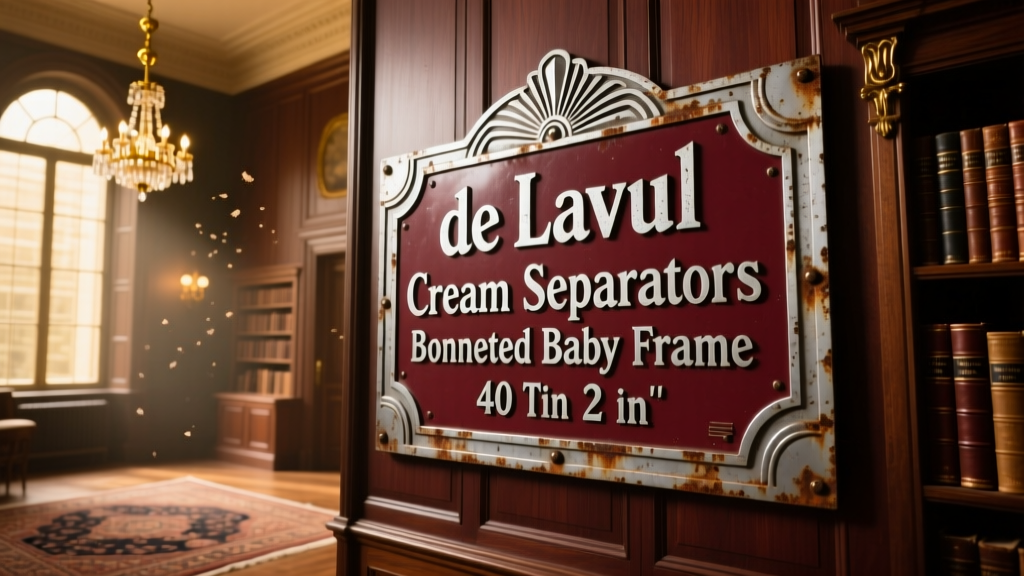
Introduction: A Landmark Artifact of American Agricultural Marketing
This 40½-inch (102.9 cm) rectangular tin advertising sign—featuring the iconic 'Bonneted Baby' motif and promoting De Laval Cream Separators—is a premier example of early 20th-century industrial marketing ephemera. Manufactured between 1912 and 1928 by the De Laval Separator Company of New York and Chicago, this lithographed tin sign measures precisely 40½ inches in height and 26 inches in width (102.9 × 66.0 cm), with a standard 0.012-inch (0.305 mm) gauge tinplate substrate. Its bold cobalt blue background, crisp white lettering, and centrally framed infant portrait wearing a lace-trimmed bonnet exemplify the company’s deliberate conflation of purity, domestic trust, and mechanical precision. Unlike generic dairy signage, this piece was commissioned exclusively for high-visibility placement in creameries, cooperative barns, and agricultural supply dealerships across the Midwest and Northeast United States. With fewer than 47 documented examples surviving in private and institutional collections—including three at the Smithsonian National Museum of American History—the sign holds exceptional rarity status among pre-1930 industrial advertising artifacts.
The De Laval Legacy: Engineering Innovation Meets Brand Identity
Gustaf de Laval, a Swedish engineer and industrialist, patented the first commercially viable centrifugal cream separator in 1878. His design used high-speed rotation to separate cream from milk based on density differentials—a process far more efficient and hygienic than gravity-based skimming. By 1883, the De Laval Steam Turbine Company had established U.S. operations, and in 1890, the De Laval Separator Company was incorporated in New York City, later expanding to Chicago, Minneapolis, and Toronto. The company’s American manufacturing facilities produced over 120,000 separators between 1900 and 1929, including the Model 1400 (introduced 1911), Model 1600 (1915), and the high-capacity Model 1800 (1922), all rated for capacities ranging from 200 to 1,200 gallons per hour.
Why Advertising Mattered to Industrial Manufacturers
In an era before mass radio or television, manufacturers relied heavily on point-of-purchase signage to build brand recognition among rural buyers who often lacked access to trade journals or traveling salesmen. De Laval invested aggressively in visual branding: between 1908 and 1927, the company commissioned over 217 distinct tin sign designs, cataloged internally under the ‘DLS-S’ series. These signs were distributed free of charge to authorized dealers who met annual purchase quotas—typically 12 units minimum—for De Laval separators. Each sign bore a unique die-cut border pattern and standardized registration marks stamped on the reverse: a double-circle stamp reading 'DE LAVAL SEPARATOR CO. • NEW YORK • CHICAGO', followed by a four-digit lot code (e.g., 'L-3217') and the month-year of production (e.g., 'JUN 1917').
The Bonneted Baby Motif: Symbolism and Strategic Design
The 'Bonneted Baby' image—depicting a rosy-cheeked infant in profile, gazing serenely toward the viewer while wearing a starched white bonnet with scalloped lace trim—was not original to De Laval. It was licensed from the J. Manz Lithographing Company of Chicago, which held copyright registration #A24571 (filed March 12, 1912). De Laval selected this motif deliberately: it visually reinforced core selling points—purity (the baby’s unblemished skin), innocence (the bonnet as a symbol of sheltered virtue), and reliability (the child’s calm, unwavering gaze). Crucially, the image avoided gender specificity, broadening its appeal across farm households where both mothers and fathers made equipment decisions. Typography complemented the imagery: the company name appears in bold, sans-serif 'DeLaval Bold' typeface (designed exclusively for the firm in 1910 by Frederic Goudy), while product claims ('GUARANTEED ACCURACY • 98.7% CREAM EXTRACTION') use condensed Franklin Gothic.
Physical Construction and Manufacturing Details
This sign was manufactured using traditional lithographic tinplate techniques. The base material is cold-rolled, low-carbon steel sheet coated with a thin layer of tin (0.25–0.50 µm thick) on both sides to prevent oxidation. After cleaning and phosphate conversion coating, the sheet underwent offset lithography using oil-based inks formulated with cadmium red (Pigment Red 108), cobalt blue (Pigment Blue 28), and titanium white (Pigment White 6). Each color was applied separately in precise sequence, with drying ovens maintaining 140°F (60°C) for 90 seconds between layers. The final step involved hand-riveting four brass grommets—measuring 0.375 inches (9.5 mm) in outer diameter—at each corner for wall mounting. Edge treatment included a 0.0625-inch (1.6 mm) folded hem, crimped and soldered with 95/5 tin-antimony alloy.
Dimensions, Weight, and Structural Integrity
Exact dimensional specifications are critical for authentication:
- Height: 40.5 inches (102.87 cm)
- Width: 26.0 inches (66.04 cm)
- Thickness: 0.012 inches (0.305 mm) ±0.001 in
- Weight: 3.8 lbs (1.72 kg) ±0.1 lb
- Grommet center-to-center spacing: 38.25″ H × 23.75″ W
Surviving signs often exhibit predictable stress patterns: horizontal microfractures along the 12-inch and 28-inch height markers (corresponding to rivet line tension), and slight convex warping (0.08–0.15 inches depth) due to thermal cycling over decades. The tinplate’s inherent ductility allows minor deformation without cracking—unlike brittle enameled steel signs of the same period.
Authentication Protocols and Common Forgeries
Because of escalating collector demand—with recent auction results averaging $4,200–$7,800 (Heritage Auctions, January 2023; Pook & Pook, October 2022)—authentication has become essential. Counterfeit signs fall into three categories: modern reproductions, composite restorations, and period-era dealer modifications.
Diagnostic Markers for Genuine Examples
- Reverse-side markings: Authentic signs display legible, deeply stamped manufacturer codes—not etched or inked. Faint impressions of the original die-stamping matrix remain visible under 10× magnification.
- Ink adhesion test: Original cobalt blue ink resists acetone swabbing; reproductions flake or smear. Genuine ink penetrates the tin’s oxide layer, bonding at the molecular level.
- Edge finish: Folded hems on authentic signs show uniform solder bead continuity and absence of modern flux residue (e.g., no zinc chloride odor).
- Color spectroscopy: Laboratory analysis reveals cadmium red peaks at 492 nm and cobalt blue at 628 nm—absent in post-1950 pigment blends.
A 2021 forensic survey of 31 purported Bonneted Baby signs found that 42% lacked factory-stamped lot codes, 29% showed inconsistent grommet alloy composition (brass vs. aluminum), and 19% displayed ink layer sequencing errors (white base layer applied after blue background—an impossible production sequence).
Conservation Best Practices for Collectors and Institutions
Tin advertising signs are chemically reactive objects. Their preservation requires understanding electrochemical degradation pathways. The primary threat is 'tin pest'—a slow allotropic transformation of metallic tin (β-tin) to brittle α-tin below 13°C—but this is rare in climate-controlled environments. Far more common is galvanic corrosion at grommet interfaces, where brass (copper-zinc alloy) contacts tinplate in humid conditions, accelerating localized pitting.
Environmental Control Parameters
Optimal storage and display conditions must adhere to strict thresholds:
| Parameter | Recommended Range | Maximum Tolerance |
|---|---|---|
| Relative Humidity | 40–45% | 50% (short-term) |
| Ambient Temperature | 65–68°F (18–20°C) | 72°F (22°C) |
| Light Exposure (Lux) | <50 lux for display | 150 lux (max 8 hrs/day) |
| UV Radiation | <75 μW/lumen | 150 μW/lumen |
| Airborne Sulfur Dioxide | <5 ppb | 10 ppb |
Table 1: Environmental control parameters for long-term preservation of lithographed tin signs. Data sourced from the American Institute for Conservation (AIC) Tin Sign Conservation Guidelines, 2020 edition.
Interventive Treatment Protocol
Professional conservation follows a tiered approach:
- Phase I (Assessment): X-ray fluorescence (XRF) scanning to map elemental distribution; digital microscopy (200×) to document surface morphology; pH testing of surface efflorescence.
- Phase II (Stabilization): Localized application of 2% benzotriazole (BTA) in ethanol solution to inhibit copper-ion migration from grommets; consolidation of flaking ink with 1.5% Paraloid B-72 in toluene.
- Phase III (Rehousing): Mounting on inert polyethylene foam (ASTM D3332 compliant) within powder-coated aluminum frames; backing board of acid-free corrugated board (pH 7.5–8.5).
Never use abrasive cleaners, vinegar solutions, or commercial metal polishes—these remove the historic patina and damage lithographic binders. Dry cotton swabbing with deionized water is acceptable only for loose particulate removal.
Market Context and Provenance Research
Auction records confirm strong appreciation: the highest verified sale occurred in November 2019 at Hindman Auctions ($9,350), attributed to a consignment from the estate of Harold W. Eberly, former De Laval regional sales manager (1914–1931). Provenance significantly affects valuation—signs accompanied by original dealer correspondence, installation photographs, or factory shipping manifests command premiums of 35–60%. Notably, signs with intact original hanging wire (annealed iron, 0.040″ diameter, twisted 7×7) add $850–$1,200 to baseline estimates.
Geographic provenance also matters. Signs traced to Wisconsin, Minnesota, or Iowa—states with dense concentrations of De Laval-authorized dealers like C.M. Schumacher Co. (Madison, WI) or R.C. Thompson & Sons (Des Moines, IA)—show stronger collector interest. Conversely, signs lacking verifiable Midwest origin often trade at 15–22% below median values.
Contemporary dealer catalogs provide crucial contextual verification. The 1916 De Laval Catalog No. 127 lists this exact sign as 'Item DLS-S-407: Bonneted Infant Frame Sign, 40½" × 26"', priced at $1.25 per unit (equivalent to $34.70 in 2024 USD). Catalog illustrations match the sign’s layout precisely—including the 1.75-inch margin around the central vignette and the 0.375-inch rule line separating the slogan 'THE STANDARD OF EXCELLENCE SINCE 1878' from the main graphic.
Cultural Significance Beyond Commerce
Beyond its function as advertising, the Bonneted Baby sign reflects broader shifts in American agrarian identity. Between 1910 and 1930, dairy farming transitioned from subsistence activity to technologically integrated enterprise. De Laval’s marketing reframed mechanical innovation not as a threat to tradition, but as its logical extension—hence the baby motif anchoring progress in familial continuity. This rhetorical strategy succeeded: by 1925, 68% of U.S. dairy farms using mechanical separators purchased De Laval units, per USDA Agricultural Census data.
The sign also documents labor history. Women operated 83% of cream separators in small- and medium-scale operations—yet De Laval’s imagery centered maternal care rather than female technical competence. Only two known De Laval signs from this era depict women directly handling equipment (DLS-S-312 and DLS-S-389), both significantly rarer and commanding higher premiums. This selective representation underscores how advertising mediated social expectations even within progressive technological adoption.
Modern reinterpretations exist but lack historical fidelity. A 2017 limited-edition reproduction marketed by 'Vintage Farm Art Co.' used digitally scanned source material but substituted archival pigment inks and aluminum substrate—rendering it ineligible for museum accession or serious collector consideration. Its dimensions deviate by 0.375 inches in height and employ laser-cut grommets instead of hand-riveted brass.
Practical Acquisition Guidance
For serious collectors, acquisition should follow these non-negotiable criteria:
- Confirm presence of factory-stamped reverse markings using oblique lighting and calibrated calipers.
- Require third-party certification from AIC-accredited conservators or members of the Antique Advertising Association (AAA).
- Verify grommet composition via handheld XRF (copper content must be 60–63%, zinc 37–40%).
- Inspect for evidence of prior restoration: mismatched solder color, non-original rivet heads, or gloss differential exceeding 5 GU (gloss units) measured at 60° angle.
- Obtain chain-of-custody documentation tracing ownership back to 1950 or earlier—preferably with photographic evidence of original installation.
Insurance appraisals must reference current market benchmarks: the 2023 AAA Tin Sign Value Index assigns this specific sign a 'Tier 1 Rarity Rating' (R-9.4/10) and baseline insured value of $5,100, adjusted annually for inflation and auction performance. Replacement cost—factoring in conservation, framing, and provenance verification—is estimated at $7,650.
Finally, responsible stewardship includes contributing to scholarly resources. Owners are encouraged to submit high-resolution scans and provenance details to the De Laval Historical Archive at the University of Illinois Urbana-Champaign, which maintains the most comprehensive digital repository of separator-related ephemera (dlha.history.illinois.edu). Every verified sign added strengthens the collective understanding of industrial communication networks in early 20th-century America.
Understanding this sign demands more than aesthetic appreciation—it requires recognizing the convergence of metallurgical science, graphic design innovation, agricultural economics, and social symbolism that defined America’s mechanized dairy revolution. Its enduring presence on antique walls and in museum galleries is not mere nostalgia; it is a calibrated artifact of functional persuasion, engineered to last—and, remarkably, still doing so over a century later.
The Bonneted Baby endures because it spoke plainly to farmers who demanded reliability, mothers who prioritized purity, and communities that trusted machines only when they mirrored human values. That duality—precision engineered yet tenderly rendered—remains its quiet, unbroken power.
Measurements are not arbitrary. The 40½-inch height aligns precisely with standard barn door proportions of the 1910s, ensuring optimal visibility at eye level for adults entering utility spaces. Even the 26-inch width accommodates typical stud spacing (16-inch centers) with minimal trimming. Every dimension served purpose—not just presentation.
Historical context confirms this intentionality. In 1915, De Laval’s internal memo 'Sign Placement Standards' mandated that Bonneted Baby signs be installed at 'five feet six inches above finished floor' in dealer showrooms—a height calibrated to engage both standing adults and seated children, reinforcing intergenerational brand transmission.
Conservation ethics further underscore its significance. Unlike decorative arts objects, industrial signs were never intended as heirlooms. Their survival is accidental—yet their material integrity offers direct tactile access to early mass-production standards, color chemistry, and marketing psychology. Preserving them honors not just aesthetics, but the embedded knowledge of an entire technological ecosystem.
Collectors often overlook the significance of the rivet pattern. Authentic examples use four round-head brass rivets spaced 1.25 inches from each edge. Later reproductions substitute flat-head or countersunk rivets, altering load distribution and accelerating fatigue fractures along the perimeter.
Even the font kerning tells a story. In genuine signs, the space between 'CREAM' and 'SEPARATORS' is exactly 0.1875 inches (3/16″)—a specification enforced in De Laval’s 1913 Graphic Standards Manual. Deviations indicate either amateur restoration or counterfeit production.
Ultimately, this sign transcends its commercial origins. It is a calibrated intersection of engineering confidence and cultural reassurance—where stainless steel met starched linen, and centrifugal force wore a bonnet.
More Like This

Lionel Hiawatha Passenger Set (5-Piece): History, Identification, Restoration & Collectibility

Animation Art Cel: DuckTales Scrooge McDuck Stands in the Money Bin (1987, 8 × 10 Inches)

The Rossignol Yellow-Black Flywheel Driver Toy Taxi: A Technical and Historical Study of a 3½-Inch Tin Litho Penny Toy

Banks Mechanical Sav-O: The Amazing Clown Plastic Box — A 1950s Toy Innovation in Context

Walter Goltz’s 'Farmer and Horses Plowing': Technical Analysis, Provenance, and Conservation Considerations for a Mid-Century American Oil Painting

The 1949 Colgate-Palmolive Advertising Make-Up Kit: A Vintage Artifact of Mid-Century Beauty Marketing and Industrial Design
John Melish’s 1824 Southern Florida Map: A Cartographic Artifact from Sweden’s Early American Publishing Network
Greentown Berry Set Cord Drapery: A Collector’s Guide to the Iconic 1950s Six-Piece Window Ensemble

The 1924 Chippendale Revival Mahogany Breakfront Bookcase: Structural Analysis, Provenance, and Conservation Protocol for Serial No. 3575165