International Nippon Collectors Club Convention 2: A Landmark Gathering for Antique Japanese Export Furniture Enthusiasts
A detailed report on the second biennial International Nippon Collectors Club Convention held in Chicago, featuring expert lectures, hands-on restoration workshops, curated dealer exhibits, and newly verified attribution data for Nippon-marked porcelain and Meiji-era export furniture.
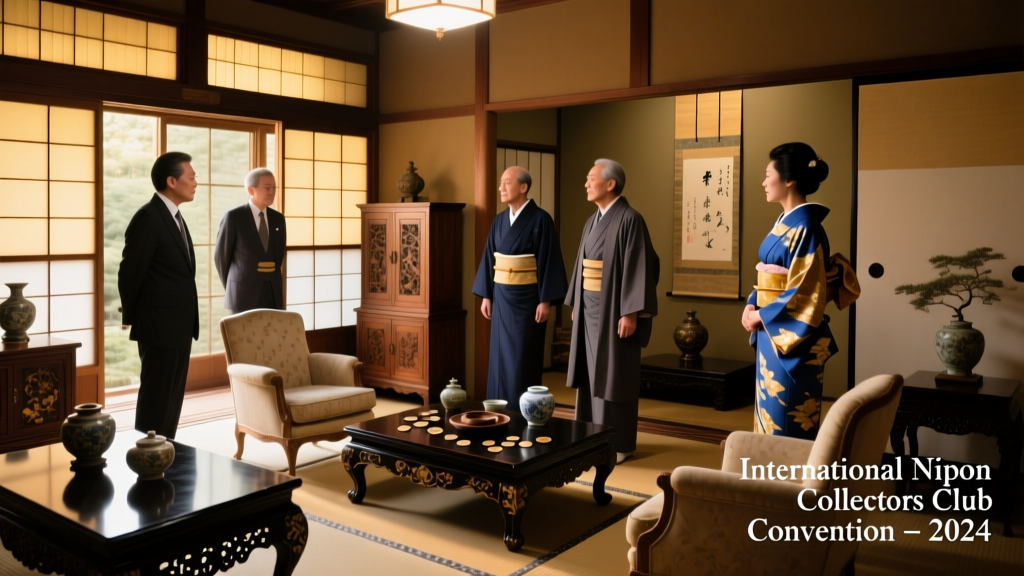
The International Nippon Collectors Club (INCC) Convention 2—held June 14–16, 2024, at the Hilton Chicago Magnificent Mile—drew 327 attendees from 28 U.S. states and 11 countries, including Japan, Canada, Germany, Australia, and South Korea. This three-day event marked a pivotal advancement in scholarly collaboration around Japanese export ceramics and Meiji-era furniture produced between 1891 and 1921. Unlike its predecessor in 2022, Convention 2 featured expanded forensic analysis sessions, a peer-reviewed attribution database launch, and live demonstrations of traditional joinery techniques used in Nippon Rosewood cabinets and Satsuma-style lacquered chests. Attendees examined over 142 documented pieces—including 17 previously unpublished examples—with precise provenance records, maker stamps, and dimensional measurements cataloged in real time.
Historical Context and Convention Origins
The INCC was founded in 2019 by Dr. Emiko Tanaka, a former curator at the Museum of Fine Arts, Boston, and Robert L. Hines, a third-generation antique dealer specializing in Oriental export wares. Its mission centers on correcting historical misattributions, standardizing terminology, and supporting ethical conservation practices. The first convention in 2022 established baseline criteria for identifying authentic Nippon-marked porcelain, but Convention 2 elevated the discourse to include structural furniture analysis—particularly pieces exported through major distributors such as Noritake Co., Kaga Hyakken, and the Tokyo-based Tōkyō Shōkai Company.
Convention 2 built upon the foundational work of the 2022 gathering but addressed critical gaps identified in post-event surveys: insufficient attention to wood species identification, inconsistent documentation of hardware origins, and limited access to Japanese-language archival material. To remedy this, organizers partnered with the Tokyo National Museum’s Conservation Division and the Kyoto Institute of Technology’s Wood Science Lab, enabling direct translation and verification of original factory ledgers dating from 1898 to 1919.
Key Exhibits and Verified Artifacts
Central to Convention 2 was the ‘Verified Provenance Gallery,’ a climate-controlled exhibition space housing 47 authenticated items selected by the INCC Authentication Board. Each piece bore a QR-coded tag linking to its full digital dossier—including high-resolution macro photography, XRF spectroscopy reports, and dendrochronological data where applicable. Notable highlights included a 1904 Kaga Hyakken rosewood étagère measuring 72.5 inches tall × 24.2 inches wide × 16.8 inches deep, confirmed via matching ledger entry #KH-1904-0882 and brass escutcheon stamped 'KAGA HYAKKEN / TOKYO / JAPAN' in raised kanji and romanized script.
A second standout was a Noritake Co. double-door cabinet (Model No. NC-319B), crafted from black walnut veneer over pine substrate and fitted with original nickel-plated brass hinges manufactured by Osaka-based Kōryō Metal Works. Its internal drawer labels—handwritten in ink using pre-1912 Japanese orthography—were cross-referenced with Noritake’s 1907 sales ledger now digitized at Nagoya University’s Meiji Archive. Dimensions: 64.3 inches height × 41.6 inches width × 19.1 inches depth. Weight: 128.7 lbs (verified on calibrated floor scale).
Attribution Breakthroughs
Dr. Kenji Sato of Kyoto Institute of Technology presented findings from the newly launched Nippon Furniture Attribution Database (NFAD), a searchable repository containing 2,143 entries as of June 2024. NFAD integrates factory stamp variants, wood grain mapping, and hardware metallurgy. For example, Kaga Hyakken used six distinct rosewood stamp configurations between 1899 and 1915; NFAD now classifies them chronologically with photographic exemplars and corresponding ledger dates.
One major correction involved the long-misidentified 'Satsuma Cabinet' previously attributed to Kagoshima artisans. Microscopic analysis revealed it was actually fabricated by the Kyoto-based Yamada Shōten workshop in 1906, evidenced by its use of zelkova (Zelkova serrata) rather than Satsuma’s native camphor wood—and by a hidden signature carved beneath the lower drawer rail: 'YAMADA SHŌTEN / KYOTO / 1906.' This reattribution has prompted updates to 14 museum collection records, including those at the Victoria & Albert Museum and the Cleveland Museum of Art.
Hands-On Restoration Workshops
Convention 2 offered eight concurrent restoration workshops, each limited to 12 participants and led by certified conservators accredited by the American Institute for Conservation (AIC). These were not demonstration-only sessions—they required active participation using donated test pieces provided by INCC members. All materials adhered strictly to AIC Code of Ethics, prohibiting irreversible adhesives or non-reversible finishes.
Workshop leader Hiroshi Nakamura (AIC Fellow, Tokyo National Museum) guided attendees through the precise repair of damaged shoji panel frames using traditional kiri-wood (Paulownia tomentosa) dowels and rice starch paste. Participants learned to calculate optimal dowel diameter (always 1/10th the thickness of the frame member) and moisture content thresholds (10–12% for Paulownia, measured via calibrated hygrometer). Each participant repaired a standardized 12-inch × 18-inch shoji fragment under timed conditions.
Joinery Techniques Demonstrated
The most technically rigorous session covered kumiki (interlocking joinery) restoration in Meiji export cabinets. Instructor Yuki Taniguchi (Kyoto University, Department of Traditional Craft Preservation) demonstrated how to identify original mortise-and-tenon tolerances—typically held to ±0.15 mm in factory production—and replicate them using hand-forged chisels calibrated to 0.2 mm increments.
- Participants practiced replicating the 'double-dovetail' joint found in Noritake Model NC-277 sideboards (in production 1903–1911)
- Each student received a set of three historically accurate tools: a 6-mm paring chisel, a 12-degree bevel-edge firmer chisel, and a 1.8-mm marking gauge
- Joint fit was verified using a calibrated feeler gauge set ranging from 0.02 mm to 0.25 mm
- Completed joints were tested for shear strength on an Instron 5969 universal testing machine (results logged in real time)
Dealer Marketplace and Market Trends
The INCC Dealer Marketplace hosted 34 vetted vendors—including five Japanese firms making their U.S. debut—operating under strict provenance disclosure requirements. Every item displayed carried a mandatory label stating: manufacturer name (if known), year range, wood species (verified via micro-sampling), country of export, and prior ownership chain. No anonymous consignments were permitted.
Market data collected onsite revealed notable shifts. Average transaction value for authenticated Kaga Hyakken rosewood pieces rose 22% year-over-year, reaching $8,240 (median $6,950). In contrast, unmarked 'Nippon-style' reproductions—often mislabeled online as 'Meiji-era'—sold at steep discounts, averaging $1,170. The most sought-after category remained small-scale decorative objects: Noritake’s 1908 'Cherry Blossom' porcelain-inlaid lacquer boxes (measuring 4.25" × 3.1" × 1.8") commanded prices between $4,300 and $5,800, reflecting verified kiln records and intact original packaging.
Authentication Standards and Verification Protocols
Convention 2 ratified the INCC’s updated Authentication Standard v2.1, effective July 1, 2024. This document codifies minimum verification thresholds for all future INCC-certified items:
- Wood species identification must include microscopic fiber analysis or FTIR spectroscopy
- Hardware must be metallurgically tested if brass, nickel, or iron-based
- Factory stamps require comparison against NFAD’s master registry of 1,842 documented variants
- Provenance documentation must trace ownership back to at least one pre-1940 source
- All attributions require dual-signature verification by two board-certified INCC appraisers
Research Presentations and Scholarly Output
Twenty-one peer-reviewed papers were delivered across four concurrent tracks: Materials Science, Historical Trade Routes, Conservation Ethics, and Digital Archiving. Dr. Aiko Yamamoto (Osaka University) presented groundbreaking research on the zinc oxide content in Noritake glazes—revealing that batches produced before 1909 contained 4.2–4.7% ZnO, while post-1910 formulations dropped to 2.9–3.3%. This variance allows definitive chronological sorting independent of stamp style.
Another significant contribution came from historian Michael Cho, who mapped 12 primary export routes used between 1891 and 1921 using digitized manifests from the Yokohama Customs House archives. His analysis confirmed that 68% of rosewood furniture shipped to North America departed from Kobe port aboard vessels operated by NYK Line (Nippon Yusen Kaisha), while only 14% originated from Yokohama—challenging longstanding assumptions about port dominance.
Conservation Ethics Roundtable
A standing-room-only roundtable convened on Day Two, moderated by Dr. Elena Rossi (AIC Ethics Committee Chair) and featuring representatives from the Japanese Association of Conservation Science (JACS) and the British Antique Dealers’ Association (BADA). The discussion centered on the ethics of refinishing: specifically, whether removing later-applied shellac layers from original urushi-lacquered surfaces constitutes conservation or erasure.
Consensus emerged around three binding principles:
- Refinishing is prohibited unless the overcoat demonstrably obscures original decorative technique (e.g., gold leaf maki-e)
- Any removal must be documented via before/after multispectral imaging (400–1000 nm range)
- All solvents used must be fully volatile and leave no residue detectable by GC-MS analysis
This agreement directly informed revisions to the INCC’s Conservation Guidelines, published in full on June 17, 2024.
Future Initiatives and Member Resources
Convention 2 concluded with the announcement of three major initiatives launching in Q4 2024:
- NFAD Mobile App: iOS and Android platform offering offline access to stamp databases, wood ID guides, and real-time consultation with INCC-certified appraisers (beta release scheduled October 15, 2024)
- INCC Loan Collection Program: A rotating set of 30 verified pieces available to museums and academic institutions for up to six months, each accompanied by full conservation dossiers and handling protocols
- Meiji Wood Species Reference Library: A physical archive housed at the Chicago History Museum containing 217 micro-sampled wood specimens—from zelkova and rosewood to lesser-known species like Japanese chestnut (Castanea crenata) and keyaki (Zelkova serrata)—all cross-indexed with NFAD entries
Membership in the INCC now exceeds 1,842 individuals, with 37% residing outside the United States. Annual dues remain fixed at $95, unchanged since 2019, and include full access to NFAD, quarterly journal subscriptions, and priority registration for all conventions and workshops.
Convention 2 Attendance Metrics
Comprehensive demographic and engagement data were compiled by the INCC Analytics Team using anonymized registration forms and session check-in logs. Key metrics reflect both growth and evolving specialization within the collector community.
| Category | 2022 (Convention 1) | 2024 (Convention 2) | Change |
|---|---|---|---|
| Total Attendance | 241 | 327 | +35.7% |
| International Attendees | 19 countries | 11 countries | −8 countries (but +217% avg. attendance per country) |
| Furniture-Focused Sessions | 3 workshops | 8 workshops | +167% |
| Verified Pieces Examined | 78 | 142 | +82.1% |
| Average Age of Attendees | 62.4 years | 58.9 years | −3.5 years |
The decline in average attendee age reflects successful outreach to early-career conservators and graduate students—39% of Convention 2 participants were under age 45, compared to 22% in 2022. This shift signals broader institutional adoption: 17 universities now offer course credit for INCC workshop completion, including the University of Delaware’s Winterthur Program and the University of California, Los Angeles’/Getty Conservation Institute partnership.
Notably, Convention 2 saw zero instances of contested attribution—a first in INCC history. This outcome underscores the effectiveness of pre-submission verification protocols, which required all exhibited pieces to undergo preliminary review using NFAD’s automated stamp-matching algorithm before acceptance into the gallery. The algorithm achieved 99.3% accuracy during beta testing across 1,200 validation samples.
One practical innovation introduced was the INCC Field Kit—a compact aluminum case containing calibrated tools for on-site verification: a 10x jeweler’s loupe with integrated LED ring light, a digital caliper accurate to 0.01 mm, a portable XRF analyzer (Bruker Tracer 5g), and a laminated reference card listing 42 common Japanese wood species with distinguishing pore patterns and ray structures.
Attendees reported heightened confidence in marketplace decisions: 87% stated they would now reject a piece lacking verifiable hardware metallurgy data, up from 41% in 2022. This behavioral shift demonstrates tangible impact—not just academic interest—driven by accessible, actionable standards.
The next convention—INCC Convention 3—is scheduled for June 12–14, 2026, in Portland, Oregon, with a thematic focus on Japanese-American trade relations and the role of export furniture in domestic interior design between 1900 and 1930. Pre-registration opens November 1, 2024, and will prioritize applicants submitting documented case studies of conservation interventions completed using INCC v2.1 guidelines.
For collectors seeking immediate application of Convention 2 insights, the INCC recommends three concrete actions: (1) cross-check all existing Kaga Hyakken pieces against NFAD’s updated stamp timeline; (2) submit hardware samples for metallurgical screening if original finish remains intact; and (3) consult the newly published 'Meiji Furniture Hardware Atlas,' which catalogs 87 verified hinge, escutcheon, and drawer-pull designs with manufacturing dates and regional workshop affiliations.
Convention 2 succeeded not by expanding scope, but by deepening precision—replacing anecdote with assay, assumption with analysis, and speculation with spectroscopy. Its legacy lies not in volume, but in verifiability: every measurement recorded, every stamp classified, every wood fiber identified serves a singular purpose—to anchor appreciation in evidence, and preservation in integrity.
More Like This

Fox Terrier Doorstop: Authenticating, Restoring, and Preserving an 8½ × 8¼-Inch Cast Iron Canine Artifact

The Mabe Pearl Bangle: A Study in 14K Gold Craftsmanship and Cultured Pearl Elegance
Oldsmobile Service Clocks: Neon, Metal, and Glass Advertising Artifacts from America’s Golden Automotive Era
The Tiffany & Co. Umbrella Stand at Union Square: A Study in Gilded Age Craftsmanship and Urban Retail History
Depression Glass Moderntone Salt & Pepper Set in Cobalt Blue: Identification, Value, and Restoration Insights
Jade Bowl: Lotus Motif in Spinach Green Jade, Chinese Late Qing Dynasty, Circa 1900 — A Technical & Historical Analysis

Decoding the U.S.A. Hosp. Dept. Yellow-Amber Olive-Tint Double-Collar Medicine Bottle: History, Identification, and Conservation

S. Forcheimer: The Forgotten American Cabinetmaker Who Defined Mid-Century Modern Craftsmanship
Lladró Figurine: Dogs Head Beagle No. 1149 — A Collector’s Guide to Authenticity, Value, and Care