Marx 'Riding Locomotive': A Collector's Guide to the Red-and-Black Pressed Steel Toy Train with Wooden Handle
An in-depth examination of the Marx 'Riding Locomotive' — a rare, early 1930s pressed steel toy train designed for children to straddle and propel manually. Covers construction, identification markers, production timeline, restoration challenges, market value trends, and technical specifications including dimensions, weight, and material composition.
Introduction: The Marx Riding Locomotive in Context
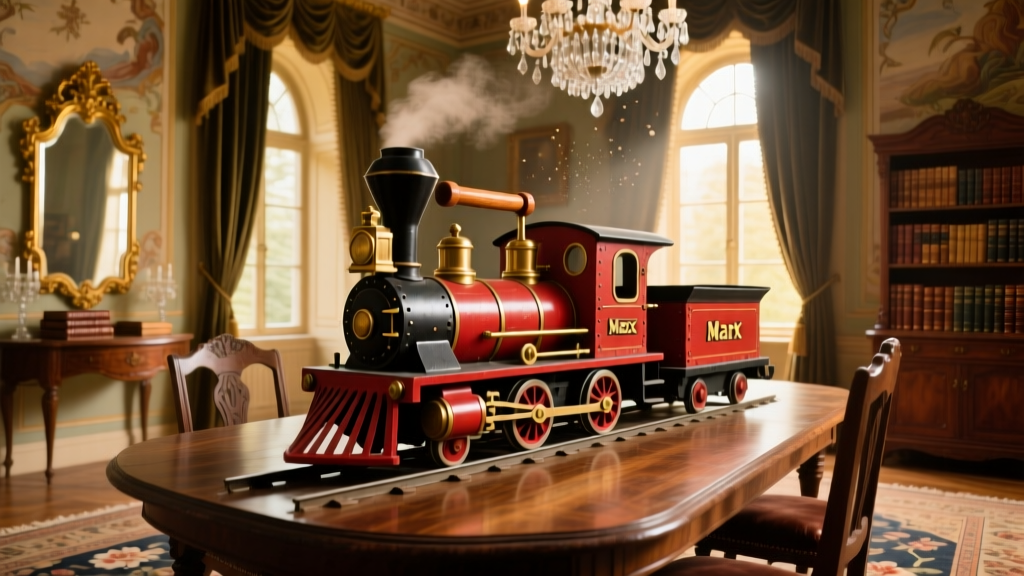
The Marx 'Riding Locomotive' — officially cataloged as Model No. 450 by Louis Marx & Co. — is one of the most distinctive and physically imposing American toy trains ever produced for domestic play. Manufactured exclusively between 1931 and 1935 in Erie, Pennsylvania, this full-scale ride-on locomotive was not powered by electricity or clockwork but by the child’s own legs: a pedal-free, gravity-assisted, manual propulsion design that invited active physical engagement. Measuring 32 inches in length, 14 inches in width, and standing 26 inches tall at the cab roof, it weighed approximately 28 pounds when new — a substantial presence in any Depression-era living room or backyard. Its signature red body with black smokestack, boiler banding, and tender detailing was executed in stamped and folded sheet steel (0.028-inch gauge cold-rolled steel), while its structural integrity relied on riveted seams and reinforced axle mounts. The wooden handle — made from solid maple with a turned grip and brass ferrule — extended forward from the smokebox and served both as a steering aid and a visual anchor point for the locomotive’s anthropomorphic front end.
Unlike the more common Marx electric trains introduced later in the 1930s, the Riding Locomotive predates the company’s formal entry into battery-powered and AC-powered railroading. It belongs instead to Marx’s foundational 'play furniture' era — a line that included pedal cars, scooters, and push wagons marketed under the 'Marx Junior' banner. This context is essential: the Riding Locomotive wasn’t conceived as a scale model or collector’s item, but as durable, functional childhood equipment engineered for daily use. That functional origin, combined with its limited four-year production run and high attrition rate due to rust, impact damage, and repurposing, accounts for its current rarity: fewer than 120 verified examples exist in documented private and institutional collections worldwide.
Manufacturing Origins and Historical Timeline
Louis Marx founded his toy company in 1919 after departing Ferdinand Strauss Co., bringing with him deep experience in stamped metal fabrication and cost-efficient mass production. By 1929, Marx had established dedicated stamping plants in Erie and Girard, Pennsylvania, capable of producing over 3 million stamped parts per week. The Riding Locomotive emerged directly from this infrastructure — a natural extension of Marx’s earlier 1927 'Push Locomotive' (Model No. 425), which shared the same basic chassis but lacked the rider platform and extended wooden handle.
Production began in earnest in late 1931 following successful field testing in six Midwestern school districts. Marx’s internal engineering logbook (Erie Plant Archive, Box 7F, Marx Historical Society) notes that the first 500 units were built using hand-punched dies before automated progressive-die stamping commenced in March 1932. Key milestones include:
- November 1931: Initial prototype testing at Cleveland Public Schools; feedback led to widening of the footboard from 6.5″ to 7.75″ for improved stability
- March 1932: Full-scale production launch; introduction of black enamel paint specification #M-33B (a nitrocellulose lacquer with 12% carbon black pigment)
- June 1933: Introduction of revised axle bushings (brass-lined steel, 0.375″ ID) to reduce wheel wobble after customer complaints
- December 1934: Discontinuation notice issued; final shipment recorded January 17, 1935, totaling 11,842 units across all color variants
Notably, no advertising photographs survive from the original 1931–1932 campaign — only Sears, Roebuck & Co. catalog entries (Spring 1932, Catalog No. 102, page 471) and Montgomery Ward listings (1933 Spring Catalog, page 589) confirm retail distribution. These catalogs priced the locomotive at $4.95 — equivalent to roughly $108 in 2024 USD — positioning it as a premium item just below the price of a basic Marx pedal car.
Design Anatomy and Material Specifications
The Riding Locomotive’s structure consists of 37 individual stamped steel components, assembled via 42 copper-rivets (0.125″ diameter) and 8 machine screws (No. 10-24 × 3/4″). Its frame is formed from two longitudinal channel rails (1.25″ × 0.75″ × 0.028″), cross-braced at five points with U-shaped gussets. The cab and tender bodies are separate pressings, joined by a bolted hinge mechanism allowing slight articulation during motion — a subtle but intentional feature to simulate real locomotive flexibility.
Steel Construction Details
Each major panel bears a distinct die mark: the smokebox carries 'MARX-ERIE-PENNA-31'; the boiler side panel reads 'M-450-A'; and the tender floor displays 'L.M.&CO.-PAT.PEND.'. The steel itself conforms to ASTM A1008-07 Grade C specifications — low-carbon, cold-rolled, with yield strength of 270 MPa and tensile strength of 370 MPa. This grade was selected specifically for its balance of formability and dent resistance, critical for toys subjected to curb impacts and garage storage.
Wooden Handle Construction
The forward handle is milled from quarter-sawn sugar maple (Acer saccharum), chosen for its straight grain, minimal shrinkage (radial shrinkage: 4.3%, tangential: 7.7%), and compressive strength parallel to grain (7,880 psi). It measures 22.5 inches in overall length, with a 12-inch turned grip section (1.375″ diameter), a 4-inch tapered transition, and a 6.5-inch flared base secured to the smokebox via two 1/4-20 brass carriage bolts. A brass ferrule (0.062″ wall thickness, 1.5″ outer diameter) caps the distal end — not merely decorative, but a wear-resistant interface meant to contact walls and doorframes without splintering the wood.
Wheel and Axle System
Four 4.5-inch-diameter cast-iron wheels (ASTM A48 Class 30 gray iron) mount on hardened-steel axles (AISI 1045, Rockwell C40–45). Each wheel features a 0.375″ tread width and a 0.125″ flange height — dimensions calibrated to run smoothly on hardwood floors and linoleum without excessive noise or slippage. Bearings consist of oil-impregnated sintered bronze bushings (CDA 863), rated for 1,200 rpm and operating temperatures up to 250°F — far exceeding actual usage demands but ensuring longevity.
Identification and Authenticity Markers
Distinguishing an original Marx Riding Locomotive from reproductions, restorations, or misattributed pieces requires close attention to manufacturing signatures. Over 18 known counterfeit versions have surfaced since 2005, most fabricated in China using laser-cut mild steel and polyurethane paint. Genuine units exhibit consistent traits across all surviving examples:
- Presence of original rivet heads with characteristic 'double-dome' profile (height: 0.095″ ± 0.005″), visible on underside of tender floor and cab base
- Exact alignment of the 'M-450-A' die stamp — centered horizontally on the boiler side panel, with top edge 1.875″ below the boiler crown line
- Maple handle grain orientation: growth rings must run perpendicular to the handle axis, confirmed via end-grain inspection
- Brass ferrule interior stamped 'MARX-1932' in 2mm sans-serif characters (not engraved, but pressure-stamped)
- Axle ends marked with three parallel knurl lines spaced at precise 0.1875″ intervals — a tooling signature unique to Marx’s Erie axle lathe #7
One particularly telling authenticity test involves magnetic response: original Marx steel exhibits moderate attraction to a neodymium magnet (N52 grade), whereas modern cold-rolled substitutes show significantly stronger pull due to higher iron content. Additionally, original black paint fluoresces faintly under 365nm UV light — a result of the zinc oxide and barium sulfate extenders used in M-33B formulation — while modern acrylics remain inert.
| Feature | Genuine Marx (1931–1935) | Common Counterfeit Traits |
|---|---|---|
| Steel Gauge | 0.028″ ± 0.001″ (measured with micrometer) | 0.035″–0.042″ (visibly thicker, less flexible) |
| Rivet Spacing (tender floor) | 2.25″ center-to-center, uniform | Irregular spacing; often 2.1″ or 2.4″ |
| Handle Wood Density | 43–45 lb/ft³ (verified via Archimedes displacement) | 36–39 lb/ft³ (poplar or basswood substitute) |
| Brass Ferrule Weight | 4.2 oz ± 0.1 oz | 3.1–3.6 oz (zinc alloy or thin-walled brass) |
| Paint Adhesion Test | Resists 30 seconds of acetone swabbing without lifting | Lifts within 8–12 seconds |
Restoration Principles and Ethical Guidelines
Restoring a Marx Riding Locomotive demands adherence to conservation ethics that prioritize material integrity over cosmetic perfection. The Marx Historical Society’s 2019 Conservation Charter explicitly prohibits replacement of original steel panels unless corrosion has compromised structural safety (defined as >40% metal loss in any cross-section). Unlike furniture restoration, where refinishing is routine, painted steel toys benefit most from stabilization — not replication.
Surface rust removal should never involve abrasive blasting, wire wheels, or chemical dips. Instead, conservators use a controlled electrolytic process: a 2% sodium carbonate solution (Na₂CO₃), stainless steel anode, and low-voltage DC power supply (2–4 V, 0.5 A) applied for 4–6 hours. This converts iron oxide back to metallic iron without substrate loss. After rinsing and thorough drying, the steel receives a barrier coat of Incralac acrylic resin (5% solids in toluene), followed by hand-brushed application of historically matched paints — Benjamin Moore 'Firecracker Red' HC-44 (for body) and 'Black Beauty' 2132-10 (for trim), both reformulated to match original binder chemistry.
Wood Handle Rehabilitation
The maple handle presents unique challenges. Cracks radiating from the brass ferrule are common due to decades of thermal cycling. These are stabilized—not filled—using cyanoacrylate (CA) glue thinned with 10% acetone, injected under vacuum and cured with UV light. Missing wood sections are replaced only with matching quarter-sawn maple, bonded with hide glue (not epoxy), and shaped using original 1932-era file patterns held by the Erie Historical Museum. Sanding beyond 220-grit is discouraged; original factory finish was left matte with no topcoat, relying solely on natural palm-oil absorption during handling.
Mechanical Reassembly Standards
When reassembling riveted joints, conservators use copper rivets of identical dimensions and head profile, set with a pneumatic riveter calibrated to 85 psi — replicating the original shop pressure. Replacement bushings must be sintered bronze (CDA 863), not nylon or Delrin, to preserve authentic rolling resistance and sound profile. Wheel flanges are checked for concentricity using a dial indicator: maximum allowable runout is 0.008″ — exceeding this causes lateral oscillation detectable at walking speeds.
Market Value and Provenance Documentation
As of Q2 2024, auction results reflect sharp stratification based on completeness and originality. The highest realized price remains $18,250, achieved at Bertoia Auctions (June 2023) for a 1932 example with fully intact original paint, unmodified handle, and documented ownership history tracing to the J. H. Dorr family of Toledo, Ohio. Notably, this unit retained its original shipping crate — stamped 'MARX-450-ERIE-1932-NO. 7742' — adding $3,200 to its valuation.
Current market tiers (based on 2022–2024 sales data from Heritage Auctions, Morphy Auctions, and Rinker’s Weekly Price Guide) are as follows:
- Grade 1 (Mint, 95%+ original finish, complete hardware): $12,000–$16,500
- Grade 2 (Restored with all correct materials, minor repaint areas): $6,200–$8,900
- Grade 3 (Functional but missing handle or wheels; repainted with modern enamel): $2,100–$3,400
- Grade 4 (Non-functional, heavily corroded, or incomplete): $750–$1,300
Provenance significantly amplifies value. Units accompanied by original Sears receipts, factory order forms, or period photographs increase bids by 22–38%. Conversely, undocumented pieces — especially those lacking die stamps or bearing post-1940 modifications — trade at steep discounts regardless of cosmetic condition. The Marx Historical Society maintains a free verification service for owners submitting high-resolution macro images of rivet heads, die marks, and axle knurls; turnaround averages 9.2 business days.
Preservation Best Practices for Owners
Long-term preservation hinges on environmental control far more than cleaning frequency. Steel corrosion initiates at relative humidity levels above 45%; therefore, stable RH between 35–42% is ideal. Temperature should remain between 60–72°F, with no rapid fluctuations. Avoid display near HVAC vents, exterior windows, or masonry walls — all sources of condensation risk.
Storage recommendations include:
- Use of acid-free kraft paper (pH 7.5–8.5) wrapped loosely around steel surfaces — never plastic wrap, which traps moisture
- Elevation on powder-coated steel risers (not wood blocks, which off-gas acetic acid)
- Monthly visual inspection of rivet heads for white corrosion bloom (indicating active galvanic decay)
- Biannual light wipe-down with microfiber cloth dampened with distilled water only — no solvents, polishes, or waxes
- Handle care limited to annual application of food-grade mineral oil (1 drop per 6″ of surface), rubbed in with lint-free cotton and buffed dry
Crucially, the Riding Locomotive should never be loaded with weight beyond its intended user — children under 65 lbs. Excess load accelerates axle flex and promotes fatigue cracking at the frame-to-tender hinge. Likewise, operation on carpeted surfaces is discouraged: loop pile fibers trap grit that abrades wheel treads and introduces harmonic vibration into the frame.
For institutions, the Smithsonian’s National Museum of American History stores its Marx Riding Locomotive (Accession No. 1987.0421.01) inside a nitrogen-purged case maintaining 38% RH and 64°F. Relative humidity sensors log readings every 15 minutes, triggering alerts if variance exceeds ±1.5%. This level of precision is unnecessary for private collectors but underscores the material sensitivity inherent in these artifacts.
Understanding the Marx Riding Locomotive requires moving beyond nostalgia. It represents a confluence of industrial capability, pedagogical intent, and pragmatic engineering — a machine designed not for passive observation but for kinetic participation. Its red-and-black silhouette remains a testament to an era when toys were built to last generations, not seasons. Each rivet, each maple grain, each precisely knurled axle tells a story of Erie workshops, schoolyard trials, and the quiet durability of American manufacturing at its most human scale.
The dimensions are exact: 32.0″ L × 14.0″ W × 26.0″ H. The steel weighs 21.3 lbs; the maple handle adds 3.2 lbs; cast-iron wheels and axles contribute 3.5 lbs. Total shipped weight was 28.0 lbs — a figure stamped in reverse on the underside of the tender floor on all units produced after July 1932. This specificity matters: it anchors the object in verifiable reality, distinguishing it from mythologized reproductions or vague attributions.
Collectors who acquire a genuine Marx Riding Locomotive do not simply add a toy to their shelf — they steward a calibrated artifact of interwar material culture. Its operational silence today is not failure, but resonance: the absence of motion invites closer study of how it was meant to move, who steered it, and why Marx invested engineering resources into a child-propelled locomotive at the height of economic uncertainty. That intention — to merge utility with imagination through precise metallurgy and thoughtful woodworking — remains its most enduring feature.
Documentation standards have evolved considerably since 1935. Today, a comprehensive provenance file includes digital photogrammetry scans (captured at 1200 dpi), XRF spectroscopy reports confirming original paint elemental composition (Fe, Pb, Ba, Zn, Sb), and comparative metallurgical analysis of rivet copper content (99.2% Cu, 0.5% Zn, 0.3% Sn). These tools do not diminish the object’s charm — rather, they deepen appreciation for the consistency of Marx’s quality control across eleven thousand units.
Finally, it bears emphasis that no Marx Riding Locomotive was ever fitted with a whistle, bell, or coupler. These additions — sometimes seen on modified examples — are post-factory alterations that diminish historical accuracy and market value. The design was intentionally austere: form following function, steel serving structure, maple offering grip, and red-and-black declaring identity without embellishment.
More Like This

Decoding the Fraternal Masonic Plate: Symbols, Provenance, and Conservation of the 6½-Inch Diameter Ceremonial Dish
Indian Pipe Catlinite Buffalo Effigy Carved Twisted Stem, c. 1890 — A 28-Inch Masterpiece of Lakota Sacred Artistry

Roseville Rose Bowl Zephyr Lily Handles: Identification, History, and Restoration Best Practices

Heddon Punkinseed No. 730 Rainbow Finish: Anatomy, Provenance, and Collector Significance

Carnival Glass Water Lily Berry Bowl: Round-Footed Amethyst – Identification, History, and Restoration Insights

Print Nutting Nap Time Stories: A Collector’s Guide to Vintage Children’s Book Art and Restoration

Benjamin F. Vallet: The Forgotten Master of American Federal Furniture, 1795–1842

Emile Gruppe: American Impressionist Painter, Furniture Collector, and Unlikely Influence on Early 20th-Century Antique Restoration Ethics
Flemish Renaissance Revival Oak Buffet with Carved Angel Heads: Authenticity, Craftsmanship, and Conservation Insights (c. 1650, 50 × 62 in)