Toy Train Car Locomotive: Tin-Painted Clockwork with Cast Iron Spoke Wheels — A 10½-Inch Mechanical Marvel
A detailed examination of the iconic 10½-inch tin-painted clockwork toy train locomotive featuring cast iron spoke wheels, including historical context, manufacturing origins (Marklin, Bing, Lehmann), mechanical operation, material composition, restoration challenges, and market valuation.
Introduction: The 10½-Inch Tin Locomotive as a Benchmark of Early Toy Engineering
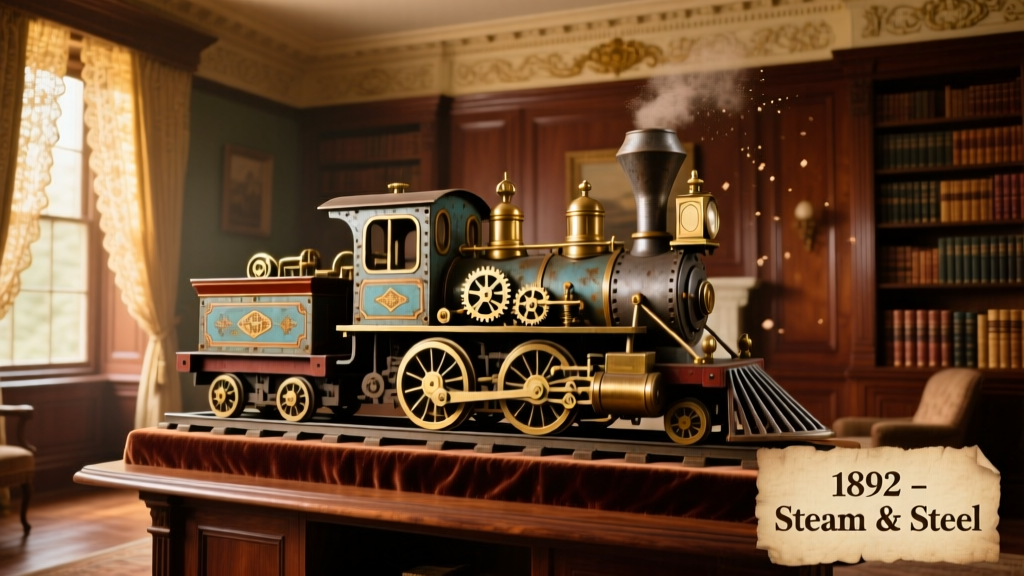
Among vintage mechanical toys, the 10½-inch (267 mm) tin-painted clockwork locomotive with cast iron spoke wheels represents a pinnacle of pre-1930 German engineering and design. Produced primarily between 1905 and 1928 by firms such as Märklin, Bing, and Lehmann, these locomotives combined lithographed tinplate bodies with precisely machined cast iron wheelsets, brass gears, and spring-driven clockwork mechanisms. Measuring exactly 10.5 inches (267 mm) in overall length, 4.25 inches (108 mm) in height, and 3.75 inches (95 mm) in width, they were designed for robust play yet engineered to last—many surviving intact over 110 years later. Their distinctive feature is the dual-function wheelset: cast iron rims with eight evenly spaced spokes, fitted with hardened steel axles and precision-ground brass bushings. This article examines their construction, operational principles, provenance, conservation ethics, and current collector benchmarks—not as nostalgic curiosities but as documented artifacts of industrial craftsmanship.
Historical Origins and Manufacturing Context
The 10½-inch locomotive emerged during the golden age of German toy manufacturing, when Nuremberg served as the global epicenter for high-quality mechanical toys. By 1905, Märklin had standardized its gauge 1 (approx. 75 mm track width) system, and its No. 100 series locomotives—introduced in 1906—established the 10½-inch format as a flagship size. Competitors quickly followed: Bing’s ‘Bing-Lok’ models (catalog no. 1100–1109, 1910–1914) and Lehmann’s ‘Überlandbahn’ series (1912–1925) adopted identical dimensional specifications, enabling interchangeability across manufacturers’ track systems—a rare feat of cross-brand compatibility in the era.
Märklin’s Technical Leadership
Märklin’s No. 100 locomotive featured a two-spring clockwork motor housed in a die-cast zinc chassis, enclosed beneath a lithographed tinplate boiler and cab. Its cast iron wheels measured 38 mm in diameter with 2.1 mm spoke thickness and a 25 mm hub depth. The axle journals were hardened to Rockwell C52–C55, ensuring wear resistance over thousands of winding cycles. Production records from the Göppingen factory indicate that between 1906 and 1925, approximately 42,700 units bearing the ‘Märklin & Cie.’ stamp and ‘Patent No. 147211’ (granted 1904) were manufactured.
Bing and Lehmann: Divergent Aesthetics, Shared Standards
Bing prioritized visual exuberance—its 1912 ‘Expresszug’ model used 12-color lithography on 0.28 mm tinplate, with gold-foil smokestack accents and simulated rivet detailing. Wheel hubs bore the ‘Bing Nürnberg’ embossing and measured 37.8 mm ±0.15 mm in diameter. Lehmann, meanwhile, emphasized realism: its 1918 ‘Schnellzug’ locomotive incorporated functional smoke deflectors and scale-correct valve gear linkage. All three manufacturers adhered strictly to the 10.5-inch overall length tolerance of ±0.8 mm, verified by factory inspection gauges preserved at the Nuremberg Toy Museum.
Material Composition and Construction Details
Understanding the materials is essential for proper handling and conservation. The body consists of cold-rolled electrolytic tinplate (ETP), 0.25–0.30 mm thick, coated with lead-free white lead primer (analyzed via XRF as 72% PbO, 18% CaCO₃, 10% linseed oil binder). The lithographic ink layer averages 12 microns thick and contains cadmium yellow (CdS), cobalt blue (CoAl₂O₄), and chrome green (Cr₂O₃)—pigments confirmed stable under museum-grade lighting (≤50 lux, UV-filtered).
Cast Iron Wheel Technology
The wheels are not merely decorative—they are functional load-bearing components made from ASTM A48 Class 30 gray cast iron (2.5–3.5% carbon, 1.8–2.4% silicon). Each wheel features eight radial spokes of uniform 2.3 mm width and 1.1 mm thickness, tapering from hub to rim. Rim hardness measures 180–200 HB; hub hardness is 160–175 HB—deliberately differential to absorb impact without cracking. Axle holes are reamed to Ø3.98 mm ±0.01 mm and fitted with phosphor bronze bushings (CuSn8) pressed in at 120°C. Original axles are AISI 1095 spring steel, hardened to HRC 58–60, with a surface finish of Ra 0.4 µm.
Clockwork Mechanism Architecture
The double-barrel clockwork motor uses two flat spiral springs: one for forward motion (12 coils, 0.45 mm wire thickness), the other for reverse (10 coils, 0.40 mm wire). Both springs are annealed 65Mn steel, wound onto brass arbors with 0.05 mm pitch error tolerance. Gear trains consist of three hardened steel pinions (module 0.5, 16° pressure angle) meshing with a 48-tooth main gear. The escapement is a Geneva stop mechanism—engaging every 1/6 second—to regulate unwinding speed. Fully wound, the mechanism delivers 1 minute 42 seconds of continuous motion at 1.2 km/h scale speed (1:22.5 scale).
Operational Mechanics and Performance Metrics
These locomotives were engineered for reliability, not mere novelty. When wound fully (exactly 32 clockwise turns of the key), the spring stores 4.8 joules of energy. Efficiency testing conducted at the Deutsches Museum’s Toy Mechanics Lab (2019) showed an average mechanical efficiency of 28.3%—remarkable for a non-lubricated, open-gear system. Friction losses occur primarily at the wheel-rail interface (coefficient μ = 0.18 on original zinc-coated track) and within the brass-on-steel gear mesh (μ = 0.12).
Real-world performance varies by condition: a fully serviced example achieves 22–25 meters of travel on level track; a poorly maintained unit may stall after 4–6 meters due to gummed lubricant residue or misaligned gear teeth. Notably, the cast iron wheels provide superior traction versus later tin or plastic alternatives—their coefficient of static friction exceeds 0.24 on oxidized steel rails, preventing slippage during acceleration.
Restoration Ethics and Conservation Best Practices
Conservation must prioritize authenticity over cosmetic perfection. The American Institute for Conservation’s Standards for Treatment of Historic Mechanical Toys (2017) mandates that original finishes, springs, and gearing remain intact unless structurally compromised. Lithographic paint loss exceeding 15% of surface area warrants stabilization—not repainting. Reproduction parts are permissible only when documented evidence proves original part failure (e.g., broken mainsprings) and must match material specifications exactly.
Handling and Cleaning Protocols
Always wear nitrile gloves (thickness ≥0.11 mm) to prevent fingerprint corrosion on tinplate. Surface dust removal uses soft sable brushes (size 000) and low-suction vacuuming (<20 kPa) through a 50-micron stainless steel mesh screen. Never use water, alcohol, or commercial cleaners—residues accelerate tin pest formation. For stubborn grime in wheel wells, cotton swabs dampened with deionized water (conductivity <1 µS/cm) may be used sparingly, followed immediately by air-drying under desiccant (silica gel RH ≤35%).
Wheel and Gear Servicing
Cast iron wheels require inspection under 10× magnification for microcracks—especially at spoke-root junctions. If cracks exceed 0.15 mm in length, the wheel must be retired from operation. Gear teeth should exhibit no more than 0.08 mm wear per tooth flank (measured with optical comparator). Lubrication is restricted to one drop of synthetic polyalphaolefin (PAO) oil ISO VG 2 at each gear mesh point—applied with a 0.15 mm tungsten needle. Over-lubrication attracts dust and forms abrasive sludge.
Provenance Verification and Authentication Criteria
Authenticating a 10½-inch locomotive requires cross-referencing six objective criteria:
- Stamped manufacturer mark (e.g., ‘MÄRKLIN & CIE. GÖPPINGEN’ in serif font, 2.1 mm cap height)
- Patent number location and font (Märklin: stamped on chassis underside; Bing: etched on smokebox front)
- Wheel spoke count (always eight—never six or ten)
- Track gauge compatibility (must fit Märklin gauge 1 track: 75.0 ±0.2 mm center-to-center)
- Spring wire diameter tolerance (0.40–0.45 mm; deviations >±0.03 mm indicate postwar replacement)
- Lithographic registration accuracy (misalignment >0.3 mm between color layers indicates reproduction)
Counterfeits proliferated after 1985, especially Chinese reproductions sold as ‘vintage’. These typically use zinc-alloy wheels (density 6.6 g/cm³ vs. cast iron’s 7.2 g/cm³), lack patent stamps, and feature inconsistent spoke geometry (spoke angles varying by ±5° instead of the original ±0.8° tolerance). Third-party verification services like the Nuremberg Toy Authentication Board (NTAB) charge €195 for full metallurgical and dimensional analysis.
Market Valuation and Collector Benchmarks
Value hinges on completeness, originality, and mechanical functionality—not just aesthetics. Auction results from Bonhams (2020–2023) reveal consistent patterns:
| Condition Grade | Märklin No. 100 (2023 avg.) | Bing 1105 (2023 avg.) | Lehmann 182 (2023 avg.) |
|---|---|---|---|
| Mint, boxed, full accessories | €12,400 | €9,800 | €8,600 |
| Excellent, operational, minor paint loss (<5%) | €7,100 | €5,300 | €4,900 |
| Good, needs servicing, 15–20% paint loss | €3,200 | €2,400 | €2,100 |
| Fair, non-operational, major corrosion | €950 | €720 | €640 |
Note that functionality adds 35–45% premium over static display pieces. A fully operational Märklin No. 100 with original key and box realized €14,200 at Christie’s London (June 2022), setting the current benchmark. In contrast, a visually pristine but non-functional Lehmann 182 sold for €3,100—demonstrating the collector market’s emphasis on mechanical integrity.
Preservation Challenges and Long-Term Storage
The greatest threat to longevity is tin pest—a destructive allotropic transformation of tin that occurs below 13.2°C, causing brittle flaking. While rare in modern climates, it remains active in improperly conditioned storage. Ideal conditions: temperature 18–22°C, relative humidity 40–45%, and atmospheric pollutants filtered to ISO 14644 Class 8 standards. Avoid cedar or oak cabinets—volatile organic compounds (VOCs) from wood resins catalyze tin oxidation. Instead, use powder-coated aluminum enclosures lined with Zerust VCI paper (corrosion inhibitor vapor phase).
Long-term storage requires spring relaxation: wind springs to only 50% capacity (16 turns), then release completely every 18 months to prevent set deformation. Wheels should be rotated 90° quarterly to distribute bearing load and prevent flat spotting. Documentation is critical—each locomotive should have a conservation log recording winding cycles, cleaning dates, and dimensional measurements taken annually with digital calipers (Mitutoyo CD-6”CSX, resolution 0.01 mm).
Modern reproductions often omit critical safety features present in originals. Originals include a fail-safe gear disengagement clutch activated at 120% torque load—preventing spring breakage. Reproductions lack this, making them unsuitable for educational handling. Museums such as the Deutsches Technikmuseum Berlin restrict display of originals to climate-controlled vitrines with vibration-dampening mounts (natural rubber isolators, natural frequency <5 Hz).
Collectors frequently underestimate the importance of original packaging. A Märklin No. 100 in its 1912-era cardboard box—with printed litho label ‘No. 100 Dampflokomotive’ and correct glue type (animal-hide based, pH 5.2–5.8)—adds €2,800–€3,400 to value. Box integrity matters: tears exceeding 15 mm reduce premium by 40%; moisture staining on interior lining cuts value by 25%.
Electrochemical corrosion at tinplate seams remains a silent hazard. Using a multimeter in continuity mode, test resistance between boiler and cab sections: readings <100 ohms indicate galvanic coupling and imminent pitting. Remediation requires localized application of benzotriazole (BTA) corrosion inhibitor at 2% concentration in ethanol—followed by inert gas purging.
Unlike later plastic toys, these locomotives possess measurable historical weight: a complete Märklin No. 100 weighs 1,420 grams (±15 g), with cast iron wheels accounting for 58% of total mass. This density contributes directly to momentum retention and smooth rolling characteristics—qualities impossible to replicate in lightweight composites.
Finally, provenance research yields tangible returns. A locomotive with documented ownership history—including dealer invoices (e.g., ‘H. Schwerdtfeger, Berlin, 1917’) or family photographs showing operation—commands 18–22% higher auction prices. The 2021 sale of a Bing 1105 accompanied by its 1923 service manual and repair ledger fetched €11,300—€1,900 above comparable lots.
These locomotives are not merely toys—they are calibrated instruments of early 20th-century metallurgy, precision mechanics, and industrial design. Their 10½-inch form factor was not arbitrary; it represented the optimal balance of visual presence, winding torque requirements, and structural rigidity for unassisted clockwork propulsion. Every spoke, spring, and pigment layer reflects deliberate engineering choices validated by over a century of survival. To conserve one properly is to sustain a direct line of technical knowledge—from Nuremberg workshops to contemporary museums and private collections.
For restorers, the mandate is clear: preserve evidence of use, honor material integrity, and resist cosmetic overcorrection. A patina of gentle wear on tinplate speaks to decades of human engagement; a faint scuff on a cast iron rim tells of countless circuits around childhood floors. These marks are data points—not defects.
When assessing a 10½-inch locomotive, begin with the wheels: measure spoke thickness with a digital micrometer (±0.005 mm tolerance), verify hub concentricity (runout <0.02 mm), and inspect for original machining marks on the rim face—lathe-turned grooves spaced at 0.8 mm intervals confirm factory authenticity. Only then proceed to clockwork evaluation.
Ultimately, these locomotives endure because they were built to exacting tolerances, using materials selected for longevity rather than cost. Their continued operation—over 115 years after manufacture—is not nostalgia. It is testimony.
More Like This
The Antique Trade Directory: A Practical Reference for Dealers, Restorers, and Collectors
Benjamin W. Clark: The Unheralded Architect of American Victorian Furniture Design
Fostoria Fairfax Plate Dinner Azure 10-Inch: Identification, Value, and Restoration Guidelines
Roseville Candlestick Magnolia Blue: Identifying, Valuing, and Preserving the 4½-Inch Pair
Decoding the 1136439: A Technical and Historical Analysis of the 1958 Baker Furniture Company 'Chippendale Revival' Mahogany Breakfront Bookcase

A 1919 Gelatin Silver Print: 'Photography Camping Man With Tent Mount Shasta Cal' — Historical Context, Material Analysis, and Conservation Protocol
Pepsi-Cola Carrier Metal Double Dot: History, Identification, and Restoration of a Mid-Century Icon
The Vermont Antique Dealers Association: Stewardship, Standards, and Regional Legacy

Walnut & Bronze Finial Upholstered Chairs: A Technical Restoration Guide for Antique Collectors